


7 Signs Your House Needs Rewiring


Flickering lights, warm sockets, or that faint burning smell near the fuse box are easy to ignore until something actually fails. But these small annoyances are often your electrics telling you they're struggling to cope, and spotting the signs your house needs rewiring early can save you from a much bigger repair bill, or worse, a fire.
If you've searched this because something feels off with your home's electrics, you're likely dealing with one or more warning signs already. This article walks through the seven most common indicators we see on inspections across London properties, from discoloured sockets to outdated fuse boxes, so you can work out whether you're looking at a minor fix or a full rewire.
We've tested electrics in thousands of London homes, from Victorian conversions to 1990s new builds, and the patterns are consistent. Below, we break down each warning sign in plain terms, explain why it happens, and tell you what to do next, including when it's time to book an EICR or consumer unit replacement rather than wait for a fault to force your hand.
1. Frequent tripping fuses or circuit breakers
A circuit breaker that trips once in a while is normal, especially if you've overloaded an extension lead. But when your consumer unit is cutting power weekly, or even daily, that's one of the clearest signs your house needs rewiring. It's your fuse box doing its job by shutting things down before a fault turns into something worse, and it deserves your attention rather than a shrug and a reset.
What this looks like
You'll notice the same breaker tripping when you switch on the kettle, run the washing machine, or plug in a hairdryer. Sometimes it's random, cutting power to a whole circuit with no obvious trigger. In older properties we've inspected across London, tenants often describe resetting the trip switch two or three times a week without ever working out why a circuit breaker keeps tripping, which is exactly the kind of pattern that points to underlying wiring problems rather than a one-off appliance fault.
Why it happens
Repeated tripping usually means a circuit is drawing more current than the wiring or breaker can safely handle. This can come from degraded insulation on old cables, loose connections that create resistance and heat, or a consumer unit that's simply too old to match your household's modern electrical demand. Homes wired 30 or 40 years ago were never designed for the number of appliances, chargers, and gadgets a typical household runs today.
If your breaker trips more than once a month with no clear cause, treat it as a warning, not a nuisance.
What to do about it
Don't just keep resetting the switch and hoping it stops. Book an Electrical Installation Condition Report (EICR) so a qualified engineer can trace exactly which circuit is faulty and why. In many cases the fix is a straightforward consumer unit replacement in London, but sometimes it flags a deeper issue with the cabling itself that needs a partial or full rewire.
-
Note which appliance or room triggers the trip
-
Avoid running multiple high-draw appliances on the same circuit until it's checked
-
Get an EICR booked rather than waiting for a total failure
An EICR report gives you a clear, documented starting point, whether that's a quick repair or confirmation that rewiring is genuinely needed, in which case it helps to know how long a house rewire takes.
2. Burning smells with no obvious cause
A faint, acrid smell near a socket or the fuse box is one of the most urgent signs your house needs rewiring, and it's not one to sit on overnight. Unlike a tripping breaker, which gives you repeated warnings, a burning smell often means heat is already building somewhere in the wall or behind a fitting, and that's a genuine electrical fire risk rather than an inconvenience.
What this looks like
Think of a smell like hot plastic, scorched dust, or a faint electrical odour that seems to come from nowhere. It's usually strongest near a specific socket, switch, or the consumer unit itself, and it may come and go depending on which appliances are running. We've had London callouts where homeowners noticed the smell only after using the tumble dryer or oven, which points straight to a specific overloaded circuit.
Why it happens
Burning smells come from overheating cables or connections, usually caused by old insulation breaking down, loose terminals, or wiring that's carrying more current than it was ever rated for. Aluminium wiring, common in some 1960s and 70s homes, is particularly prone to this as it expands and contracts differently to copper over time.
A burning smell near your electrics is never something to wait out until morning.
What to do about it
Switch off the affected circuit at the consumer unit immediately and don't use it again until it's checked. Call a qualified electrician the same day, not next week. If the smell is strong or you see any scorch marks, treat it as an emergency and contact your local fire service for advice before touching anything further.
3. Flickering or dimming lights
Lights that flicker or dim when you turn on another appliance are one of the more overlooked signs your house needs rewiring. It's easy to blame the bulb and swap it, but if the flickering keeps happening after a fresh bulb, the problem sits in the wiring, not the fitting.
What this looks like
Watch for lights that dim briefly when the fridge kicks in, the kettle boils, or the washing machine starts a cycle. Sometimes it's one room, sometimes it's the whole house. In older London terraces we've inspected, this pattern often shows up gradually over months before residents think to mention it, which means the underlying fault has usually had time to get worse.
Why it happens
Flickering usually points to a loose connection somewhere in the circuit, a worn-out light switch, or a wire that's no longer making solid contact with its terminal. It can also mean your circuits are overloaded, so when a high-draw appliance switches on, it pulls voltage away from the lighting circuit, which is why it helps to know how to prevent overloaded sockets. Old or brittle wiring insulation makes this worse, since the connections underneath degrade faster than newer cable would.
Flickering lights that persist after a bulb change almost always trace back to the wiring, not the fitting.
What to do about it
Replace the bulb first to rule out the obvious, but if the flickering continues, get an electrician out for fault finding on your circuits to inspect the switch, the circuit, and the connections at the consumer unit. A proper domestic EICR in London will catch loose terminals and overloaded circuits before they turn into a tripping breaker or worse.
4. Discoloured, warm or loose sockets and switches
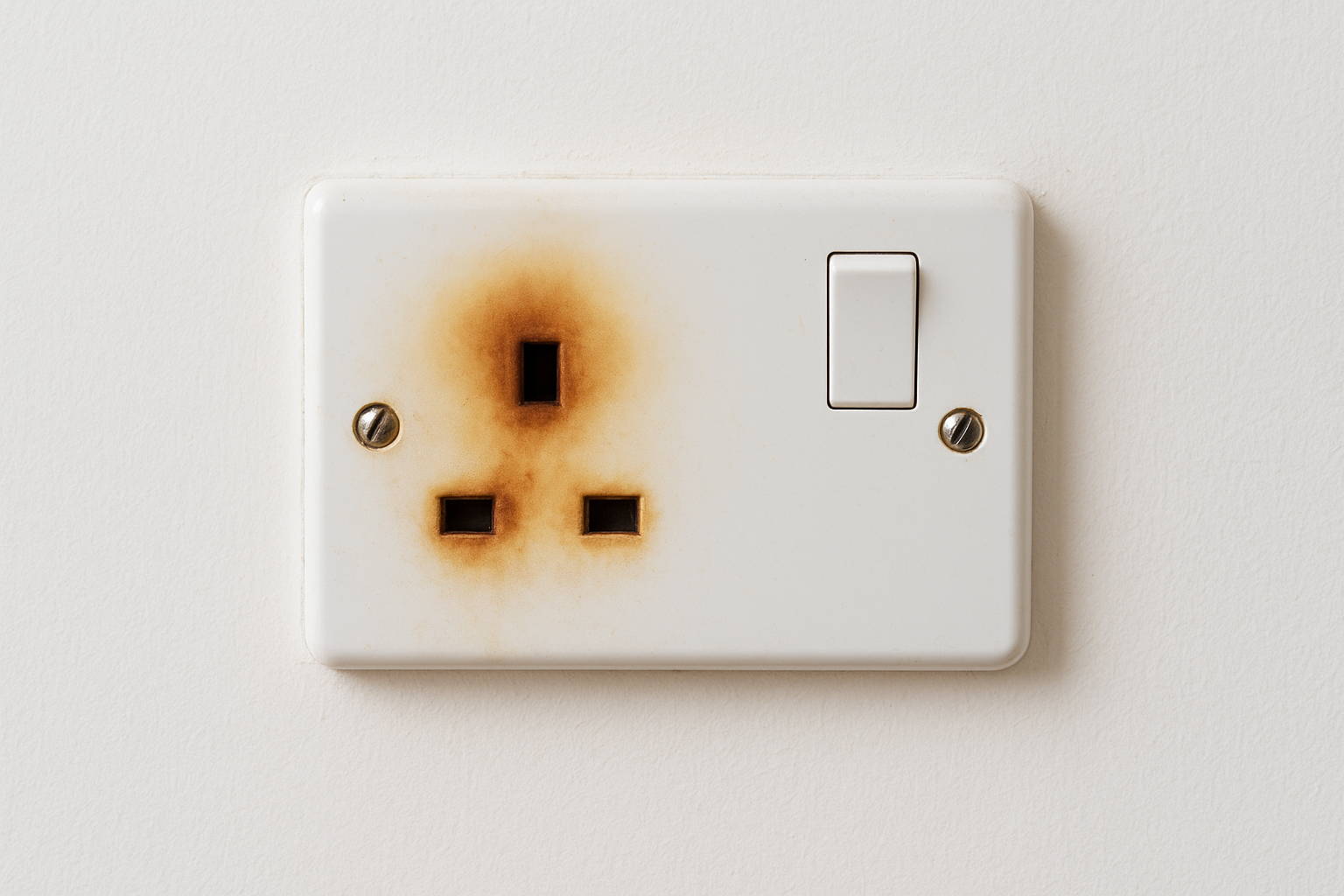
A socket that's turned brown or a switch that feels warm to the touch is a physical, visible version of the signs your house needs rewiring we've already covered. Where flickering lights and tripping breakers give you a symptom, discolouration shows you the damage itself, often after heat has been building for months.
What this looks like
Check for scorch marks or a yellowish-brown tinge around the socket faceplate, a switch that feels noticeably warm when nothing's plugged in, or a plate that wobbles when you push the plug in. We often find this while working through a PAT testing checklist and during EICR inspections, on sockets that look fine at a glance but feel loose or slightly melted once you touch them.
Why it happens
Heat damage like this comes from a loose connection inside the socket, worn-out terminals that no longer grip the wire properly, or a circuit that's been overloaded repeatedly. Every time current arcs across a poor connection, it generates a small amount of heat, and over months or years that heat scorches the plastic and weakens the wiring further.
A warm or discoloured socket has already been overheating, it hasn't just started.
What to do about it
Stop using that socket straight away and don't just switch out the faceplate yourself, since the fault sits behind it. Book an electrician to inspect the wiring and terminal connections, and treat any scorch marks as a reason to get a full EICR rather than a spot fix on that one point alone.
5. Buzzing, crackling or sizzling sounds from outlets
Any noise coming from a socket or switch, however faint, belongs on this list of signs your house needs rewiring. Sound is often the earliest clue you get, arriving before you see discolouration or smell anything burning, so it pays to take it seriously the first time you notice it.
What this looks like
Listen for a soft buzz, a crackle, or a faint sizzling sound coming from behind a socket faceplate, a light switch, or the consumer unit itself. It's usually quiet enough that you only catch it in a silent room, and it may only happen when an appliance plugged into that socket is switched on. Some homeowners describe it as sounding like static or a very faint electrical hum.
Why it happens
That noise is electrical arcing, current jumping across a gap it shouldn't be crossing because a connection has come loose or corroded. Old wiring with brittle insulation is especially prone to this, since the copper strands underneath shift slightly and lose their tight grip on the terminal over time. Damp can make it worse too, particularly in older properties with solid walls and limited ventilation around wiring runs.
Any buzzing or crackling from a socket means current is arcing somewhere it shouldn't be.
What to do about it
Switch off the circuit at the consumer unit and stop using that socket or switch immediately. Get a qualified electrician out promptly rather than waiting for a scheduled EICR, since arcing can progress to a scorch mark or fire faster than most people expect.
6. An outdated fuse box or old wiring materials
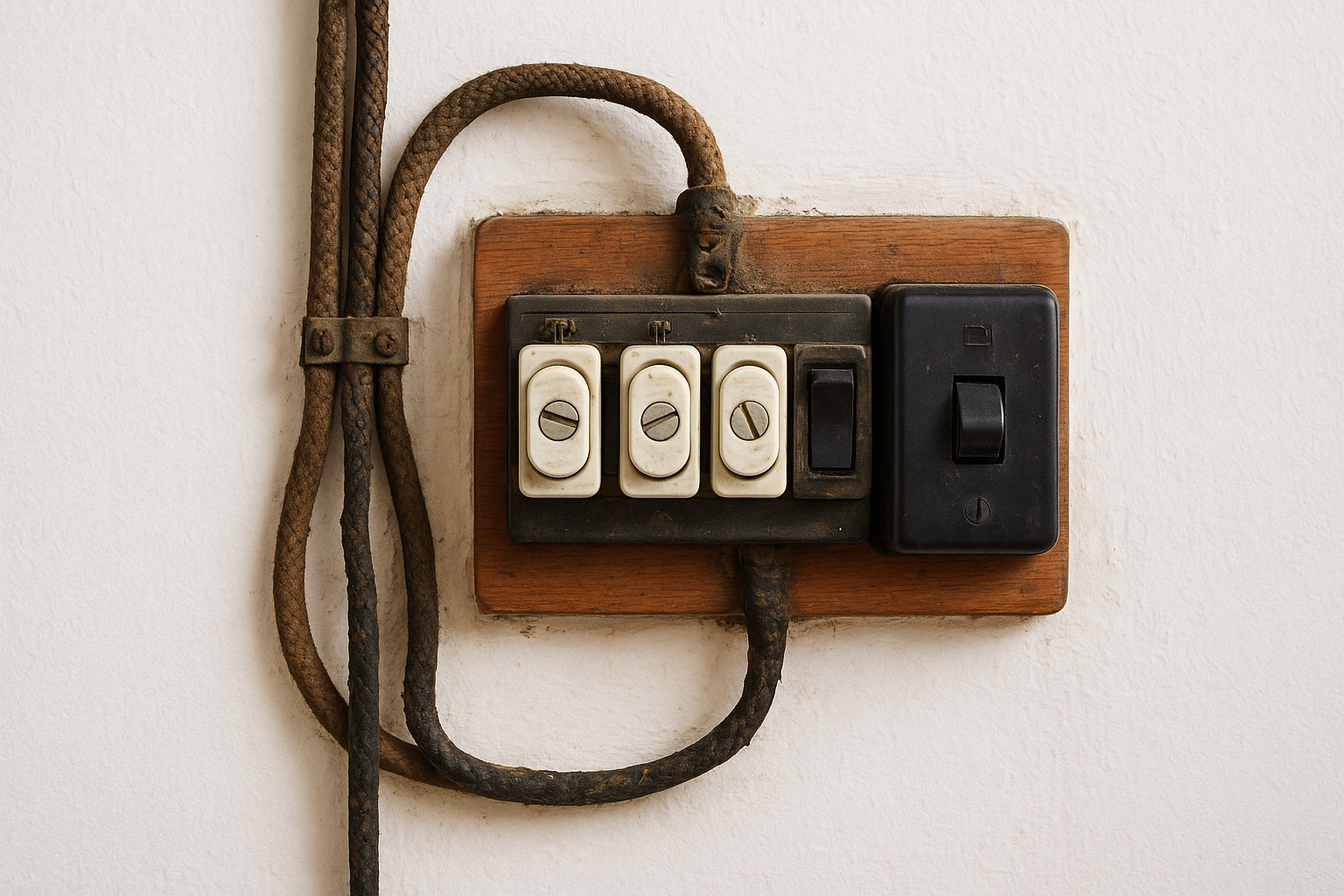
Sometimes the clearest of all the signs your house needs rewiring isn't a symptom at all, it's the equipment itself. A fuse box with a wooden back, rewireable fuses, or a mix of cable types tells us most of what we need to know before we even test a single circuit.
What this looks like
Look at your consumer unit first. If it has a wooden backing, ceramic fuse holders, or a black bakelite casing rather than a modern plastic unit with switches, it's likely decades old. Inside walls, old wiring often shows up as fabric-braided cable or rubber insulation that's gone brittle and crumbly, sometimes with black or grey sheathing instead of the modern grey and white twin-and-earth we install today.
Why it happens
Properties that haven't been touched since the 1960s, 70s, or even 80s were wired to standards that no longer meet current safety regulations. Rubber and fabric-insulated cabling degrades with age regardless of use, becoming a fire and shock risk simply through time. Older fuse boxes also lack the RCD protection that modern units use to cut power instantly during a fault.
A fuse box with wooden backing or rewireable fuses is a rewiring conversation waiting to happen.
What to do about it
Get an EICR to confirm the wiring's actual condition rather than guessing from its age alone. If the consumer unit itself is the main issue, a straightforward replacement may solve it, and it's worth checking fuse box upgrade costs in London, but old cable materials found throughout the property usually mean a full rewire is the safer long-term fix.
7. Electric shocks when using appliances or switches
Getting a small static-like tingle from a switch or appliance is one of the more physically alarming signs your house needs rewiring, and it's not something to brush off as static electricity. A genuine electric shock, even a mild one, means current is escaping where it shouldn't, and that's a fault in the wiring or earthing, not bad luck.
What this looks like
You might feel a jolt when touching a switch, a socket faceplate, or the metal casing of an appliance like a kettle or washing machine. Sometimes it happens only when your hands are damp, which makes the shock stronger since water conducts electricity more readily. We've seen cases where a whole family assumed it was just "how that switch feels" for months before mentioning it during an inspection.
Why it happens
Shocks usually point to a faulty earth connection, damaged insulation letting live wires make contact with metal casings, or wiring that's degraded enough to leak current where it touches a switch plate or appliance body. Older properties without proper earthing or RCD protection are especially vulnerable, since there's nothing to cut the power instantly when current escapes its intended path.
Any shock from a switch or appliance, however small, means current is escaping where it shouldn't be.
What to do about it
Stop using the appliance or switch immediately and unplug it if you can do so safely. Book an emergency electrician rather than a routine appointment, since shocks indicate a live fault, not a slow-developing one. An EICR will confirm whether the issue is isolated or a sign the whole property needs rewiring.
Getting peace of mind about your wiring
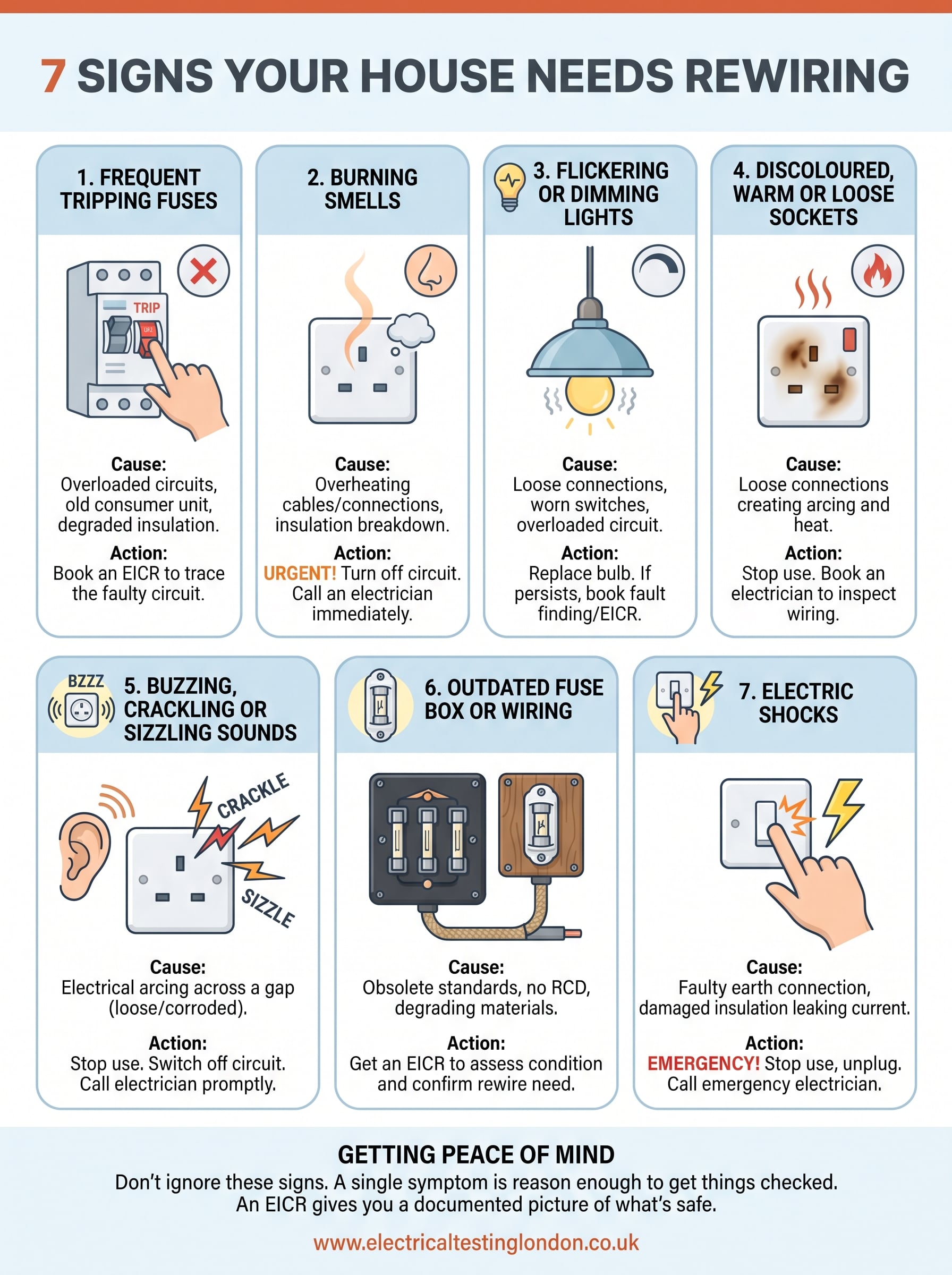
None of these seven signs need to appear all at once for you to have a genuine problem. A single warm socket or one persistent trip is enough reason to get things checked properly, rather than waiting for the other six to show up too. Old wiring rarely fixes itself, and the longer it's left, the more expensive and disruptive the eventual repair tends to be.
What matters most is getting a clear, professional answer rather than guessing from symptoms alone. An EICR gives you exactly that: a documented picture of what's safe, what needs attention, and whether you're looking at a small repair or a full rewire. If you've spotted any of the warning signs above in your own home, don't sit on it. Get a quote from our team and have a qualified engineer give your property the once-over before a minor fault turns into a costly one.

