






8-Point Electrical Equipment Safety Inspection Checklist



Faulty cables, damaged plugs and poorly earthed tools cause most electrical equipment incidents in workplaces and rented properties. You need a repeatable way to spot them before someone gets hurt. A vague glance at a kettle lead does not count as an inspection, and it will not stand up if an insurer or enforcement officer asks for proof.
Below you will find a practical electrical equipment safety inspection checklist with eight points. Each one covers a specific check, from cable and plug condition to earthing and portable tools. Work through them in order, tick off each item, and note the date, the item and the result. That record is what shows you have taken reasonable care.
This list is for routine visual checks between formal tests. It does not replace PAT testing or an EICR carried out by a qualified engineer. At Electrical Testing London, our engineers have at least 10 years of experience, and we explain below when a failed check means you should stop using an item and call a professional.
1. Electrical Testing London professional inspection
What the check covers
A professional inspection from Electrical Testing London repeats the visual checks in the rest of this list, then adds instrument testing that your eyes cannot do. Our engineers test each item and record the result against it. For portable appliance testing, that usually means:
-
Earth continuity on Class I equipment
-
Insulation resistance between live parts and the casing
-
Polarity and lead continuity on cables and extension leads
-
Fuse rating checked against the appliance
-
A dated pass or fail label and an asset register entry
For the fixed wiring behind your sockets, an EICR tests circuits, earthing, bonding and RCD trip times. Instrument readings are what separate a proper inspection from a quick look.
A visual check shows you damage, but only a test shows you the fault hiding inside a cable that looks perfect.
Who it is for
Landlords and property managers need this most. Legal duties on rented homes and workplaces mean you must be able to show dated, signed evidence, and a tick on your own sheet will not carry the same weight.
Commercial clients with shared equipment, such as offices, shops, kitchens and workshops, also benefit. Homebuyers and homeowners who want certified peace of mind before a purchase or insurance renewal get the same standard of report.
When to use it instead of a self-check
Book an engineer when an item fails any visual check in sections 2 to 8, or when you cannot say when it was last tested. Do the same after a repair, a flood or a power surge, and when equipment is new to your premises.
Also book one when your self-checks start to feel like guesswork. Use your own checklist for the routine weeks in between, and let a qualified person handle formal testing and certification on a schedule.
2. Plugs, sockets and connectors
What to check
Begin with the plug, because it takes the most knocks. Unplug the item first, then inspect the plug body, pins and cable grip. Check the socket too, and confirm it holds the plug firmly. On any electrical equipment safety inspection checklist, these points should be ticked every time:
-
Plug casing is intact, with no cracks or exposed pins
-
Pins are straight and clean
-
Cable grip clamps the outer sheath, not the wires
-
Fuse is the right rating for the appliance
Common defects to look for
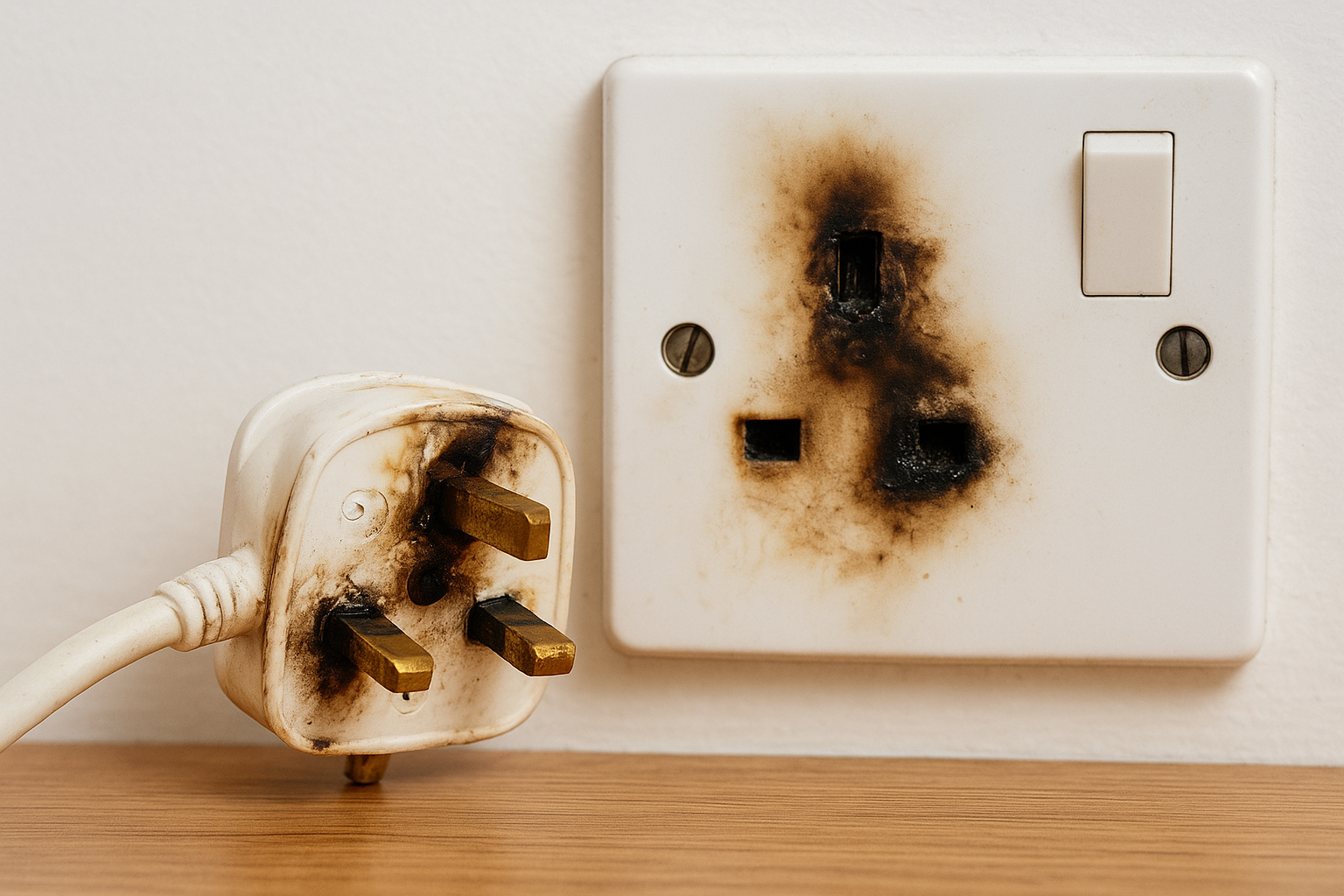
Heat damage is the one defect you must never ignore. Scorch marks or melted plastic around the pins mean a loose connection is overheating. Also watch for:
-
Coloured inner wires showing where the cable enters the plug
-
Bent, loose or discoloured pins
-
Plugs repaired with tape
-
Sockets that wobble, crackle or feel warm
What to do if it fails
Unplug the item and take it out of use straight away. Label it clearly so nobody plugs it back in.
A scorched plug or socket is a fire warning, so stop using it before you work out why.
Replace damaged plugs rather than patching them. A competent person should fit the new one and check the fuse rating. If the fault is in the wall socket, switch off the circuit at the consumer unit and book an electrician.
3. Flexible cables and extension leads
What to check
Run your hand along the full length of each cable with the item unplugged. Look closely at the outer sheath, both cable entry points and every extension lead you use. Tick off these points:
-
Sheath is unbroken, with no cuts, kinks or crushed sections
-
Cable is not frayed or pulled loose where it enters the plug or appliance
-
Extension leads are fully uncoiled when powering heavy loads
-
Cable has no joins and does not trail across walkways
Common defects to look for
Damage tends to hide at the ends and in high-traffic spots. Cuts and flattened sections often sit where a cable passes under a door or a chair wheel. Also look for:
-
Inner insulation or coloured wires showing through the sheath
-
Cables joined with tape or a connector block
-
Sheath that feels stiff, melted or discoloured
-
Extension leads daisy-chained together or overloaded with adaptors
What to do if it fails
Withdraw the cable or lead from use immediately and tag it as faulty. Never patch a damaged flexible cable with insulating tape, because tape hides the fault without fixing it.
A taped cable is a damaged cable, so replace it rather than repair it.
Replace the lead, or ask a competent person to fit a new cable and check the fuse. If a lead keeps getting hot or tripping the supply, you probably have an overload, so move on to section 6.
4. Equipment casings, switches and guards
What to check
Casings are the barrier between you and live parts, so include them in every round of your electrical equipment safety inspection checklist. Unplug the item, then look over the outer casing, switches and guards:
-
Casing is intact, with all screws present and no gaps
-
Switches click positively and return to the right position
-
Guards, covers and vents are fitted and clear
-
No signs of liquid ingress or overheating
Common defects to look for
Cracks are the obvious problem, but missing screws and blocked vents are just as telling. Equipment that cannot shed heat will fail early, and a loose switch can arc inside the housing. Also watch for:
-
Cracked, chipped or melted housings
-
Sticky, loose or broken switches
-
Missing or bent guards on fans, saws and grinders
-
Burning smells, discolouration or dust packed into vents
What to do if it fails
Unplug the item and stop using it at once. Do not open the casing to investigate unless you are competent to do so.
A cracked or open casing exposes live parts, so treat the item as failed until it has been repaired.
Tag it as faulty and send it for repair or replacement. A missing guard counts as a failure even if the tool still runs. Once it is fixed, have it retested by a qualified engineer before it returns to service.
5. Earthing, bonding and RCD protection
What to check
Earthing carries fault current safely away, so confirm it on every Class I appliance. That means anything with a three-pin plug and no double-insulation symbol. You cannot see earth continuity, but you can check that the earth path looks complete. Tick off these points on your electrical equipment safety inspection checklist:
-
Earth pin is present and the green and yellow wire is attached
-
Visible bonding clamps on water and gas pipes are tight
-
RCD trips when you press its test button
-
Portable RCD adaptors are tested before each use
Common defects to look for
Missing or snapped earth pins and loose green and yellow conductors are the usual culprits. Also watch for:
-
Plastic dummy pins or adaptors that defeat the earth
-
Corroded or slack bonding clamps
-
Metal-cased tools fitted with a two-core cable
-
An RCD that will not trip on test, or trips for no clear reason
What to do if it fails
Take the item out of use and tag it. Never bypass, tape down or disable an RCD, even if it trips often, because nuisance tripping usually points to a real fault.
An RCD that does not trip when tested is not protecting anyone, so treat it as failed.
Book a qualified engineer for any earthing, bonding or consumer unit fault. These repairs are not DIY jobs, and the engineer will test and certify the fix before you rely on the circuit again.
6. Fuses, circuit protection and overload risks
What to check
Start with the fuse in each plug, because it protects the cable rather than the appliance. Match the rating to the label on the item, then look at what is plugged into each socket. Tick off these points on your electrical equipment safety inspection checklist:
-
Fuse rating suits the appliance (commonly 3A up to about 700W, 13A above that)
-
Fuse is a proper cartridge type, with no foil or wire
-
Load on each extension lead stays under 13A, around 3,000W
-
Consumer unit switches are labelled and sit in the correct position
Common defects to look for
Wrong fuses cause the most trouble. A 13A fuse in a lamp plug will let a damaged cable overheat long before it blows. Also watch for:
-
Foil, nails or wire used in place of a fuse
-
Adaptors, plugs or leads that feel hot
-
A breaker that trips repeatedly on the same circuit
-
Scorch marks or a burning smell at the consumer unit
What to do if it fails
Remove the overloaded item or lead from use and unplug everything on it. Replace a wrong fuse with the correct rating, and never fit a bigger one to stop it blowing.
A fuse that keeps blowing is doing its job, so find the fault instead of upgrading the fuse.
Spread loads across several sockets, or add a properly rated circuit. Any consumer unit fault needs a qualified engineer, who will test the circuit before you use it again.
7. Portable tools and PAT labels
What to check
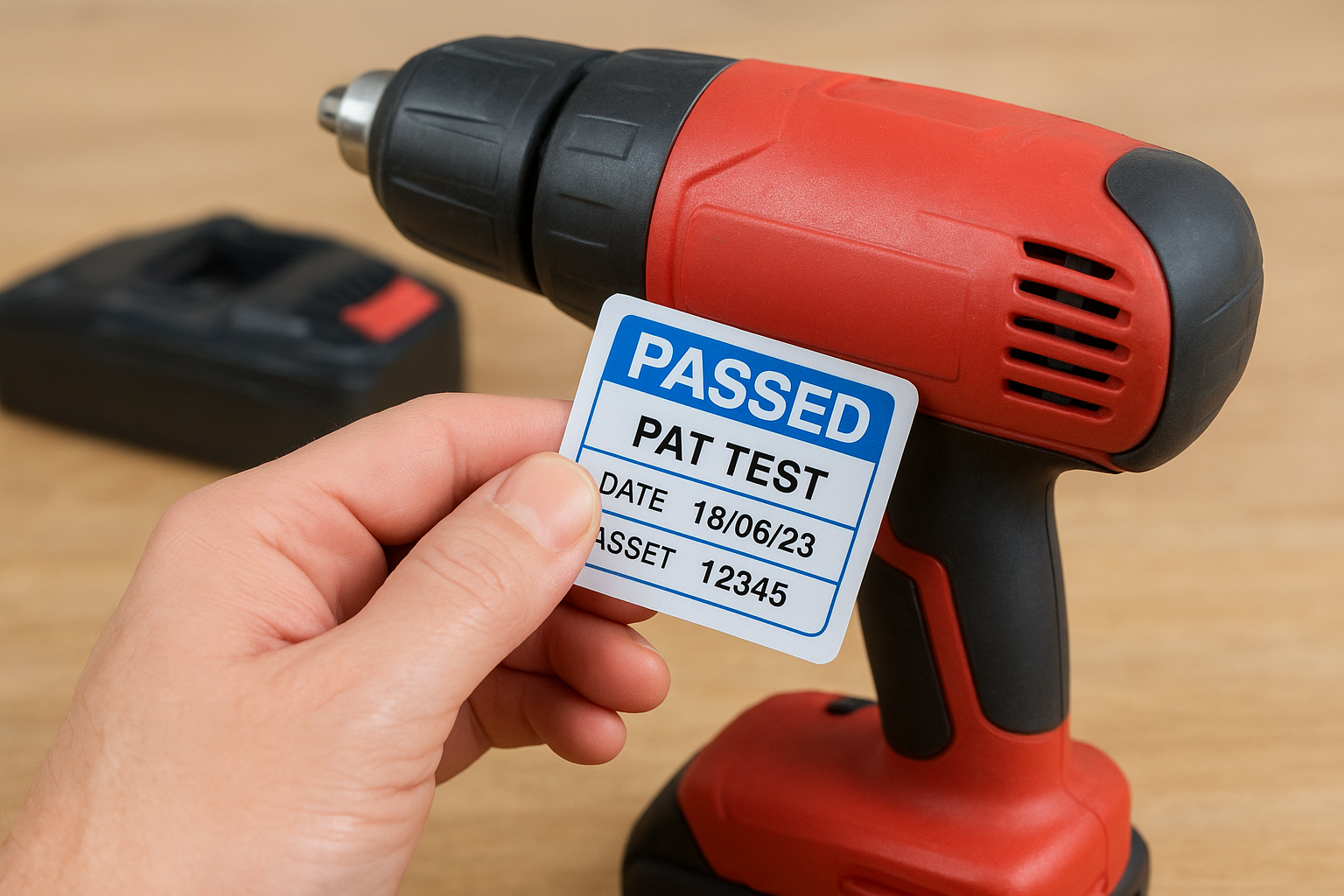
Portable tools take the hardest knocks, so give them their own line on your electrical equipment safety inspection checklist. Unplug each tool, then check the PAT label before you look at the tool itself:
-
Label is present, legible and shows a pass
-
Retest date has not passed
-
Asset number matches your register
-
Chuck, blade or disc guard is fitted and secure
-
Chargers and transformers are undamaged
Common defects to look for
Missing or faded labels are the most common finding. A tool with no label has no test history, so treat it as untested until an engineer says otherwise. Also watch for:
-
Overdue, handwritten or peeling labels
-
Cracked housings after a drop
-
Cables replaced or repaired since the last test
-
Heavy sparking or a burning smell from the motor
-
Chargers used with the wrong battery
What to do if it fails
Remove the tool from use and tag it. An out-of-date label counts as a failed check, even when the tool looks fine and runs well.
A PAT label tells you when a tool was last tested, not whether it is safe today, so check both.
Book PAT testing with a qualified engineer for anything untested, overdue or repaired. Keep the tool locked away until it carries a fresh pass label and its entry in your register is updated.
8. Environment, labelling and safe use
What to check
Equipment is only as safe as the place it sits in. Look at where and how each item is used, then confirm that labels and instructions are still readable. Add these points to your electrical equipment safety inspection checklist:
-
Equipment suits the conditions, such as damp, dusty or outdoor areas
-
Rating plates, warning labels and isolation points are legible
-
Cables and vents have clear space around them
-
Sockets are well away from sinks, hoses and open water
-
Users know where to isolate the supply in an emergency
Common defects to look for
Water is the biggest environmental threat. Indoor-rated equipment used outside or in a wet kitchen is a common finding, as are faded rating plates. Also watch for:
-
Heaters or leads covered by boxes, clothing or stock
-
Cables trailing through puddles or across walkways
-
Stickers or tape hiding warning labels
-
Unlabelled isolators or emergency switches
-
Equipment used for a job it was not designed for
What to do if it fails
Move or isolate the item first, then fix the cause. Relocate it away from water, or replace it with a suitably rated item, such as an outdoor-rated lead on an RCD-protected supply.
Safe equipment in an unsafe setting is still a hazard, so fix the environment as well as the item.
Restore any missing labels and show staff how to isolate the supply. If damp has already reached fixed wiring or sockets, book an engineer to test the circuit before anyone uses it again.
How often to inspect and how to record results
How often to inspect
PAT testing frequency depends on how hard the equipment works and where it lives. Treat these intervals as starting points, then let your risk assessment raise or lower them.
|
Equipment |
Your visual check |
Formal PAT test |
|---|---|---|
|
Hand tools, site and workshop kit |
Before each use |
Every 3 to 6 months |
|
Extension leads, kettles, heaters |
Monthly |
Yearly |
|
Office and desk equipment |
Quarterly |
Every 2 to 4 years |
Fixed wiring runs on a longer cycle. Landlords in England need an EICR at least every five years, and sooner if an inspector recommends it.
What to record
Records are your proof. Keep one log per site and capture the same fields every time:
-
Date and the inspector's name
-
Item description and asset number
-
Which of the eight points you checked
-
Result (pass or fail) and the action taken
-
Next check or retest date
If a check is not written down with a date and a result, you cannot prove it happened.
Store the log somewhere shared, such as a spreadsheet or asset register. Leave every failed item open until the retest result is entered, and attach the engineer's certificate to its entry so the paper trail stays complete.
Keeping your equipment safe
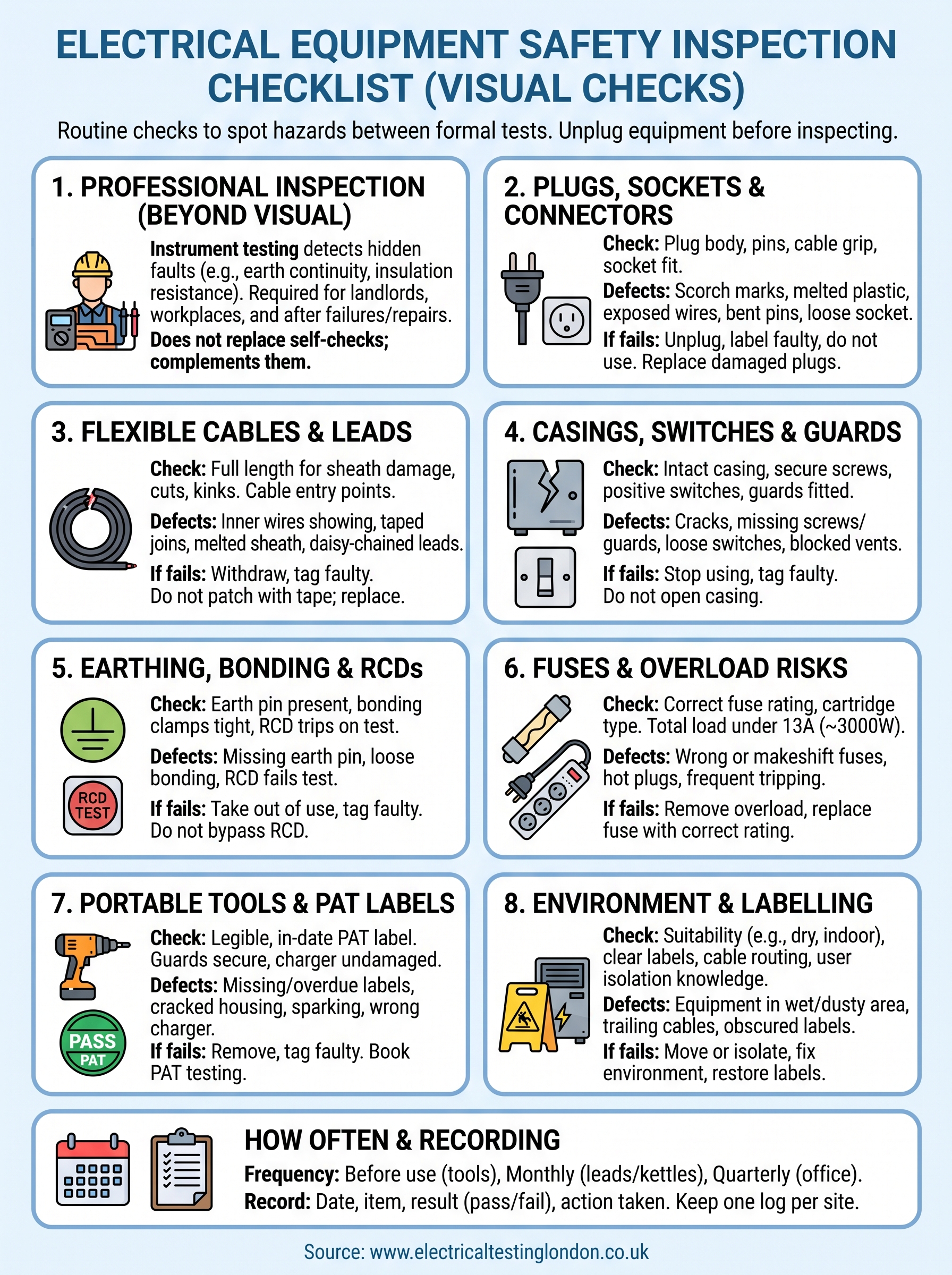
Safe equipment comes down to habit. Work through the eight points on this electrical equipment safety inspection checklist on a regular schedule, from plugs and cables to earthing, fuses, portable tools and the space around them. Pull anything that fails out of use, tag it, and write the result down.
Remember that your own checks only cover what you can see. Formal testing by a qualified engineer finds the faults hiding inside cables and appliances, and a dated record proves you acted on what you found.
If you have failed items, expired labels or equipment nobody can account for, request a quote for PAT testing or an EICR from Electrical Testing London. Our engineers cover London and the South East, and you will get certified results you can file straight away.