


Automatic Emergency Light Testing: What It Is, How It Works


Automatic emergency light testing means the luminaires, or a central controller, run the routine tests for you. That covers a short monthly functional test and a full annual duration test, with nobody flicking a key switch. Faults show on an LED or a dashboard instead of being found by someone on a ladder. Automatic test systems have their own standard, BS EN 62034, but the legal duty to keep your emergency lighting working stays with you.
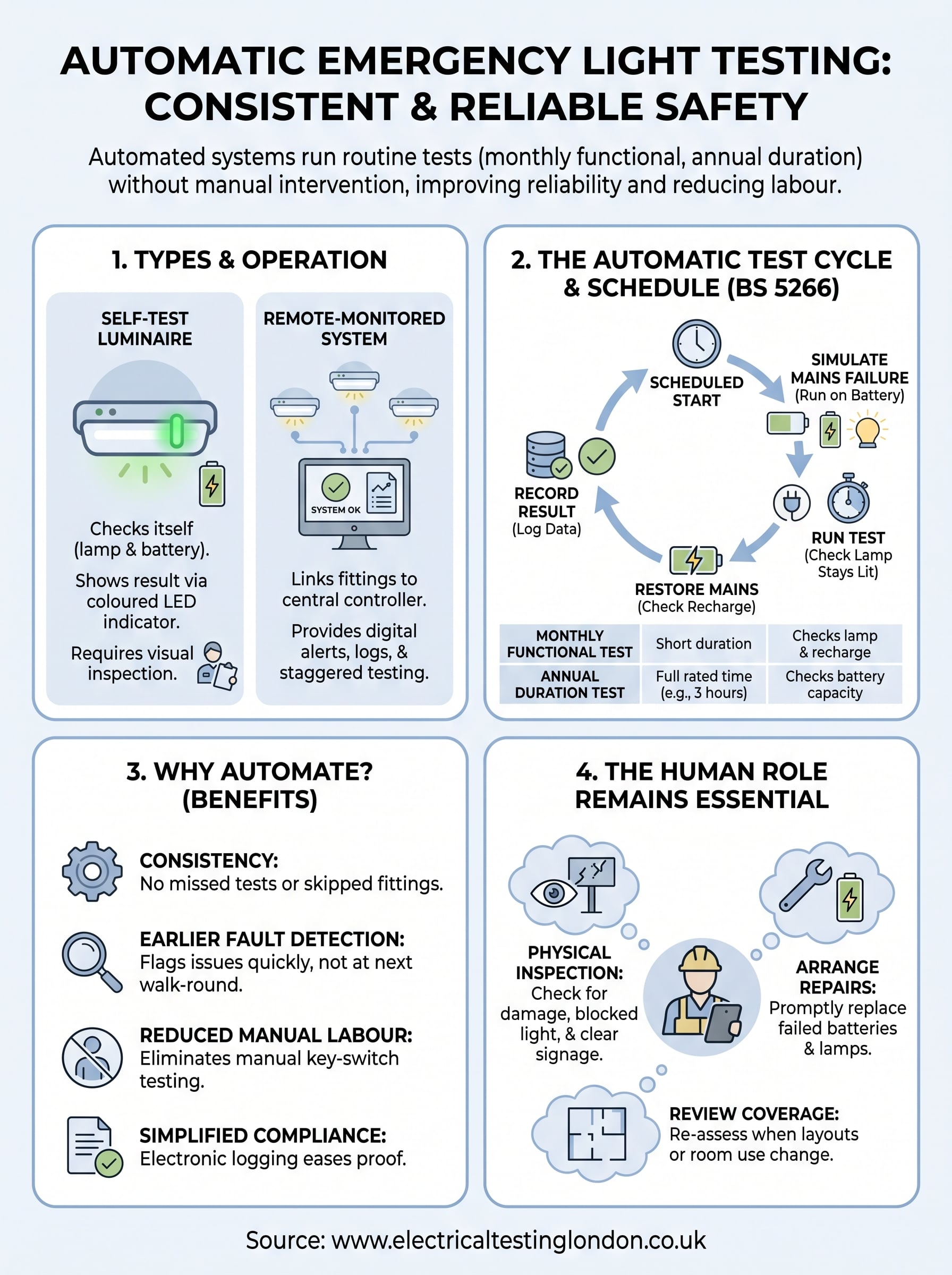
There are two common forms. Self-test luminaires check their own lamp and battery and show the result on an indicator. Remote-monitored systems link every fitting to a central controller, so you can run tests, receive alerts and keep a digital logbook without walking the building. The second form is what most people mean by remote emergency light testing.
This article explains why automatic testing matters, how it works, how to move your building over, and what it still leaves to a person. At Electrical Testing London we carry out monthly flick tests and annual 3 hour tests across London and the South East. We see where manual testing struggles and where automation genuinely helps.
Why automatic emergency light testing is worth having
Automatic testing matters because emergency lights fail silently. A dead battery looks identical to a healthy one until the mains drops, so the only protection is testing on schedule, every time. Automation removes the two usual causes of failure: missed tests and unrecorded results.
What the rules expect from you
In England, the responsible person under the Regulatory Reform (Fire Safety) Order 2005 must keep escape routes adequately lit and the system maintained. BS 5266 and BS EN 50172 set out the inspection and testing routine that most premises follow. Automatic systems do not change that schedule. They carry it out for you.
|
Test |
Frequency |
What it proves |
|---|---|---|
|
Monthly functional test |
Once a month, short duration |
The lamp lights from the battery and the battery recharges afterwards |
|
Annual duration test |
Once a year, full rated duration (commonly 3 hours) |
The battery can power the lamp for the whole rated time |
You must also keep records of every test and every fault, whether you test by hand or automatically.
Automatic testing changes who runs the tests, not which tests the standards require.
What you gain over manual testing
The first gain is consistency. A controller does not forget, go on holiday or skip a floor because the stairwell is awkward. Self-test units also remove the need to reach each fitting with a test button, which often means a ladder. They avoid cutting power to a whole building, because each luminaire tests itself.
The second gain is earlier fault detection. A unit can flag a failing battery or lamp within days of the fault, not at the next monthly walk-round. With a remote-monitored system the results are also logged electronically, which makes proving compliance far easier. The trade-off is cost. Automatic systems usually cost more to install but less to run over their life, because they cut labour and management time.
How automatic emergency light testing works
An automatic system simulates a mains failure on a schedule. It switches the luminaire to battery, checks that the lamp lights, restores the mains, confirms the battery is recharging and reports the result. The differences between systems lie in who sees that result and how.
Self-test luminaires
A self-test luminaire has a control circuit built into the fitting. It runs short function tests and a yearly duration test without outside input. It shows its status on a coloured LED, and some units also sound an audible warning. Indicator codes differ between manufacturers, so read the datasheet and train whoever inspects the building. Someone still has to walk the site, read the indicators and write the results in the logbook.
Remote-monitored systems
A remote-monitored, or addressable, system gives every luminaire its own address on a network. A central controller starts the tests, collects the results and raises alerts. The network may run over cabling or wirelessly, and the same approach works with central battery systems. You can review status from a screen or web page, and the logbook fills itself. Software can also stagger the annual tests so the whole building is never on battery at once.
The test cycle step by step
-
The responsible person sets the test schedule, ideally at quiet times.
-
The system simulates a mains failure and runs the luminaires from battery.
-
It checks that each lamp stays lit for the whole test.
-
It restores the mains supply.
-
It checks that chargers work and luminaires are back on mains power.
-
It stores the results, then a person arranges repairs for anything flagged.
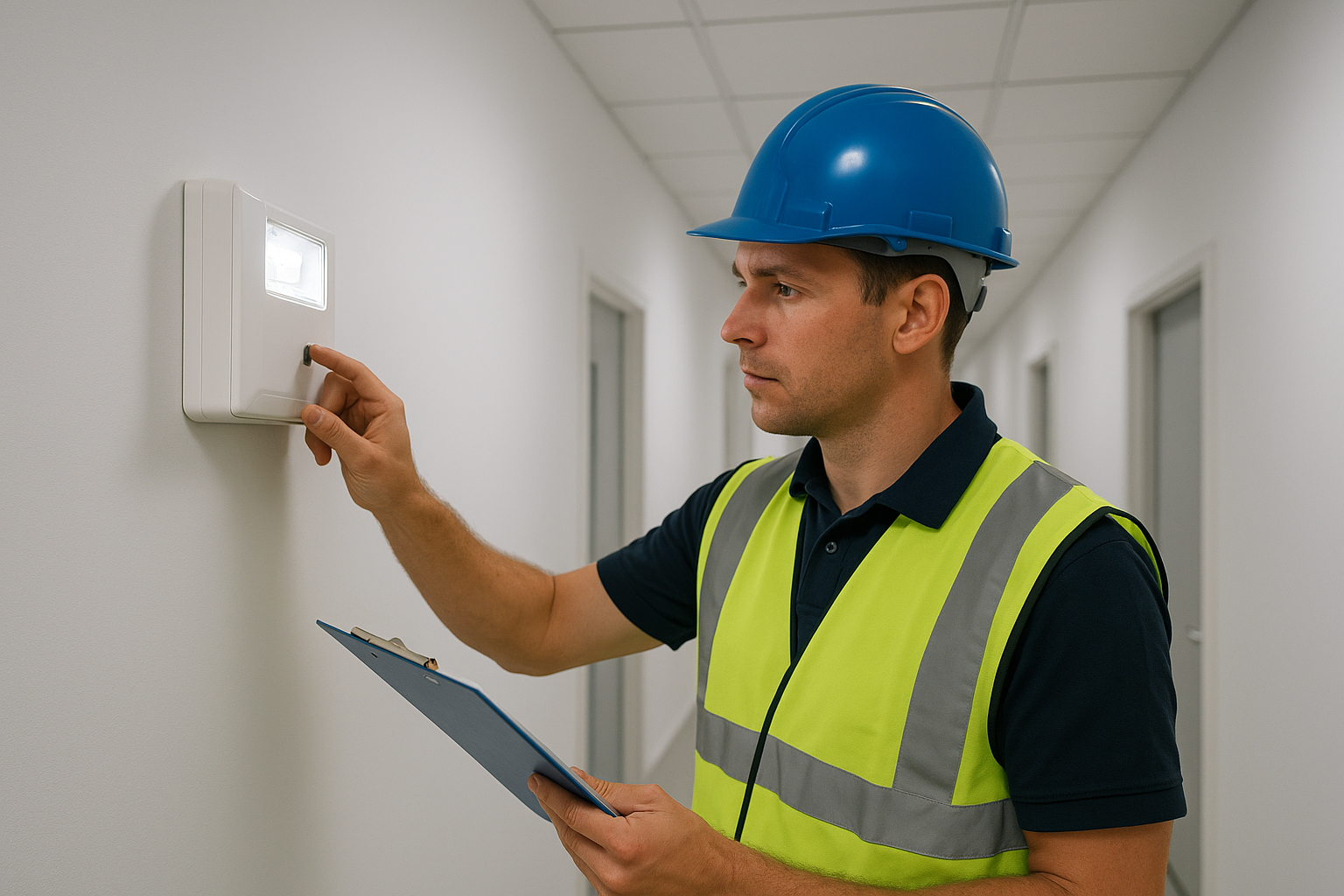
Whether the result lands on an LED or a dashboard, step 6 is always a person fixing the fault.
How to move your building to automatic testing
Start with what you already have, because the type of luminaire decides your options. Self-contained fittings with their own batteries can often be replaced or upgraded one by one. Central battery systems need a different approach, so identify which you have before you talk to any supplier.
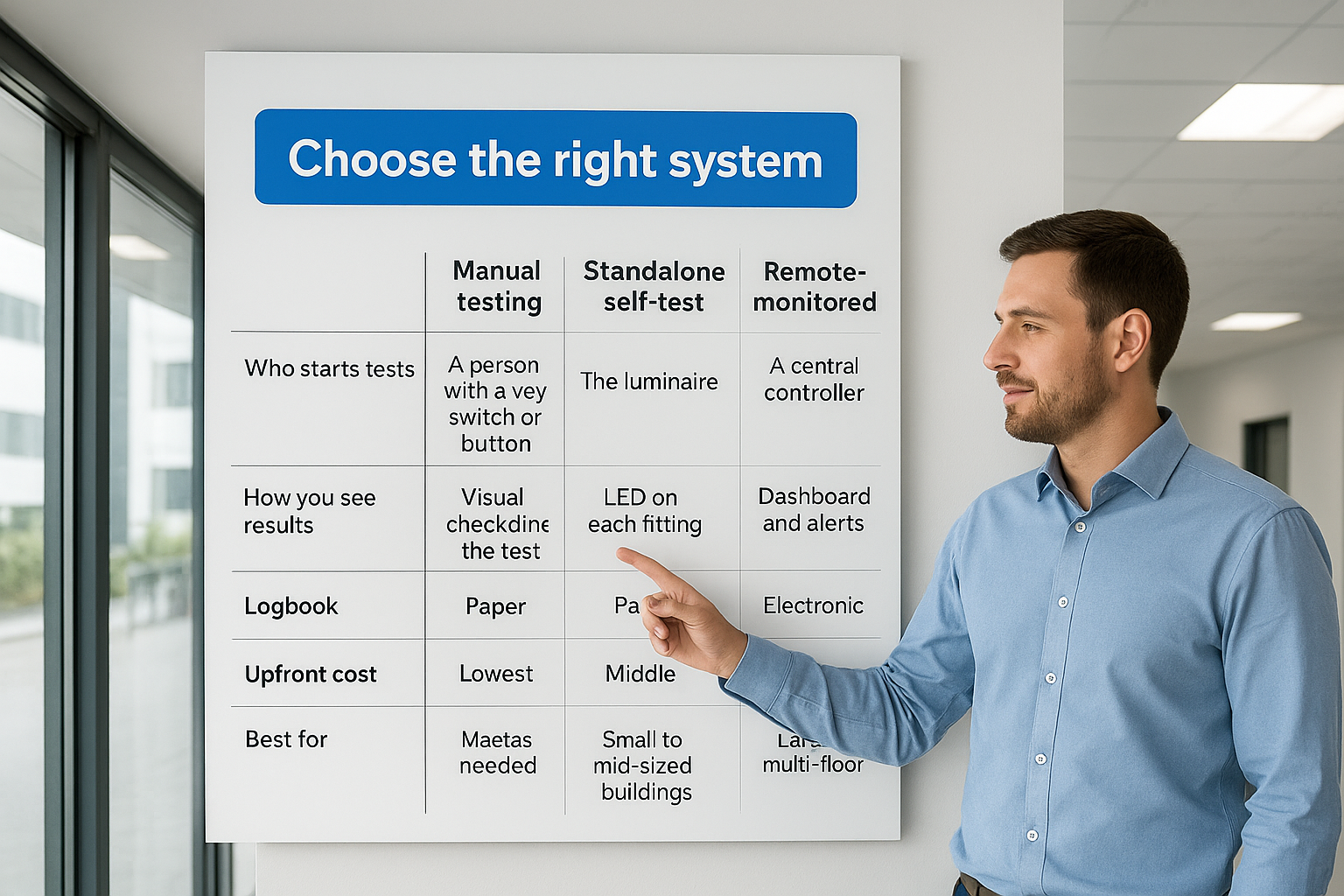
Choose the right system
|
|
Manual testing |
Standalone self-test |
Remote-monitored |
|---|---|---|---|
|
Who starts tests |
A person with a key switch or button |
The luminaire |
A central controller |
|
How you see results |
Visual check during the test |
LED on each fitting |
Dashboard and alerts |
|
Logbook |
Paper |
Paper, filled in by hand |
Electronic |
|
Upfront cost |
Lowest |
Middle |
Highest |
|
Best for |
Very small premises |
Small to mid-sized buildings |
Large, multi-floor or multi-site buildings |
Plan the switch
-
Audit your luminaires. Count them, note the type and age, and list the faulty ones.
-
Pick the level of automation from the table above, based on building size and how many people look after it.
-
Specify systems that meet BS EN 62034 where you want central automatic testing.
-
Appoint a competent person to check indicators, keep the logbook and arrange repairs.
-
Set the schedule: monthly functional tests and one annual duration test, timed for low occupancy.
Keep the building occupied during annual tests
Batteries need time to recharge after a full duration test, often around 24 hours, so check the manufacturer's figure. If every light is tested at once, the building has no emergency cover during that recharge. Stagger the tests so alternate luminaires are tested on different days. This is simple to do with software on self-contained systems. A central battery unit cannot test alternate fittings, because the duration test needs full load. There the options are dual battery sets, or two central units each serving half the luminaires.
What it costs and what still needs a person
Automation reduces testing visits but does not remove the need for competent inspection. As a baseline, here is what manual testing by an engineer costs per year at our listed London and South East rates, assuming twelve monthly flick tests plus one annual 3 hour test.
|
Rate |
Monthly flick tests (×12) |
Annual 3 hour test |
Yearly total |
|---|---|---|---|
|
Weekday 8am to 5pm |
£960 (£80 each) |
£199 |
£1,159 |
|
Weekday 5pm to 10pm |
£1,140 (£95 each) |
£249 |
£1,389 |
Your own quote depends on the site. Automatic hardware cost depends on the number of luminaires, so compare its installed cost against this yearly figure over the life of the batteries.
What still needs a person
Automation does not replace every human check. Someone should still:
-
Inspect each luminaire for damage, blocked light and missing or faded signs.
-
Read the indicators and record every result.
-
Replace failed batteries and lamps promptly.
-
Review coverage when walls, layouts or room use change.
A self-test unit will not tell you that a new partition has left a corridor dark. If you still run standard luminaires, we provide monthly flick tests, annual 3 hour tests and an emergency lighting test certificate.
Automation tests the equipment you have, so a person must still check that you have the right equipment in the right places.
Is automatic testing right for your building?
Automatic emergency light testing runs the same monthly and annual tests the standards already require, with more consistency and less disruption. Self-test luminaires suit smaller buildings, and remote-monitored systems suit larger or multi-site premises, where electronic records and staggered tests save real time. Neither removes the need for a competent person to inspect, record and repair.
If your building still relies on manual tests, price a year of visits against the cost of upgrading before you decide. We carry out emergency lighting testing across London and the South East, with monthly and annual visits and a certificate. To get your own figures, request a quote for emergency light testing.

