


BS7671 Electrical Safety Certificate: What It Is and How to Get One


If you've been asked for a BS7671 electrical safety certificate and aren't sure what that actually means, you're not alone. Landlords, homebuyers, and business owners across London hear the term thrown around by solicitors, letting agents, and insurers, but rarely get a straight answer about what it covers or why it matters. That confusion usually costs time, and sometimes a failed sale or a fine.
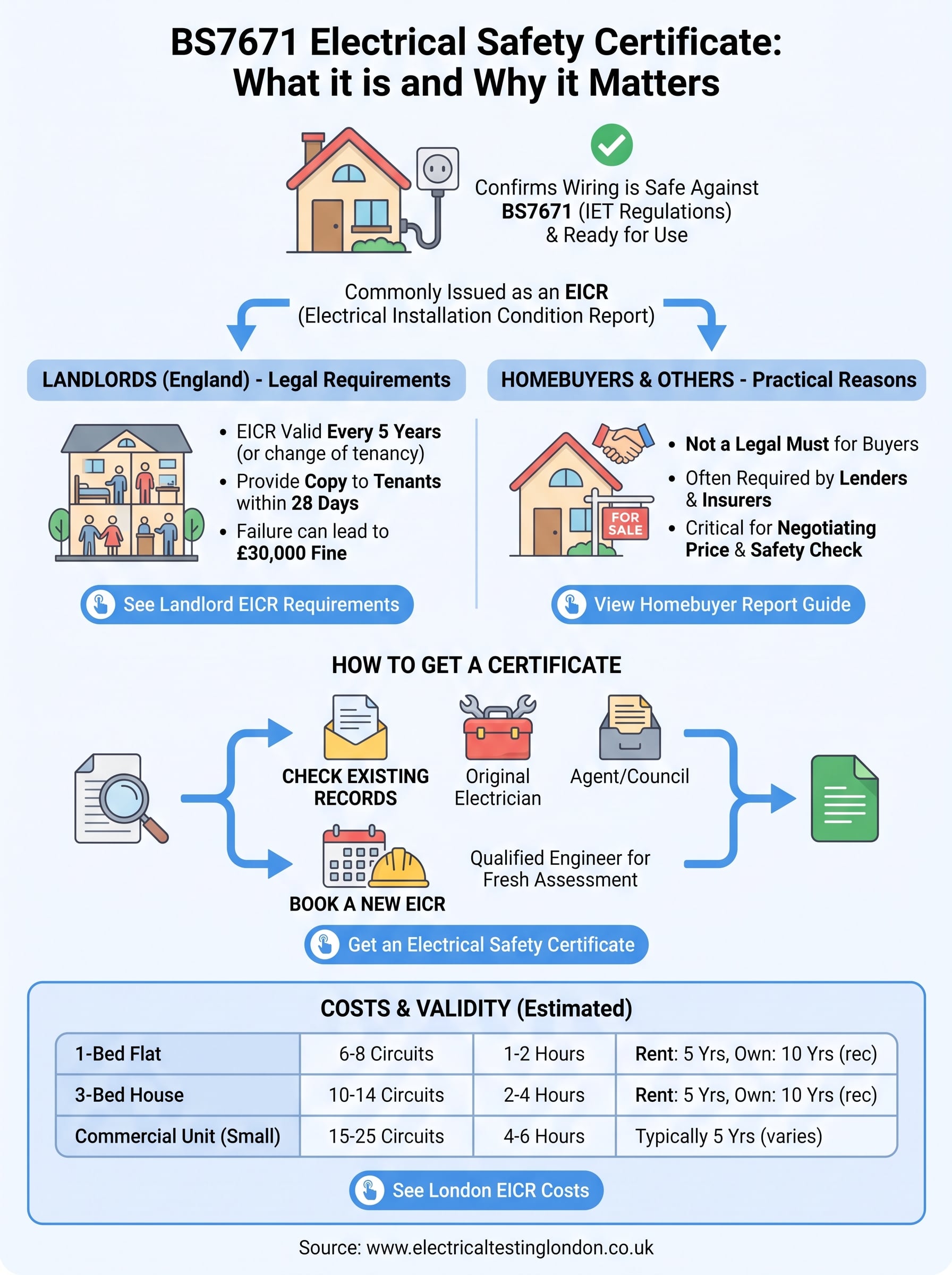
In plain terms, this certificate confirms your electrical installation has been inspected against BS7671, the national wiring regulations, and found safe to use. It's most commonly issued as an Electrical Installation Condition Report (EICR), whether you're letting a property, buying a home, or running a commercial premises. Knowing this upfront saves you chasing the wrong document.
Below, we explain what the certificate actually covers, who needs one and when, and exactly how to get a copy of a BS7671 electrical safety certificate if you've lost yours or need one from a previous inspection. We'll also cover how our qualified engineers carry out these assessments across London and the South East, so you know what to expect before booking.
Why the BS7671 certificate matters for your property
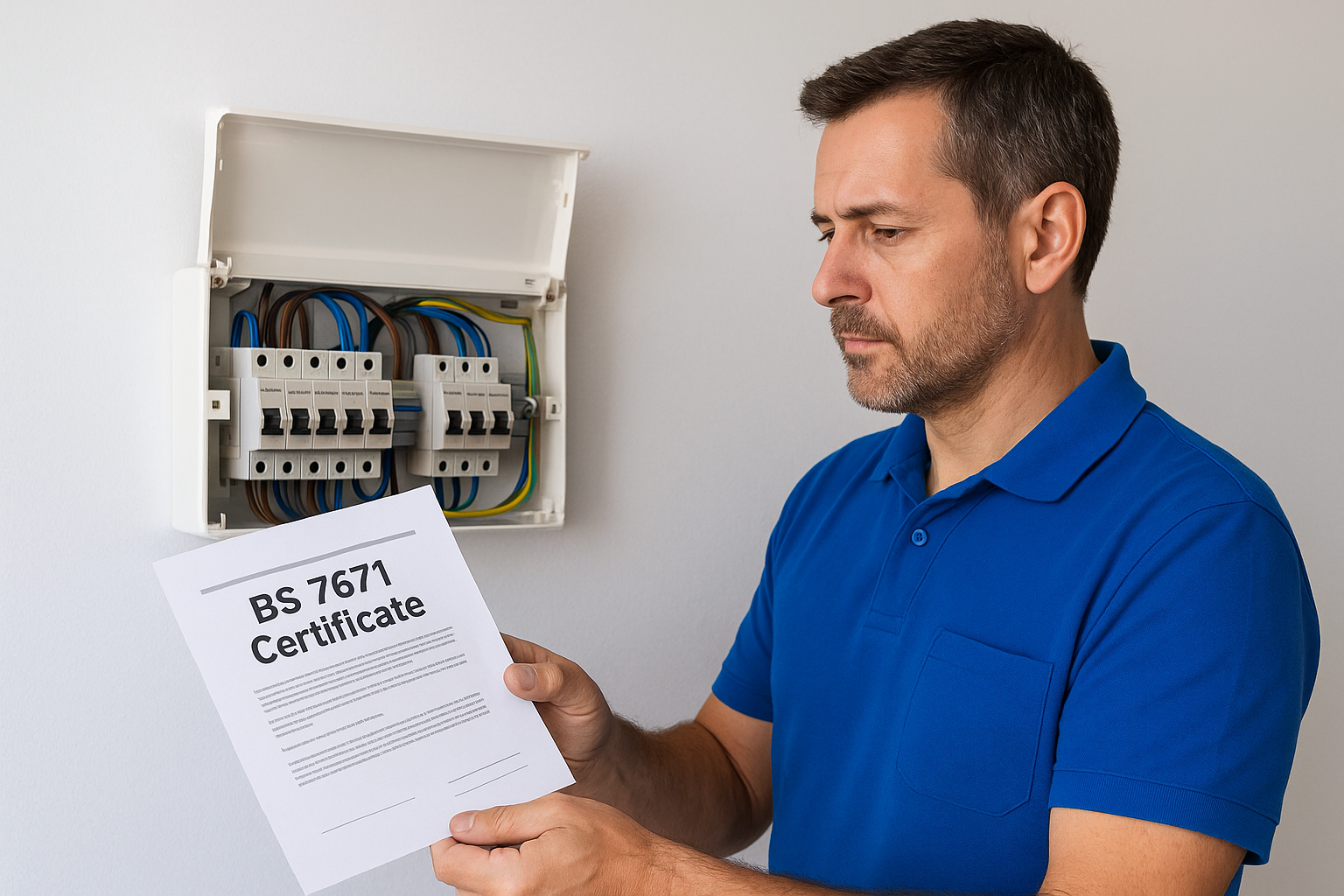
BS7671 is the IET Wiring Regulations, the UK wiring standard in plain English that every qualified electrician in the UK works to when installing or inspecting wiring, sockets, consumer units, and fixed electrical equipment. A certificate confirming compliance with BS7671 tells you that a competent person has physically tested your installation, not just glanced at it, and found it safe against current standards. Skipping this isn't a paperwork shortcut; it's a genuine safety gap, because faulty wiring is one of the leading causes of house fires in the UK according to the Home Office fire statistics.
The legal weight behind the document
Government regulation makes this more than best practice for certain property types. Under the Electrical Safety Standards in the Private Rented Sector Regulations 2020, part of the wider framework of UK electrical safety laws, landlords in England must have a valid EICR carried out at least every five years and provide a copy to tenants within 28 days of the inspection. Councils can issue fines of up to £30,000 for non-compliance, and in serious cases can force remedial works at the landlord's expense. Commercial property electrical safety certificates face similar scrutiny under the Health and Safety at Work Act, where employers have a duty to keep electrical systems safe for staff and visitors.
A BS7671 certificate isn't a formality, it's the difference between a safe property and a legal liability.
Homebuyers sit in a slightly different position, since there's no statutory requirement to produce one before completion. That said, most solicitors and mortgage lenders now ask for evidence of electrical safety as standard due diligence, particularly on older properties or ones with visible signs of DIY electrical work. Without it, you're negotiating blind, and buyers frequently use a poor or missing report as leverage to renegotiate price.
Who asks for it, and why
Different parties want this certificate for different reasons, and understanding their motivation helps you anticipate what they'll expect to see.
|
Who's asking |
Why they need it |
|---|---|
|
Local council or tenant |
Confirms landlord compliance under the 2020 regulations |
|
Mortgage lender or solicitor |
Due diligence before releasing funds on a purchase |
|
Buildings insurer |
Validates cover in the event of an electrical fire claim |
|
Health and safety inspector |
Confirms duty of care to employees and visitors on commercial premises |
|
Letting agent |
Standard requirement before marketing a rental property |
Insurers deserve particular attention here, because many policies contain clauses that reduce or void payouts if an electrical fault caused damage and there's no evidence of a recent, satisfactory inspection. Property owners often only discover this exclusion after a claim gets rejected, which is an expensive way to learn the lesson.
Beyond the paperwork
Rather than treating the certificate as a box-ticking exercise, it's worth seeing it as a genuine health check on your wiring. An EICR inspection under BS7671 flags issues ranging from minor deviations from current standards (coded C3) through to dangerous conditions requiring immediate attention (coded C1), and it helps to know what the EICR codes actually mean. Catching a C1 fault, like exposed live parts or a damaged consumer unit, before it causes harm is the entire point of the exercise. Our engineers at Electrical Installation Condition Reports explain every code in plain English on the report itself, so you're never left guessing what needs fixing and what can wait. That clarity matters just as much as the certificate itself, because a report full of jargon helps nobody make a genuinely informed decision about their property.
How to get a copy of your BS7671 certificate
Getting hold of a BS7671 certificate is usually straightforward, provided you know which route applies to your situation. If you've had an inspection done before, the fastest path is contacting whoever carried it out. If you've never had one, or need a fresh assessment for a sale, tenancy, or insurance query, you'll need to get an electrical safety certificate by booking a qualified engineer to test the installation from scratch. Either way, how to get a copy of a BS7671 electrical safety certificate starts with working out which of these two positions you're in.
If the inspection happened recently
Most electricians and testing companies keep digital records of every EICR they issue, often for several years after the job. Start by checking any email correspondence from the original booking, since the certificate itself is frequently attached as a PDF alongside the invoice. If you can't find it there, ring the company directly with the property address and the approximate date of the inspection. A reputable firm should be able to pull the record within a day or two, sometimes for a small admin fee if it's an older job.
The quickest way to get a copy is asking the electrician who did the original test, not starting the process over.
Requesting the certificate step by step
When chasing a copy, work through this in order:
-
Check your own paperwork and email inbox first for the original PDF or paper copy.
-
Contact the electrician or testing company that carried out the inspection, quoting the property address and approximate date.
-
Ask your letting agent or managing agent if you rent through one, since they often hold copies for compliance records.
-
Check with your local council if the property is licensed as a rental, as councils sometimes retain copies submitted for licensing purposes.
-
If none of these produce a result, treat it as a lost certificate and arrange a new inspection.
When you need a brand new inspection
Sometimes there simply isn't a certificate to retrieve, either because one was never carried out or because the property has changed hands multiple times without proper handover of documents. In that case, booking a fresh EICR is the only realistic option, and it also gives you an up-to-date picture of the wiring rather than relying on a report that might be years out of date, so it's worth knowing what an EICR checks beforehand. We cover this process fully on our Electrical Installation Condition Reports page, including how quickly we can turn around inspections across London properties.
What to do if your certificate can't be found
Losing track of a BS7671 certificate happens more often than you'd think, especially in properties that have changed hands, changed landlords, or changed letting agents over the years. Paperwork gets left behind in house moves, email accounts get closed, and small electrical firms sometimes shut down without transferring records to anyone. None of this means you're stuck, but it does mean you need a clear plan rather than hoping the document turns up on its own.
Why records go missing so easily
Older properties are the worst offenders here, particularly ones bought decades ago where the original electrician has long since retired or the business no longer trades. Solicitors handling a sale rarely chase historic certificates on your behalf, so the responsibility sits with you as the current owner or landlord. Digital record-keeping has improved this in recent years, but anything issued before around 2015 is far less likely to exist in an accessible electronic format.
Practical steps when the trail runs cold
Work through these before assuming the certificate is gone for good:
-
Search the property's conveyancing file from your original purchase, since solicitors sometimes retain copies of documents handed over at completion.
-
Ask the previous owner or landlord directly if you're still in contact, as they may have kept a paper copy in a folder rather than digitally.
-
Contact NICEIC, NAPIT, or the relevant competent person scheme if you know which body the original electrician was registered with, since some schemes hold member records centrally.
-
Check building control records with your local council for major electrical works carried out under Part P notifications.
If no copy exists anywhere, the safest move is booking a fresh inspection rather than guessing at the wiring's condition.
When a new inspection becomes the only option
Once you've exhausted the obvious channels, arranging a new EICR stops being a last resort and becomes simply the sensible next step. Trying to sell, let, or insure a property without any verifiable record of its electrical condition puts you in a weaker position regardless of how the wiring actually performs. Booking a fresh inspection also removes any doubt about whether the property has been altered since the last test, which a recovered old certificate could never confirm anyway. Our engineers handle this regularly for landlords and homeowners across London who've hit exactly this dead end, and you can book an EICR in London with a certified electrician without needing to explain the history first.
Costs and validity of a BS7671 certificate
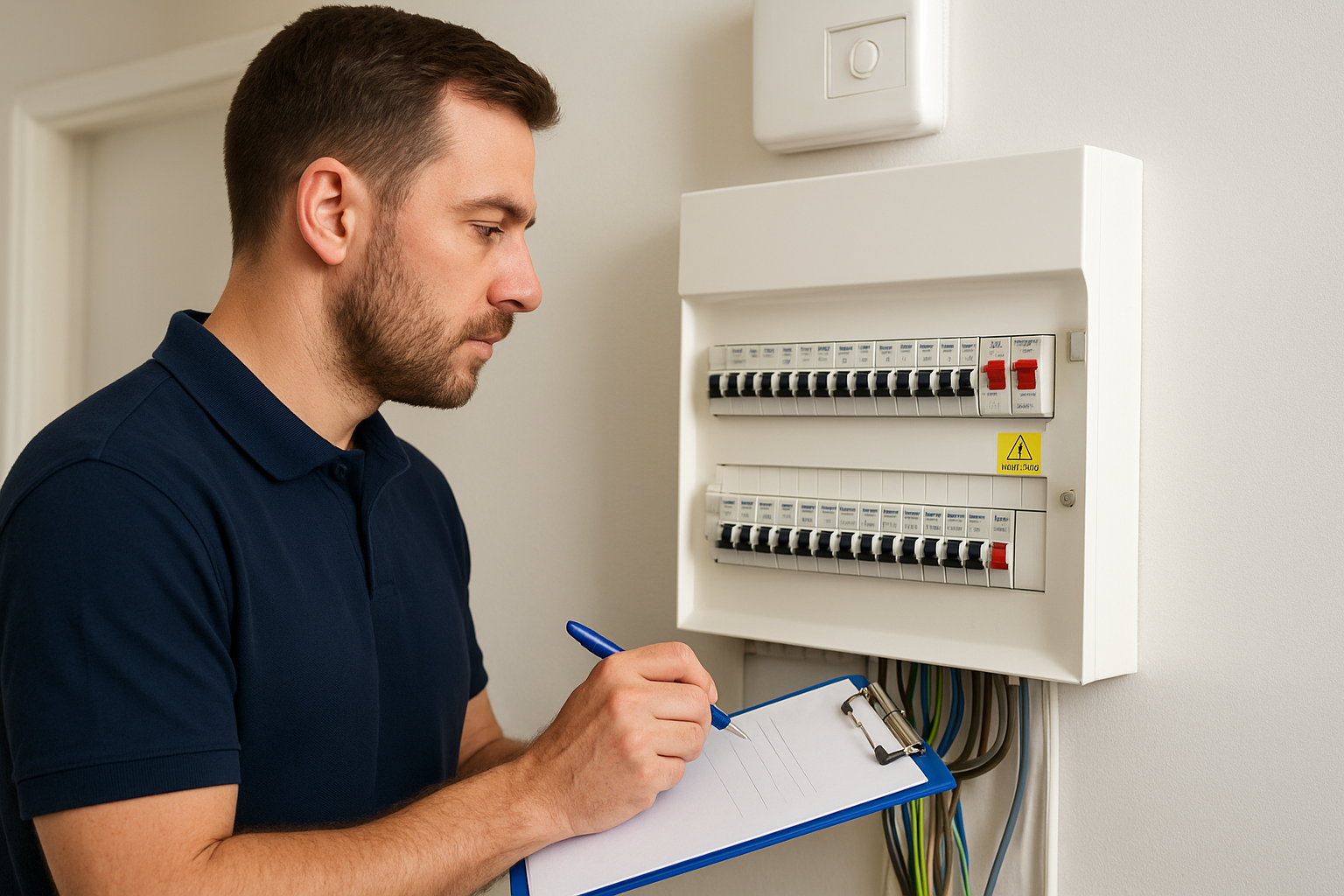
Pricing for a BS7671 electrical safety certificate varies more than most people expect, mainly because the inspection scales with the size and complexity of the installation rather than a flat rate. A one-bedroom flat with a modern consumer unit takes far less time to test than a five-bedroom house with multiple circuits, outbuildings, or an ageing fuse board. Commercial electrical inspection costs sit at the higher end again, since inspectors need to test more distribution boards, emergency systems, and often work around business hours to avoid disrupting trade.
What affects the price
Several factors push the cost up or down beyond simple property size. The number of circuits, the age of the wiring, and how accessible the installation is all matter, since a boxed-in consumer unit or blocked loft hatch adds time to the job. Properties with previous remedial work also take longer to assess, because the engineer needs to verify that earlier fixes meet current standards rather than just checking new areas.
|
Property type |
Typical circuits |
Rough time on site |
|---|---|---|
|
One-bed flat |
6-8 |
1-2 hours |
|
Three-bed house |
10-14 |
2-4 hours |
|
Small commercial unit |
15-25 |
4-6 hours |
|
Large commercial premises |
25+ |
Full day or more |
We publish clear, upfront figures on EICR costs in London by property size and circuits so you know roughly what to expect before booking, rather than waiting for a vague quote after the fact.
How long a certificate stays valid
Validity depends entirely on what type of property you're dealing with, and mixing these up is one of the most common mistakes we see. Rented residential properties need a fresh EICR every five years under the 2020 regulations, or at every change of tenancy if that comes sooner, which is why how long an EICR certificate stays valid depends on the property. Owner-occupied homes have no legal deadline, though most electricians recommend retesting every ten years, or five if the property has an older installation. Commercial premises typically need retesting every five years too, though higher-risk environments like industrial units or properties with swimming pools often require checks every one to three years.
A certificate doesn't expire on a fixed date everywhere, it expires when the law or the risk of the property says it should.
Getting this wrong in either direction causes problems: retesting too early wastes money, while leaving it too long risks non-compliance and voided insurance cover exactly when you need it most.
Landlord and homebuyer requirements explained
Landlords and homebuyers face genuinely different rules when it comes to a BS7671 electrical safety certificate, and mixing up the two obligations catches out plenty of property owners. Knowing exactly what's legally required, versus what's simply good practice, helps you avoid both non-compliance and unnecessary spending on tests you don't strictly need yet.
What landlords must provide
Under the Electrical Safety Standards in the Private Rented Sector Regulations 2020, every landlord in England renting out residential property must hold a valid EICR and hand tenants a copy within 28 days of the inspection taking place. Under the EICR requirements for landlords, new tenancies need proof of a satisfactory report before the tenant moves in, and existing tenancies need retesting at least every five years. Failing to comply lets local councils issue remedial notices, and continued non-compliance can bring fines of up to £30,000 per breach.
Landlords who skip this step aren't just risking a fine, they're risking a tenant's safety and their own insurance cover.
Beyond the certificate itself, landlords must also act on any C1 or C2 codes flagged in the report within 28 days, or sooner if the inspector marks the issue as urgent. Our team at Electrical Testing London handles both the inspection and the remedial work where needed, so landlords aren't left juggling separate contractors against a tight legal deadline.
What homebuyers should ask for
Homebuyers sit outside statutory requirements, since no law forces a seller to produce an EICR before completion. Solicitors and mortgage lenders, though, increasingly treat electrical safety evidence as standard due diligence, particularly on properties built before the 1990s or ones showing signs of amateur rewiring. Requesting a recent, satisfactory certificate before exchanging contracts gives you leverage to negotiate remedial costs into the price if problems turn up.
Without a certificate on hand, buyers have three practical options:
-
Ask the seller's solicitor to provide any existing EICR or homebuyer's electrical report on file.
-
Commission an independent inspection before exchange, ideally alongside the property survey.
-
Build a retest clause into the offer if the seller can't produce recent paperwork.
Commercial buyers face a sharper version of the same issue, since business insurance and health and safety compliance both hinge on documented electrical safety from day one of occupation. A homebuyers electrical report gives buyers of any property type a clear, independent picture before money changes hands, rather than relying on the seller's word.
Staying on top of your electrical compliance
A BS7671 electrical safety certificate isn't just something to produce when a solicitor or council asks for it. It's proof that someone competent has actually checked your wiring against current standards, rather than you hoping it's fine because the lights still work. Whether you're chasing a lost copy, booking a first inspection, or working out when your next EICR falls due, the principle stays the same: sort it before someone forces the issue, not after.
Landlords face legal deadlines, homebuyers face negotiating leverage, and everyone faces the basic risk of faulty wiring causing real harm. None of that improves by waiting. If you're unsure where you stand or need a fresh inspection booked in, get a quote from our team and we'll talk you through exactly what your property needs, with no guesswork involved.

