






Commercial EICR Frequency: Intervals for Each Premises Type



Commercial EICR frequency is how often the fixed electrical wiring of a business premises should be inspected, tested and recorded in an Electrical Installation Condition Report. For most offices, shops, schools and restaurants, the recommended interval is five years. Higher-risk premises need it sooner. Factories and theatres are usually put on three years. Launderettes, swimming pools and petrol stations are put on one year. Construction site installations are put on three months.
No single law sets one date for every commercial building. The Electricity at Work Regulations 1989 require you to keep your installation safe, and the interval on your EICR is how you show you are doing that. The date printed on your latest report therefore matters more than any general rule of thumb.
This guide explains why the interval matters and how to work out the right one for your premises. It also covers what pulls the date forward and what to do between inspections. We carry out commercial EICRs for businesses in London and the South East, so the advice comes from the testing side.
Why commercial EICR frequency matters
Frequency matters because the law makes you responsible for keeping the installation safe, and an out-of-date EICR leaves you unable to prove that you do.
The legal duty behind the interval
Regulation 4(2) of the Electricity at Work Regulations 1989 requires electrical systems to be maintained so as to prevent danger, as far as is reasonably practicable. The Health and Safety at Work etc. Act 1974 adds a general duty on employers to protect staff and others. HSE guidance on the regulations, available from the HSE, sets no mandatory test frequency.
An EICR is the accepted way to demonstrate compliance. The strict five-year rule you may have read about applies to privately rented homes in England under the 2020 regulations. It does not apply to commercial premises, where the interval is a matter of risk and competent advice.
There is no fixed legal date for commercial premises, so your EICR interval is the evidence that you maintain the installation safely.
Who has to arrange it
Responsibility sits with whoever controls the electrical installation. That can differ across a single building:
-
Landlords or managing agents usually cover common areas and landlord-owned systems.
-
Tenants or occupiers cover the systems they control, as set out in the lease.
-
Insurers and licensing authorities often ask for a current report, which can effectively set your deadline.
Check your lease and your insurance policy before you assume five years is enough.
How to work out your commercial EICR frequency
To work out your interval, find your premises type in the table below. Then check the "next inspection" date on your last report, because that date overrides the general figure.
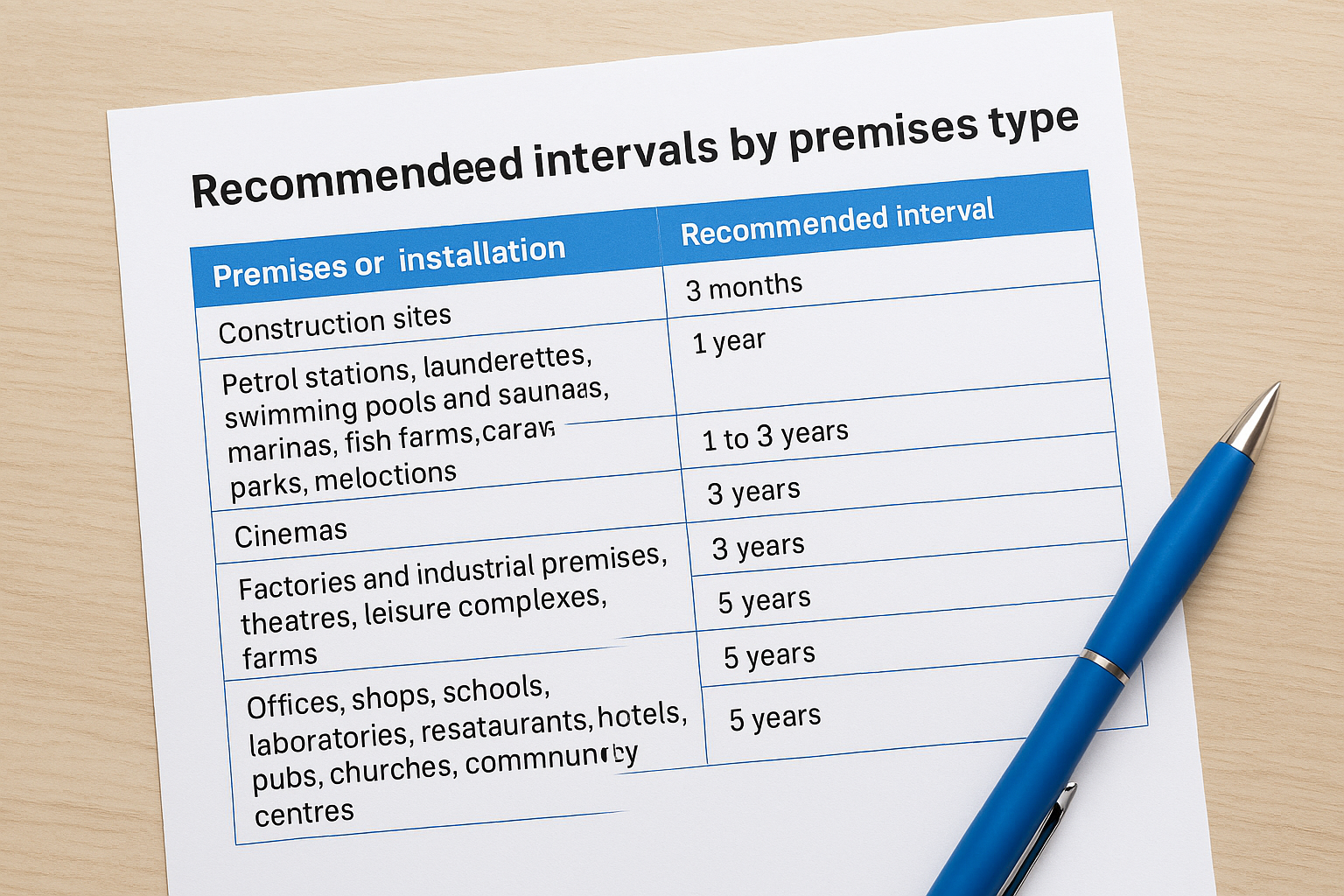
Recommended intervals by premises type
These figures follow the recommended maximum intervals in IET Guidance Note 3, which accompanies BS 7671. Use them as a starting point.
|
Premises or installation |
Recommended interval |
|---|---|
|
Construction sites |
3 months |
|
Petrol stations, launderettes, swimming pools and saunas, marinas, fish farms, caravan parks, medical locations |
1 year |
|
Cinemas |
1 to 3 years |
|
Factories and industrial premises, theatres, leisure complexes, farms |
3 years |
|
Offices, shops, schools, laboratories, restaurants, hotels, pubs, churches, community centres |
5 years |
The inspector sets the first interval from this guidance. The next one then depends on the condition of the installation, how you use the building and its maintenance history. If you want to know how often an EICR needs to be done for your commercial property, the report date is the final answer.
Your premises type gives the starting interval, but the inspector's date on your latest report is the one you follow.
A worked example
Say a small office is inspected on 12 March 2026 and the report is satisfactory with a five-year interval. The next EICR falls due by March 2031. Put the date in the calendar with a reminder six months earlier.
Now suppose a tenant converts half the floor into a commercial kitchen in 2028. The load, the heat and the moisture have changed, so you should bring the inspection forward rather than wait for 2031. Our Commercial EICR starts at £169 for up to 10 circuits, with additional circuits from £10 each plus VAT. The report states its next inspection date, and for standard premises the validity is five years.
What shortens your inspection interval
Anything that raises the electrical risk or changes the installation can shorten the interval. A harsh environment, a heavy load, a poor last report and a change of use are the usual causes.
Triggers that bring the date forward
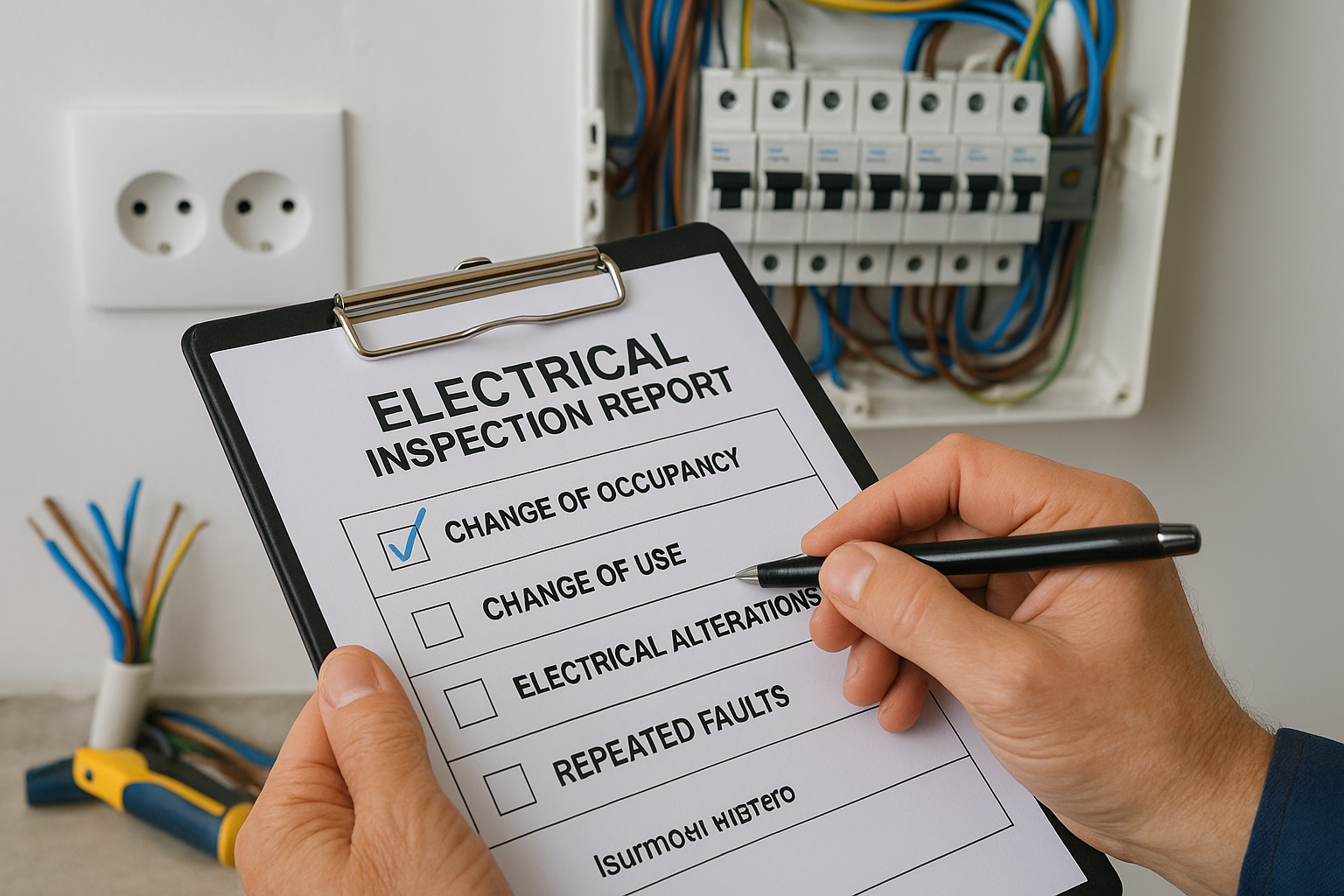
Even a report that says "next test in five years" should be revisited when any of these happen:
-
Change of tenant or occupancy, because loads and layouts differ.
-
Change of use, such as office to retail, or retail to food preparation.
-
Electrical alterations, including new circuits, new distribution boards or large increases in load.
-
Repeated faults, such as tripping, overheating or burning smells.
-
Damage, from fire, flooding, impact, rodents or water ingress.
-
Insurer, landlord or licence conditions that require more recent evidence.
A change of tenant is not a statutory trigger on its own, but it is a sensible moment to inspect. Records are often incomplete and the new use may change the risk.
When use, load or condition changes, test sooner, whatever date the last report gave.
How the report codes affect your date
The codes on your EICR decide what happens next. C1 means danger is present and needs immediate action. C2 means potential danger and urgent action. C3 means improvement is recommended. FI means further investigation is needed.
A report with a C1, C2 or FI is unsatisfactory. You need remedial work, and often a follow-up inspection, before you can rely on the next-inspection date. A report with only C3 observations can still be satisfactory.
What to do between inspections
Between EICRs, keep the installation monitored and your paperwork complete. This is what keeps a five-year interval defensible and makes the next report cheaper to resolve.
Thermal imaging and interim checks
A thermal imaging survey finds unusual hot spots in distribution boards and switchgear under normal operating load, with no downtime or disruption. We recommend it once a year between EICR tests. It supplements the EICR and does not replace it.
|
Thermal imaging inspection |
Price |
|---|---|
|
10 distribution boards |
£350 |
|
Each extra distribution board |
£25 |
|
LV switchgear thermal inspection |
£500 |
Ask staff to report tripping, warm sockets or damaged accessories as soon as they notice them. Those reports are the early warning that justifies an earlier test.
Keep a compliance file and book early
Build one file that answers the three questions an insurer or auditor will ask: when was the last test, what was found, and when is the next one due?
-
The current EICR and its next due date.
-
Remedial records and completion certificates.
-
Distribution board schedules.
-
Maintenance and fault logs.
Book at least a few months before the due date so that any remedial work is finished before the old report expires. With our remedial works, the follow-up Satisfactory EICR is free.
Book the inspection before the due date, so remedial work never leaves you without a satisfactory report.
Setting your next date
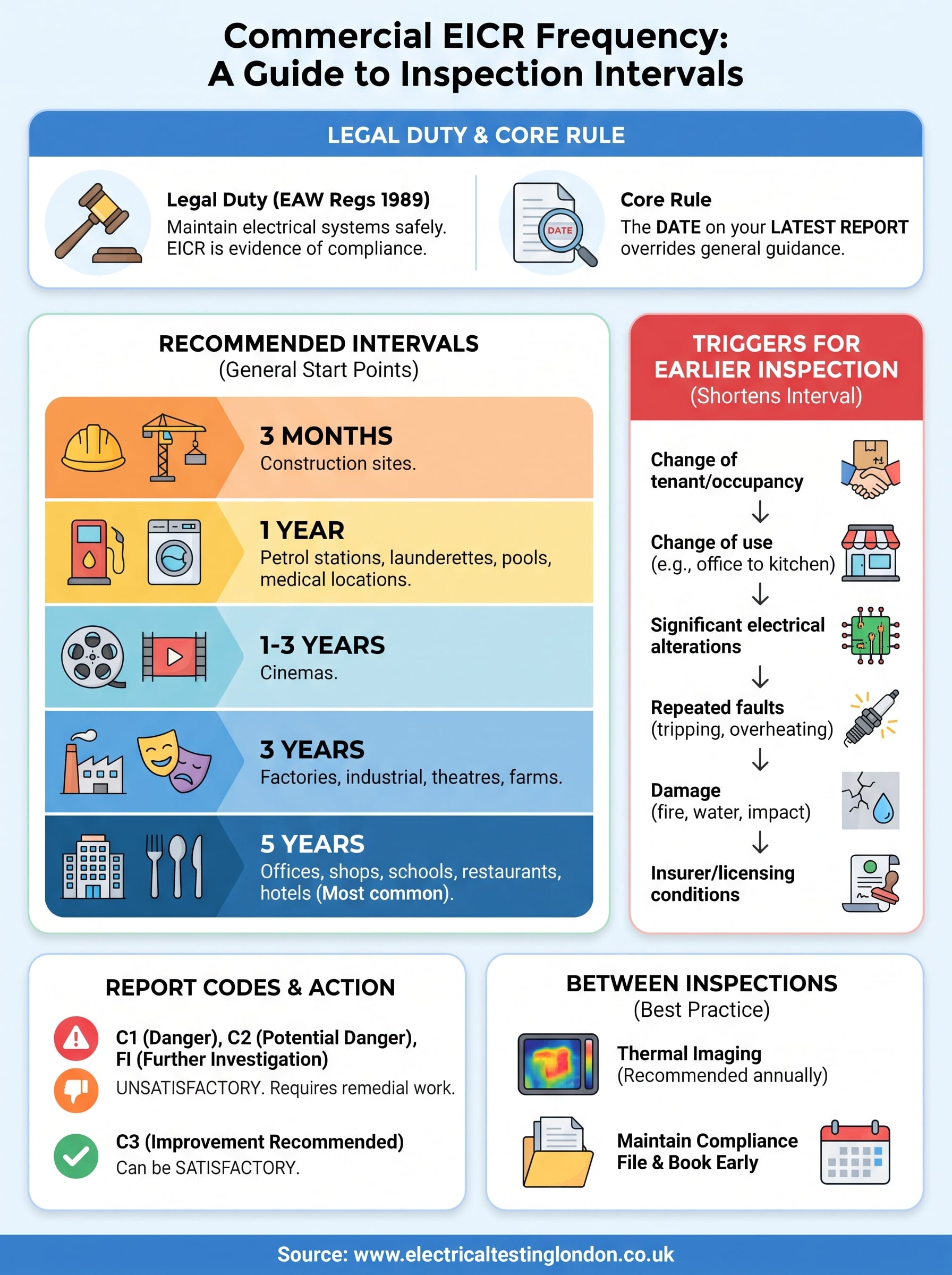
For most commercial premises, the answer is every five years. Higher-risk sites sit at three years, one year or less, and the next-inspection date on your latest EICR overrides any general figure. Changes in use, load, condition or insurer requirements can all bring that date forward.
If you are not sure what your date should be, or you want it set by an engineer who will inspect the site, request a quote for your commercial EICR. We cover London and the South East.