


EICR Certificate Renewal: When and How to Renew It


If your EICR is due to expire soon, or you've already missed the date, you're not alone. Landlords and homeowners across London ask us the same question every week: what actually triggers EICR certificate renewal, and what happens if you leave it too late. The answer matters more than most people realise, because an out-of-date report can invalidate insurance, breach tenancy law, or leave a property genuinely unsafe.
Most domestic EICRs need renewing every five years, though some certificates are only valid for three, as rented properties and commercial units often face shorter intervals set by the report itself or by law. The renewal process isn't just booking another test. It means acting on the previous report's findings, choosing a qualified engineer, and timing the inspection so you're never left without valid cover.
This guide walks through exactly when your certificate expires, what the law requires of landlords specifically, and the practical steps to get a renewal booked and passed without last-minute stress. We'll also cover what happens to remedial work flagged in your last report and how that affects your next inspection.
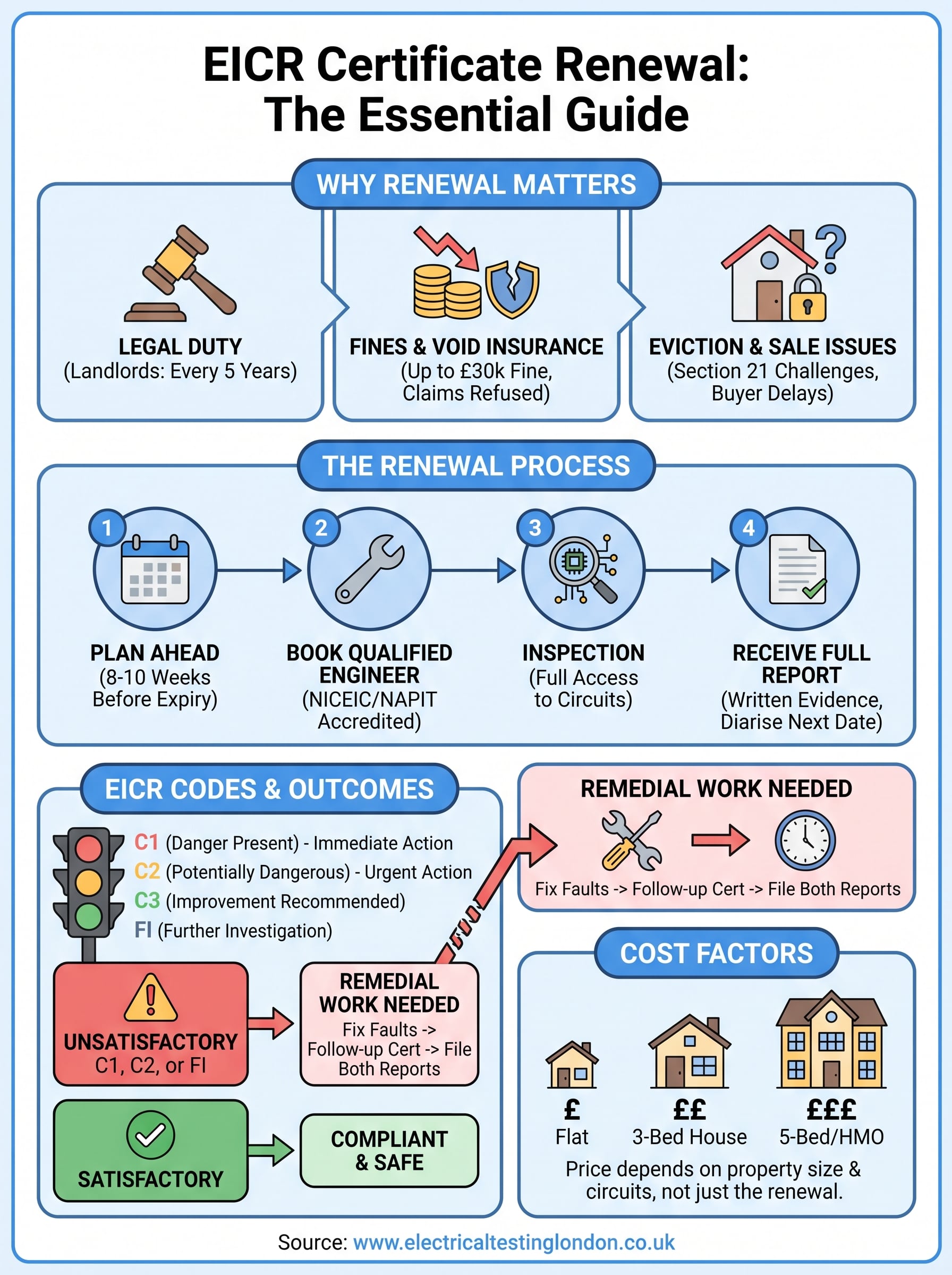
Why EICR certificate renewal matters for landlords
The legal requirement under the Electrical Safety Standards
Landlords in England have a legal duty under the Electrical Safety Standards in the Private Rented Sector (England) Regulations 2020 to have every rented property inspected by a qualified person at least every five years, or sooner if the previous report specifies it, and the EICR rules and testing frequency for landlords set out exactly how that duty applies. This isn't guidance, it's a statutory obligation, so once your certificate's expiry date passes, you're technically renting out a property without valid proof of electrical safety, even if nothing's actually wrong with the wiring. You can read the government's full breakdown of the rules on the UK government website.
What happens if you miss the renewal date
Missing the deadline isn't a paperwork technicality, it carries real financial and legal risk. Local authorities can issue fines of up to £30,000 for landlords who fail to comply, and repeated non-compliance can trigger remedial notices or, in serious cases, banning orders. Tenants also have the right to request a copy of the current EICR within 28 days of asking, and if you can't produce one, you're already in breach of your obligations.
A lapsed EICR doesn't just risk a fine, it can void your landlord insurance the moment something goes wrong.
Beyond fines, an expired certificate creates problems that ripple through the rest of your tenancy management:
-
Insurance claims can be refused if an electrical fault causes damage or injury and the property lacked a valid EICR at the time.
-
Section 21 eviction notices can be challenged or delayed if you can't show up-to-date compliance documents.
-
Selling or remortgaging the property becomes harder, since solicitors and lenders increasingly ask for current electrical safety certificates.
-
Tenant disputes escalate faster when safety documentation is missing, giving tenants stronger grounds to withhold rent or complain to the council.
Staying ahead of the deadline also protects you from a slower-moving but genuine safety hazard, since electrical installations degrade with age, tenant use, and DIY additions that were never signed off by a qualified electrician. Working with a trusted provider such as our domestic EICR service in London means the renewal gets booked before expiry, not scrambled together after a tenant complaint or a failed sale forces the issue.
How to renew your EICR certificate
Renewing an EICR isn't complicated, but it does need a bit of planning so you're not caught without valid cover. The process starts well before the expiry date on your existing certificate, not on the day it lapses.
Steps to book your renewal inspection
Getting a certificate renewal sorted properly means following a clear sequence rather than just phoning the first electrician you find:
-
Check your current certificate's expiry date and any recommended review period noted by the inspector, since some properties need earlier retesting.
-
Book a registered electrician who holds current NICEIC or NAPIT accreditation, ideally the same firm that did your last inspection so they know the property's history, and check how to choose a certified electrician for an EICR in London before you commit.
-
Give access to every circuit and consumer unit, including outbuildings, garages, and any recent additions like EV chargers or extensions.
-
Request the full report in writing, not just a pass or fail summary, so you have documented evidence for tenants, insurers, or buyers.
-
Diarise the next renewal date immediately, ideally with a reminder set 8 to 10 weeks before expiry.
Book your next inspection before the old certificate expires, not after, and you'll never be caught without valid cover.
Timing it right before expiry
Booking a few weeks ahead of expiry gives you breathing room if the engineer flags remedial work that needs completing before a satisfactory report can be issued. Landlords juggling multiple properties often stagger renewal dates across the year rather than letting several certificates expire at once, which spreads cost and reduces admin pressure. Our team at Electrical Testing London handles this scheduling directly with landlords and letting agents, so renewals happen on time without you having to track every property's paperwork manually.
Understanding EICR codes and grades
Every EICR report ends with a classification, and that outcome decides whether your certificate renewal counts as a pass or whether you're straight back into remedial territory. Engineers use a standard set of EICR codes to flag issues, ranging from immediate danger to minor observations, and understanding them helps you interpret the report you're handed rather than just trusting a summary line.
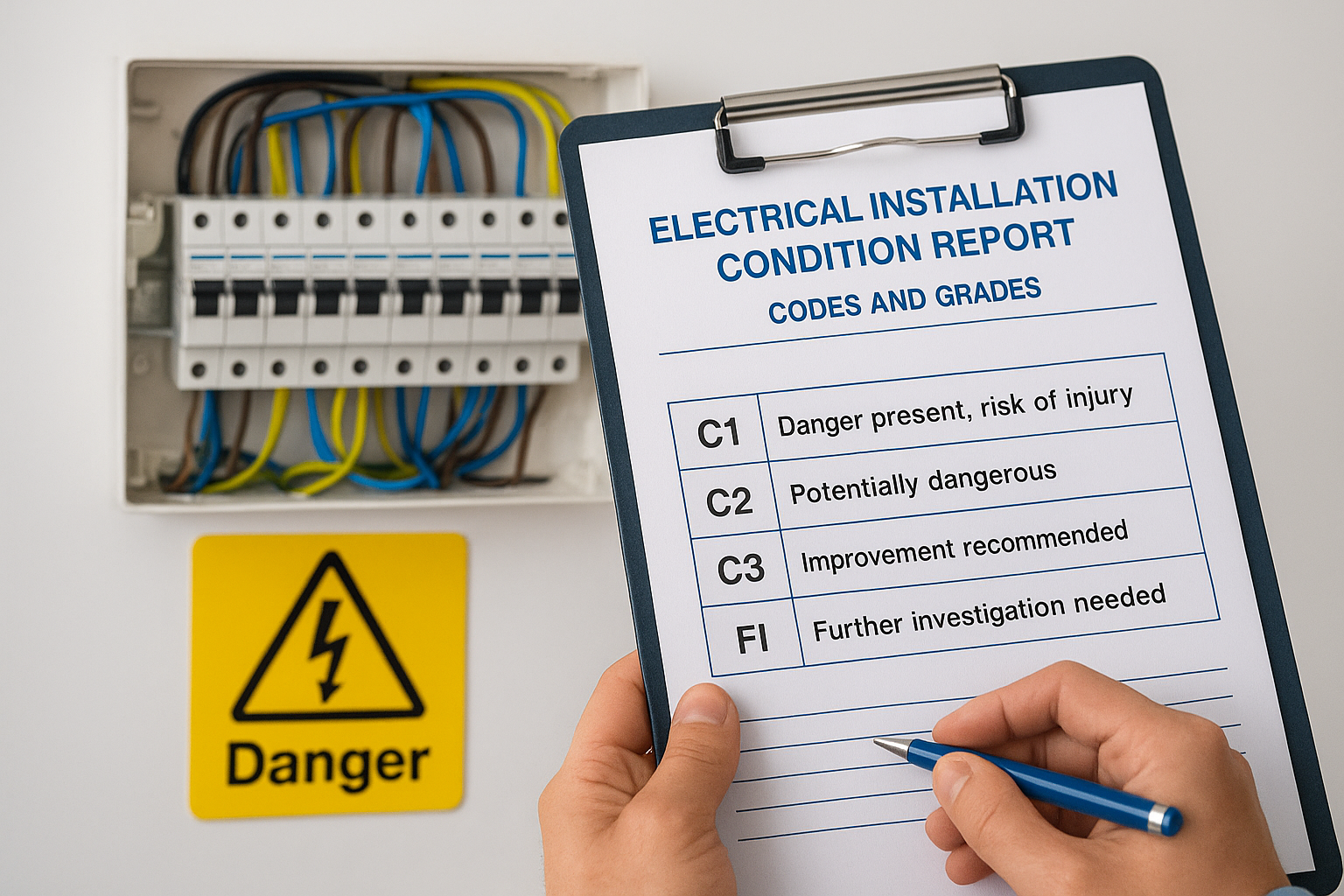
The four classification codes
Inspectors record each fault against one of four codes, and the code determines urgency, not just severity of wording:
|
Code |
Meaning |
Action required |
|---|---|---|
|
C1 |
Danger present, risk of injury |
Immediate remedial work |
|
C2 |
Potentially dangerous |
Urgent remedial work |
|
C3 |
Improvement recommended |
Not mandatory, but advisable |
|
FI |
Further investigation needed |
Additional testing before grading |
A single C2 code turns a satisfactory report into an unsatisfactory one, no matter how minor everything else looks.
Satisfactory vs unsatisfactory reports
Once every circuit's been checked, the engineer issues an overall verdict of satisfactory or unsatisfactory. Any C1 or C2 code automatically pushes the whole report into unsatisfactory territory, which means landlords can't legally rely on it as proof of compliance until the fault's fixed and retested, so it's worth knowing what happens if an EICR fails and the deadlines that follow. FI codes sit in a grey area too, since they signal the electrician couldn't confirm safety without more digging, so treat them the same as an unresolved issue rather than a pass. Grasping this EICR grading system before your next inspection means you won't be blindsided when a report comes back unsatisfactory over something that sounds, on paper, fairly minor.
What happens if remedial work is needed
When your engineer flags a C1 or C2 code, the report comes back unsatisfactory, and you can't treat that as a valid EICR certificate renewal until the faults are fixed. The inspector will hand you a schedule of works listing every dangerous or potentially dangerous issue, usually with a recommended timeframe attached to each one. Ignoring this schedule isn't an option for landlords, since an unsatisfactory report leaves you in the same legal position as having no certificate at all.
Getting from unsatisfactory to compliant usually follows a set pattern:
-
Review the schedule of works line by line with your electrician so you understand what's urgent versus what can wait.
-
Book remedial works with a qualified electrician, ideally the same firm that carried out the inspection.
-
Request a follow-up inspection or minor works certificate once the faults are corrected, confirming the specific circuits now meet standard.
-
File the follow-up certificate alongside your original EICR so you have a complete paper trail for tenants, insurers, or buyers.
An unsatisfactory EICR isn't the end of the process, it's the start of the fix, and only the follow-up certificate proves the job's actually done.
How long remedial works take depends entirely on the scope, from a single socket swap sorted in an afternoon to a full consumer unit replacement, whose cost is worth checking upfront, since that job needs scheduling around tenant access. Landlords managing several properties often find it faster to use one contractor for both the inspection and the remedial work, since there's no handover delay between diagnosis and repair. Our team handling EICR remedial works, costs and deadlines picks up exactly where the inspection leaves off, so the property gets back to a satisfactory, compliant status without a second company re-learning its history.
How much does EICR renewal cost
Pricing for EICR renewal depends mostly on property size and how many circuits the engineer needs to test, not on the fact that it's a renewal rather than a first inspection. A one-bedroom flat with a modern consumer unit takes far less time than a five-bedroom house with an extension, an outbuilding, and a mix of old and new wiring, so expect the quote to reflect that scope rather than a flat nationwide rate.
Typical price ranges by property type
Costs across London and the South East generally fall into these bands, though always confirm with a written quote before booking:
|
Property type |
Typical cost range |
|---|---|
|
One-bedroom flat |
£120 to £180 |
|
Three-bedroom house |
£180 to £250 |
|
Five-bedroom house or HMO |
£250 to £400+ |
|
Small commercial unit |
£200 to £450 |
The number of circuits, not the size of the building, is usually what pushes an EICR quote up or down.
What affects the final price
Several factors shift these figures beyond square footage. Houses of Multiple Occupation (HMOs) usually cost more because each let room often has its own circuits and sockets needing separate checks. Older properties with outdated fuse boards or unrecorded rewiring take longer to test safely, and access issues, like a locked loft or a tenant who's hard to schedule around, can add a return visit fee.
Getting a transparent quote upfront avoids the nasty surprise of a low headline price ballooning once the engineer's on site. We publish clear EICR costs in London by property size and circuits so you know the price before you commit, and any remedial work gets quoted separately once the schedule of defects is confirmed, not bundled into a vague estimate.
Staying on top of your electrical safety
Renewing your EICR certificate on time isn't just box-ticking, it's the difference between a property that's genuinely safe and one that's exposed to fines, invalid insurance, and tenant disputes. Get into the habit of diarising your expiry date the moment a new report lands, act quickly on any C1 or C2 codes, and treat remedial work as part of the renewal process rather than a separate hassle to deal with later.
Landlords who stay organised rarely face last-minute scrambles or unsatisfactory reports that catch them off guard. Booking early, using an engineer who knows your property's history, and keeping every certificate on file gives you a paper trail that protects you legally and practically.
If your certificate's due, or you're not sure when it expires, don't wait for a tenant complaint to force the issue. Get a quote from our team and get your renewal booked in before it becomes a problem.

