






EICR Fines for Landlords in England: Amounts and Triggers



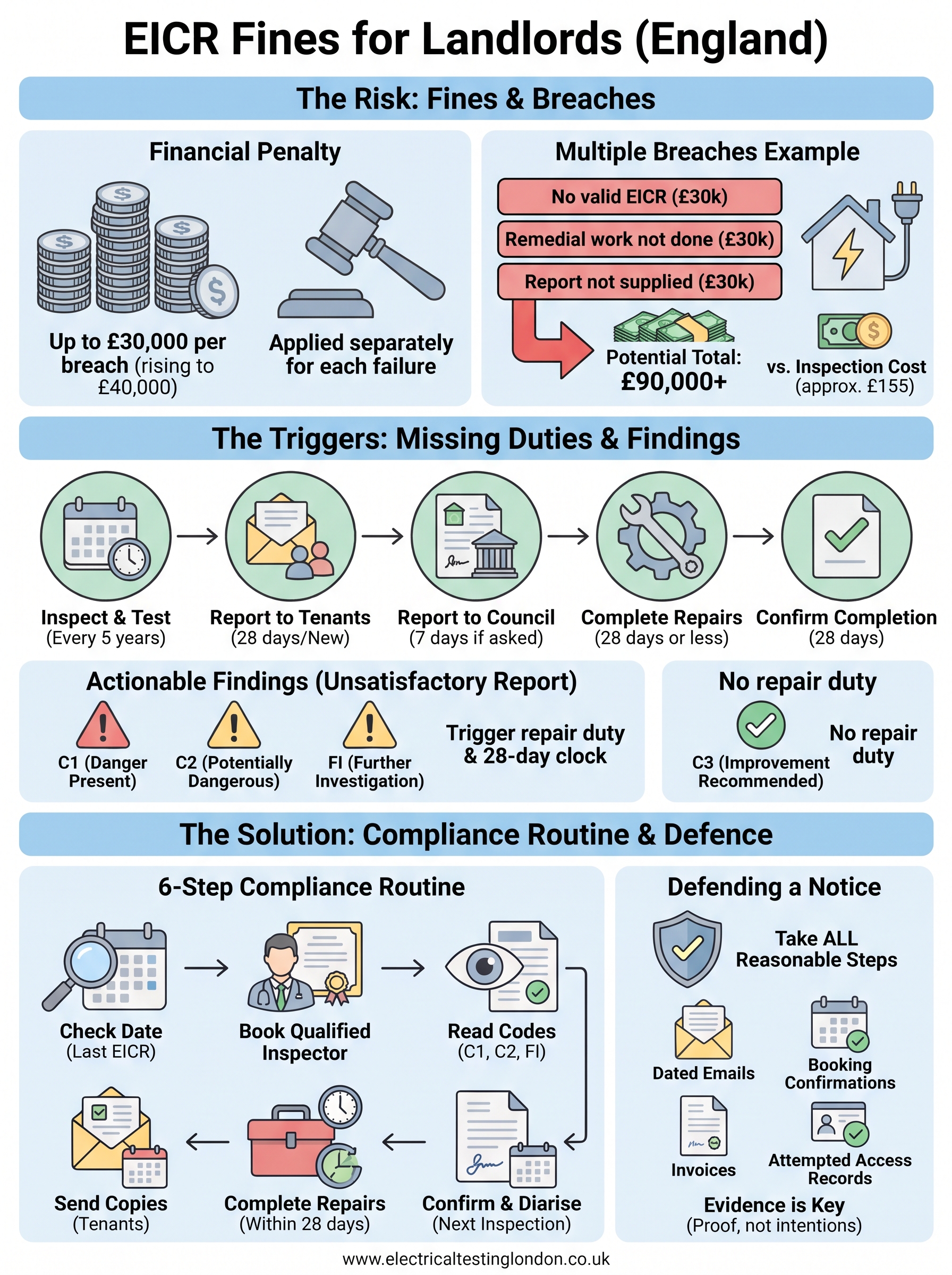
EICR fines for landlords are civil penalties of up to £30,000 per breach. A local authority in England issues them when you let a home without a valid Electrical Installation Condition Report (EICR), ignore the defects it finds, or fail to hand over the paperwork. An EICR is an inspection report on the fixed wiring of a property, and it ends in a Satisfactory or Unsatisfactory outcome. Reforms to the private rented sector raise the ceiling to £40,000, so plan around the higher figure.
This guide explains why the penalties matter, which failures trigger them, and the routine that keeps you compliant. It also covers what happens when a council starts an investigation and how you can defend yourself. You will find a deadline table, a cost table and a worked example, so you can check your own properties as you read.
Electrical Testing London carries out domestic EICRs for landlords, letting agents and property managers across London and the South East. Our engineers have at least 10 years of experience. The advice below reflects the problems that landlords actually run into after an inspection, not just the wording of the regulations.
Why EICR fines matter to landlords
They matter because the penalty is large, it applies to each breach separately, and it dwarfs the cost of compliance. A fine is also rarely the end of it, because the council can order the work and recover its costs.
How much you can be fined
Under the Electrical Safety Standards in the Private Rented Sector (England) Regulations 2020, the local housing authority can impose a financial penalty of up to £30,000 per breach. Reforms to the sector lift that cap to £40,000, so confirm the figure currently in force with your council.
Councils set the amount under their own published enforcement policy. They weigh how serious the failure was, the risk to tenants and your history as a landlord. There is no fixed tariff. A first offence may land well below the cap, but you should not count on that.
Why one lapse can mean several penalties
Each failure counts as a separate breach. A landlord with no EICR who then ignores a council request could face several penalties at once.
|
Breach |
Maximum penalty (£30,000 cap) |
|---|---|
|
No valid EICR in place |
£30,000 |
|
Remedial work not completed in time |
£30,000 |
|
Report not supplied to tenants or council |
£30,000 |
|
Theoretical total |
£90,000 |
At a £40,000 cap, the same three breaches reach £120,000. Now compare that with the cost of avoiding it. Our domestic EICR for a three-bedroom property costs £155.
The inspection is the cheapest line in the whole equation, and the penalty is the most expensive.
What triggers an EICR fine
A fine follows a failure to meet one of the duties in the 2020 Regulations, not simply an Unsatisfactory report. In practice, most penalties come from five missed obligations.
The five duties and their deadlines
|
Duty |
Deadline |
|---|---|
|
Have the installation inspected and tested by a qualified person |
At least every 5 years, or sooner if the report says so |
|
Give a copy of the report to existing tenants |
Within 28 days of the inspection |
|
Give a copy to new tenants |
Before they occupy the property |
|
Give a copy to the council if asked |
Within 7 days of the request |
|
Complete remedial or further investigative work |
Within 28 days, or less if the report states it |
You must also confirm in writing to your tenants and the council that the work is finished, within 28 days of completion. Keep your own copy of the report to hand to the next inspector.
Which findings force you to act
The report grades each fault with a code. C1 means danger is present, and C2 means potentially dangerous. FI means further investigation is needed. Any of these makes the report Unsatisfactory and starts the 28-day clock.
C3 means improvement is recommended. It does not trigger the repair duty. The Unsatisfactory result is not the breach. Ignoring it is.
Where the rules apply
The rules cover private rented tenancies in England, for new tenancies from 1 July 2020 and existing ones from 1 April 2021. There are exceptions, such as social housing and long leases of seven years or more. Scotland, Wales and Northern Ireland have their own electrical safety rules, so this guide does not apply there.
You are fined for what you fail to do after the inspection, not for what the inspection finds.
How to avoid EICR fines
Avoiding a fine comes down to a repeatable routine: inspect on time, fix defects fast, and document everything. The routine costs little and takes a few hours per property.
A six-step compliance routine
-
Check the date of the last EICR for every property. If there is none, or it is older than five years, book now.
-
Use a qualified inspector with proper insurance and calibrated test equipment. Ask for evidence of both.
-
Read the outcome and codes as soon as the report arrives. Any C1, C2 or FI needs action.
-
Send copies to tenants within 28 days, and record the date you did.
-
Complete repairs within 28 days, or sooner if the report states a shorter period.
-
Confirm completion in writing to tenants and the council, then diarise the next inspection.
The most common slip is step 5. Landlords receive the report, then wait for a convenient moment. Our engineers send a quotation for rectifying any defects together with the certificate, so you can approve repairs straight away.
What compliance costs
Our domestic EICR prices rise with the size of the property and include up to eight circuits. A typical inspection takes 2 to 4 hours.
|
Property size |
Domestic EICR price |
|---|---|
|
Studio |
£115 |
|
1 bedroom |
£130 |
|
2 bedrooms |
£145 |
|
3 bedrooms |
£155 |
|
4 bedrooms |
£170 |
|
5 bedrooms |
£190 |
|
6 bedrooms |
£210 |
Extra circuits cost £15 each plus VAT. A three-bedroom house with ten circuits comes to £155 plus two extra circuits at £15, which is £185 before VAT. The report stays valid for up to five years, unless the inspector sets a shorter interval. That works out at about £37 a year for the ten-circuit house, against a possible penalty of £30,000 or more.
Five years of cover for one inspection fee is the cheapest compliance step you will ever take.
What happens if the council investigates
If the council believes you are in breach, it acts in stages, and you get chances to respond at each one. Knowing the sequence helps you stay calm and protect your position.
The steps a council follows
-
The council asks for a copy of your EICR, and you have 7 days to supply it.
-
If it has reasonable grounds to believe you are in breach, it serves a remedial notice. You then have 28 days to carry out the required work.
-
If you do not comply, the council can arrange the work itself, with the tenant's consent, and recover the cost from you.
-
It can also issue a notice of intent to impose a financial penalty. You have 28 days to make written representations.
-
After considering your response, it issues a final notice with the amount. You can appeal to the First-tier Tribunal.

How to defend a notice
The regulations give you a defence if you took all reasonable steps to comply. That defence depends on proof, not good intentions. Keep dated emails, booking confirmations, invoices and the signed completion confirmation.
Tenants sometimes refuse access for inspection or repairs. Write to them, offer several dates and keep copies of every attempt. A paper trail of that kind is often what separates a reduced penalty from a full one.
Evidence of reasonable steps is your best defence, and you can only build it before the notice arrives.
Keeping your rentals compliant
The rules are simple. Hold a valid EICR for every tenancy, repair any C1, C2 or FI finding within 28 days, and send copies to tenants and the council when required. Do that and the penalty never comes into play. Fines of £30,000 per breach, rising to £40,000, are a risk only for landlords who let the dates slip or leave defects unattended.
Start with a quick audit of your properties and their last inspection dates. Book any that are overdue, and diarise the rest. If you own homes in London or the South East, you can request a quote for your EICR and have the certificate, and a quotation for any repairs, ready well inside your deadlines.