


EICR for Rented Properties: What Landlords Must Know


If you rent out a property in London or anywhere else in England, the law already tells you what to do about electrical safety, and getting it wrong carries real financial and legal risk. An EICR for rented properties is not optional paperwork you can skip until a tenant complains. Since 2020, the Electrical Safety Standards in the Private Rented Sector regulations have made a valid report a legal requirement for almost every tenancy.
This article answers the question landlords ask us most: what exactly must you do to comply? We cover who needs a rental electrical safety check, how often it's required, what happens if your property fails, and the penalties for ignoring the rules. You'll also see how the report differs from a standard homeowner's check and why insurers and local councils both care about the result.
We've carried out thousands of these inspections across London and the South East, so we know where landlords typically go wrong, missed deadlines, outdated consumer units, unqualified work from previous tenants. Read on and you'll leave knowing exactly what your legal obligations are and how to meet them without unnecessary cost or delay.
Why EICR compliance matters for landlords
Running a rental property in England without a valid EICR is a legal gamble, not a grey area. The Electrical Safety Standards in the Private Rented Sector (England) Regulations 2020 (external link: gov.uk guidance) place a clear legal duty on every landlord letting a property in England to have the electrical installation inspected and tested at least once every five years by a qualified person. This applies to almost all tenancy types, including assured shorthold tenancies, lodger arrangements, and student lets, with only a small number of exemptions such as long leases of over seven years, as set out in the EICR regulations for landlords in England. An eicr for rented properties isn't a courtesy check you carry out when it suits you, it's a statutory obligation with a fixed timetable attached to it.
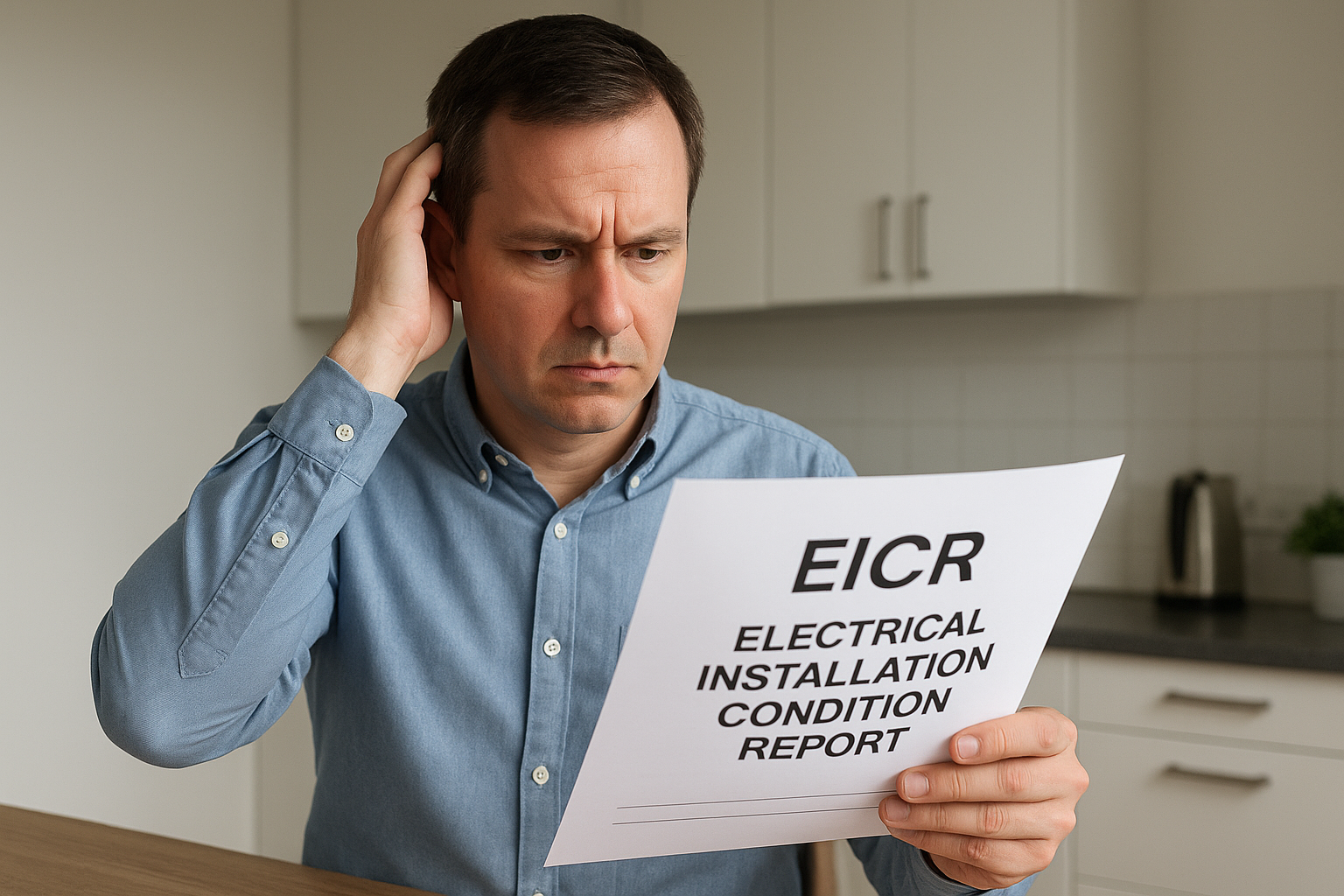
An EICR isn't a recommendation, it's the law for every private tenancy in England.
Skipping the inspection, or letting one lapse past its expiry date, exposes you to consequences that go well beyond an awkward conversation with your tenant. Local councils have real enforcement powers under these regulations, and they use them. If a council inspects your property (often triggered by a tenant complaint) and finds you don't hold a satisfactory report, they can issue a remedial notice giving you 28 days to arrange one. Ignore that notice and the fines escalate quickly.
|
Failure to comply |
Possible consequence |
|---|---|
|
No EICR in place |
Local authority remedial notice, up to 28 days to comply |
|
Ignoring a remedial notice |
Civil penalty of up to £30,000 |
|
Unsatisfactory report not actioned |
Council can arrange the work and recharge you |
|
Serious safety risk uncorrected |
Prohibition on letting the property until fixed |
Those figures aren't theoretical. Councils across London, from Camden to Croydon, have already issued five-figure penalties to landlords who ignored remedial notices, and the number of enforcement actions rises every year as awareness of the regulations spreads among tenants and housing officers alike.
The knock-on effects most landlords don't expect
Beyond direct fines, an out-of-date or missing report creates problems that ripple into other parts of your business. Insurers increasingly ask for evidence of a valid EICR before paying out on a claim involving fire or electrical damage, and a lapsed report can be grounds to reduce or refuse a payout entirely. Mortgage lenders on buy-to-let properties are also starting to request proof of compliance during remortgaging, particularly for portfolio landlords. If you use a letting agent, most reputable agencies now refuse to market a property without a current EICR on file, since they carry their own liability if something goes wrong.
Compliance also matters at the point of dispute. If a tenant raises a complaint with the council, or takes you to a tribunal over disrepair, the first document requested is almost always the electrical report. Landlords who can produce a satisfactory, in-date EICR resolve these disputes quickly. Landlords who can't often find themselves facing wider scrutiny of the whole property, including gas safety and fire precautions.
Safety is the actual point
Underneath the paperwork, the regulation exists because faulty electrics genuinely kill people. Government fire statistics consistently show electrical faults among the leading causes of accidental house fires in England, and older or DIY-modified wiring in rental stock is a recurring factor. A rental electrical safety check identifies overloaded circuits, damaged wiring, and missing earthing or bonding before they become the reason for a call to the fire brigade. Treat the EICR as a genuine safety audit rather than a box-ticking exercise, and you protect your tenants, your asset, and yourself from liability all at once. If you're weighing up whether to book an inspection now or wait for a renewal reminder, our domestic EICR in London service sets out exactly what a compliant report covers for landlords in London and the South East.
How to arrange an EICR for your rental property
Arranging a landlord electrical safety check in London is straightforward once you know what to check before you hand over a deposit. Start by choosing a certified electrician who holds a recognised qualification, ideally registered with a competent person scheme such as NICEIC or NAPIT, and ask to see evidence rather than taking a website claim at face value. Anyone can call themselves an electrician, but only a qualified inspector working to BS 7671 wiring regulations can legally sign off a report that satisfies the 2020 regulations. If your letting agent normally arranges this for you, ask them directly who carries out the work and how long they've been trading, since the liability for a poor report ultimately sits with you as the landlord, not the agent.
A cheap EICR from an unqualified tester is worse than no report at all, because it gives you false confidence.
Getting quotes matters, but comparing them on price alone is a mistake many landlords make. A rental electrical safety check should include a full visual inspection, dead testing of circuits with the power off, and live testing once the installation is confirmed safe, not a quick walk-round with a socket tester. Ask each quote to confirm what's included, how long the inspection will take on site, and whether the price covers the written report or charges extra for it.
What to have ready before the engineer arrives
A bit of preparation on the day speeds up the inspection and avoids a wasted callout charge if the engineer can't access key areas.
-
Clear access to the consumer unit, meter cupboard, and any outbuildings with electrical supply
-
A list of any known issues, past repairs, or DIY work carried out since the last inspection
-
Confirmation that tenants know an engineer is attending and roughly when
-
Copies of any previous EICR or electrical certificates for comparison
-
Keys or access codes for locked rooms, garages, or storage areas with wiring
Timing your booking around the legal deadline
Don't wait until the five-year deadline landlords have to renew an EICR is days away before you start looking for an engineer. Reputable testing firms in London get booked up, especially around the end of the tax year when many landlords renew their compliance paperwork at once. Booking six to eight weeks ahead gives you breathing room if the report comes back unsatisfactory and needs remedial work before the deadline passes. Landlords managing several properties often stagger inspection dates across the year rather than renewing everything at once, which spreads the cost and avoids a scramble every five years. If you're unsure when your current report expires, check the date printed on the last certificate, since this is the figure councils and tenants will ask for if a dispute arises. Our team handles scheduling for portfolio landlords across London and the South East, coordinating multiple properties so you're never chasing a deadline at the last minute.
What happens during an EICR inspection
Walking through an inspection helps you understand what you're paying for and why it takes as long as it does. A qualified engineer carrying out an EICR step by step works through a set sequence: visual checks first, then the installation is isolated and tested with the power off, and finally selected circuits are tested live to confirm everything behaves as it should under real conditions. This isn't a five-minute glance at the fuse board. On an average three-bedroom rental, expect the engineer on site for two to three hours, longer on older properties or those with outbuildings, extensions, or a history of DIY electrical work.
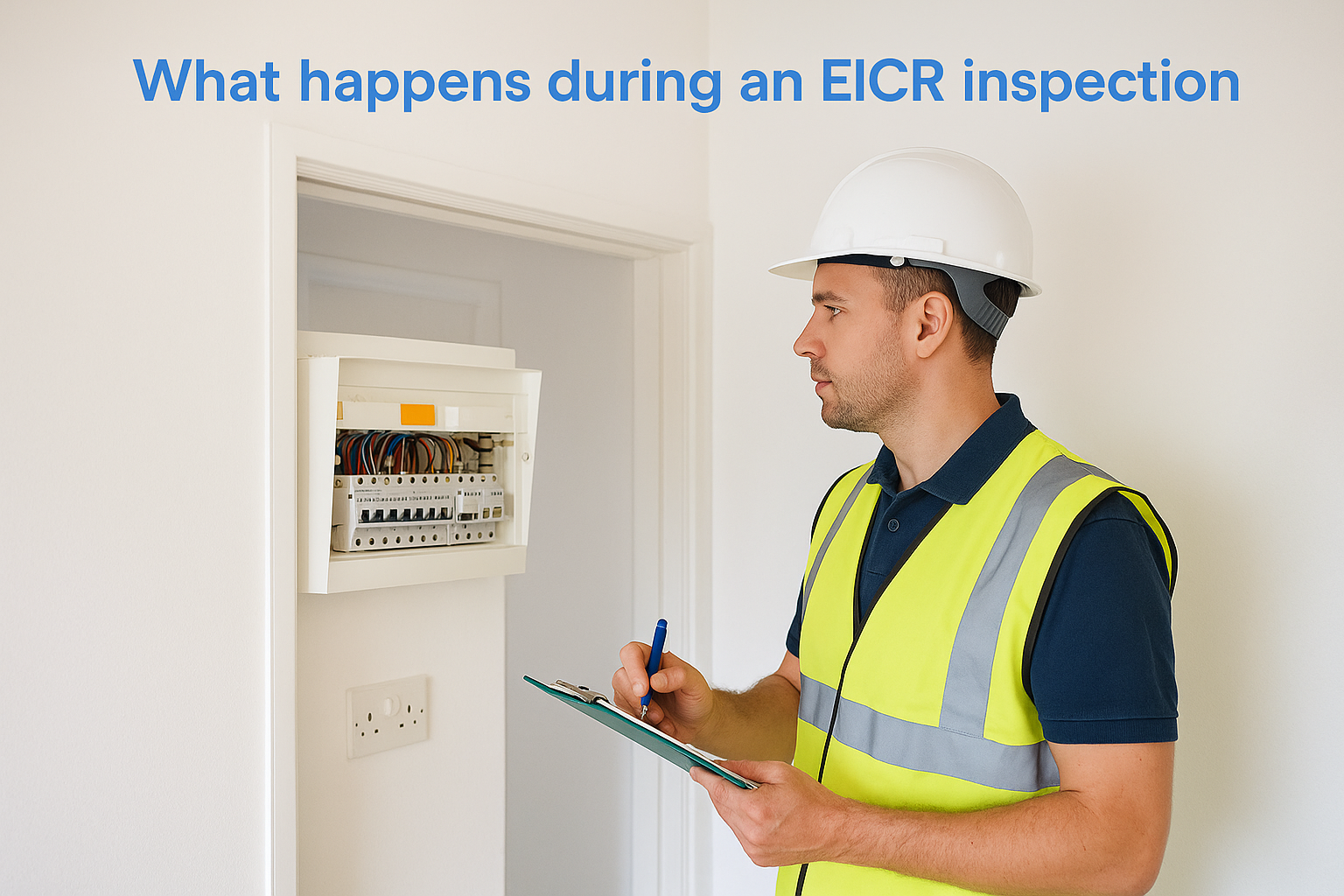
The visual inspection
Before any testing equipment comes out, the engineer walks the property checking for obvious defects: cracked sockets, scorch marks near switches, exposed cabling, and signs of previous unqualified work. They'll also check the consumer unit itself, looking at its age, the type of protective devices fitted, and whether it meets current standards for RCD protection. A rental electrical safety check at this stage often flags issues a landlord has walked past for years without noticing, since untrained eyes rarely spot the early warning signs of a failing installation.
Dead testing
With the power isolated, the engineer tests each circuit for continuity, insulation resistance, and correct polarity. This confirms the wiring itself is sound and hasn't degraded, been damaged by rodents or building work, or been wired incorrectly at some point in the property's history. Dead testing is where hidden faults surface, faults you'd never see just by flicking switches on and off.
Live testing
Once the dead tests pass, power is restored and the engineer checks earth loop impedance, RCD trip times, and that protective devices operate within the time limits set by BS 7671. This confirms the safety devices will actually cut power fast enough in a fault condition, which is the whole point of having them fitted.
The test isn't complete until the safety devices are proven to work, not just present.
What gets checked, at a glance
|
Inspection stage |
What's assessed |
|---|---|
|
Visual inspection |
Sockets, switches, consumer unit condition, visible damage |
|
Dead testing |
Circuit continuity, insulation resistance, wiring integrity |
|
Live testing |
Earth loop impedance, RCD trip times, protective device function |
|
Documentation |
Circuit schedule, observations, overall classification |
Once testing finishes, the engineer compiles their findings into the written report, recording every observation against a numbered circuit schedule and assigning a classification code to anything that falls short of current standards. That coding system is what determines whether your property passes as "satisfactory" or fails as "unsatisfactory", and it's worth understanding in detail before you receive your own report, since the codes dictate exactly how urgently you need to act.
Understanding EICR codes: C1, C2, C3 and FI
Every observation on an eicr for rented properties gets assigned a classification code, and understanding what an EICR certificate means is the difference between panicking over a minor note and correctly prioritising a genuine danger. The engineer doesn't just say "pass" or "fail", they record every defect found during the inspection against a specific code that tells you how urgent the fix is. Landlords who understand these codes can talk to their electrician with confidence, question a quote for remedial work, and avoid paying for a full rewire when a single socket needs replacing.
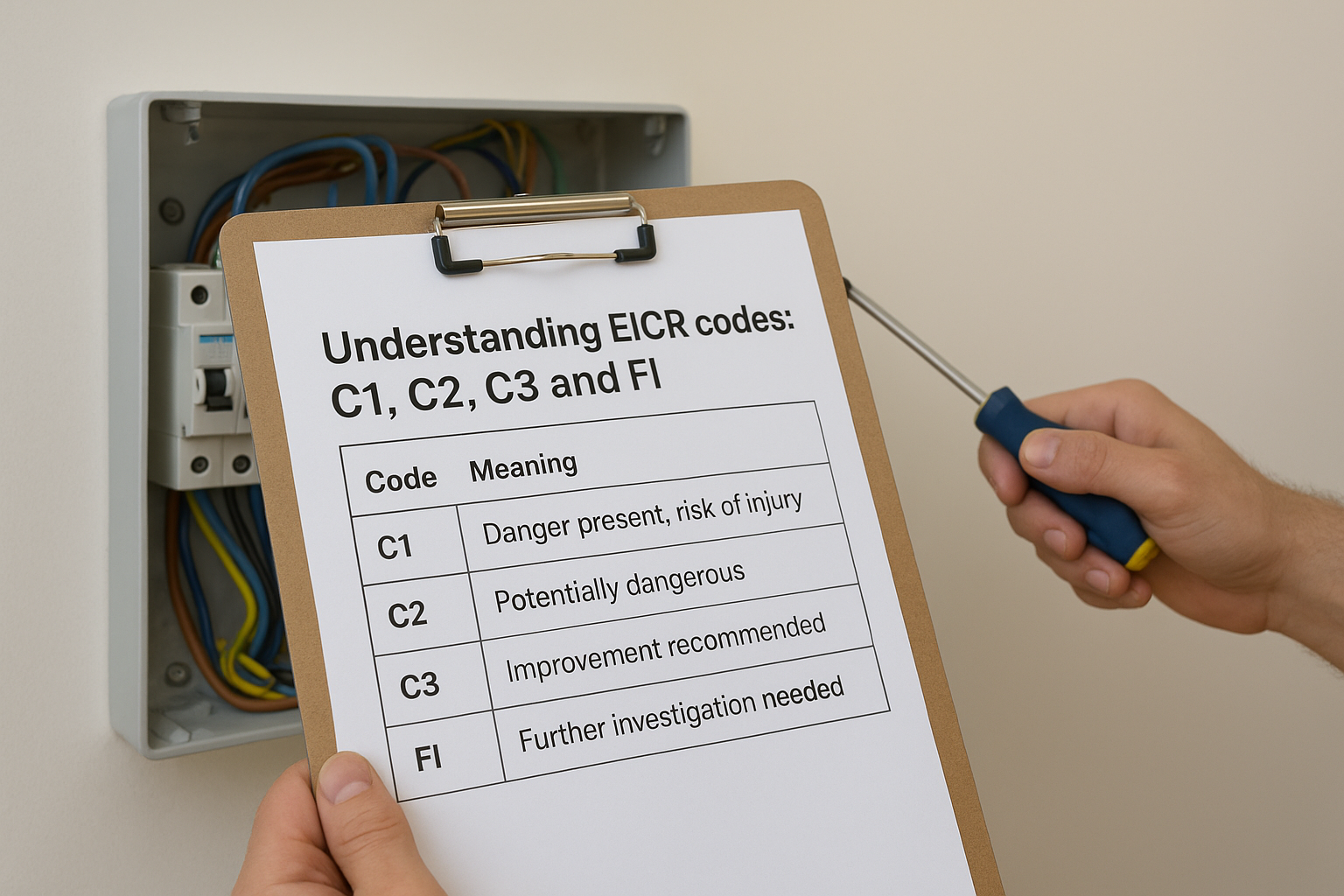
A single C1 observation makes the whole report unsatisfactory, no matter how good everything else looks.
The four classification codes explained
Four codes cover the full range of findings, from immediate danger down to a simple recommendation for improvement.
|
Code |
Meaning |
Urgency |
|---|---|---|
|
C1 |
Danger present, risk of injury |
Immediate action required |
|
C2 |
Potentially dangerous |
Urgent remedial work needed |
|
C3 |
Improvement recommended |
No legal action required |
|
FI |
Further investigation needed |
Must be carried out without delay |
C1: danger present
Code C1 means the engineer found a risk of injury right now, not a theoretical future problem. Exposed live parts, a damaged consumer unit with live conductors accessible, or reversed polarity on a socket are typical C1 findings. When this appears on your report, the engineer should isolate the danger on the spot, sometimes switching off the affected circuit before they even leave the property. Any C1 observation makes the entire report unsatisfactory automatically, and it needs fixing immediately, not scheduled for next month.
C2: potentially dangerous
Unlike a C1, a C2 doesn't present an immediate risk but could become dangerous if left unaddressed. Missing RCD protection on a circuit, inadequate earthing, or a consumer unit made from combustible material without a fire-rated enclosure are common C2 codes. This is the classification landlords encounter most often on older properties, since consumer units fitted before around 2015 rarely meet current standards for RCD coverage. A C2 also renders the whole report unsatisfactory, and you're expected to arrange the remedial work promptly, generally within a matter of weeks rather than months.
C3 and further investigation
Minor issues that don't compromise safety but fall short of current best practice get marked C3. A socket without a modern faceplate design, or cabling that meets the standard in force when it was installed but not today's guidance, are typical examples. A C3 doesn't make your report unsatisfactory and carries no legal obligation to act, though it's sensible to address recommendations over time as part of routine maintenance. The FI code sits differently again: it means the engineer couldn't confirm whether something is safe without further testing, often because access was restricted or a circuit behaved unexpectedly. Treat an FI code the same way you'd treat a C2, since leaving it unresolved means you genuinely don't know if a rental electrical safety check has actually confirmed your property is safe.
What to do if your EICR is unsatisfactory
Receiving an unsatisfactory report on your eicr for rented properties isn't the end of the world, but it does start a clock you can't ignore. An unsatisfactory result means at least one C1 or C2 code (or an unresolved FI) has been recorded, and when an EICR fails the 2020 regulations require you to carry out the remedial work within 28 days, or sooner if the report specifies a shorter deadline for a serious hazard. Landlords sometimes assume they can wait until the next tenancy changeover to sort things out. You can't. The obligation applies from the moment the report lands in your inbox, regardless of who's currently living in the property.
An unsatisfactory EICR gives you 28 days to fix the problem, not 28 days to think about it.
Getting the remedial work done
Once you know what's wrong, the priority is arranging a qualified electrician to carry out the fix, ideally the same firm that carried out the inspection, since they already understand the property's wiring history. Ask for a written quote broken down by circuit or observation so you can see exactly what you're paying for against each code. For anything marked C1, expect the work to be scheduled within days rather than weeks; for C2 findings, most competent engineers will still push to get you sorted well inside the 28-day window rather than right up against it.
Documenting the fix properly
After the work is finished, you need a follow-up certificate confirming each defect has been resolved, not just a verbal assurance from the electrician. This is usually either an updated EICR or a Minor Electrical Installation Works Certificate covering the specific circuits repaired, and it becomes the document you show a council officer or tenant if the original unsatisfactory report is ever raised again.
-
Get remedial work quoted against each individual code, not as one lump sum
-
Confirm in writing which circuits or fittings were repaired or replaced
-
Request a follow-up certificate or updated report showing satisfactory status
-
Keep both the original unsatisfactory report and the follow-up certificate on file
-
Send the follow-up certificate to your tenant and letting agent, not just the council
Telling your local council
Some councils expect landlords to notify them proactively once an unsatisfactory report is remedied, particularly if a tenant complaint triggered the original inspection. Check your local authority's private rented sector team for their specific process, since requirements vary slightly between London boroughs. Keeping a paper trail here protects you if a dispute resurfaces months later. If the remedial work uncovers something bigger, an ageing consumer unit or extensive rewiring needs, our EICR remedial works service handles the fix and the follow-up paperwork together, so you're not left chasing two separate contractors against a legal deadline.
How much an EICR costs and how long it lasts
Pricing for an eicr for rented properties varies more than most landlords expect, and the number you're quoted depends heavily on the size and condition of the property rather than a fixed industry rate. A one-bedroom flat with a modern consumer unit and straightforward wiring costs far less to inspect than a large converted house with multiple tenants, outbuildings, and decades of accumulated rewiring work. Location plays a part too, since engineers covering central London typically factor in travel time and parking that a rural inspection wouldn't need. Expect a rental electrical safety check on a standard property to take a few hours on site, and the price should reflect that time plus the written report, not just a flat callout fee.
A quote that seems too cheap usually means a rushed inspection, not a good deal.
What affects the price
Several factors push the cost up or down, and asking about each one before you book helps you compare quotes fairly rather than just picking the lowest number.
|
Factor |
Effect on price |
|---|---|
|
Number of bedrooms/circuits |
More circuits mean more testing time |
|
Age of consumer unit |
Older units often need more detailed checks |
|
Property type (flat, house, HMO) |
HMOs typically cost more due to complexity |
|
Access difficulty |
Restricted access adds time and cost |
|
Location within London/South East |
Central areas may carry a travel premium |
As a rough guide, a typical one or two-bedroom flat runs from around £100 to £150, a three or four-bedroom house from £150 to £250, and larger HMOs or commercial units considerably more depending on the number of tenants and circuits involved. Our guide to EICR certificate cost in London by property size breaks these figures down so you can budget accurately before you book, rather than guessing at what a fair quote looks like.
How long the report stays valid
Once you have a satisfactory report, how long an EICR certificate lasts is five years under the 2020 regulations for most private tenancies, though this drops to shorter intervals in specific circumstances. HMOs, for example, often need reinspection every five years too, but individual local licensing conditions can occasionally set a stricter interval, so it's worth checking your HMO licence alongside the general rule. Newer installations sometimes get a longer first interval if the engineer confirms the wiring is in excellent condition, but five years remains the standard maximum you should plan around.
Setting a reminder well before the expiry date, rather than relying on memory, saves you from accidentally letting a report lapse mid-tenancy. Many landlords we work with book their next inspection around four and a half years after the last one, giving enough time to sort remedial work if anything comes back unsatisfactory before the legal deadline actually arrives.
EICR rules and penalties across the UK
Many landlords assume the rules are identical everywhere, but the legal position for an eicr for rented properties actually differs depending on which UK nation your property sits in. The Electrical Safety Standards in the Private Rented Sector (England) Regulations 2020 apply, as the name suggests, only to England. Scotland, Wales, and Northern Ireland each run their own frameworks, with different timescales, enforcement routes, and penalties attached. If you manage properties across borders, treating one set of rules as universal is a mistake that catches out portfolio landlords more often than you'd expect.

Compliance rules change at the border, so never assume your England-based process covers a Scottish or Welsh property.
How the four nations compare
Scotland has required landlords to hold a satisfactory electrical inspection since 2015, predating England's regulations by five years, under the Repairing Standard. Wales folded electrical safety into the Renting Homes (Wales) Act 2016, which took effect in December 2022 and requires an EICR at the start of a tenancy and every five years after. Northern Ireland currently has no equivalent statutory EICR requirement for private tenancies, though landlords there still carry a general duty of care and risk civil liability if faulty wiring causes harm.
|
Nation |
Legal basis |
Inspection interval |
Enforcement body |
|---|---|---|---|
|
England |
Electrical Safety Standards Regulations 2020 |
Every 5 years |
Local authority |
|
Scotland |
Repairing Standard (since 2015) |
Every 5 years |
First-tier Tribunal |
|
Wales |
Renting Homes (Wales) Act 2016 |
Every 5 years |
Rent Smart Wales / local authority |
|
Northern Ireland |
No specific EICR statute |
N/A (best practice) |
General duty of care |
Penalties differ by nation too
England's civil penalty regime, up to £30,000 for ignoring a remedial notice, gets the most attention, but Scotland's tribunal can order a landlord to carry out repairs and, in persistent cases, refer matters for wider regulatory action against a landlord registration. Wales, through Rent Smart Wales, can suspend or revoke a landlord's registration or licence entirely, which stops you letting any property in Wales until compliance is restored, arguably a more disruptive penalty than a fine. A rental electrical safety check that's satisfactory in one nation won't automatically satisfy a different nation's regulator if you relet a property there, so keep separate compliance files per property rather than one blanket record.
What this means for cross-border landlords
If your portfolio spans London, the South East, and further afield, build a simple compliance calendar that flags which regulation applies to each address, since missing a Welsh renewal because you were tracking England's five-year cycle is an easy and costly slip. Our team works primarily across London and the South East, so if that's where your properties sit, our guide to landlord EICR certificate requirements and renewal keeps you aligned with the England-specific rules that carry the most active enforcement right now.
Handling tenant access and other common issues
Getting an engineer into the property is often the biggest practical obstacle to completing an eicr for rented properties, and it's rarely a legal problem, it's a scheduling one. Tenants have the right to reasonable notice before anyone enters their home, so you can't just turn up with an electrician and expect cooperation. Most tenancy agreements specify at least 24 hours' written notice for routine access, and giving less than that invites a refusal you have no real grounds to challenge. Building a good relationship with tenants from the start of a tenancy makes this whole process far smoother, since people who feel respected tend to accommodate a rental electrical safety check without a fight.
Access problems are almost always communication problems, not legal ones.
Getting tenants to cooperate
Sending a clear, friendly notice well ahead of the appointment solves most access issues before they start. Explain why the inspection is happening, roughly how long it takes, and that it's a legal requirement rather than an optional inconvenience you're imposing on them.
Subject: Electrical Safety Inspection - [Date] between [time]

Hi [Tenant name],

As required by law, I need to arrange an electrical safety inspection (EICR) at the property. Our engineer, [name], will attend on [date] between [time window] and will need access to the consumer unit, all rooms, and any outbuildings with wiring.

The inspection usually takes 2-3 hours. Please let me know if this date doesn't work so we can find an alternative before the deadline.

Thanks,
[Landlord name]
What to do if a tenant refuses access
If a tenant repeatedly refuses reasonable access, you still carry the legal obligation to complete the inspection, so document every attempt in writing. Send at least two further notices by email or letter, keep copies, and note dates and times of any refusal. Councils generally expect to see this paper trail if you're ever challenged over a missed deadline, and it demonstrates you took reasonable steps rather than simply letting the report lapse. In persistent cases, most tenancy agreements allow you to apply for a court order granting access, though this is a last resort most landlords never need to use.
Other common snags
Beyond access, a handful of recurring issues trip landlords up on almost every job.
-
Locked outbuildings or garages with their own electrical supply that nobody has a key for on the day
-
Multiple occupants in an HMO, where coordinating one convenient time for everyone is genuinely difficult
-
Previous DIY work by a former tenant that the current occupant knows nothing about, discovered only during testing
-
Missing paperwork from a previous landlord or agent, leaving no record of the last inspection date
Working through these snags early, ideally before the engineer's visit rather than on the day, keeps the inspection on schedule and avoids a wasted callout charge. Landlords managing several properties across London often find it easier to hand the whole coordination process, notices, rescheduling, and follow-up, to a testing firm that deals with tenant communication as a matter of routine rather than an occasional headache.
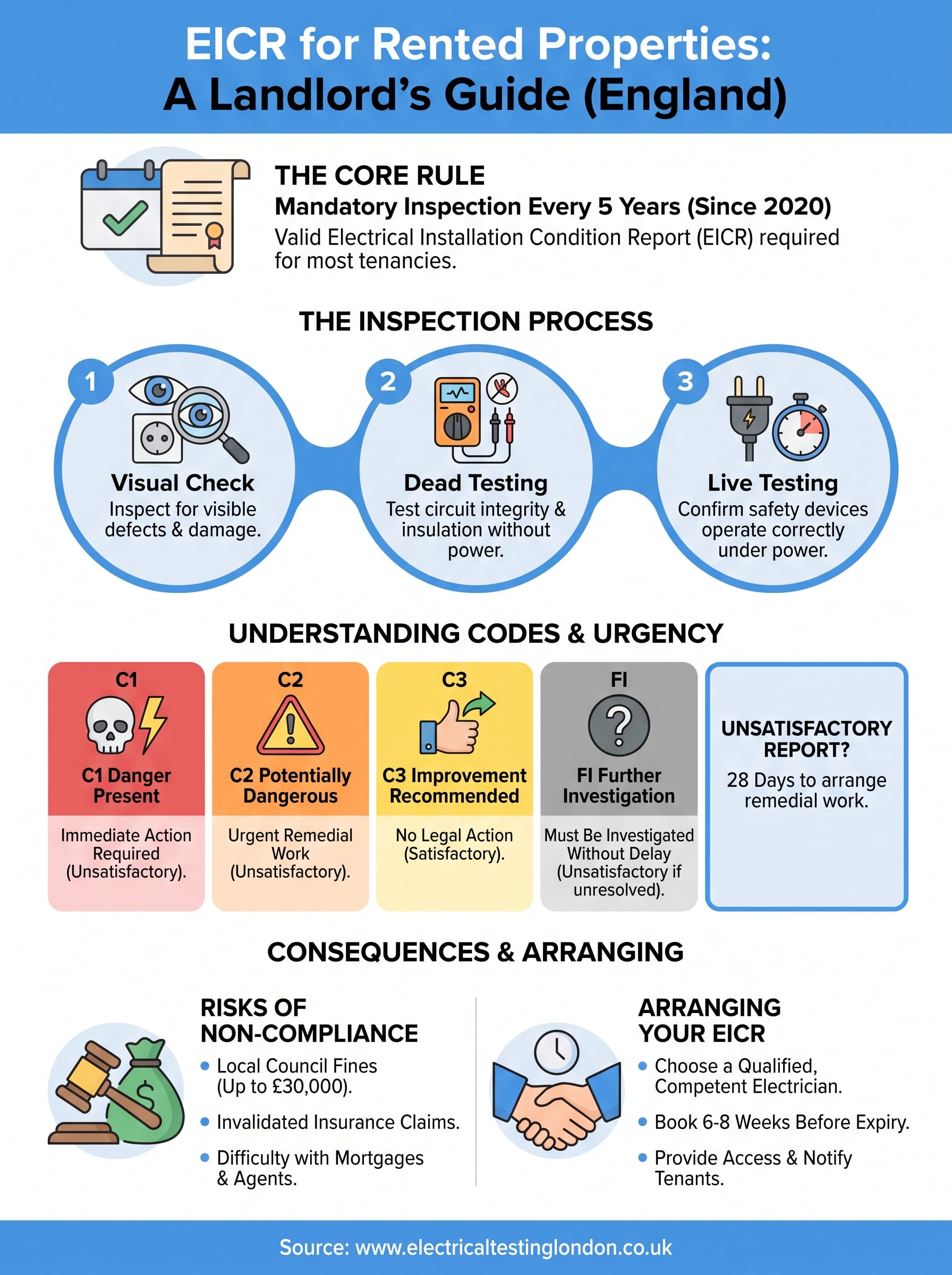
Keeping your rental property compliant and safe
Compliance with an eicr for rented properties comes down to a few basics: know your five-year deadline, book a qualified engineer well ahead of it, act fast on any C1 or C2 finding, and keep paperwork that proves you did all of this properly. Get those fundamentals right and you protect your tenants, your income, and yourself from the fines and disputes that catch out landlords who treat the report as an afterthought. Skip them, and you're gambling with sums far higher than the cost of the inspection itself.
Most landlords who fall foul of these rules didn't mean to. They just left it too late, or trusted the wrong engineer. Don't let that be you. If your rental electrical safety check is due, overdue, or you simply want a fair, transparent price before you commit, get a quote for your landlord EICR and get it sorted properly, first time.

