


EICR South London: 5 Types of Provider and Who Each Suits


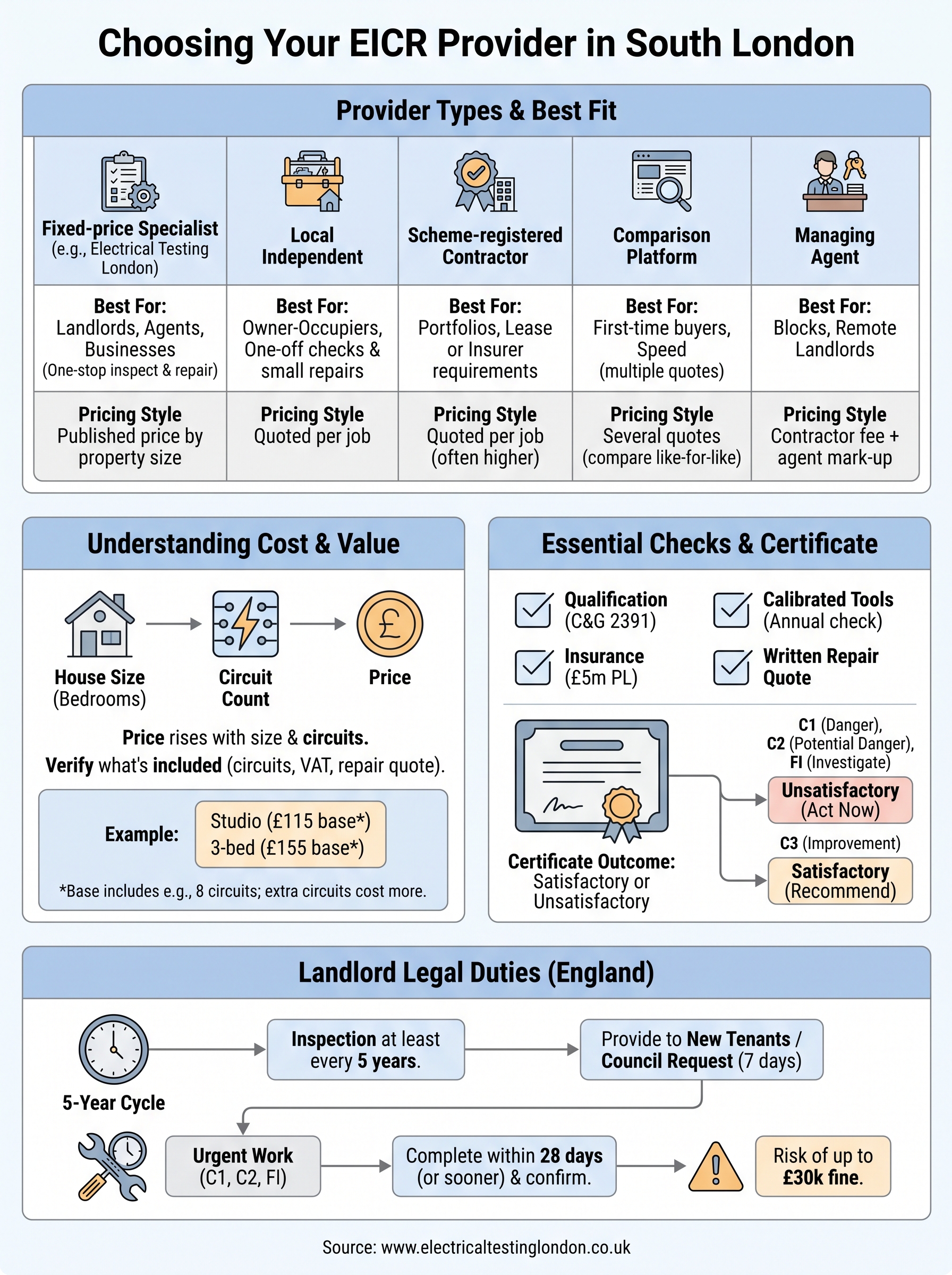
The best way to get an EICR South London is to hire an inspector who publishes a fixed price by property size, holds the right qualifications, and gives you a coded certificate plus a written quote for any repairs. Five types of provider fit that job, and each suits a different reader. A fixed-price specialist suits landlords, agents and small businesses. A local independent suits a one-off home check. A scheme-registered contractor suits you when a lease or insurer asks for one. A comparison platform suits first-timers, and a managing agent suits blocks and managed lets.
The problem is that quotes for the same inspection vary widely. Advertised prices across South London run from about £79 to £250 plus VAT, depending on the provider and the size of the property. The low figures often leave out extra circuits, VAT or the repair quote. Landlords also work to a legal deadline, so a poor choice costs time as well as money.
Electrical Testing London carries out EICRs across London, which is why it opens the list. The article then covers how each type of provider works, what you should expect to pay, and how to check a quote and the certificate before you book.
1. Electrical Testing London: fixed-price EICR specialist
How it works
An engineer inspects and tests the fixed wiring. The results then go to a Qualifying Supervisor, who checks the inspection results and defect analysis before preparing the certification. The EICR is produced electronically in the office, and any defects arrive with a quotation for rectification in the same pack. A domestic inspection typically takes 2 to 4 hours.
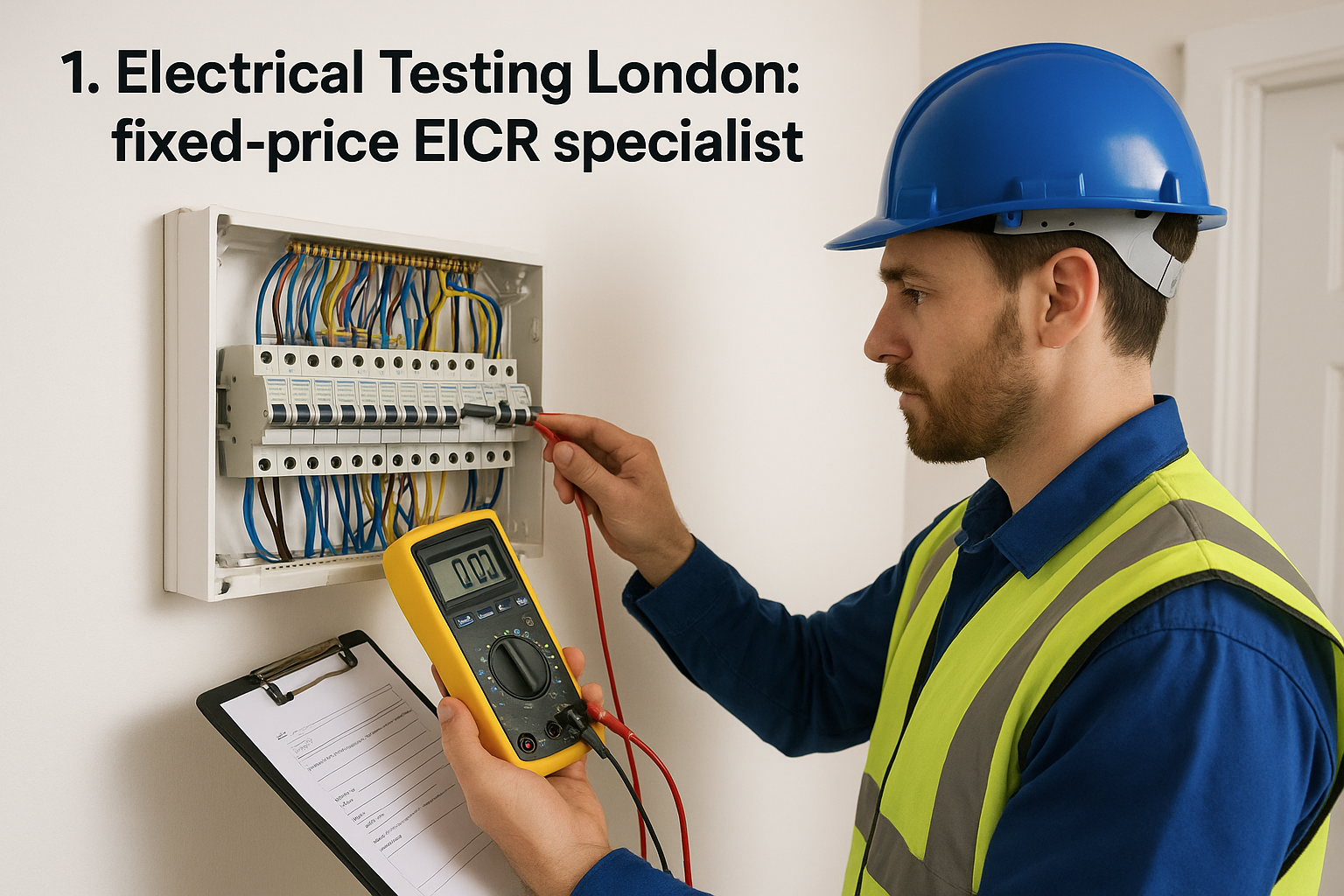
Behind the paperwork sits the equipment. Test instruments are checked monthly for benchmarking and fully calibrated every year. Inspectors and engineers each have at least 10 years of experience, and enquiries get a reply on the same day.
Who it suits
Landlords, homeowners, letting agents and commercial clients all use this route. It works best when you want one firm for the inspection and the repairs. Electrical Testing London also carries out remedial works across London and Greater London, and South London addresses sit inside that area.
-
Landlords and agents who need a certificate and a repair quote in one booking
-
Homeowners and homebuyers who want a known price before they call
-
Businesses that need a commercial EICR, backed by £5 million public liability insurance
The strongest case for a specialist is a published price and one firm that can fix what it finds.
Cost and what to check
Domestic EICR pricing starts at £115 for a studio, and the commercial EICR starts at £169 for up to 10 circuits. Prices are standardised, so the full cost is known at booking. The size-by-size table is in the cost section below.
Read the terms before you book. Cancellations need 48 hours' notice on working days. An EICR cancelled less than 5 working days before the works is charged at 26% of the quotation balance. Payment is due 7 days after completion, by cash or BACS.
2. A local independent electrician
How it works
A sole trader or small firm visits, tests each circuit and writes the findings on a standard model form. Many do EICRs alongside other jobs, so availability depends on their diary. The certificate has the same format as any other, but the quality of the inspector decides how thorough the testing is.
Who it suits
Owner-occupiers with an older home and a trusted local electrician get the most from this route. It suits one-off inspections where you also want small repairs from the same person, such as adding sockets or replacing a faulty consumer unit switch. It is a weaker fit for landlords with several properties and fixed deadlines.
A good independent is the best fit when you want one trusted person looking after the whole house.
Cost and what to check
Prices are quoted per job, so they can sit above or below a specialist's published rates. Ask for a written fixed quote that states the circuit count, whether VAT is included, and whether a remedial quotation comes with it. Then check three things:
-
A qualification in inspection and testing, such as the City & Guilds 2391 series
-
Test instruments with a current calibration certificate
-
Public liability insurance, with the cover amount in writing
3. A scheme-registered electrical contractor
How it works
Contractors on a competent person or approved contractor scheme, such as NICEIC or NAPIT, are assessed by that scheme and listed on its online register. You can verify the firm on the register before booking. The scheme normally offers a complaints route if the work falls short. Check that the registration covers inspection and testing, not only installation work.
Who it suits
Landlords with portfolios, commercial occupiers and managers of larger buildings often prefer this route. It is the obvious choice when a lease, insurer or client contract names a registered contractor. It also gives you a second party to turn to if you dispute a report.
Choose registration when someone else, such as an insurer or a lease, requires it.
Cost and what to check
Registered firms carry membership and assessment costs, so their quotes can run higher. Compare like for like by giving each firm the same circuit count and property details. Registration is not a legal condition of an EICR. The law asks for a qualified and competent person, and a registered firm is one way to show that. Ask for the inspector's own qualifications as well as the firm's badge.
4. Online comparison and quote platforms
How it works
You describe the property, including bedrooms, circuit count and access, and the platform passes the job to local traders. You then compare quotes and reviews side by side. A trade directory can return several replies within a day, which saves you phoning around.
Who it suits
First-time EICR buyers without a regular electrician get the most from this route. It also helps when you need several quotes quickly for a rental that is close to its deadline. It is less useful for a complex commercial building, where the scope needs a conversation.
Platforms save you phone calls, but only identical job details make the quotes comparable.
Cost and what to check
Quotes are only comparable if each trader prices the same job details. Two traders pricing a "3-bed house" may assume different circuit counts. Read reviews that mention EICRs specifically, because a glowing review for a kitchen rewire says little about inspection quality. Find out what vetting the platform actually carries out, and then confirm the inspector's qualifications yourself.
5. A managing agent or facilities contractor
How it works
Your letting agent, managing agent or facilities team instructs a contractor on your behalf, arranges access and passes the cost on. In a managed building, ask which areas the report covers. Your own flat or unit, the common parts and shared plant are often separate scopes. An EICR limited to one unit does not describe shared distribution outside that agreed extent.
Who it suits
Landlords who live away from their property suit this route. So do flat owners in managed blocks and businesses in multi-tenant buildings, where one person controls access to risers and boards. Name who can actually open the door on the day, because a concierge or security desk may not be able to open a riser.
In a managed building, the scope of the report matters as much as the price.
Cost and what to check
Expect a contractor fee plus an agent's charge or mark-up. Ask for an itemised invoice that separates the two. Request the full certificate and the schedule of test results, not a one-line summary. As the landlord or owner, you need the real documents if a tenant or council asks for them. Confirm in writing whether the contractor's report is addressed to you or to the agent.
What an EICR costs in South London
Domestic prices by property size
Domestic EICR prices rise with the number of bedrooms because larger homes have more circuits. Electrical Testing London's published rates are below, and each includes up to eight circuits in one property.
|
Property size |
Price |
|---|---|
|
Studio |
£115 |
|
1 bedroom |
£130 |
|
2 bedrooms |
£145 |
|
3 bedrooms |
£155 |
|
4 bedrooms |
£170 |
|
5 bedrooms |
£190 |
|
6 bedrooms |
£210 |
Extra circuits cost £15 each plus VAT. Elsewhere in South London, advertised domestic rates run from £79 to £250 plus VAT. Treat any "from" price as the cheapest case, which is usually a small flat.
Commercial pricing and a worked example
A commercial EICR from Electrical Testing London starts at £169 for up to 10 circuits, and additional circuits are charged from £10 each plus VAT. Some commercial firms instead charge per distribution board and per circuit when no earlier records exist. Ask whether your premises have a previous report, because it can shorten the job.
Two worked examples show how the figures apply:
-
A 3-bedroom house with 10 circuits: £155 base price plus 2 extra circuits at £15, which is £30 plus VAT
-
A shop with 14 circuits: £169 base price plus 4 extra circuits at the minimum £10, which is £40 plus VAT
A cheap headline price is only a bargain if it covers your actual circuit count.
How the five options compare
Use this table to match your situation to a provider type.
|
Option |
Pricing style |
Best for |
Watch for |
|---|---|---|---|
|
Electrical Testing London |
Published price by property size |
Landlords, agents, businesses wanting repairs from one firm |
Cancellation terms |
|
Local independent |
Quoted per job |
Owner-occupiers, one-off checks |
Qualifications and calibration |
|
Scheme-registered contractor |
Quoted per job |
Portfolios, lease or insurer requirements |
Registration scope |
|
Comparison platform |
Several quotes |
First-time EICR buyers |
Like-for-like details |
|
Managing agent |
Contractor fee plus agent charge |
Blocks, remote landlords |
Scope and mark-up |
How to check a quote and book with confidence
What the certificate must show
A proper EICR ends in an overall outcome of Satisfactory or Unsatisfactory, with every defect given an observation code. Check that your report uses these codes and that nothing is left vague.
|
Code |
Meaning |
Effect |
|---|---|---|
|
C1 |
Danger present, risk of injury |
Unsatisfactory, act immediately |
|
C2 |
Potentially dangerous |
Unsatisfactory, urgent action |
|
C3 |
Improvement recommended |
Does not cause a fail alone |
|
FI |
Further investigation required |
Unsatisfactory until investigated |
The certificate should list the circuits tested, the observations and the recommended date of the next inspection. Ask the firm to send a repair quote with it, so you can act on any C1, C2 or FI straight away.
A certificate without clear codes and a next-inspection date is an invoice, not a report.
Deadlines and rules for landlords
For private rented homes in England, the law requires an inspection at least every 5 years. Copies must go to new tenants before they move in, and to the local council within 7 days of a request. If the report calls for urgent work, you must complete it within 28 days, or sooner if the report says so, and confirm this in writing. Councils can fine landlords up to £30,000 for breaches. The government guidance for landlords sets out the full duties.
Owner-occupiers have no legal interval, though 10 years is the usual advice, plus a check when you buy a home. Businesses must keep installations safe under the Electricity at Work Regulations 1989. The inspector sets the next inspection date, commonly within 5 years.
A checklist before you book
Run through these points before you pay a deposit:
-
Confirm the circuit count and whether the quote includes VAT.
-
Ask who signs the report and which qualification they hold.
-
Check that the test instruments are calibrated, and ask when.
-
Get the insurance cover amount in writing.
-
Confirm that a repair quote comes with the certificate.
-
Arrange access and warn occupiers that power will be switched off briefly.
-
Read the cancellation and payment terms.
Choosing who to book
The right EICR provider in South London is the one whose price, qualifications and paperwork you can verify before the visit. A fixed-price specialist gives you the clearest cost, a local independent gives you a personal relationship, a registered contractor satisfies lease and insurer rules, a platform speeds up quote hunting, and a managing agent removes the admin. Whoever you pick, insist on coded observations, a next-inspection date and a written repair quote.
If you want a price for your property, you can request a quote from Electrical Testing London. Give your property size and circuit count, and you will see the full cost before you commit.

