






Electrical Compliance Certificate: What It Covers



If you've been asked for an electrical compliance certificate, whether by a letting agent, a mortgage lender, or your local council, you need to know exactly what you're paying for. A what does an electrical compliance certificate cover question usually comes up right before a deadline, and vague answers from a landlord forum won't cut it when your tenancy or sale depends on getting it right.
In short, this certificate confirms your electrical installation has been inspected against BS 7671 wiring regulations and records the condition of circuits, consumer units, sockets, and earthing arrangements. It's the paperwork that proves your property won't electrocute or burn down anyone using it, and it's what landlords are legally required to hold under the Electrical Safety Standards regulations.
We've tested thousands of properties across London and the South East, so this article breaks down exactly what an engineer checks, how the results get classified, and why a document you might see once every five years carries so much legal weight for landlords, homeowners, and commercial premises alike.
Why an electrical compliance certificate matters
An electrical compliance certificate isn't a formality you file away and forget. It's the legal proof that an installation has been checked by a qualified engineer and won't put anyone at risk of shock, fire, or worse. Faulty electrics cause thousands of house fires in the UK every year, and a huge proportion of those properties had never had a proper inspection. This certificate is the difference between guessing your wiring is fine and knowing it.
Landlords have a legal duty
Since 2020, every private landlord in England must hold a valid Electrical Installation Condition Report (EICR), also known as a landlord electrical safety certificate, for each rented property, renewed at least every five years. This isn't guidance you can quietly ignore. Councils can issue fines of up to £30,000 per breach, and if a tenant is injured because of an electrical fault you failed to catch, you're exposed to civil liability too. Letting agents increasingly won't market a property without one on file, and mortgage lenders on buy-to-let properties are asking for it before completion.
An electrical compliance certificate is the one document that stands between a landlord and a five-figure fine.
It catches problems before they become emergencies
Overloaded circuits, corroded connections, and missing earth bonding rarely announce themselves. They sit quietly until a fault trips a breaker, or worse, doesn't. During inspections, we regularly find:
-
Consumer units without proper RCD protection
-
Sockets on circuits carrying more load than they're rated for
-
Damaged cabling hidden behind walls or under floors
-
Missing or degraded earthing on older installations
Each of these is invisible day to day until something goes wrong. The inspection converts hidden risk into a documented, fixable list.
Insurers and buyers expect one
Home insurance policies increasingly ask whether your electrics have been tested, and a claim can be reduced or refused if an uninspected fault caused the damage. For homebuyers, a compliance certificate (or a Homebuyers Electrical Report) gives you leverage in negotiations if the report flags remedial work, and it protects you from inheriting someone else's wiring problems along with the keys, which is why the rules on an electrical safety certificate for a house sale are worth reading before you exchange.
Commercial premises face the same scrutiny
Businesses have duties under the Health and Safety at Work Act to keep electrical systems safe for staff and visitors, and insurers routinely request current EICR paperwork before paying out on any claim involving fire or electrical damage. If you manage a shop, office, or warehouse, the electrical safety certificate for commercial premises is as much a part of your compliance file as your fire risk assessment. You can see how this fits alongside our commercial EICR services for businesses managing multiple sites.
What an electrical compliance certificate covers
Every inspection follows the same structure, whether it's a two-bed flat or a warehouse unit. The engineer works through the entire installation from the consumer unit outwards, testing and recording as they go, then classifies any issues found. This is what actually gets checked during the visit, not just a quick look at the fuse box, and our full EICR checklist for UK properties sets out every item line by line.
The physical inspection
The engineer examines the consumer unit for correct RCD and MCB protection, checks every accessible socket and switch for damage or overheating, and inspects visible cabling for signs of wear, rodent damage, or unsafe DIY work. They'll also check earthing and bonding at the incoming supply, since a missing earth connection is one of the most common and most dangerous faults we find.
The testing phase
Beyond the visual check, the engineer runs electrical tests on every circuit, insulation resistance, earth loop impedance, and RCD trip times among them. These numbers confirm the wiring performs safely under fault conditions, not just that it looks fine on the surface.
A certificate that only covers a visual check isn't doing its job; the numbers from live testing are what actually prove safety.
How faults get classified
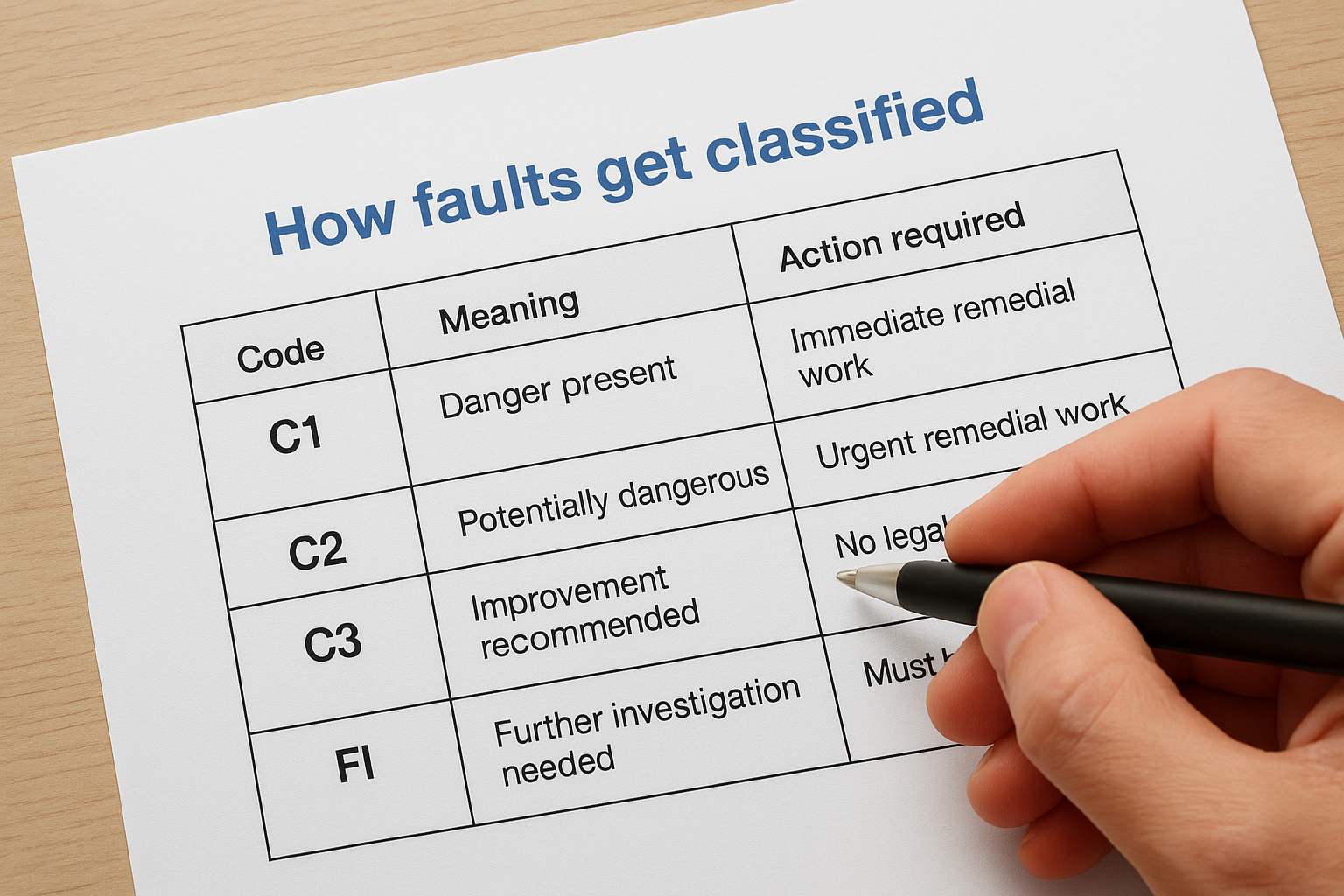
Every defect found gets a code, and this is where the report earns its legal weight:
|
Code |
Meaning |
Action required |
|---|---|---|
|
C1 |
Danger present |
Immediate remedial work |
|
C2 |
Potentially dangerous |
Urgent remedial work |
|
C3 |
Improvement recommended |
No legal obligation, but advised |
|
FI |
Further investigation needed |
Must be followed up |
Any C1 or C2 finding means the report is marked unsatisfactory, which is what triggers the legal obligation for landlords to act. This structure is why an electrical installation condition report carries far more weight than an informal once-over from an electrician.
How to get an electrical compliance certificate
Getting one sorted isn't complicated, but it does need to be done properly. You can't just ask any handyman with a multimeter to sign off your installation; the report only carries legal weight if it's produced by someone qualified to issue an electrical safety certificate.
Choosing the right engineer
Look for an engineer registered with a recognised competent person scheme, such as NICEIC or NAPIT, since this confirms they're qualified to test and certify installations under BS 7671. Ask how many years they've been inspecting properties similar to yours, whether that's a Victorian terrace, a new-build flat, or a retail unit with three-phase supply. A good engineer will also explain findings in plain English rather than handing you a report full of codes you can't interpret.
Anyone can call themselves an electrician, but only a competent person scheme member can issue a certificate that holds up legally.
What the visit involves
Booking is straightforward once you've picked a provider. Here's what to expect:
-
Access arrangements: the engineer needs access to the consumer unit, all rooms, and any outbuildings with electrics
-
Duration: a typical domestic inspection takes two to four hours; larger commercial premises take longer
-
Power interruptions: expect brief power cuts during testing, so warn tenants or staff in advance
-
Report turnaround: most providers issue the finished certificate within 24 to 48 hours
Commercial clients managing multiple properties often set up a rolling schedule so certificates don't all expire at once, which spreads the cost and avoids a compliance scramble every five years. If you'd rather not track dates yourself, our team can arrange this for you through our EICR testing services across London and the South East.
How long it lasts and what happens if it fails
Validity isn't the same for every property, and assuming your certificate covers you for another five years without checking the date is a common mistake. The electrical compliance certificate is only proof of safety for the period it states, and once that expires, you're back to square one legally.
Validity periods differ by property type
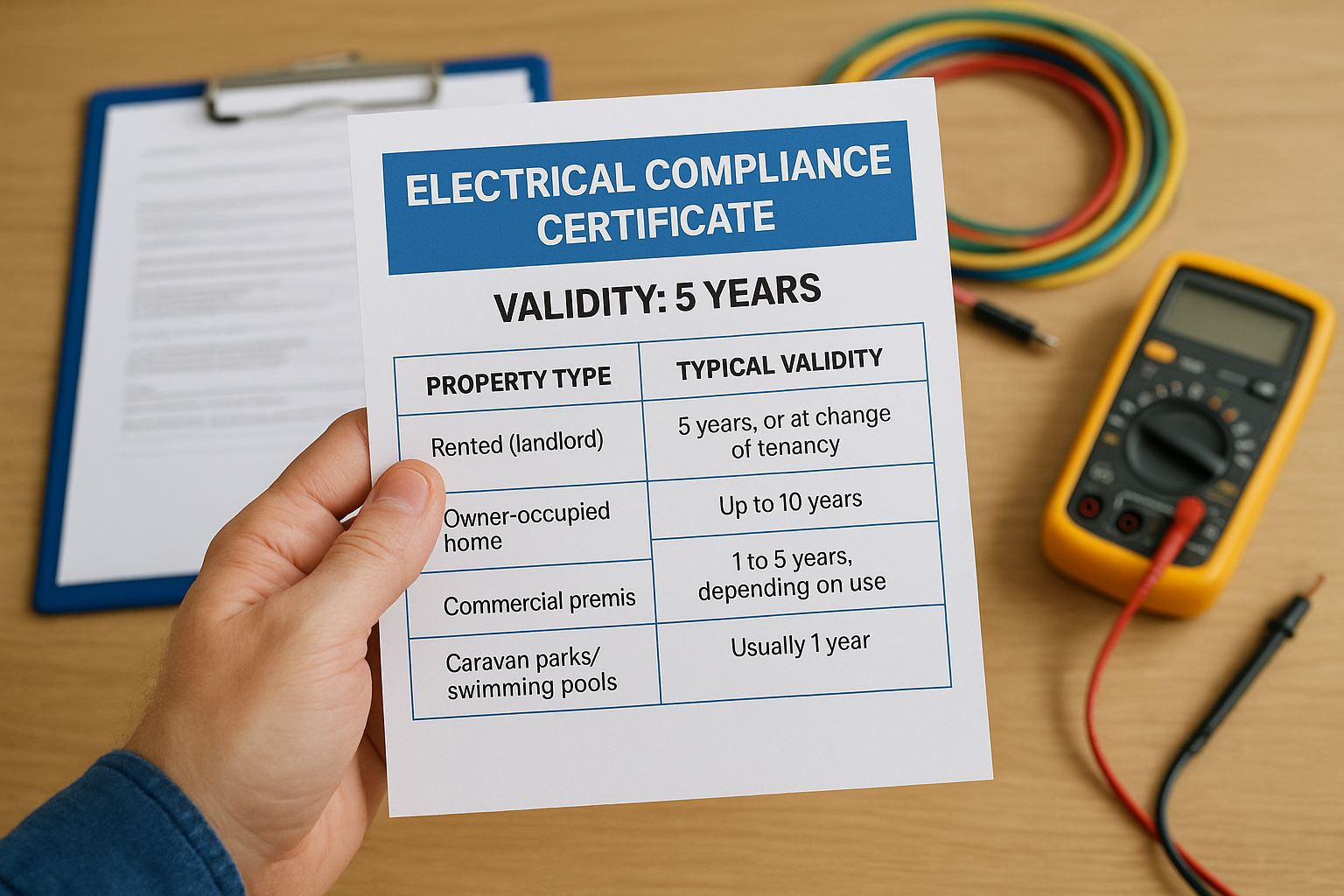
Different properties carry different timescales, so it's worth knowing how long a certificate lasts by property type and which applies to you:
|
Property type |
Typical validity |
|---|---|
|
Rented (landlord) |
5 years, or at change of tenancy |
|
Owner-occupied home |
Up to 10 years |
|
Commercial premises |
1 to 5 years, depending on use |
|
Caravan parks/swimming pools |
Usually 1 year |
Higher-risk premises get reinspected more often because equipment and usage patterns change faster than in a quiet domestic setting.
An unsatisfactory result triggers action
When an inspection turns up a C1 or C2 code, the report comes back marked unsatisfactory, and that's not a box you can leave ticked. Landlords are legally required to arrange remedial work within 28 days, or sooner if the danger is immediate, and then have the fix confirmed by a follow-up test. Skipping this step leaves you holding an invalid certificate that won't satisfy a council inspection, an insurer, or a tenant's solicitor, so it pays to understand what happens if you fail an electrical inspection.
An unsatisfactory report isn't the end of the process, it's the start of a legal countdown.
Getting the remedial work done by the same engineer who carried out the inspection usually speeds things up, since they already know exactly what needs fixing and can issue a minor works certificate once it's sorted. We handle this end to end through our remedial electrical works service, so a failed report doesn't turn into weeks of delay.
Staying on the right side of electrical safety
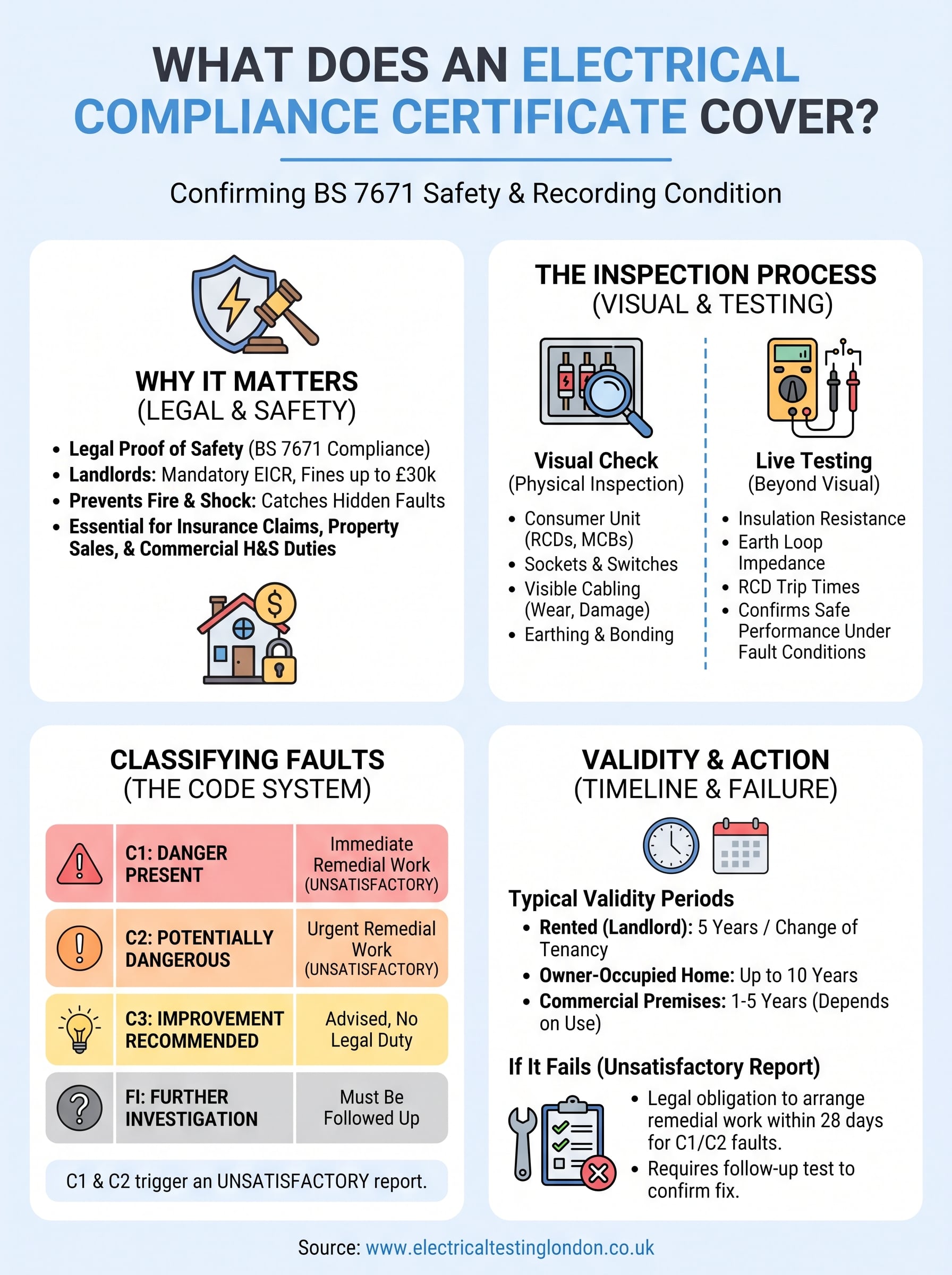
An electrical compliance certificate isn't paperwork for its own sake. It's the record that proves your consumer unit, wiring, and earthing have been tested against BS 7671 and won't put anyone at risk. Landlords face fines up to £30,000 for skipping it, homeowners lose insurance protection without one, and businesses risk their health and safety obligations if the file is missing when an inspector or insurer asks. Knowing what the inspection covers, the C1 to C3 coding system, and the validity period for your property type means you won't get caught out by a deadline you didn't see coming.
Don't wait for a letting agent or lender to chase you for one. Book an inspection while you've got time to fix any issues properly, rather than scrambling under a 28-day deadline. Request a quote from our engineers for your property today.