






Electrical Inspection Report Letter Sample: Write Yours



To write an electrical inspection report, follow the BS 7671 structure in order. Record the installation details, state the scope and limitations, code each observation, give the overall condition, and sign the declaration. Then send the report with a short cover letter. This guide gives you a copy-ready electrical inspection report letter sample and the wording for each part. You can adapt it for a home, a rented flat or a small commercial unit.
Most samples online fall short in one of two ways. Some are blank checklists with no wording. Others are generic workplace audit templates that ignore the C1, C2, C3 and FI codes used in the UK. That is a problem when a landlord, buyer, letting agent or insurer will rely on your report. A report that is vague about what was not tested also leaves the person who signs it exposed.
Below, you get the grounding first: which document is which and which sections a report needs. Then four steps, each with wording you can copy into your own document. The template shows structure and phrasing only. A competent person who has carried out the inspection and testing must complete and sign the real report.
What an electrical inspection report must contain
A UK electrical inspection report is an Electrical Installation Condition Report (EICR). It describes the condition of an existing fixed installation against BS 7671. It lists every defect with a code and ends with a verdict of Satisfactory or Unsatisfactory.
Report, letter and certificate: which is which
People use "report", "certificate" and "letter" loosely, but they are different documents.

|
Document |
Used for |
What it records |
|---|---|---|
|
EICR |
An existing installation, on a periodic check, sale or let |
Verdict, coded observations, test results |
|
Electrical Installation Certificate |
A new installation or new circuits |
That the work meets BS 7671 |
|
Minor works certificate |
A small addition, such as one extra socket |
A single-page record of the work |
|
Cover letter |
Sent with an EICR |
A plain-English summary for the client |
The cover letter explains the report but never replaces it. The EICR is the formal record, and the letter helps a non-specialist understand it.
The EICR is the record that counts; the letter only helps the client read it.
The sections your report needs
Whatever layout you use, keep these parts in this order. Most contractors use the IET model forms for BS 7671, and the order below follows the same logic. Make sure any form you use matches the current amendment of BS 7671:2018.
-
Client and contractor details
-
Reason for producing the report
-
Installation details (address, type of premises, age, earthing arrangement)
-
Extent and limitations of the inspection
-
Summary of condition and overall verdict
-
Recommendations and date of next inspection
-
Declaration and signatures
-
Schedule of observations
-
Schedule of circuit details and test results
For a home, the residential electrical inspection report also covers the consumer unit, earthing and bonding, and each circuit in the property.
Step 1. Record the details and set the scope
Start with who ordered the report, where the installation is and why you inspected it. Then state exactly what you did and did not inspect.
Record who, where and why
Fill in the identification fields before you touch a tester. Copy this block and replace the brackets.
CLIENT: [Name, address, contact]
CONTRACTOR: [Company, address, registration number]
REASON FOR REPORT: [Periodic inspection / change of tenancy / sale of property / insurance request]
DATE(S) OF INSPECTION: [dd/mm/yyyy]
INSTALLATION: [Full address, type of premises, estimated age]
EARTHING ARRANGEMENT: [TN-S / TN-C-S / TT]
RECORDS AVAILABLE: [Previous report, circuit charts, none]
Write the extent and limitations honestly
State the extent of the inspection and any limitations, because these protect both you and the client. Say what was covered, such as "all fixed wiring and accessories in the dwelling". Then list what was not, such as concealed cables, loft areas without access, or circuits that could not be isolated. Record who agreed the limits.
EXTENT: Fixed electrical installation in [areas], including the consumer unit, all circuits and accessories.
LIMITATIONS: Concealed wiring not inspected. [Loft / outbuilding / circuit] not inspected because [reason]. Limitations agreed with [name] on [date].
Say what you did not inspect as clearly as what you did.
Step 2. Record and code each observation
Every defect goes in the schedule of observations with a location, a description and one classification code. Use the code that matches the danger, not the effort needed to fix it.
Use the four classification codes
Each observation gets only the highest code that applies.
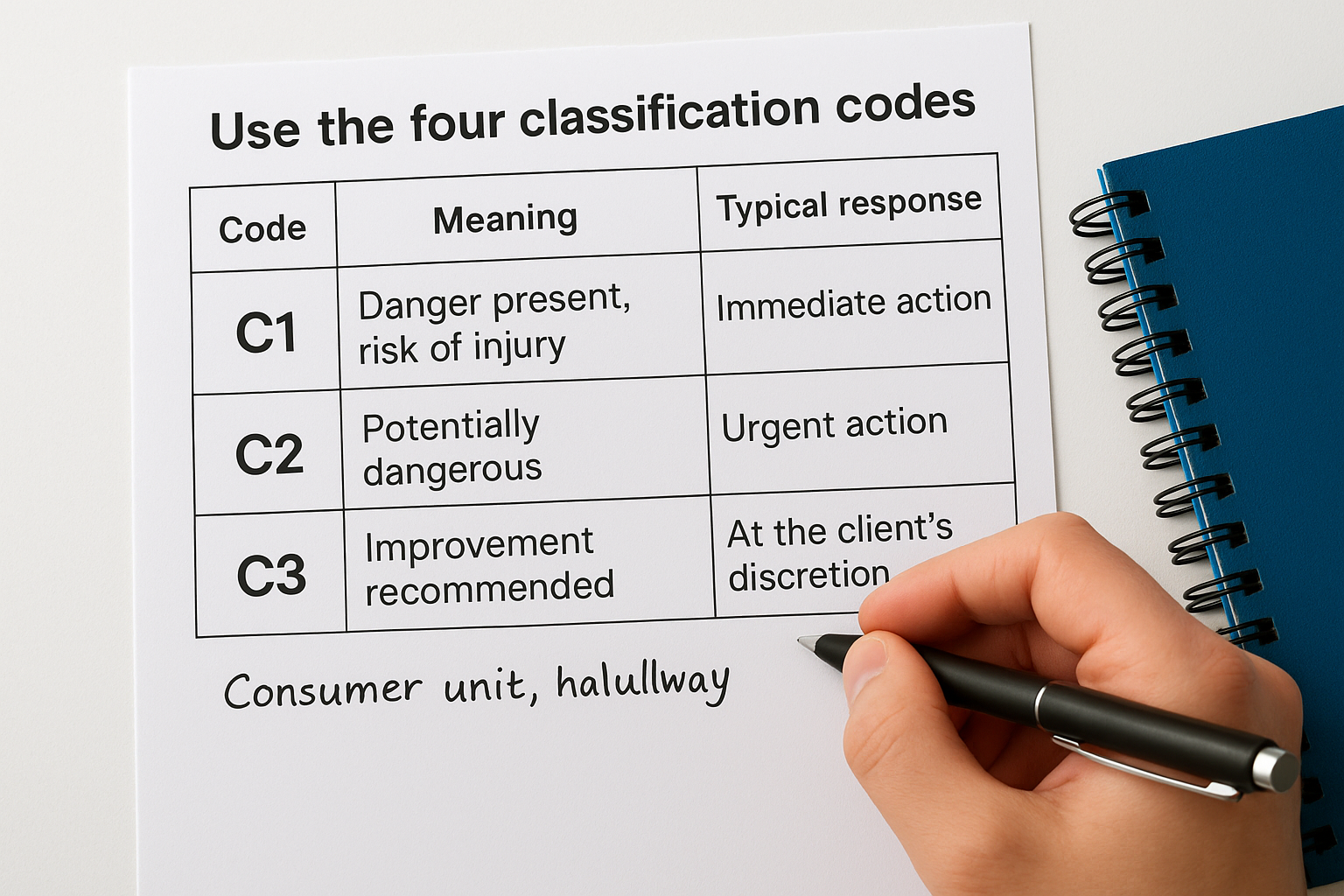
|
Code |
Meaning |
Typical response |
|---|---|---|
|
C1 |
Danger present, risk of injury |
Immediate action |
|
C2 |
Potentially dangerous |
Urgent action |
|
C3 |
Improvement recommended |
At the client's discretion |
|
FI |
Further investigation required |
Investigate without delay |
An FI code is not a failing grade. It means you could not decide on the condition without further work, so it still counts against a Satisfactory result.
Write observations someone else can act on
A good observation names the location, describes the fault and gives the code. A reader who was not there should still be able to find and fix it.
Item 1 | C1 | Cooker connection unit, kitchen | Exposed live conductors at terminals, cover missing.
Item 2 | C2 | Ground floor sockets | No 30 mA RCD protection to sockets likely to supply outdoor equipment.
Item 3 | C3 | Consumer unit, hallway | Circuits not labelled, schedule missing.
An observation without a location and a code is just a complaint.
Step 3. State the overall condition and next inspection
The overall assessment is either Satisfactory or Unsatisfactory, and your coded observations decide it. After the verdict, give a next inspection date and sign the declaration.
Reach the Satisfactory or Unsatisfactory verdict
A report is Unsatisfactory if it contains any C1, C2 or FI observation. A report with only C3 observations can be Satisfactory. Put the verdict in a short summary at the top of the report, not buried in the schedules.
OVERALL ASSESSMENT OF THE INSTALLATION: [SATISFACTORY / UNSATISFACTORY]
SUMMARY: Inspection identified [n] C1, [n] C2, [n] C3 and [n] FI observations. The installation is unsatisfactory because of items [numbers].
Set the next inspection date and declare the work
The inspector sets the interval, and the right gap depends on the property. Rented homes in England should not go beyond 5 years or a change of tenancy. Owner-occupied homes are commonly set at up to 10 years. Commercial premises are commonly 5 years or less, depending on use.
The declaration names the people responsible and the instruments used. Record each instrument's serial number and calibration date. At Electrical Testing London, test equipment is checked monthly and fully calibrated every year, and a Qualifying Supervisor checks the results before certification.
RECOMMENDED DATE OF NEXT INSPECTION: [dd/mm/yyyy]
INSPECTED AND TESTED BY: [Name, position, signature, date]
REPORT AUTHORISED BY: [Name, position, signature, date]
TEST INSTRUMENTS: [Make, serial number, calibration date]
The inspector chooses the next inspection date, based on the installation's condition and use.
Step 4. Send the report with a cover letter
Send the completed report with a one-page letter that gives the verdict, the number of defects and the action needed. Save the report as a PDF so nobody can edit it after you sign.
Cover letter sample
Keep the letter in plain English and refer to the attached report for the detail.
Dear [Client name],

Electrical Installation Condition Report: [Property address]

Thank you for instructing us to inspect the fixed electrical installation at the property above. We carried out the inspection and testing on [date] in accordance with BS 7671.

Overall assessment: [SATISFACTORY / UNSATISFACTORY]

We recorded [n] observations: [n] C1, [n] C2, [n] C3 and [n] FI. The most serious are: [one or two plain-English sentences].

Recommended action: [Items coded C1 need immediate attention and items coded C2 need urgent attention. A quotation for the remedial work is attached.]

Next inspection due: [date]

Please keep the attached report safe, as you may need to show it to tenants, buyers, insurers or a local authority.

Yours sincerely,
[Name, position, company]
Issue the report and follow up
For a rented home in England, landlords must give the report to existing tenants within 28 days of the inspection. They must give it to the local authority within 7 days of a request. If the report is Unsatisfactory, remedial work must be done within 28 days, or sooner if the report says so, and the landlord must confirm completion in writing.
Keep a copy of the report and your test records. Attach a quotation for the remedial work, as we do, so the client can act on the findings. A domestic inspection typically takes 2 to 4 hours on site.
A report only protects the client once the remedial work has been done and confirmed.
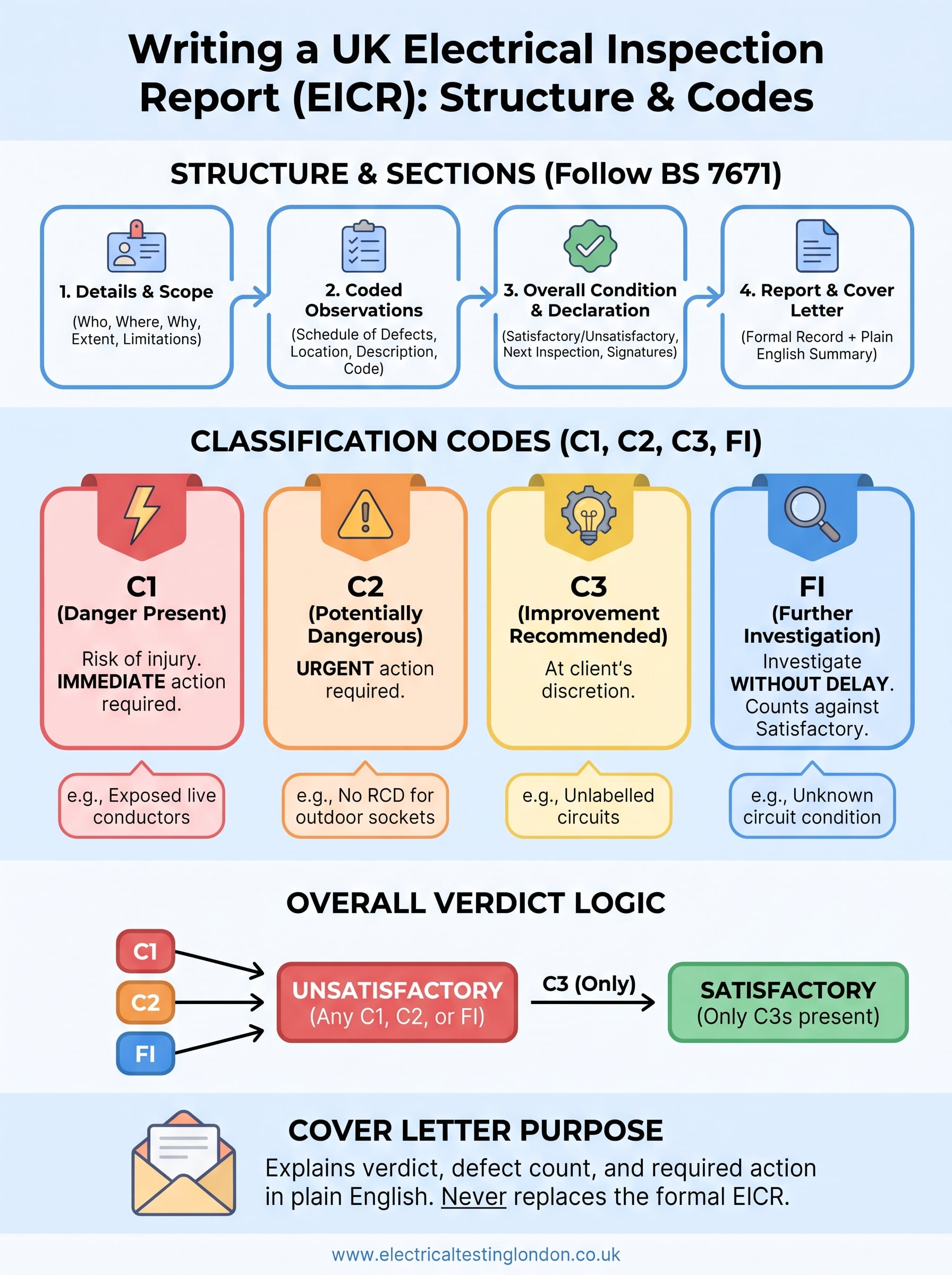
Putting the sample to work
Build the report in this order: details, scope, coded observations, verdict and declaration. Then add a cover letter that tells the client what the verdict means and what to do next. Use the code blocks as wording to adapt, and keep your own test results and observations as the substance. If you are a landlord or homeowner rather than an inspector, use the same structure to check that a report you receive is complete.
If you need an inspection carried out and certified by qualified engineers, you can request a quote for your EICR and receive the certificate with a quotation for any remedial work.