






Electrical Periodic Inspection Report: What It Covers



Section 1
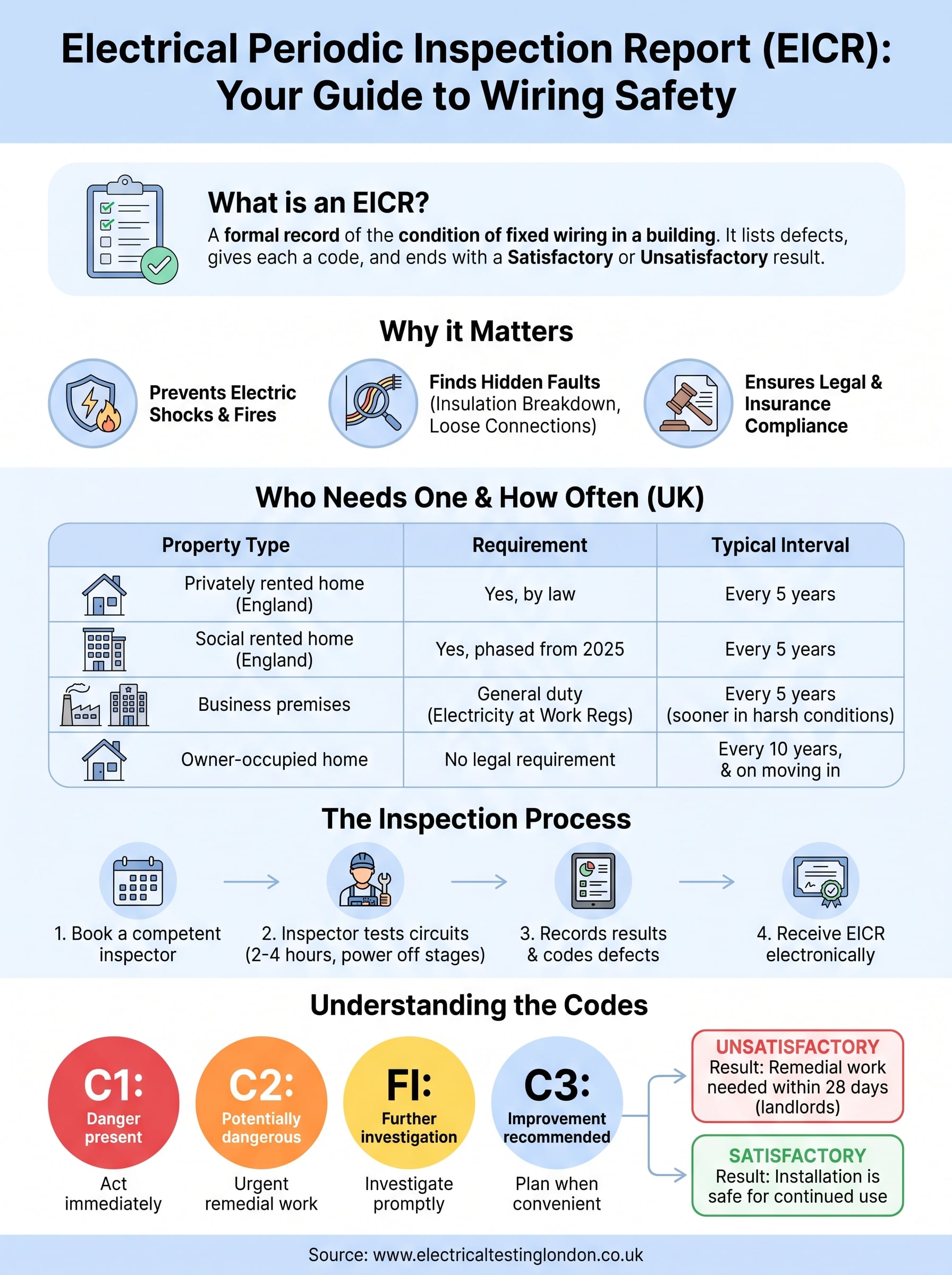
An electrical periodic inspection report is a formal record of the condition of the fixed wiring in a building, produced after a qualified electrician inspects and tests it. The document is now formally called an Electrical Installation Condition Report (EICR), though many people still say PIR. It lists any defects, gives each a code for how serious it is, and ends with an overall Satisfactory or Unsatisfactory result.
Unlike a certificate for new work, the report judges an installation that already exists. It is evidence of condition on the day of testing, not a guarantee for the future. It covers cabling, the consumer unit, sockets, switches, lighting and fixed equipment, but not plug-in appliances.
This guide explains why you may need a report, how to have one done, what the form contains and how to read the codes. We carry out these inspections for homeowners, landlords and businesses across London and the South East, so the figures and practical advice come from that work.
Why an electrical periodic inspection report matters
You need one because wiring wears out unseen, and in many cases the law or your insurer expects proof that it is safe. The report is the standard way to show it.
What the report protects you from
Cables run behind plaster, under floors and above ceilings, so you cannot see insulation breakdown, loose connections or overloaded circuits. Age, heat and past DIY alterations all take a toll. A report finds these faults before they cause an electric shock or a fire, and it checks that protective devices such as RCDs trip fast enough.
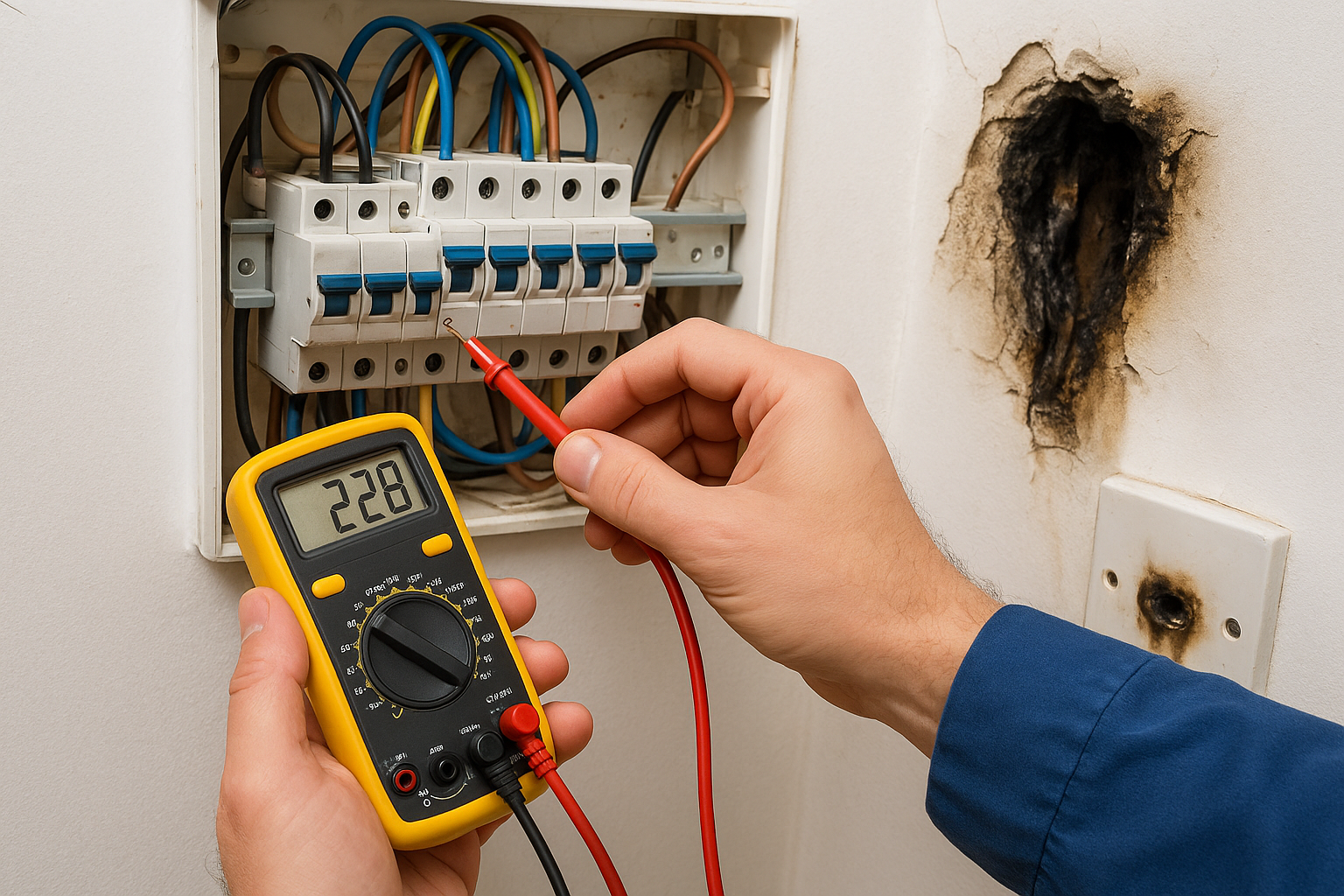
It also has practical uses. Letting agents, buyers, insurers and local authorities often ask to see a recent one, and a clean report is straightforward proof that you looked after the property.
Wiring that looks fine can still be unsafe, and only testing shows the difference.
Who needs one and how often
The requirement depends on who occupies the property. Landlords have a legal duty under the landlord electrical safety requirements, businesses have a general duty to keep installations safe, and homeowners are advised to test periodically.
|
Property type |
Required? |
Typical interval |
|---|---|---|
|
Privately rented home in England |
Yes, by law |
At least every 5 years, or sooner if the last report says so |
|
Social rented home in England |
Yes, phased in from November 2025 (new tenancies) and May 2026 (existing) |
Every 5 years |
|
Business premises |
General duty under the Electricity at Work Regulations 1989 |
Every 5 years is usual, sooner in harsh environments |
|
Owner-occupied home |
No legal requirement |
Every 10 years, and when you move in |
Book sooner if you see any of these signs:
-
Breakers or RCDs that trip repeatedly
-
Burning smells, scorch marks or warm sockets
-
Flickering lights with no obvious cause
-
A recent purchase, major alteration or change of occupier
How to get an electrical periodic inspection report done
Book a competent, insured inspector, give them full access, and allow a few hours with the power switched off in stages.
Choosing a qualified inspector
The person who signs the report must be competent to inspect and test to BS 7671, the UK wiring standard. Ask about their inspection and testing qualification, their public liability insurance and whether their instruments are regularly calibrated. Our inspectors have at least 10 years of experience, and we check our instruments monthly and calibrate them annually.
Ask for the price and scope in writing. It should state how many circuits are included, how extra circuits are charged and when you will receive the report. A fixed rate list means you know the full cost at booking.
What happens on the day
A typical visit follows five steps:
-
The inspector agrees the scope with you and reviews any previous report.
-
They inspect the consumer unit, sockets, switches, lights and visible cabling.
-
They isolate circuits one at a time for dead tests, then carry out live tests.
-
They record results and give each defect a code.
-
The certificate is checked and issued, usually electronically.
A domestic inspection typically takes 2 to 4 hours, and larger or more complex premises take longer. Clear access to the consumer unit and every room, and warn occupiers about the power cuts. If you manage tenanted homes, give tenants notice.
What it costs
Periodic electrical inspection cost depends mainly on property size and circuit count. Our domestic EICR prices include up to eight circuits:
|
Property size |
Domestic EICR |
|---|---|
|
Studio |
£115 |
|
1 bedroom |
£130 |
|
2 bedrooms |
£145 |
|
3 bedrooms |
£155 |
|
4 bedrooms |
£170 |
|
5 bedrooms |
£190 |
|
6 bedrooms |
£210 |
Extra circuits cost £15 each plus VAT. A three-bedroom house with 10 circuits is therefore £155 plus two extra circuits at £30, which is £185 before VAT on the extras. A commercial EICR starts at £169 for up to 10 circuits, with additional circuits from £10 each plus VAT.
Check how many circuits a quote includes, because that is what separates one price from another.
What the report form contains
The form follows a standard layout so that any electrician can read it. A periodic inspection report for an electrical installation always records who it is for, what was examined, what was found and who signed it off.
The parts of the form
The sections run in this order:
-
Details of the client, the installation and the purpose of the report
-
Extent and limitations of the inspection
-
Summary of the installation's condition and the overall assessment
-
Observations and recommendations, each with a code
-
Schedule of inspections, covering items such as earthing, bonding and the condition of the consumer unit
-
Schedule of circuit details and test results for each distribution board
-
Declaration signed by the inspector, and reviewed by a Qualifying Supervisor in our case
Read extent and limitations carefully. It records what was not inspected, for example a locked room or an inaccessible loft, and how much of the installation was sampled rather than fully exposed. A report is only as broad as that section says.
What is tested
The test results schedule records five main checks:
-
Continuity: wires are properly connected, with no unintended breaks.
-
Insulation resistance: insulation is intact and not breaking down.
-
Polarity: live and neutral are correctly connected.
-
Earth fault loop impedance: a fault will trip the protection quickly.
-
RCD operation: devices trip fast enough to prevent shock.
A periodic report is not an Electrical Installation Certificate, which is issued after new work and confirms that work complied with the regulations. It also excludes portable appliances, which fall under PAT testing.
The report describes the installation as it stands today, not the quality of any future work.
What the codes mean and what to do next
Each defect gets one of four EICR codes, and the codes decide the overall result. A report with any C1, C2 or FI is Unsatisfactory, while C3 observations alone still leave it Satisfactory.
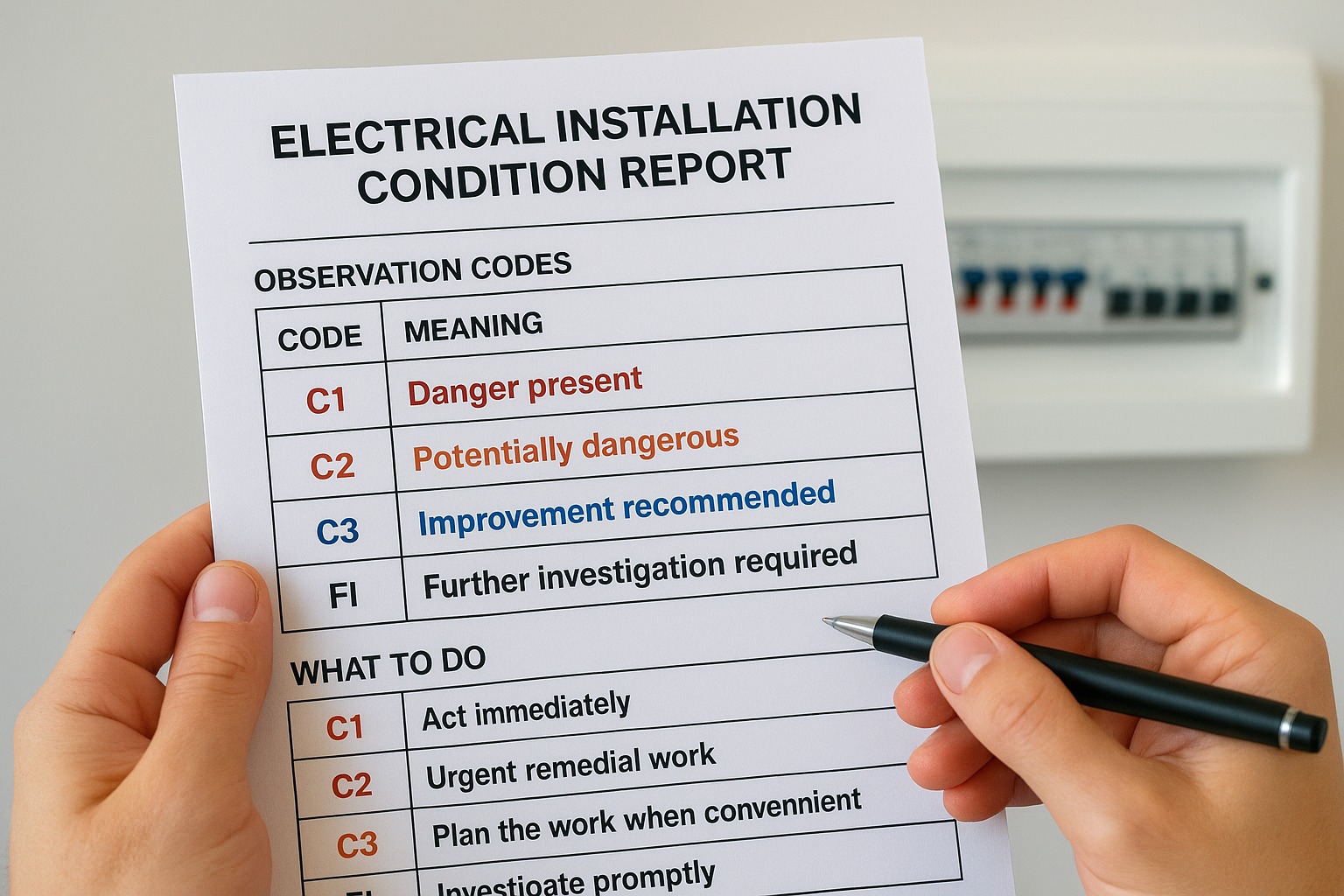
The observation codes
|
Code |
Meaning |
What to do |
|---|---|---|
|
C1 |
Danger present |
Act immediately. The inspector will usually make it safe on the spot |
|
C2 |
Potentially dangerous |
Urgent remedial work |
|
C3 |
Improvement recommended |
Not dangerous, so plan the work when convenient |
|
FI |
Further investigation required |
Investigate promptly, because safety could not be confirmed |
After an unsatisfactory report
Get a quotation for the repairs and complete them promptly. In England, landlords must carry out remedial work within 28 days of the report, or sooner if it says so. They must also give tenants a copy of the report within 28 days and written confirmation once the work is done.
We send a quotation for rectifying defects together with the certification, and our commercial EICR includes a free Satisfactory EICR after remedial work. Between full reports, a yearly thermal imaging survey, from £350 for ten distribution boards, can reveal hot spots before they become faults.
An Unsatisfactory result is a repair list, not a failure, and once the work is done you have a clean record.
Getting your report booked
An electrical periodic inspection report tells you the true condition of your wiring, rates every defect and gives you a record that landlords, owners and businesses can rely on. Check the extent and limitations, act on every C1, C2 and FI, and keep to the interval that suits your property.
If you are ready to arrange one, request a quote with your property type and the number of circuits and we will confirm the price before you book.