


Electrical Regulations UK: BS 7671 and Compliance Explained


If you own, manage, or let a property in the UK, you'll bump into the term electrical regulations UK sooner or later, usually when a tenant asks for proof of safety or an insurer wants documentation. The trouble is that the rules sit across several documents, and nobody explains them in plain English until something forces the issue.
The short answer is that BS 7671, the UK wiring standard in plain English, currently in its 18th Edition with amendments, is behind almost every compliance requirement you'll face, from landlord safety checks to new consumer unit installations. It sets out how electrical work should be designed, installed, and tested, and it underpins the EICR that lenders, landlords, and letting agents now routinely demand.
In this article, we break down what BS 7671 actually covers, how the 18th Edition amendments changed inspection and testing requirements, and what compliance looks like in practice for landlords, homeowners, and commercial premises. We draw on what our engineers see daily on jobs across London and the South East, so you get a working understanding, not just legal jargon.
Why electrical regulations matter in the UK
The real-world risks of getting it wrong
Electricity doesn't forgive shortcuts. Faulty wiring, overloaded circuits, and worn-out consumer units start thousands of house fires every year, and government fire statistics consistently link a large share of accidental dwelling fires back to electrical faults. Electrical regulations UK exist because the consequences of bad wiring aren't abstract, they're burnt-out kitchens, damaged tenancies, and in the worst cases, injuries or deaths. Our engineers see the same pattern repeat across London properties: a DIY extension lead overloaded for years, a consumer unit that's never been touched since the 1980s, or bathroom wiring installed without the right protection.
Electrical safety rules exist because faulty wiring is one of the most common, and most preventable, causes of house fires in the UK.
Legal duties for landlords and employers
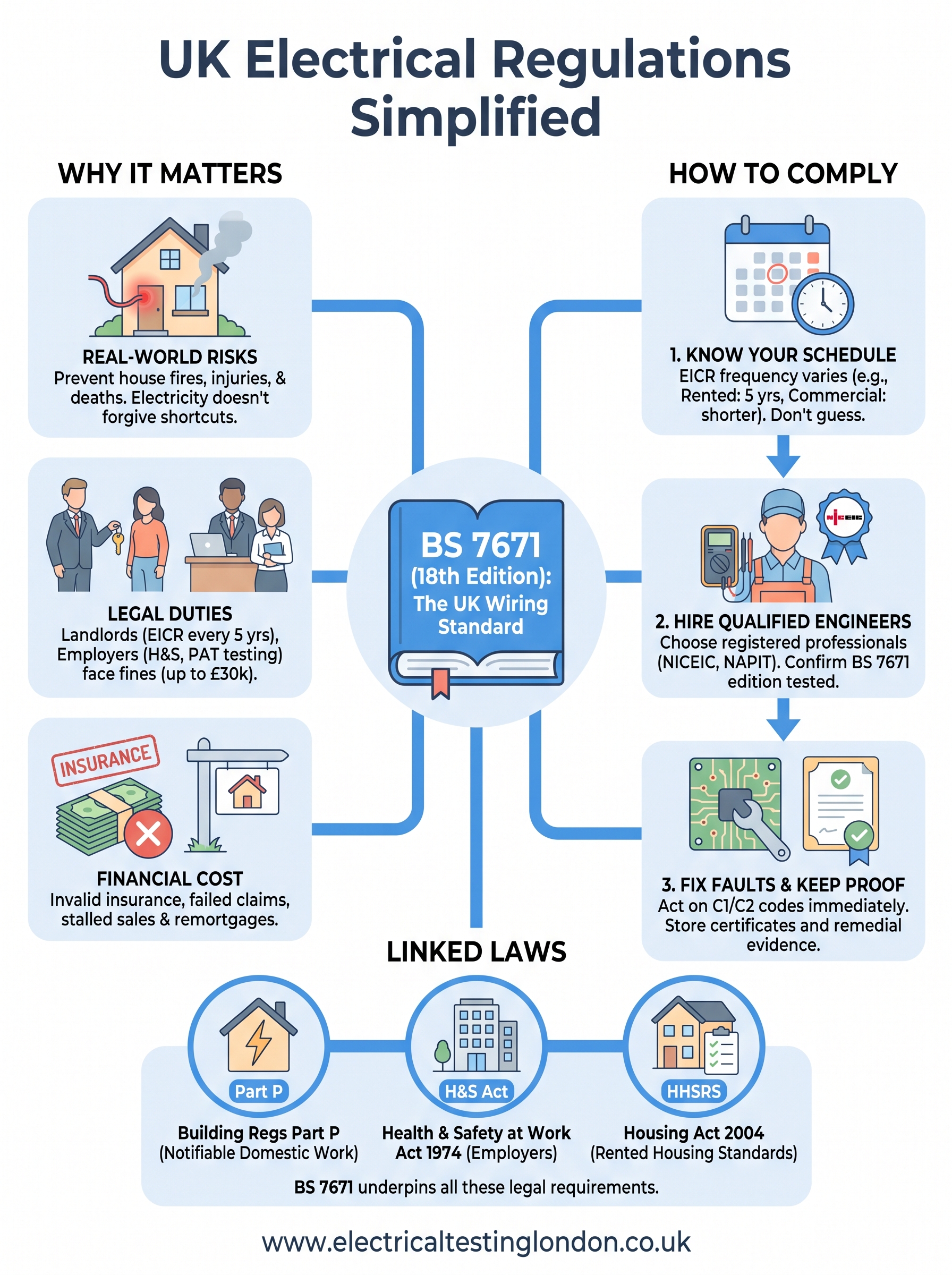
Landlords carry a specific legal duty here that goes well beyond good practice, and the landlord electrical safety regulations spell out exactly what that involves. Since 2020, England has required private landlords to have the electrical installations in their rented properties inspected and tested at least every five years under the Electrical Safety Standards in the Private Rented Sector Regulations. Ignoring that duty isn't just risky, it's illegal, and local authorities can fine landlords up to £30,000 for failing to act on enforcement notices. Employers face a parallel obligation under the Electricity at Work Regulations 1989, which requires businesses to maintain their electrical systems so they don't endanger staff or visitors, a duty that in practice gets discharged through routine EICR and PAT testing requirements schedules.
The cost of non-compliance
Money rarely gets saved by skipping the rules. Dodging an EICR might avoid a bill today, but it leaves you exposed the moment something goes wrong, whether that's a tenant dispute, a failed insurance claim, or a mortgage lender refusing to release funds on a sale. Insurance policies commonly include conditions requiring properties to meet current UK electrical safety standards, and insurers have been known to reject claims where a fire followed years of unaddressed faults that a previous report had already flagged. Selling or remortgaging a property without proof of compliance can also stall a transaction at exactly the wrong moment, often adding weeks of delay while a report gets arranged.
|
Who's affected |
Main legal driver |
Typical consequence of non-compliance |
|---|---|---|
|
Private landlords |
Electrical Safety Standards Regulations 2020 |
Fines up to £30,000, weakened tenancy defence |
|
Employers and commercial premises |
Electricity at Work Regulations 1989 |
HSE enforcement, prosecution, invalid cover |
|
Homeowners and sellers |
Building Regulations Part P, mortgage conditions |
Delayed sales, refused remortgage, void insurance |
Why the rules keep changing
Standards move because the way we use electricity keeps changing too. EV charger installation regulations, home battery storage, and smart home tech barely existed when older editions of the wiring regulations were written, so BS 7671 gets amended to address new equipment and new risks as they appear. Regulators update the rules faster than most property owners expect, which is exactly why a report that passed comfortably five years ago might flag issues today under the current UK wiring regulations. If it's been a while since your last check, our EICR testing service will tell you exactly where your property stands against the version of BS 7671 in force right now.
How to comply with BS 7671 and UK regulations
Start with the right inspection schedule
Compliance begins with knowing which checks apply to your property type and how often you need them. A rented home needs a full EICR every five years at most, commercial electrical testing frequency is often shorter depending on the environment, and anywhere with portable equipment should have a rolling PAT testing programme. Working out your own schedule isn't guesswork, BS 7671 and the accompanying guidance set how often you need an EICR by property type, so a shop unit, a warehouse, and a rented flat won't share the same timetable.
Compliance isn't a one-off certificate, it's a schedule you keep to, and missing the next date is where most landlords come unstuck.
Book a qualified engineer, not just any electrician
Hiring the right person matters as much as booking the test itself. Look for an engineer registered with a recognised scheme, such as NICEIC or NAPIT, and ask how many years they've worked on domestic or commercial installations similar to yours. A properly qualified engineer will test against the current amendment of BS 7671, not an outdated version, and will explain any C1, C2, or C3 codes on your report in plain terms rather than leaving you to interpret jargon alone.
-
Confirm the engineer's registration number before booking
-
Ask which edition and amendment of BS 7671 they're testing against
-
Request a written quote that specifies EICR, PAT, or remedial work separately
-
Check turnaround time for the report itself, not just the visit
Fix what the report flags, then keep proof
Acting on the findings closes the loop that inspection alone doesn't. An EICR that comes back with C1 or C2 codes means remedial work is required, and leaving those unresolved defeats the purpose of paying for the test in the first place. Our remedial electrical works team regularly returns to properties within days of a failed report to close out exactly these defects, then issues a follow-up certificate confirming the fix. Storing that paperwork properly, alongside your original report, is what protects you if a tenant, buyer, or insurer ever asks for evidence.
Build compliance into routine property management
Ongoing compliance works best when it's scheduled rather than remembered. Set calendar reminders well ahead of expiry dates, keep a single folder (digital or physical) for every certificate across your portfolio, and treat UK electrical regulations as part of routine maintenance rather than a box-ticking exercise triggered by a tenancy renewal or a sale falling through.
Key laws linked to electrical installation work
Building Regulations Part P
Notifiable electrical work in England and Wales falls under Building Regulations Part P for electrical installations, which requires certain jobs, such as a new consumer unit or a full rewire, to be either carried out by a registered competent person or signed off by building control. Skipping this step doesn't just risk a fine, it leaves a gap in your paperwork trail that surfaces the moment you try to sell or remortgage. Buyers' solicitors routinely ask for Part P certificates alongside an EICR, and a missing certificate can hold up completion for weeks while retrospective inspection gets arranged.
Health and Safety at Work Act 1974
Beyond the specific Electricity at Work Regulations already mentioned, the broader Health and Safety at Work Act 1974 places a general duty on employers to protect anyone affected by their business activities, including visitors and contractors, not just staff. Electrical safety sits squarely inside that duty, and the HSE treats a poorly maintained installation as a breach worth investigating, particularly after an incident. Commercial landlords and business owners who overlook this often assume their obligations start and end with an EICR, when in fact the Act sets the legal foundation that makes testing a requirement rather than a courtesy.
Housing Act 2004 and the HHSRS
Councils assess rented housing against the Housing Health and Safety Rating System (HHSRS) under the Housing Act 2004, and electrical hazards are one of the categories inspectors actively look for. A property that fails this assessment can trigger enforcement action independent of anything in the 2020 landlord regulations, giving local authorities two separate legal routes to act on the same faulty wiring.
One faulty consumer unit can breach several laws at once, which is exactly why a single EICR is worth more than most landlords realise.
|
Law |
Applies to |
What it requires |
|---|---|---|
|
Building Regulations Part P |
Notifiable domestic electrical work |
Registered installer or building control sign-off |
|
Health and Safety at Work Act 1974 |
Employers, commercial premises |
General duty to protect staff and visitors |
|
Housing Act 2004 (HHSRS) |
Rented housing |
Council assessment of electrical hazards |
Why the overlap matters
Together, these laws mean a single wiring fault can create liability under more than one statute at once. Understanding UK electrical regulations properly means recognising that BS 7671 sits underneath all of them as the technical standard everyone points back to when deciding whether an installation is actually safe.
What BS 7671 covers in practice
Design and installation rules
BS 7671 starts long before a test is ever booked. It sets the technical rules for how cables are sized, how circuits are protected, and how earthing and bonding need to be arranged so a fault trips a breaker instead of starting a fire. Wiring regulations at this level dictate practical things your engineer checks on site: whether a socket sits too close to a sink, whether cable runs are protected from nails and screws, and whether a circuit is loaded within safe limits. Get the design wrong and every later inspection will keep flagging the same underlying problem.
Inspection, testing, and the coding system
Once an installation exists, BS 7671 defines how it gets checked and reported on. EICR testing grades any defect using what the EICR codes mean, C1 for danger present, C2 for potentially dangerous, C3 for improvement recommended, and FI where further investigation is needed. This coding is what turns a technical inspection into something a landlord or homeowner can actually act on.
A C1 code means someone could be hurt right now, which is why it demands immediate action, not scheduling around a convenient date.
Special locations and higher-risk installations
Certain settings carry extra requirements because the risks are higher. Bathrooms and shower rooms are split into zones, each with rules about what equipment can sit where, and swimming pools, saunas, and outdoor installations get their own dedicated sections. EV charging installation is one of the areas BS 7671 has expanded most in recent years, requiring specific protective devices to guard against fault currents that ordinary domestic circuits were never designed to handle. If you're planning a charger at home or across a commercial car park, our EV charging installation team designs the circuit to meet the current amendment, not the version that applied when the building was first wired.
Amendments and staying current
BS 7671 doesn't stand still, and each amendment responds to new technology or evidence from real incidents. The latest edition of the IET Wiring Regulations, the 18th Edition updated through Amendment 2, tightened requirements around surge protection and further clarified how EV charging and other emerging loads should be assessed. An installation compliant five years ago can fail against today's standard purely because the standard moved, not because the wiring got worse, which is exactly why periodic testing matters as much as the original installation itself.
Making sense of your compliance duties
Getting to grips with electrical regulations UK doesn't need a law degree. BS 7671 sets the technical standard, the surrounding acts and regulations decide who must act on it, and your EICR is the document that ties everything together into something you can actually show a tenant, buyer, or insurer. Once you know which laws apply to your property and how often testing is due, compliance becomes a routine task rather than a recurring worry.
What matters now is acting on it rather than filing this away as background reading. Regular inspections catch problems while they're still cheap to fix, and a qualified engineer will keep your paperwork current against whatever amendment is in force. If your last check was years ago, or you've never had one, get a quote for an EICR and find out exactly where your property stands.

