






Electrical Safety Certificate Cost in London: What You Pay



The electrical safety certificate cost in London runs from about £115 for a studio to £350 or more for a large house with many circuits. In almost every case, the certificate is an Electrical Installation Condition Report (EICR). This is a formal inspection of a property's fixed wiring, consumer unit, sockets and earthing, and it ends in a Satisfactory or Unsatisfactory result. The price depends mainly on property size and the number of circuits the electrician has to test.
This article shows you how to work out your own figure rather than just quoting a range. You will see London prices by property size, worked examples, the factors that move a quote up or down, how to compare quotes like for like, and what you receive once the inspection is done.
Electrical Testing London carries out EICRs for landlords, homeowners and businesses across London. The domestic prices below are our own listed rates, set beside the ranges that other published London price guides give. That lets you check any quote against the market, ours included.
Why the cost of an electrical safety certificate matters
The cost matters because the certificate is a legal requirement for many people, and quotes for the same property can differ by well over £100. A landlord with a valid EICR can let a property lawfully. A landlord without one risks a fine of up to £30,000. Knowing what a fair price looks like stops you overpaying, and it stops you accepting a rock-bottom quote that hides extras.
What an electrical safety certificate actually is
"Electrical safety certificate" is a loose term. Most people searching for it mean an EICR, but three documents get called by that name, and only one is priced as an inspection.
|
Document |
What it records |
When it is issued |
|---|---|---|
|
EICR |
The condition of an existing installation after inspection and testing |
Periodic checks, new tenancies, property purchases, insurance requests |
|
Electrical Installation Certificate (EIC) |
A new installation or major alteration meets BS 7671 |
After a new circuit, consumer unit or rewire |
|
Minor Electrical Installation Works Certificate |
A small alteration, such as adding a socket to an existing circuit |
After minor work |
When people ask how much an EICR costs, they mean the inspection fee. The other two certificates come from the electrician who does the work. They are normally part of that job's price rather than a separate inspection charge.
Who has to pay for one
Private landlords in England must have the electrical installation inspected and tested at least every five years, and before a new tenancy begins. The rules come from the Electrical Safety Standards in the Private Rented Sector (England) Regulations 2020, and the government guidance sets out the detail. Tenants must receive a copy of the report, and the local authority can fine a landlord who does not comply.
Homeowners have no legal duty to hold an EICR. An inspection roughly every ten years is still sensible, and it is worth commissioning when you buy an older property and do not know the wiring's history. No law requires a seller to hand over a report, but a buyer, lender or insurer may ask for one.
Businesses must keep their electrical systems safe under the Electricity at Work Regulations 1989. Those regulations set no fixed interval, so commercial EICRs usually follow a risk assessment, commonly every five years.
Landlords have a legal deadline and a penalty attached to the EICR, so the price is a compliance cost, not an optional extra.
How to work out your EICR cost in London
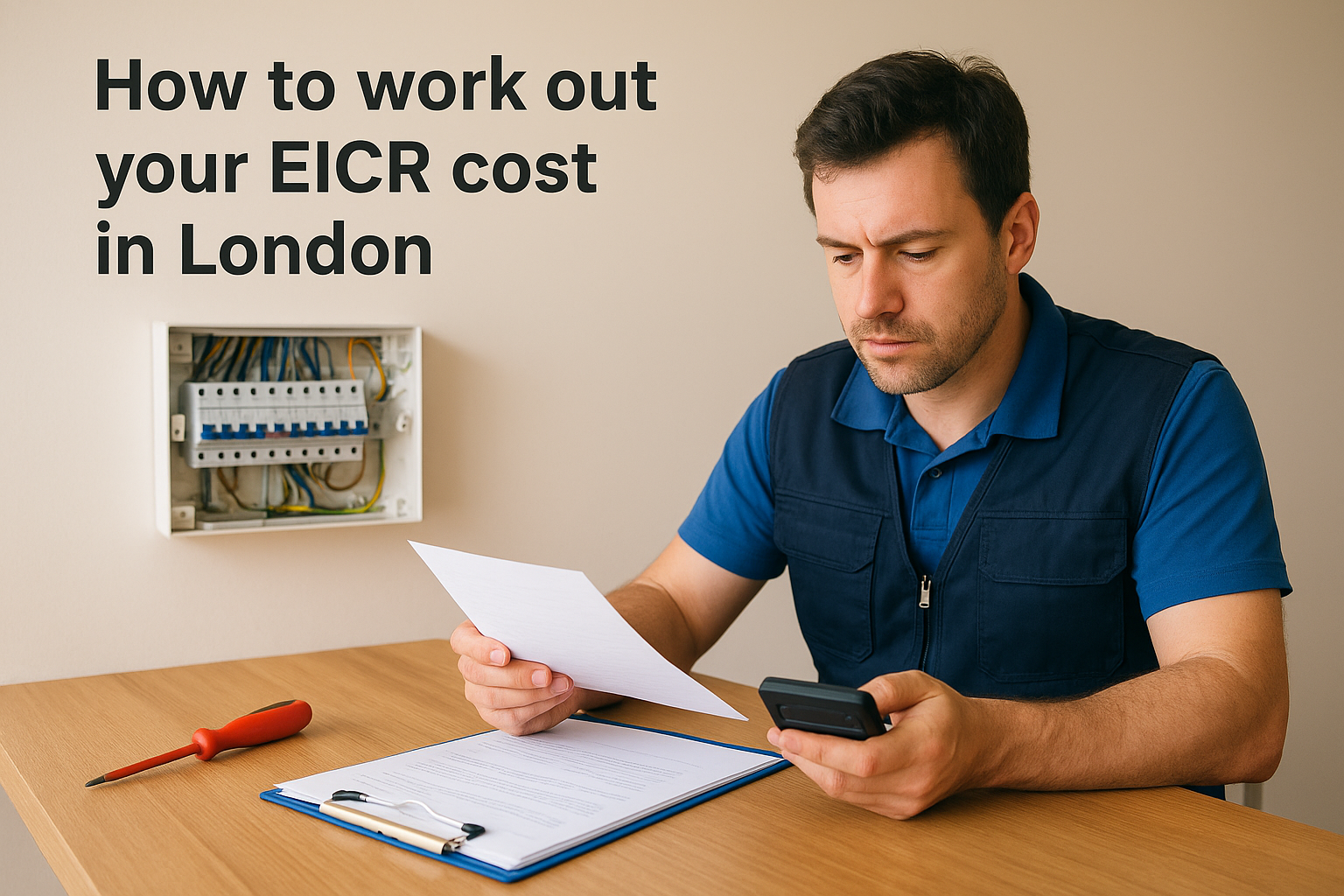
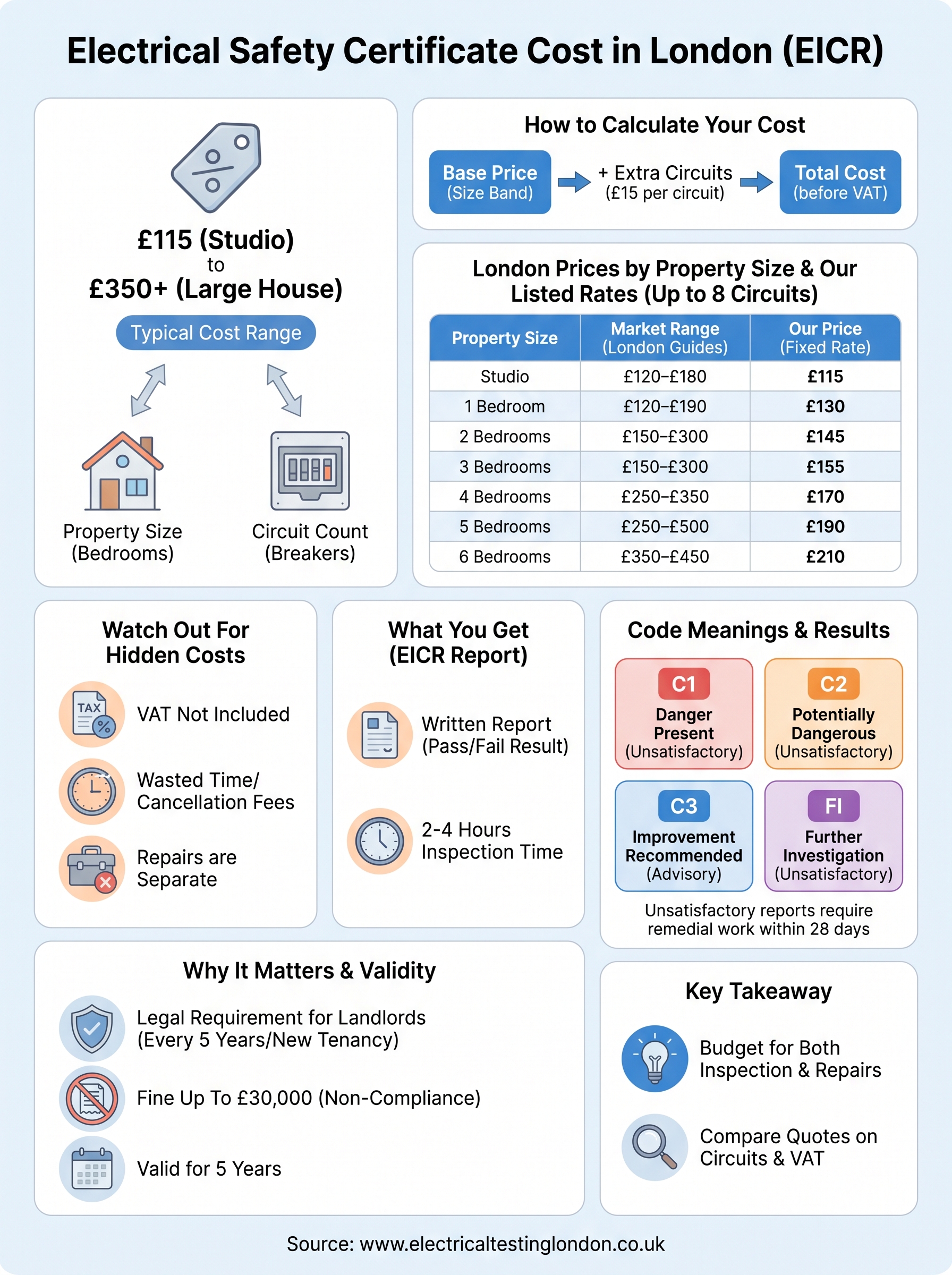
Work out your price in three moves: take the base price for your property size, count your circuits, and add a charge for any circuits beyond the allowance. Do this before you request quotes, and you will know within a few pounds what a fair figure looks like.
-
Match your home to a size band: a studio, or one to six bedrooms.
-
Count the circuits on your consumer unit. Each labelled breaker or RCBO is usually one circuit, and a second consumer unit adds its own.
-
Subtract the circuits included in the base price (eight for our domestic EICR) and multiply the rest by the per-circuit charge, which is £15 plus VAT for us.
-
Ask whether the quote includes VAT, so you compare like with like.
-
Leave repairs out. Remedial work is quoted after the inspection, not before.
London prices by property size
The table sets the ranges that published London price guides give beside our own listed domestic prices. Our prices include up to eight circuits in one property.
|
Property size |
Typical range in London price guides |
Our listed price |
|---|---|---|
|
Studio |
£120–£180 |
£115 |
|
1 bedroom |
£120–£190 |
£130 |
|
2 bedrooms |
£150–£300 |
£145 |
|
3 bedrooms |
£150–£300 |
£155 |
|
4 bedrooms |
£250–£350 |
£170 |
|
5 bedrooms |
£250–£500 |
£190 |
|
6 bedrooms |
£350–£450 |
£210 |
Nationally, guides put an average home at around £180 to £200. London guides sit higher, with some quoting £200 to £400 for London properties. Central postcodes can add a small premium for travel and parking, but the gap is usually tens of pounds, not hundreds. Our listed domestic prices sit at the lower end of these ranges or below.
Property size sets the starting price, but the circuit count sets the final one.
Worked examples
The examples below use our listed prices and the £15 charge for each circuit above eight. Circuit counts are illustrative, so count your own consumer unit before you rely on any total.
|
Property |
Circuits |
Calculation |
Total before any VAT |
|---|---|---|---|
|
2-bedroom flat |
10 |
£145 + 2 × £15 |
£175 |
|
3-bedroom house |
12 |
£155 + 4 × £15 |
£215 |
|
4-bedroom house |
14 |
£170 + 6 × £15 |
£260 |
|
Three 1-bedroom flats, 8 circuits each |
24 |
3 × £130 |
£390 |
The last row shows how a landlord with a small portfolio can budget. Each property needs its own report, so the cost multiplies by the number of properties. Meanwhile, the 4-bedroom house costs £90 more than its base price purely because of its circuits.
Commercial premises
Commercial work is priced differently, because business installations tend to have more circuits and more complex supplies. Our commercial EICR starts from £169 for up to 10 circuits, with additional circuits charged from £10 each plus VAT. A shop with 16 circuits would therefore start at £169 + 6 × £10 = £229.
Published per-circuit rates for commercial work run from roughly £10 to £50, so check which rate applies to your premises. Our commercial EICR also includes a free Satisfactory EICR once remedial work is complete.
What pushes the price of an EICR up or down
Four things move a quote: the number of circuits, the age and condition of the installation, how easily the electrician can reach everything, and the terms around the booking. Bedrooms are only a shorthand, because the electrician is really pricing the testing time.
Circuits and consumer units
Every circuit needs its own tests for insulation resistance, earth continuity and polarity, so more circuits mean more time. A flat with eight circuits costs less than a house with twenty, even if the flat has more bedrooms than you would expect. Properties with a second consumer unit, such as an annexe or garage board, add a full set of testing and records.
You can count your own circuits in a few minutes by looking at the labelled breakers. Give that number when you ask for a quote, and you avoid a surprise at the door.
Age, condition and access
Older installations take longer to inspect, especially when there are no records of previous alterations. The electrician then has to trace circuits by hand before testing them. Rewireable fuse boards, mixed cable types and undocumented DIY work all add time.
Access matters just as much. Locked rooms, a loft hatch blocked by storage or a meter cupboard nobody can open can force a second visit. Clear access on the day is the cheapest saving available to you.
Terms around the booking
Some costs sit outside the inspection itself, and they are the ones people overlook:
-
VAT: confirm whether the quoted figure includes it.
-
Cancellation: we charge 26% of the quotation balance for EICR cancellations made less than 5 working days before the scheduled works.
-
Wasted time: we charge £25.00 per hour per technician for non-productive time, such as waiting for access.
-
Late payment: our payment terms are 7 days from job completion, with an admin fee on overdue amounts.
Every provider has terms like these. Ask to see them before you book, not after.
Count your circuits and confirm access before you ask for a quote, and you will remove most of the guesswork from the price.
How to compare EICR quotes and spot bad value
A fair comparison starts with identical scope. Two quotes of £150 and £220 are not comparable until you know how many circuits each includes, whether VAT is added, and who carries out the testing. Set them side by side with a short checklist.
What a like-for-like quote states
Ask each provider for the following in writing:
-
The number of circuits covered in the price, and the charge for each extra one.
-
Whether the price includes VAT.
-
Who will inspect, and their qualifications and experience. Ours are fully qualified, with at least 10 years of experience.
-
Confirmation that testing follows recognised standards, such as the IET Code of Practice that we work to.
-
The format of the report, and how quickly you will receive it.
-
Public liability insurance. We carry £5 million.
-
The cancellation and waiting-time terms.
A provider with standardised pricing can give you the full cost at booking. That is a sign of a business that has thought through its jobs, rather than one that adds charges on the doorstep.
Red flags that signal poor value
A headline price well below the market, such as under £100 for a whole property, deserves a question. A proper inspection takes hours, so ask what has been left out. Common answers are a tiny circuit allowance, VAT added later, or a rushed visit that skips testing.
Other warning signs include pressure to book on the spot, no clear statement of who will do the work, and vague wording on what the report covers. A trustworthy provider is happy to explain all of it.
Repairs: the cost the certificate does not include
The inspection fee covers testing and the report. Repairs are separate, because nobody knows what the testing will find until it is done. Published UK guides put electrician rates at roughly £40 to £70 an hour, so a single fix is often modest. Several defects on an old installation can add up.
We provide a quotation for remedial works to rectify any defects together with the certification, so you see the repair cost when you receive the report. You can accept it, or use another electrician. Either way, keep a budget for repairs if the installation is old.
Compare quotes on circuits, VAT, qualifications and terms, and the cheapest headline figure often stops looking cheapest.
What you receive after the inspection
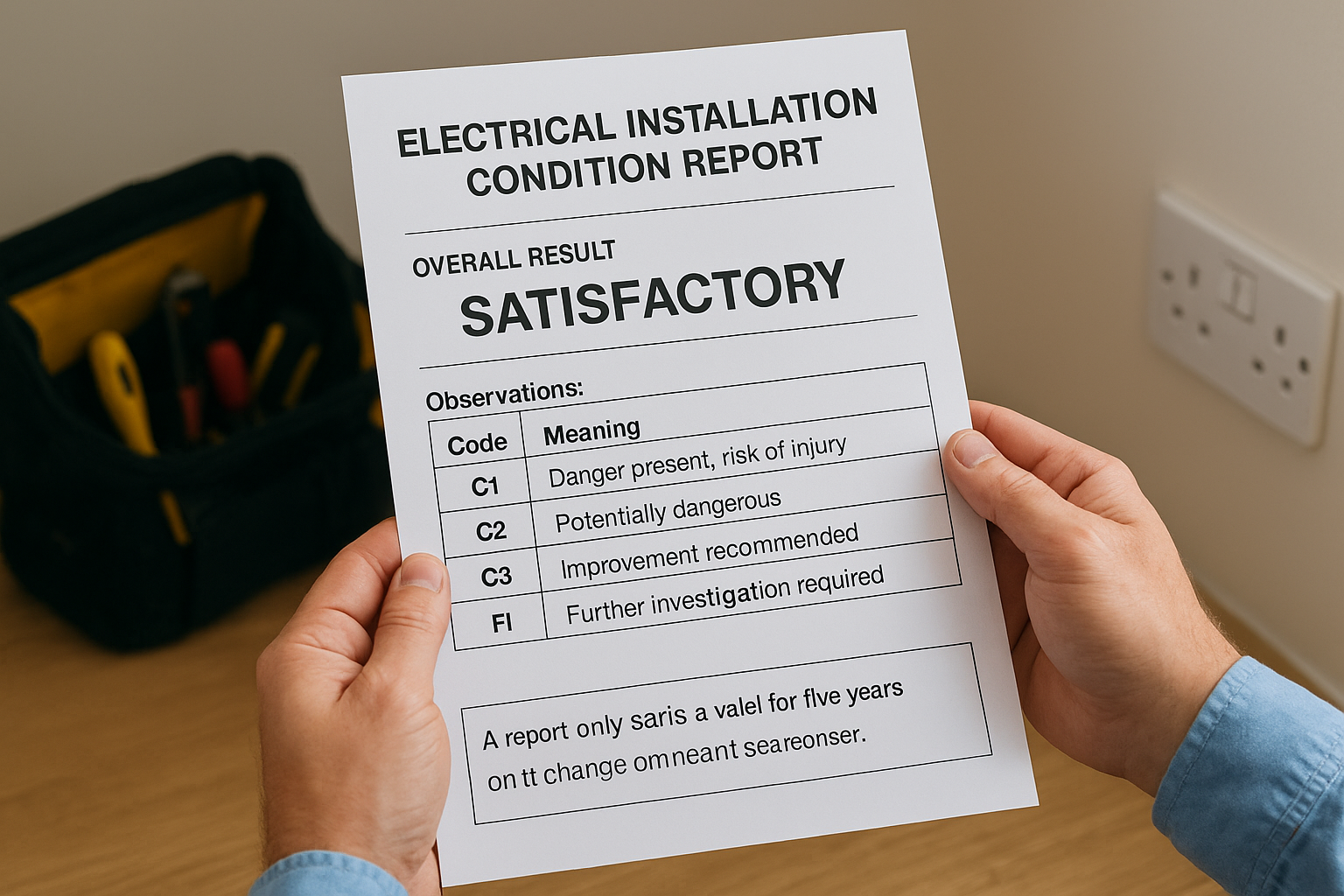
You receive a written report with an overall result and a coded list of observations. A domestic inspection typically takes 2 to 4 hours, and the report follows once our Qualifying Supervisor has checked the results and defect analysis. The result tells you whether you are compliant, and the codes tell you what to fix.
How to read the result and the codes
Each observation carries a code, and the codes decide the overall result.
|
Code |
Meaning |
Effect on the result |
|---|---|---|
|
C1 |
Danger present, risk of injury |
Unsatisfactory |
|
C2 |
Potentially dangerous |
Unsatisfactory |
|
C3 |
Improvement recommended |
Does not on its own cause a fail |
|
FI |
Further investigation required |
Unsatisfactory until resolved |
A report with any C1, C2 or FI is Unsatisfactory. For landlords in England, the remedial work must be completed within 28 days, or sooner if the report says so. You then send written confirmation of the completed work to the tenant and the local authority. After the repairs, a new Satisfactory report closes the issue.
How long the certificate lasts
A domestic EICR is valid for five years, or until a change of tenancy, whichever is sooner. For rental properties, that matches the legal interval. Owner-occupiers have no expiry date, but a lender or insurer may still prefer a recent report.
Landlords must give tenants a copy of the report, and the local authority can request one. Keep a digital copy where you can find it, and diarise the next inspection well before the five years run out.
A report is only as useful as the actions it triggers, so budget for the repairs as well as the inspection.
Your next step for a London EICR
The electrical safety certificate cost in London comes down to three numbers: your property size, your circuit count and whether VAT is included. Use the worked examples to build your own total, compare quotes on the same basis, and treat a price far below the market as something to question, not a bargain to grab. Keep a repair budget, especially for an older installation.
When you are ready for a firm figure, request a quote with your property type and circuit count. We respond to enquiries on the same day, and you can also call us on 0207 112 5379 from Monday to Friday, 9am to 5:30pm.