


Electrical Safety Check for Landlords: Rules, Costs and EICR


If you rent out property in England, an electrical safety check for landlords isn't optional. It's a legal duty under the Electrical Safety Standards in the Private Rented Sector Regulations 2020, and getting it wrong can mean fines of up to £30,000. Yet plenty of landlords still aren't sure exactly what's required, how often, or what a competent electrician actually checks during an inspection.
This article answers those questions directly. You'll learn what the EICR (Electrical Installation Condition Report) covers, the legal inspection interval, what happens if your property fails, and roughly what you should expect to pay for compliance in London and the South East.
We've written this from the perspective of engineers who carry out these inspections daily across rented properties, from single flats to multi-unit portfolios. Below, we cover the rules in plain terms, break down realistic costs, and explain how to get your certification sorted without unnecessary delays or disruption to your tenants.
Why electrical safety checks matter for landlords
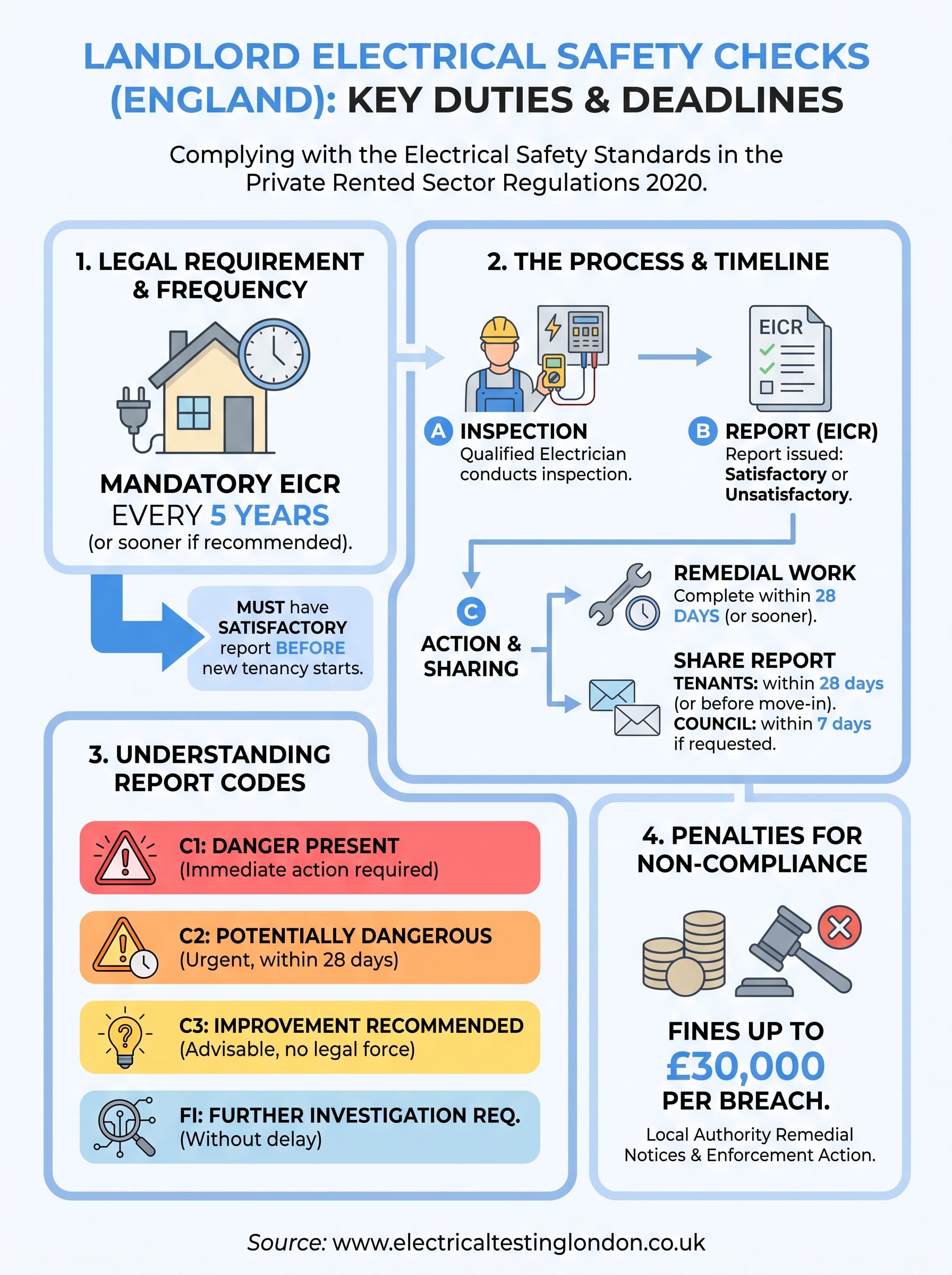
Since 2020, the EICR regulations for landlords in England have made a valid EICR a legal precondition for letting a property in England. You can't hand over keys, renew a tenancy, or advertise a rental without one. The rules apply to almost every type of tenancy agreement, including houses in multiple occupation (HMOs), assured shorthold tenancies, and lodgers renting a room within an owner-occupied home. Local authorities enforce the regulations, and they have real teeth: they can demand remedial work within 28 days and issue civil penalties of up to £30,000 per breach if a landlord ignores the notice.
The legal duties you can't ignore
Understanding what the law actually requires helps you avoid falling foul of it by accident. Landlords in England must:
-
Have the electrical installation inspected and tested by a qualified electrician at least every five years, or sooner if a previous report recommends it.
-
Obtain a satisfactory EICR before a new tenancy starts.
-
Supply a copy of the report to existing tenants within 28 days of the inspection, and to new tenants before they move in.
-
Provide a copy to the local authority within 7 days if requested.
-
Carry out any remedial work flagged as urgent (classified C1 or C2 on the report) within 28 days, or sooner if the report specifies.
Skipping a landlord electrical safety check doesn't just risk a fine, it risks a fire, a shock, or an invalid insurance claim when you need it most.
What happens if you don't comply
Non-compliance carries consequences well beyond the immediate legal exposure. Local councils can and do issue remedial notices, and failure to act on one escalates quickly to financial penalties. Beyond the regulatory side, an out-of-date or missing EICR can derail a property sale, complicate a mortgage application, and give tenants legitimate grounds to withhold rent or pursue a claim if something goes wrong electrically.
|
Situation |
Typical Consequence |
|---|---|
|
No EICR at start of tenancy |
Council improvement notice, penalty up to £30,000 |
|
Ignoring urgent remedial work (C1/C2) |
Escalating enforcement action, potential prosecution |
|
Invalid or expired report at renewal |
Tenancy technically non-compliant, insurance risk |
|
Report withheld from tenant |
Breach of duty, possible rent repayment order claim |
The safety risks behind the paperwork
Regulation aside, the underlying purpose of an electrical safety check for landlords is preventing genuinely dangerous outcomes. Faulty wiring is one of the leading causes of accidental house fires in the UK, and older rental stock, particularly Victorian and Edwardian conversions common across London, often hides ageing consumer units, degraded insulation, or DIY wiring from previous occupants. Testing catches these issues before they become emergencies, protecting tenants and safeguarding your investment. Government guidance from the Health and Safety Executive backs this up: electrical faults contribute to thousands of domestic fires annually, most of which are entirely preventable with routine inspection.
How to arrange an EICR for your rental property
Arranging a landlord electrical safety check in London doesn't need to be complicated, but it does need to be done properly. Start by booking with a registered electrician, ideally one certified through a recognised scheme such as NICEIC or NAPIT, since local authorities can reject reports from unqualified testers, and it's worth knowing how to choose a certified electrician before you commit. At Electrical Testing London, our engineers hold at least ten years of hands-on experience with rental properties across London and the South East, so we know exactly what inspectors and councils expect to see on a compliant report. You can request a quote for EICR testing directly through our site, and we'll confirm availability within one working day.
Booking around tenants
Giving tenants proper notice matters just as much as picking the right electrician. Most tenancy agreements require at least 24 hours' written notice before an inspector can access the property, so build that into your timeline rather than trying to arrange same-day access. A typical domestic inspection takes between one and three hours depending on the size of the property and the number of circuits, and tenants don't need to vacate during testing, though power will be briefly interrupted room by room.
Book your EICR before the tenancy renewal date, not after, and you'll never be caught chasing a deadline you've already missed.
What the electrician needs on site
Before the visit, gather what the engineer will need to complete the inspection efficiently:
-
Access to the consumer unit (fuse box), usually under stairs, in a hallway cupboard, or garage
-
Any previous EICR or electrical certificates for comparison
-
Clear access to sockets, switches, and any outbuildings with wired power
-
A brief history of recent electrical work, extensions, or DIY additions
Having this ready cuts down inspection time considerably. Landlords managing several properties often batch inspections across a portfolio in the same week, which keeps costs predictable and avoids scrambling to renew certificates individually as each five-year deadline approaches.
Understanding your EICR results and remedial work
Once the inspection wraps up, you'll receive a report marked either satisfactory or unsatisfactory. A satisfactory result means the installation is safe to continue in use, with no immediate action needed until the next five-year check. An unsatisfactory result means the electrician has found at least one observation serious enough to need attention, and what happens if an EICR fails is that this outcome triggers your 28-day legal deadline for remedial work.
Reading the classification codes
Every observation on the report carries a code, and knowing what each EICR code means saves you from panicking over a minor issue or, worse, ignoring a serious one.

|
Code |
Meaning |
Action required |
|---|---|---|
|
C1 |
Danger present, risk of injury |
Immediate remedial action |
|
C2 |
Potentially dangerous |
Urgent remedial action, within 28 days |
|
C3 |
Improvement recommended |
No legal obligation, but advisable |
|
FI |
Further investigation required |
Must be carried out without delay |
A single C1 or C2 code turns a routine inspection into a legal deadline you can't afford to miss.
Getting remedial work done and re-tested
Sorting a C1 or C2 finding usually means bringing a qualified electrician back to carry out the remedial electrical work, whether that's replacing a damaged consumer unit, correcting faulty wiring, or adding missing earth bonding. Electrical Testing London handles this end to end through our remedial electrical works service, so you're not left juggling separate contractors or chasing paperwork between the original inspection and the follow-up. Once the work is complete, the electrician issues a minor works certificate or an updated EICR confirming the installation is now satisfactory, and that document becomes part of your compliance file.
Remember that FI codes need chasing just as fast as C2s, since "further investigation" often uncovers a hidden fault behind a wall or under flooring. Skipping this step because the report technically says "satisfactory pending investigation" is a common mistake that leaves landlords exposed if an inspector or council later reviews the file.
How much does an electrical safety check cost
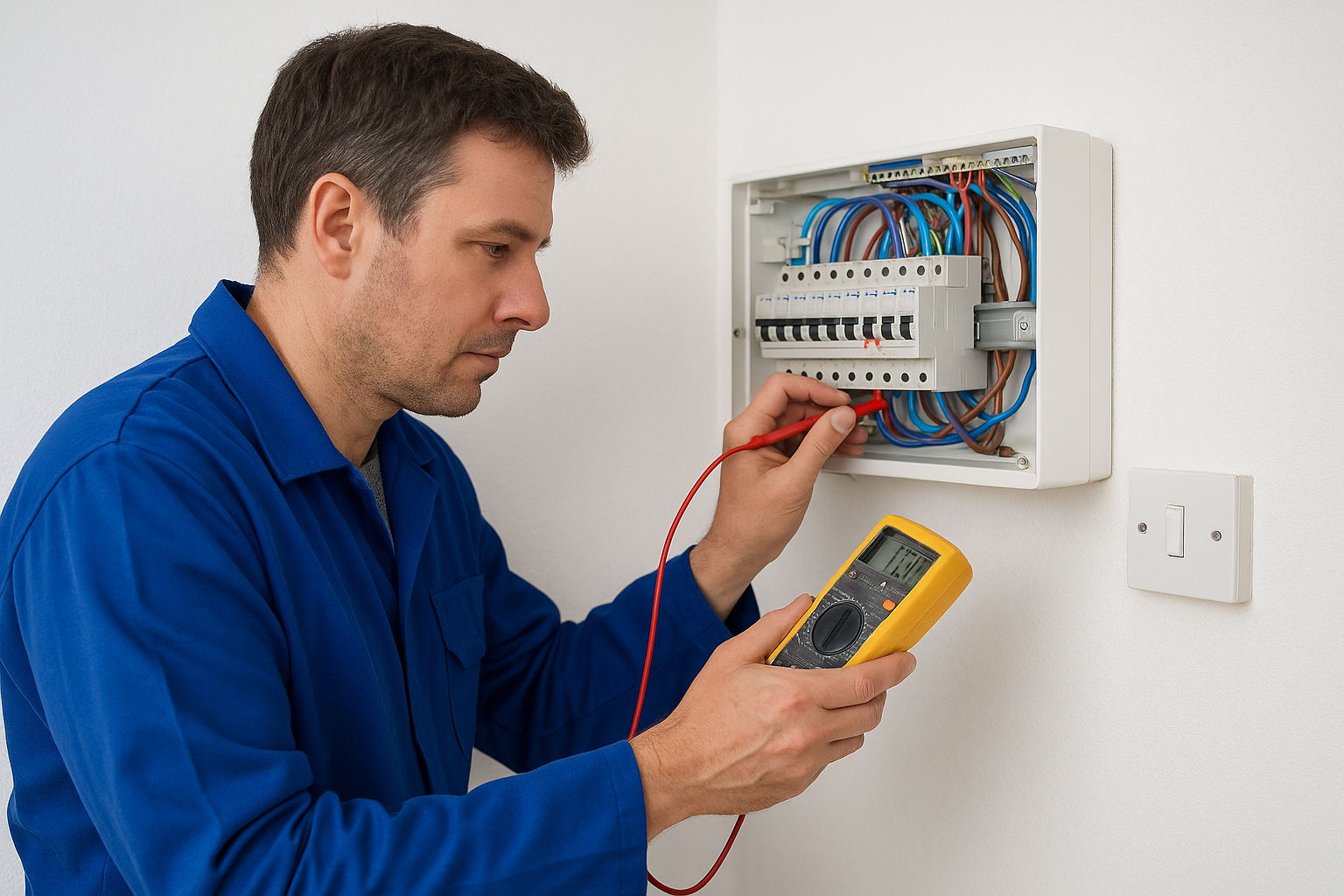
Pricing for a landlord electrical inspection depends on property size, number of circuits, and access difficulty, but London landlords should budget realistically rather than chase the cheapest quote going. A one-bedroom flat with a straightforward consumer unit typically costs less to test than a converted HMO with multiple circuits, outbuildings, and shared meters. Get a tailored quote for landlord EICR testing rather than relying on generic averages you find online, since regional pricing across London and the South East varies more than national guides suggest.
Typical price ranges by property type
Below is a realistic guide based on properties we inspect regularly across London rental stock:
|
Property Type |
Typical EICR Price Range |
|---|---|
|
Studio or one-bed flat |
£120 to £180 |
|
Two to three-bed house |
£150 to £250 |
|
HMO (per unit basis) |
£250 to £450+ |
|
Small commercial unit |
£200 to £400 |
Paying slightly more for a properly qualified electrician now costs far less than a rejected certificate and a repeat inspection later.
Factors that push the price up or down
Several things shift the quote beyond the base property size. Consumer unit age and condition matter, since an old rewireable fuse box often needs closer inspection than a modern RCBO board. Number of accessible circuits, outbuildings with wired power, and previous DIY additions all add testing time, and time is what you're paying for. Location within London occasionally affects call-out costs slightly, though most reputable firms quote a flat fee regardless of borough.
Budgeting for remedial work separately
Remember that the landlord electrical safety certificate cost only covers the inspection itself, not any fixes an unsatisfactory report flags. Remedial work, whether it's a new consumer unit or correcting faulty wiring, gets quoted separately once the electrician knows exactly what needs doing. Portfolio landlords often find it cheaper long-term to budget a small annual reserve for remedial work rather than treating every unsatisfactory report as an unplanned emergency expense.
Staying compliant and avoiding penalties
Complying with landlord electrical safety checks isn't complicated once you build a system around it, but it does require more than a one-off inspection and a folder you forget about. Councils increasingly cross-reference EICR dates against tenancy deposit registrations and licensing records, particularly for HMOs, so gaps get noticed faster than many landlords expect. Setting a reminder for the five-year renewal date the moment you receive a satisfactory report is the single easiest habit that keeps you compliant without last-minute scrambling.
Building a simple compliance routine
Most enforcement action against landlords stems from poor record-keeping rather than genuinely dangerous wiring, so a basic routine closes that gap:
-
Diarise the EICR renewal date the day you receive each report, not the day before it expires
-
Keep digital copies of every certificate, remedial works record, and minor works certificate in one folder per property
-
Send tenants their copy within 28 days as standard practice, even if they haven't asked
-
Flag any C1, C2, or FI code immediately to your electrician rather than waiting for a formal notice
A landlord who treats compliance as an ongoing routine never has to worry about a surprise penalty notice.
Handling multiple properties without losing track
Portfolio landlords face a different challenge: dozens of expiry dates spread across different addresses and tenancy start dates. Grouping inspections geographically, rather than strictly by expiry date, often saves both time and call-out costs, provided you don't let any single certificate lapse in the process. Working with one electrical contractor across your whole portfolio also means consistent record formats, which makes life much easier if a local authority ever requests documentation for several properties at once.
What to do if you inherit a non-compliant property
Buying or taking over management of a property with no valid EICR on file happens more often than you'd think, especially with older London stock changing hands. Arrange an inspection before advertising the tenancy rather than after, since starting a new tenancy without a satisfactory report is exactly the scenario the regulations were written to prevent.
Keeping your rental property safe
An electrical safety check for landlords isn't a box-ticking exercise, it's the difference between a tenancy that runs smoothly and one that ends in a fire, a fine, or a costly dispute. Get the five-year cycle right, respond fast to any C1 or C2 code, and keep your paperwork organised, and compliance stops being something you worry about.
Budgeting properly for both the inspection and any remedial work means you're never caught out by a surprise expense or a missed deadline. Whether you manage a single flat or a growing portfolio across London and the South East, the same principle holds: book early, use a qualified electrician, and treat the report as a working document rather than a formality.
If you're due a renewal, managing multiple properties, or dealing with an unsatisfactory report, request a quote for landlord EICR testing and we'll sort the details with you directly.

