


Electrical Safety Check Form: What It Should Include


Section 1
Search for an electrical safety check form online and you'll find dozens of generic templates, most of them stripped-down checklists that miss half of what a proper inspection actually needs to record. If you're a landlord filling one in before a tenancy, or a homeowner trying to document the state of your wiring, a vague tick-box sheet won't hold up if something goes wrong or an insurer asks questions.
A proper electrical safety check template needs to capture specific details: the condition of the consumer unit, circuit-by-circuit test readings, visible damage or wear, RCD protection status, and a clear pass or fail outcome with dated observations. Without these, the form is just paperwork, not evidence of a genuine inspection.
This article breaks down exactly what a thorough form should contain, section by section, so you know what to check yourself and what a qualified engineer should be recording when they carry out your inspection. We'll also explain where a basic checklist ends and where you actually need a formal EICR instead.
Why an electrical safety check form matters
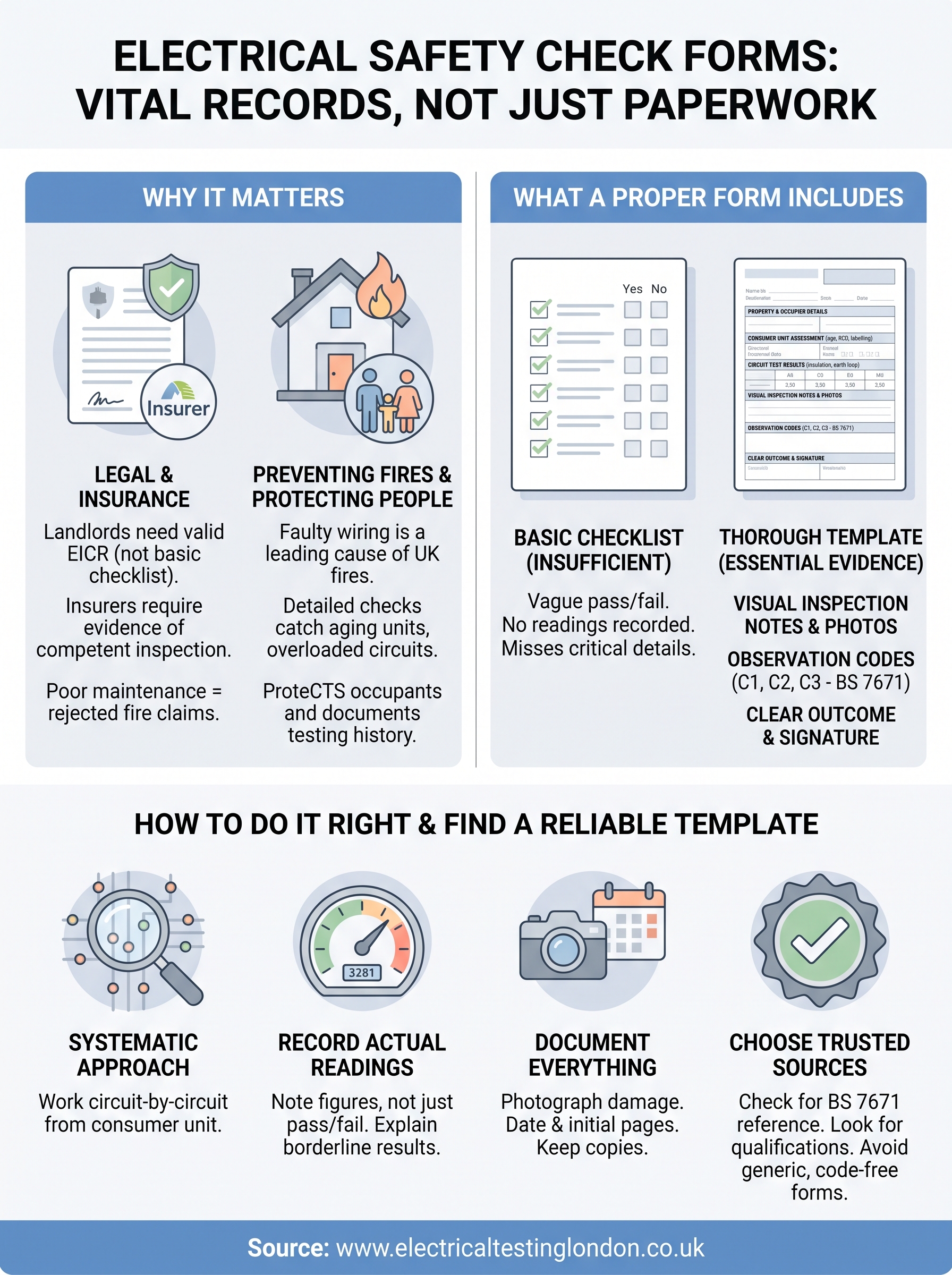
Legal duties and insurance cover
Landlords in England must have a valid Electrical Installation Condition Report for every rented property under the rules and costs governing electrical safety checks for landlords, and a basic electrical safety check form is often the first step in spotting problems before a formal inspection is due. Skipping this step, or filling in a vague form that doesn't record actual test readings, leaves you exposed if a tenant is injured or a fire investigation asks for evidence. Our team handles domestic EICR testing in London for landlords precisely because a flimsy checklist doesn't satisfy the Electrical Safety Standards in the Private Rented Sector Regulations 2020.
Insurers pay close attention to this paperwork too. Many home and buildings policies include clauses requiring evidence of a competent electrical inspection, and a claim can be reduced or refused if your only documentation is a homemade form with no dated readings or engineer's signature. Providers such as the Association of British Insurers have flagged poor electrical maintenance as a recurring factor in rejected fire claims, which makes a properly completed form part of your financial protection, not just a compliance exercise.
Preventing fires and protecting people
Faulty wiring remains one of the leading causes of house fires in the UK, and most of these incidents trace back to ageing consumer units, overloaded circuits, or missing RCD protection that a thorough check would have caught. A form that only asks "is the wiring okay?" gives you nothing to act on; one that records circuit loadings, insulation resistance, and earth continuity gives you a genuine early warning system.
A safety check form is only as useful as the detail it forces you to record.
Occupants matter as much as the building itself. Children, elderly residents, and tenants who rent multiple properties from the same landlord all depend on someone actually testing the system rather than glancing at it. A detailed record also means that when something does go wrong, you can show exactly what was checked, when, and by whom, which protects you as much as it protects the people living or working in the property.
What an electrical safety check form should include
A genuine electrical safety check form needs specific fields, not a single yes/no box. Property details, inspection date, and the engineer's qualifications should sit at the top, followed by a room-by-room breakdown of every accessible circuit and fitting. Below that, you need actual test data: consumer unit condition, RCD trip times, insulation resistance, and earth continuity readings, each recorded against the relevant circuit rather than lumped together as one vague pass.
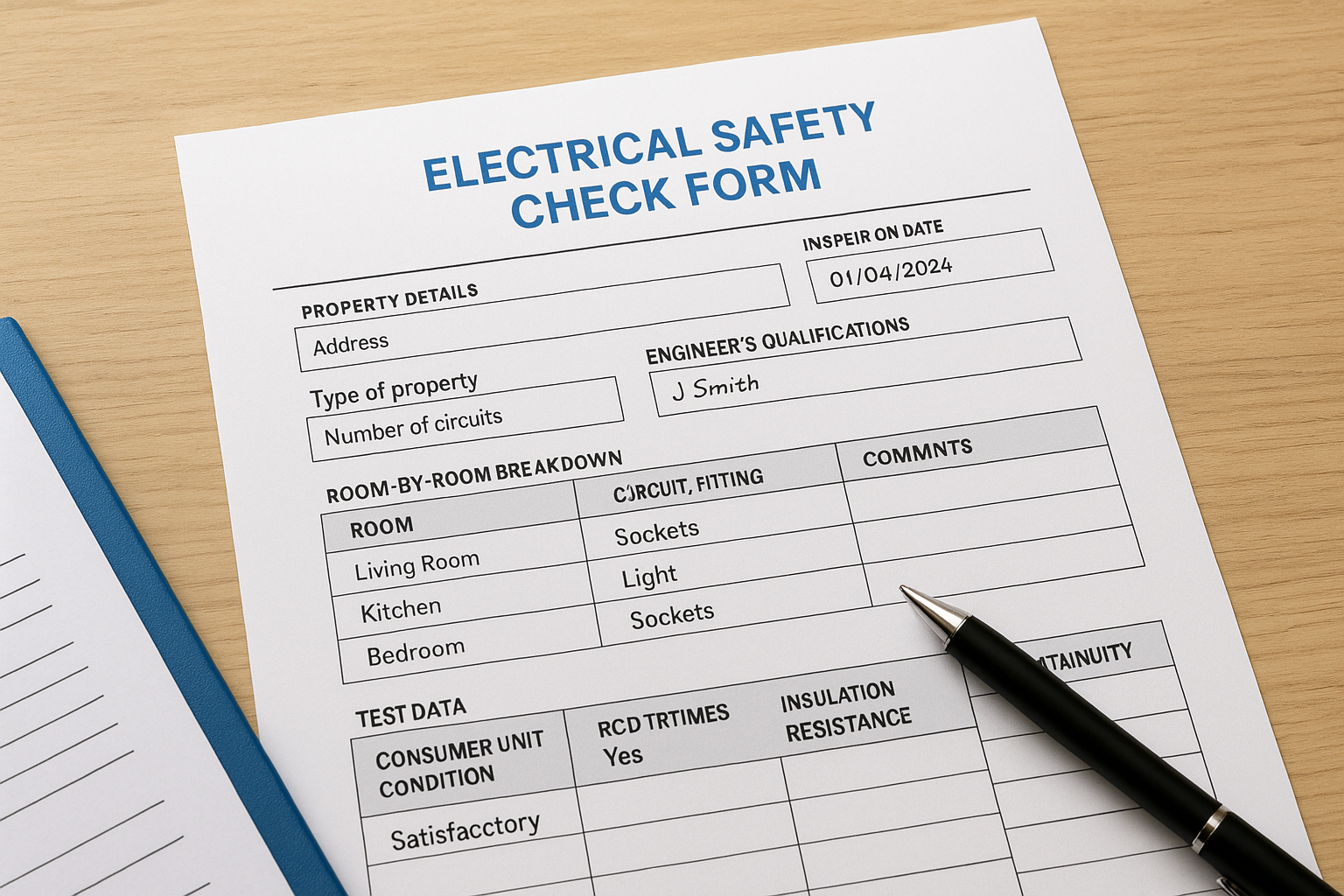
If a form doesn't ask for numbers, it isn't checking anything.
Here's what a thorough template should always contain:
-
Property and occupier details (address, type of property, number of circuits)
-
Consumer unit assessment (age, RCD provision, labelling accuracy)
-
Circuit test results (insulation resistance, polarity, earth fault loop impedance)
-
Visual inspection notes (damaged sockets, exposed cabling, signs of overheating)
-
Observation codes where issues are found, using the standard C1, C2, C3 classification system referenced in BS 7671
-
Overall outcome (satisfactory or unsatisfactory) with a signature and date
Without observation codes, a form can't distinguish between a minor cosmetic issue and something dangerous enough to need immediate remedial work. This is exactly where a basic checklist stops being useful and a formal EICR takes over, since only a qualified engineer can apply these codes correctly and produce a document that satisfies landlords' legal obligations or an insurer's evidence requirements, as the full checklist of what an EICR covers makes clear. Our engineers use exactly this structure when carrying out EICR inspections across London properties, so nothing gets missed between the paperwork and the actual wiring.
How to complete an electrical safety check form correctly
Getting the paperwork right matters as much as the inspection itself, and it helps to see what a completed EICR report looks like before you start filling anything in. A form filled in carelessly, with boxes ticked but no actual readings noted, gives you false confidence rather than real protection.
Work through circuits systematically
Start at the consumer unit and move room by room, testing and recording each circuit before moving to the next, much as a step-by-step EICR inspection is carried out. Jumping around the property leads to missed sockets, forgotten outbuildings, and duplicated entries. Note the circuit reference next to every reading so the form matches the actual distribution board labelling, not a generic description that means nothing six months later.
A form filled in out of order is a form with gaps.
Record readings, not impressions
Write down the actual figures for insulation resistance, earth loop impedance, and RCD trip times rather than simply marking "pass". If a reading sits close to a limit, note it and explain why, since a borderline result today can become a failure next year. Anyone using an electrical safety check form without recording numbers is really just guessing.
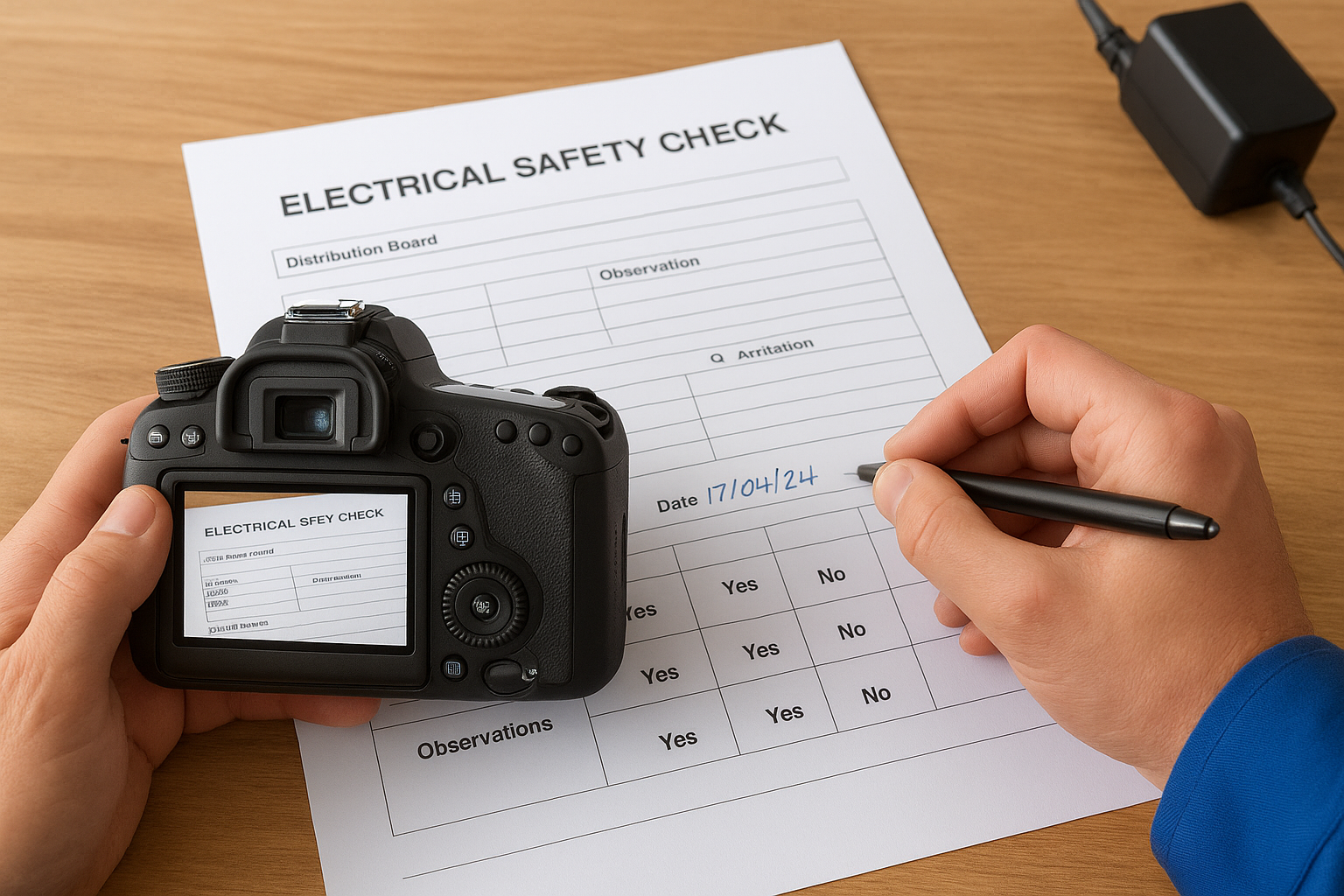
Photograph and date everything
A few clear checks make the whole document more useful:
-
Photograph any damage, exposed wiring, or non-standard connections you find
-
Date and initial every page, not just the final signature
-
Cross-reference observation codes to the specific circuit they relate to
-
Keep a copy before handing the original to a landlord, tenant, or insurer
Done properly, the form becomes a genuine record rather than a box-ticking exercise, and it gives whoever reviews it later something they can actually act on.
Finding a reliable electrical safety check template
Not every downloadable template deserves your trust. Many free versions online were built for general checklists, not proper electrical inspections, and they skip fields like earth loop impedance or observation codes entirely. Before you use one, check it actually references BS 7671, one of the UK electrical safety standards that underpin any genuine inspection.
What to check before you download anything
Quickly scan any template against these points before relying on it:
-
Does it include space for numerical readings, not just tick boxes?
-
Does it reference observation codes (C1, C2, C3) rather than a plain pass/fail?
-
Does it ask for the engineer's qualifications and registration details?
-
Was it produced by a body connected to electrical standards, such as the NICEIC or a similar competent person scheme?
A template without observation codes isn't an inspection tool, it's a wish list.
Owners and landlords sometimes assume a free electrical safety check form found through a search is interchangeable with a proper EICR. It isn't. A template can help you spot obvious issues between formal inspections, but it can't replace the testing equipment, training, and legal standing that someone qualified to issue an electrical safety certificate brings. If you want a document that actually holds up to scrutiny from tenants, insurers, or building control, book a proper inspection rather than relying on a self-completed form. Our team can arrange an EICR at short notice across London and the South East, with test readings recorded exactly as they should be.
Staying on top of your electrical safety records
Keeping good records isn't a one-off task. Treat your electrical safety check form as the start of an ongoing file, updated every time you inspect a property or fix a fault, not a single document you complete and forget. Landlords especially should review this paperwork alongside tenancy renewals, while homeowners benefit from checking it whenever they add new circuits or appliances.
Remember that a template only takes you so far. It's useful for spotting obvious problems between formal checks, but it can't replace the readings, codes, and legal standing that come from a proper inspection carried out by someone qualified to do it. When your records need that extra level of assurance, or you're simply not sure whether your current paperwork would hold up, request a quote for an electrical inspection carried out by our engineers across London and the South East.

