






Electrical Safety Check Near Me: What It Covers and Costs



Typing electrical safety check near me into Google usually means one of two things: something's worrying you about your wiring, or you need proof of compliance for a landlord certificate, insurance policy, or house sale. Either way, you want a straight answer about what actually happens during the visit and what it will cost you, not a sales pitch.
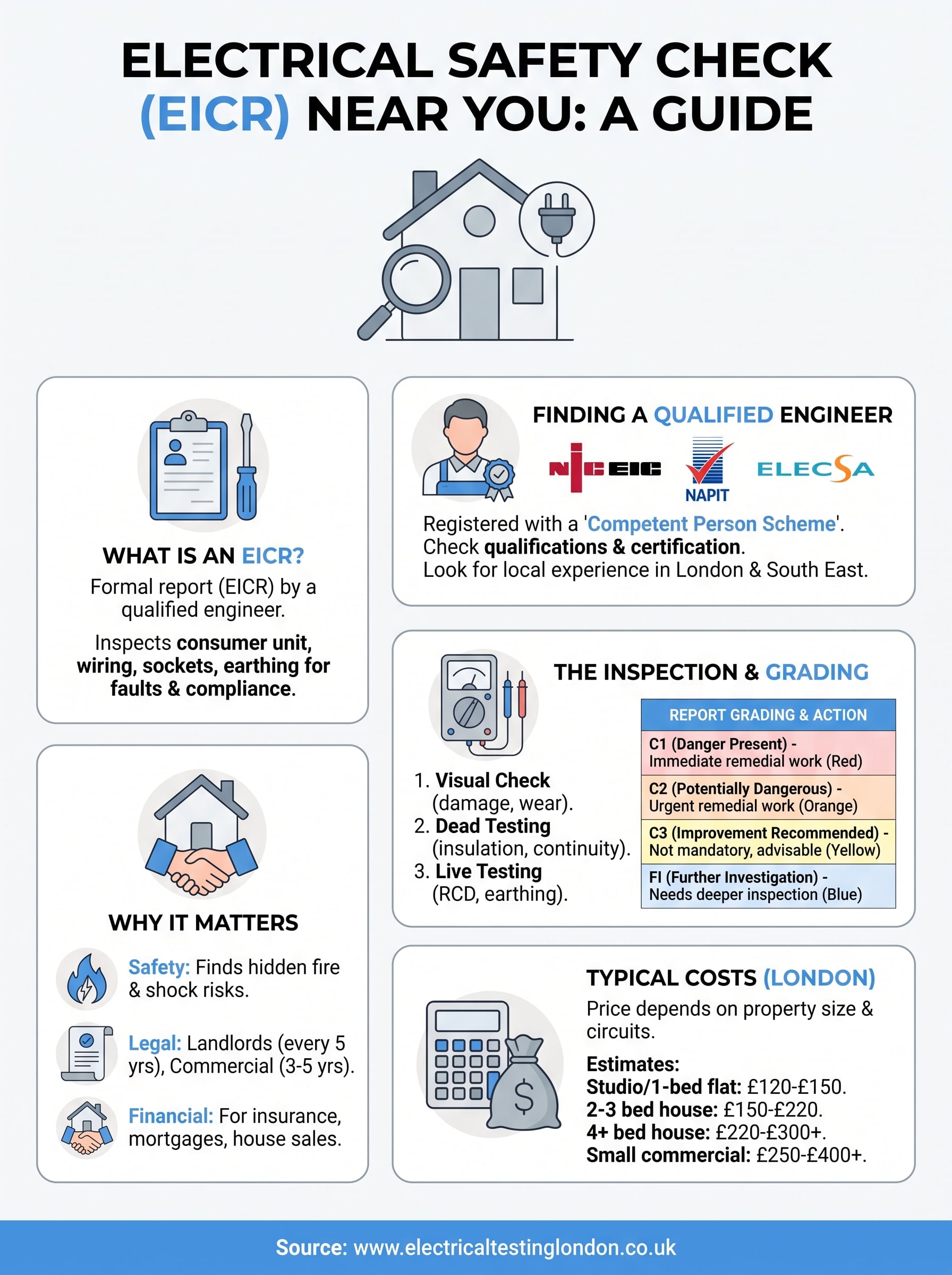
A proper electrical safety check, formally called an EICR (Electrical Installation Condition Report), involves a qualified engineer inspecting your consumer unit, wiring, sockets, and earthing to identify faults, wear, or non-compliance with current regulations. Costs in London typically range from around £120 for a small flat to £300 or more for a larger house or commercial unit, depending on the number of circuits and property size. The report grades any issues found and tells you exactly what needs fixing.
This article walks through what's included in a standard inspection, how long it takes, the difference between checks for homeowners, landlords, and businesses, and what you can expect to pay based on property type and location. By the end, you'll know exactly what to book and why it matters for your safety and your legal obligations.
Why an electrical safety check matters
Getting an electrical safety check isn't just a box-ticking exercise. It catches the faults you can't see with the naked eye, the kind that cause house fires, electric shocks, and expensive damage long before you'd notice a problem yourself. Hidden wiring faults account for a significant share of accidental house fires in the UK each year, and most of them start in circuits that looked perfectly fine on the surface.
Fire and shock risks you can't see
Overloaded circuits, degraded insulation, and outdated consumer units often show no visible warning signs until something fails. A qualified engineer uses specialist testing equipment to measure insulation resistance, earth loop impedance, and circuit continuity, picking up faults that would otherwise go unnoticed for years. This is especially important in older properties, rented flats with a string of past tenants, and homes that have had DIY electrical work done at some point.
A wiring fault you can't see is still a fault that can start a fire.
Legal duties for landlords and businesses
If you're a landlord in England, the rules on electrical safety checks are unambiguous: you must have a valid EICR for every rented property, renewed at least every five years, under the Electrical Safety Standards in the Private Rented Sector (England) Regulations 2020. Businesses have similar duties under the Electricity at Work Regulations 1989, which require employers to keep electrical systems safe and well maintained, so it's worth knowing how often you need an electrical safety check for your property type. Skipping this isn't a grey area, it's a compliance failure that can lead to fines and invalidated insurance.
|
Who needs it |
Legal requirement |
Typical frequency |
|---|---|---|
|
Private landlords |
Mandatory EICR |
Every 5 years |
|
Commercial premises |
Mandatory under H&S law |
Every 3-5 years |
|
Homeowners |
Not legally required |
Every 10 years (recommended) |
|
Homebuyers |
Not required, but advised |
Before purchase |
You can read more about the private rented sector rules directly on GOV.UK.
Insurance, mortgages and house sales
Many home insurance policies now ask whether your electrics have been checked within the last decade, and a claim can be reduced or refused if faulty wiring is found to have caused a fire and no recent report exists. Buyers and mortgage lenders increasingly expect an electrical safety check when buying a house before completion too, since it flags issues that could otherwise become a costly surprise after moving in. Sorting this early avoids delays at exchange and gives you leverage to negotiate repairs into the sale price.
Booking a professional EICR testing service gives you a clear, dated record that satisfies landlords' obligations, reassures insurers, and gives homeowners genuine peace of mind. It's the difference between guessing your wiring is fine and actually knowing it.
How to find a qualified electrician near you
Searching "electrical safety check near me" throws up dozens of names, but not all of them are properly qualified to issue an EICR, so it pays to know the ways to find an EICR electrician near you. You want someone registered with a recognised competent person scheme, not just a local handyman who does a bit of wiring on the side. The certificate only carries weight with landlords, insurers, and mortgage lenders if the person signing it is properly accredited.
Check qualifications and certification schemes
Look for engineers registered with NICEIC, NAPIT, or ELECSA, the main UK schemes that audit electricians' work and competence, and check who can issue an electrical safety certificate before you hire. Registration means the engineer has been assessed against British Standard BS 7671 wiring regulations and undergoes regular reassessment, so the paperwork you get back actually means something. You can verify registration directly through the NICEIC website, which is worth the two minutes it takes if you're hiring someone you haven't used before.
A certificate is only as good as the qualifications behind the signature.
Look for local experience and reviews
Experience with London's housing stock matters more than people realise. A Victorian terrace with rewired sections, a converted flat with shared circuits, or a commercial unit with three-phase supply all throw up different issues, and an engineer who works across London and the South East day to day will spot problems that someone unfamiliar with the area might miss. Check reviews for mentions of punctuality, clear explanations, and tidy work, not just a star rating.
Compare quotes and credentials before booking
Don't just take the cheapest quote at face value. Ask a few quick questions before you commit:
-
Are you registered with NICEIC, NAPIT, or another approved scheme?
-
Can you send proof of your qualification and insurance?
-
What's included in the price: full inspection, testing, and a written report?
-
How quickly will I get the certificate after the visit?
-
Do you offer remedial work if issues are found?
A reputable local firm will answer all five without hesitation. If you'd rather skip the vetting process altogether, you can book a domestic EICR in London with a fully qualified engineer directly, with transparent pricing and at least a decade of hands-on experience behind every inspection.
What happens during an electrical safety check
Once you've booked a home electrical inspection, the process itself is straightforward, though it's worth knowing what to expect so nothing catches you off guard. A domestic EICR usually takes between one and three hours depending on property size, number of circuits, and how accessible your consumer unit and sockets are.
Before the engineer arrives
You don't need to do much preparation, but clearing access to your consumer unit, loft hatch, and any sockets behind furniture speeds things up considerably. It also helps to have any previous electrical certificates on hand, since the engineer will want to compare current findings against past work. Tenants should give landlords notice, as the property needs to be accessible for the full duration of the visit.
The inspection step by step
The engineer works through a set sequence of EICR inspection steps, checking each part of your installation against BS 7671 wiring regulations:
-
Visual inspection of the consumer unit, cabling, and accessories for damage or wear
-
Dead testing to check insulation resistance and circuit continuity before power is reconnected
-
Live testing of earth loop impedance and RCD (residual current device) trip times
-
Checking socket polarity and earthing at multiple points around the property
-
Confirming the consumer unit itself meets current safety standards
Every socket and circuit gets tested, not just the ones you happen to use.
After the visit: your report and grading
Once testing finishes, you receive a written report grading any issues found using a standard classification system. This is where the real value of a thorough electrical inspection shows up, because it tells you exactly what's urgent and what can wait.
|
Code |
Meaning |
Action needed |
|---|---|---|
|
C1 |
Danger present |
Immediate remedial work |
|
C2 |
Potentially dangerous |
Urgent remedial work |
|
C3 |
Improvement recommended |
Not mandatory, advisable |
|
FI |
Further investigation |
Needs deeper inspection |
Anything rated C1 or C2 means the report won't pass as satisfactory until it's fixed, which matters if you're relying on it for a landlord certificate or insurance purposes.
How much does an electrical safety check cost
Pricing for an electrical safety check in London depends mostly on property size, the number of circuits, and how quickly you need the certificate. A one-bedroom flat with a straightforward consumer unit costs far less to test than a five-bedroom house with multiple extensions and outbuildings, simply because there's more to inspect and more time on site.
What drives the price up or down
Several factors push the quote higher or lower before an engineer even arrives. Larger properties take longer because there are more circuits, sockets, and fixed appliances to test individually. Access issues, like a consumer unit buried behind stored furniture or a loft hatch that's hard to reach, add time too. Commercial units with three-phase supplies or specialist equipment need more thorough testing than a standard domestic circuit, which is reflected in the price.
Typical pricing by property type
Here's a realistic breakdown of what you should expect to pay across common property types in London and the South East:
|
Property type |
Typical cost |
Approx. duration |
|---|---|---|
|
Studio or 1-bed flat |
£120 - £150 |
1 hour |
|
2-3 bed house |
£150 - £220 |
1.5 - 2 hours |
|
4+ bed house |
£220 - £300+ |
2 - 3 hours |
|
Small commercial unit |
£250 - £400+ |
3+ hours |
The cheapest quote rarely covers the same depth of testing as a properly priced one.
Remedial work, if the report flags any C1 or C2 issues, sits outside this base cost and gets quoted separately once the engineer knows exactly what needs fixing.
Getting value, not just a low price
Quotes that undercut everyone else usually mean a shorter visit, less thorough testing, or a report that skips detail landlords and insurers expect to see. Genuine value comes from a fully qualified engineer who tests every circuit properly, explains findings in plain language, and hands you a report that actually holds up if it's ever challenged by an insurer or letting agent. Fixed, transparent pricing removes the guesswork too, so you know the final bill before the visit even starts. You can see current rates and get a fixed quote for your property type before booking, rather than waiting for a surprise invoice afterwards.
Keeping your electrics safe and compliant
An electrical safety check near you isn't just paperwork to file away. It's the difference between assuming your wiring is fine and actually knowing it, backed by a report from someone qualified to test it properly. Whether you're a landlord meeting a legal deadline, a homeowner planning to sell, or someone who just wants peace of mind after noticing a flickering light, the process is the same: a thorough inspection, honest grading of any faults, and a clear plan for fixing what matters.
Don't wait for a tripped fuse or a burning smell to prompt action. Faults hide in walls and consumer units until they don't, and by then the cost is always higher than a routine inspection would have been. If you're ready to book someone properly accredited, with transparent pricing and no surprises on the invoice, get a quote for your electrical safety check and get your property checked properly.