






Electrical Safety for Landlords: Your Legal Obligations Explained



If you rent out property in England, electrical safety for landlords isn't optional. It's a legal duty backed by specific regulations, and getting it wrong can mean fines, invalidated insurance, or worse if something goes wrong in a tenant's home. Yet plenty of landlords still aren't sure exactly what's required, how often, or who needs to sign it off.
The short answer: since 2020, private landlords in England must have a valid EICR (Electrical Installation Condition Report) carried out every five years by a qualified engineer, along with regular checks on portable appliances you supply and any fixed wiring in the property. Miss a deadline or ignore a remedial notice, and you're breaching the Electrical Safety Standards in the Private Rented Sector Regulations 2020, full stop.
This article breaks down exactly what the law expects from you as a landlord, from inspection frequency to what happens after a failed report, so you know precisely where you stand and what to book in next.
Why electrical safety compliance matters for landlords
Electrical faults cause a significant share of accidental house fires in the UK every year, and rented properties carry a disproportionate risk because tenants rarely have control over the wiring, sockets, or consumer unit they're using. Electrical safety for landlords isn't a box-ticking exercise dreamed up by bureaucrats. It exists because faulty wiring, overloaded circuits, and ageing installations genuinely put lives at risk, and the importance of electrical safety sits with you as the person legally responsible for the property, not your tenant.
The legal reality since 2020
Government figures show electrical faults account for thousands of house fires annually in England, which is exactly why the Electrical Safety Standards in the Private Rented Sector Regulations 2020 were introduced. These rules turned what used to be good practice into a firm legal requirement. Every private landlord in England must now hold a valid electrical installation condition report and act on any issues it flags. Skipping this isn't a grey area. It's a direct breach of your landlord electrical safety obligations, and local authorities have the power to investigate and enforce.
A five-year inspection cycle exists because electrical faults rarely announce themselves before it's too late.
The human and financial cost of getting it wrong
Beyond the legal side, think about what's actually at stake. A degraded connection behind a socket, a consumer unit without proper RCD protection, or DIY wiring from a previous tenant can all sit undetected for years, then fail catastrophically. Fires, electric shocks, and property damage aren't abstract risks in older rental stock, particularly in London's Victorian and Edwardian terraces where original wiring sometimes still lurks behind later renovations. Regular portable appliance testing and periodic inspections catch these problems while they're still cheap and simple to fix, rather than after a tenant has been injured or a property has burned.
Here's what tends to go wrong in properties that skip regular checks:
-
Overloaded sockets and extension leads from tenants working around insufficient power points
-
Corroded or loose connections in older consumer units
-
Unsafe DIY alterations carried out by previous occupants or landlords
-
Missing or faulty RCD protection on circuits serving bathrooms and kitchens
-
Deteriorating insulation on cabling that's decades past its expected lifespan
Insurance, liability and your bottom line
Insurers increasingly ask for evidence of a current electrical safety certificate in London when you make a claim, and if you can't produce one after a fire or electrical incident, they can refuse to pay out entirely. That's a conversation no landlord wants to have after losing a property to fire damage. Mortgage lenders on buy-to-let properties are also paying closer attention to compliance paperwork, and some now request proof of electrical safety certification as part of routine reviews. Failing to comply doesn't just expose you to fines, it can quietly unravel your entire financial safety net at the exact moment you need it most.
Protecting your reputation and tenant relationships
Word travels fast among tenants, especially in London's competitive rental market where reviews and word-of-mouth heavily influence who applies for your property. Landlords with a track record of letting maintenance slide, especially on something as fundamental as electrical safety, find it harder to attract and retain good tenants. Conversely, being upfront about your inspection schedule and sharing your EICR proactively builds trust from day one. Tenants who feel genuinely safe in a property are far more likely to renew, treat the place well, and report problems early rather than letting them fester.
Ultimately, compliance and good landlording aren't separate goals. Meeting your legal obligations around electrical safety protects the people living in your property, protects your investment, and protects you from the financial fallout of an incident that proper testing could have prevented. The next section covers exactly how to meet those obligations in practice, from booking the right inspection to keeping your paperwork in order.
How to meet your legal electrical safety obligations
Meeting your landlord electrical safety obligations comes down to a handful of concrete steps, not a vague sense of "keeping things safe." The 2020 regulations set out precise timing, specific documentation, and clear responsibilities that apply from the day you first let a property. Getting the sequence right from tenancy start to renewal is what keeps you compliant and, just as importantly, keeps you out of a local authority's enforcement queue.
The core requirements, step by step
Before any tenant moves in, and every five years after that, you need a full inspection carried out by a qualified electrician, which is the heart of meeting EICR landlord requirements. Here's the practical checklist most landlords work through:
-
Book an EICR before a new tenancy starts, or before 1 April 2021 for existing tenancies (a deadline long since passed, so act now if you're behind)
-
Renew the report at least every five years, or sooner if the previous report specifies an earlier date
-
Give tenants a copy of the current EICR within 28 days of the inspection
-
Provide a copy to new tenants before they move in, and to your local authority within seven days if requested
-
Act on any C1 or C2 codes within 28 days, or sooner if the report specifies
-
Keep records of every inspection, remedial works, and confirmation of completion for at least the next inspection cycle
Missing the 28-day window to fix a dangerous fault turns a paperwork issue into a legal breach overnight.
Who does what: your obligations at a glance
Different parties have different jobs in this process, and confusion here is a common reason landlords fall out of compliance without realising it.
|
Responsibility |
Who handles it |
|---|---|
|
Commissioning the EICR |
Landlord (or managing agent) |
|
Carrying out the inspection |
Qualified, competent electrician |
|
Supplying the report to tenants |
Landlord, within 28 days |
|
Reporting to local authority if requested |
Landlord, within 7 days |
|
Completing remedial work |
Landlord, arranged via a qualified electrician |
|
Confirming remedial work |
Follow-up report from the electrician |
Once you understand who owns each step, the process becomes far less daunting. Registered social landlords also fall under similar duties in most cases, so don't assume charitable status or a smaller portfolio exempts you.
Building compliance into your routine
Smart landlords don't wait for a five-year deadline to creep up on them. Setting a calendar reminder eleven months out from your last EICR gives you breathing room to book an inspection, address any findings, and still hit the legal deadline comfortably. Treating your consumer unit, wiring, and sockets the same way you'd treat a boiler service, on a fixed schedule rather than reactively, removes most of the risk of accidental non-compliance. If you manage several properties, staggering renewal dates across the year also spreads the cost and workload rather than facing five inspections in the same month.
Our team at Electrical Testing London handles this exact scheduling for landlords across the capital, so you're never chasing a deadline you didn't see coming.
Understanding your EICR and its safety codes
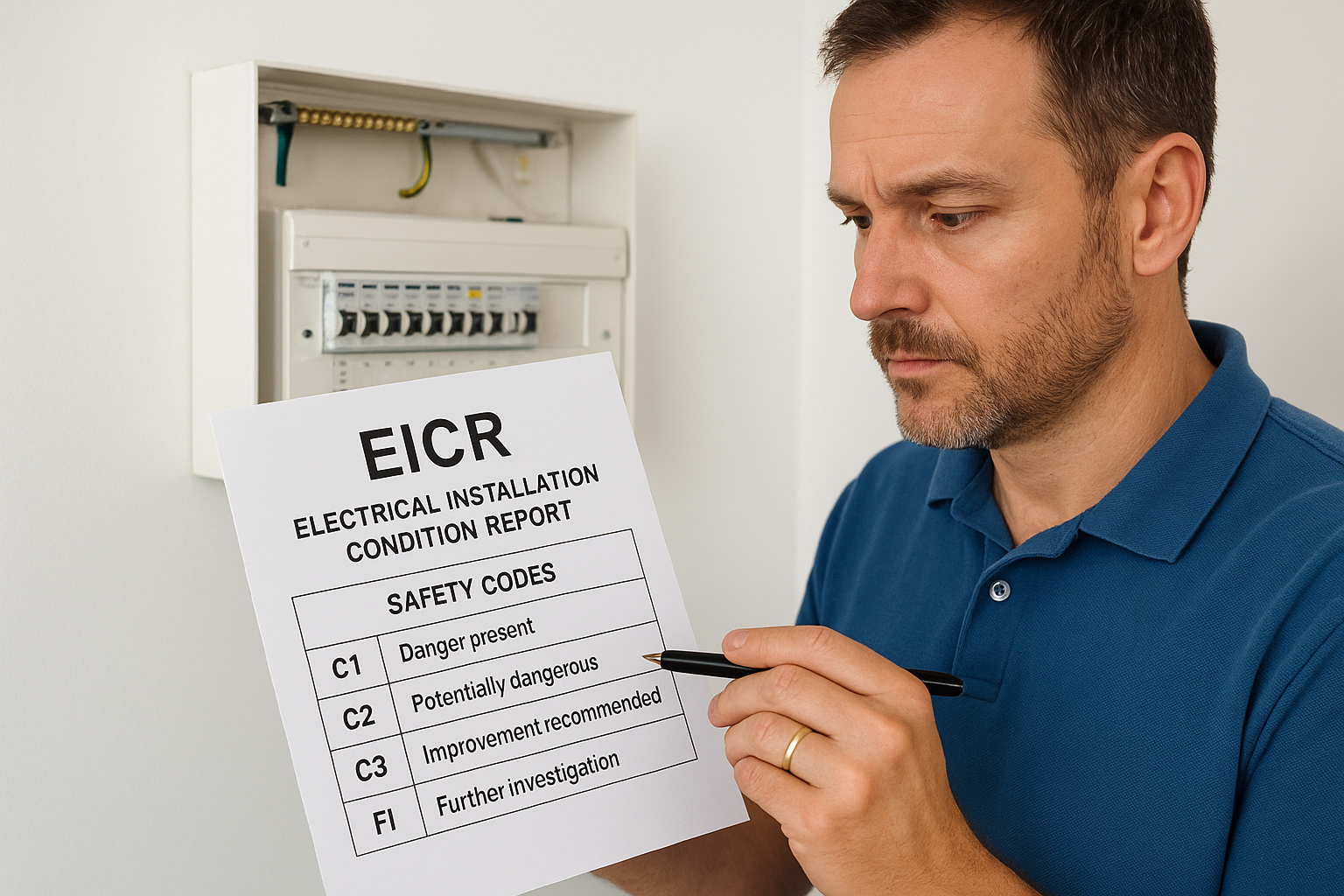
An EICR (Electrical Installation Condition Report) is a detailed inspection of the fixed wiring, sockets, consumer unit, and earthing arrangements in a property, not the appliances plugged into it. Every observation the electrician makes gets a classification code, and those codes determine what happens next. Landlords who don't understand the coding system often panic unnecessarily over minor findings, or worse, ignore something serious because the report reads like technical jargon rather than a clear instruction.
What the codes actually mean
Each code carries a specific level of urgency, and knowing what each EICR code means matters just as much as booking the inspection in the first place.
|
Code |
Meaning |
Action required |
|---|---|---|
|
C1 |
Danger present, risk of injury |
Immediate remedial action |
|
C2 |
Potentially dangerous |
Urgent remedial action, typically within 28 days |
|
C3 |
Improvement recommended |
No legal obligation, but worth addressing |
|
FI |
Further investigation required |
Must be carried out without delay |
A single C2 code on your EICR is enough to make the entire report unsatisfactory in the eyes of the law.
Only C1, C2, and FI codes make a report unsatisfactory. A report with only C3 observations still passes, though sensible landlords address those recommendations anyway rather than let a minor issue drift into a bigger one before the next inspection cycle.
Reading the report beyond the codes
Besides the code table itself, your electrical installation condition report includes a summary of the installation's overall condition, a schedule of every circuit tested, and the electrician's recommended date for the next inspection. Occasionally that recommended date is shorter than five years, particularly in older properties or where the consumer unit is nearing the end of its practical life. Ignore that recommendation at your own risk, since a local authority reviewing your paperwork will expect you to have followed the electrician's professional judgement, not just the statutory minimum.
Spotting patterns across multiple properties also pays off if you manage a portfolio. If several reports flag similar C3 issues, such as missing socket covers or unearthed light fittings, that's usually a sign of a shared installation era or a previous contractor cutting corners, and it's worth addressing proactively across your whole portfolio rather than property by property.
Getting a report you can actually interpret starts with using an electrician who explains findings in plain terms rather than handing over a form and moving on. Our engineers carrying out domestic EICRs in London talk you through every code before they leave, so you're never left guessing what a C2 on page three actually means for your tenants or your legal position.
What to do when your EICR is unsatisfactory
Getting a report back marked "unsatisfactory" isn't the end of the world, but it does start a legal clock. An unsatisfactory EICR simply means the electrician found at least one C1, C2, or FI code during the inspection, and under the 2020 regulations you now have a fixed window to put things right. Panicking over the wording helps nobody. What matters is moving quickly, using the right contractor, and keeping evidence of every step you take.
The 28-day clock starts now
Once your electrician flags a C1 or C2, you're required to complete EICR remedial works within 28 days, or sooner if the report specifies a tighter deadline. C1 findings mean an immediate danger, so in practice a competent electrician will often make the installation safe on the spot before leaving the property, rather than waiting for a follow-up visit. FI codes need further investigation without delay, since the electrician couldn't fully assess the risk during the original inspection.
Treat a C2 code as a deadline, not a suggestion, because the law does exactly that.
Booking the remedial work and getting it certified
Here's the sequence that keeps you compliant and gives you paperwork worth showing a local authority if they ever ask:
-
Arrange remedial electrical work with a qualified, competent electrician, ideally the same firm that carried out the original inspection
-
Confirm in writing what work is being done and against which code it addresses
-
Request a follow-up report or a Minor Electrical Installation Works Certificate once the work is finished
-
Send the confirmation to your tenant so they know the issue has been resolved
-
File the original EICR alongside the remedial certificate together, not as separate loose documents
Skipping the follow-up certificate is one of the most common mistakes landlords make. A verbal assurance from a tradesperson that "it's sorted" carries no legal weight if your local authority ever requests evidence.
Reporting to your local authority
Sometimes a council's private sector housing team requests a copy of your EICR directly, particularly if a tenant has raised a complaint. You then have seven days to supply it, along with confirmation that any remedial work has been completed. Missing that window, even when the underlying electrical work has genuinely been fixed, still counts as a breach of your landlord electrical safety obligations, so don't let paperwork lag behind the actual repairs.
Our engineers at Electrical Testing London carry out remedial work directly off the back of our own inspections, so there's no gap between diagnosis and fix, and you get a single, consistent paper trail rather than chasing two separate contractors for one job.
Penalties for non-compliance with electrical safety rules
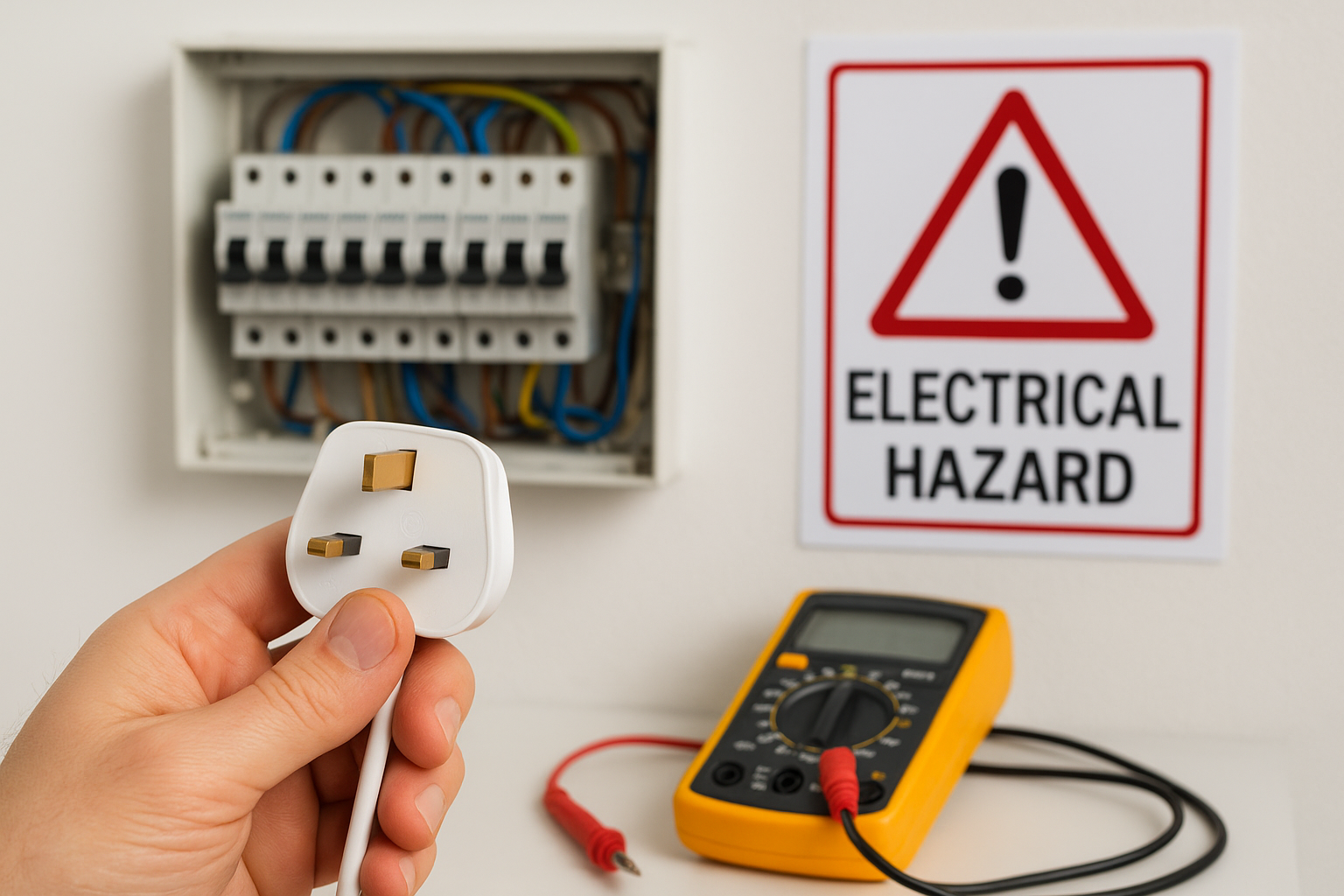
Ignoring the Electrical Safety Standards in the Private Rented Sector Regulations 2020 isn't a paperwork slip that quietly goes away. Local authorities have real enforcement powers here, and they're increasingly using them as awareness of the rules spreads across London boroughs. Non-compliance with electrical safety rules can trigger a remedial notice first, but if you ignore that too, financial penalties follow quickly, and they're not small.
How the fines actually stack up
When a council finds you've breached your duties, it can issue a penalty notice of up to £30,000 per breach, and that figure isn't a typo. Unlike some housing regulations with modest fixed fines, this one was deliberately set high to make electrical safety impossible to shrug off.
|
Breach |
Possible consequence |
|---|---|
|
No valid EICR in place |
Remedial notice, then penalty up to £30,000 |
|
Ignoring a remedial notice |
Local authority arranges works, recovers cost from landlord |
|
Failing to supply report to tenant |
Penalty notice, up to £30,000 |
|
Failing to report to local authority within 7 days |
Penalty notice, up to £30,000 |
|
Renting out property after enforcement action |
Further penalties, potential banning order |
A single missed 28-day deadline can cost you thousands more than the remedial work itself would have.
What enforcement looks like in practice
Before reaching for a fine, most councils start with a remedial notice, giving you 28 days to sort the issue and provide evidence. If you don't respond, or the work still isn't done, the local authority can arrange the remedial work itself and bill you for the full cost, on top of any penalty. Trading standards and private sector housing teams across London have become noticeably more active on this since 2020, partly driven by tenant complaints and partly by routine licensing checks on HMOs and selective licensing schemes, both of which now often cross-reference EICR compliance as standard.
Consequences beyond the fine itself
Suppose you're already facing a Section 21 eviction process or applying for a new mortgage on a buy-to-let. An unresolved electrical safety breach can complicate both, since letting agents, solicitors, and lenders increasingly ask for compliance evidence as a matter of course. Repeated or serious breaches can also feed into a landlord's record with a local authority, potentially contributing towards a banning order if other housing offences are involved. Insurers, as covered earlier, may simply refuse a claim outright if a fire or electrical incident occurs while your EICR was overdue, meaning the £30,000 maximum penalty is sometimes the smaller of two financial hits you'd face.
Getting your inspection booked before a deadline arrives, rather than after a warning letter lands, remains by far the cheapest way to avoid every scenario in that table above.
Electrical safety rules across England, Scotland, Wales and Northern Ireland
Everything covered so far applies specifically to England, and that distinction catches out landlords with properties in more than one part of the UK. Electrical safety for landlords isn't governed by a single UK-wide law. Scotland, Wales and Northern Ireland each run their own frameworks, with different legal bases, different EICR inspection timescales, and in one case, no direct statutory EICR requirement at all. Assuming the 2020 English regulations travel across the border with you is a mistake that catches out portfolio landlords more often than you'd think.
Scotland led the way years earlier
Scotland actually got there first. Since 2015, the Repairing Standard has required private landlords to have a satisfactory electrical installation report carried out at least every five years, alongside annual checks on smoke and heat alarms. Landlords in Scotland must also provide tenants with a copy of the report and keep it available for inspection by the local authority. If you're used to England's rules, the substance feels familiar, but the legislation and enforcement route sit under Scottish housing law rather than the 2020 English regulations.
Wales ties electrical safety to fitness for habitation
Wales folded electrical safety into a broader piece of legislation. Under the Renting Homes (Wales) Act 2016, landlords must ensure a property meets fitness for human habitation standards, and a valid EICR every five years forms part of that duty. Contract-holders, the Welsh term for tenants under this Act, must receive a copy of the report, and the same 28-day window applies for remedying anything classed as dangerous. Structurally it mirrors England's approach, but you're working within Welsh housing law rather than a direct copy of the English regulations.
Assuming your EICR paperwork automatically satisfies the rules in every UK nation is exactly how landlords with mixed portfolios end up non-compliant.
Northern Ireland lags behind
Northern Ireland is the outlier. There's currently no specific statutory requirement mirroring England's five-year EICR cycle, though landlords still carry general duties under the Housing (Northern Ireland) Order 1992 to keep a property fit for habitation, which in practice includes safe electrical installations. Many landlords there commission EICRs voluntarily anyway, both for insurance purposes and because tighter regulation is widely expected to follow England's lead eventually.
|
Nation |
Legal basis |
EICR frequency |
|---|---|---|
|
England |
Electrical Safety Standards (PRS) Regulations 2020 |
Every 5 years |
|
Scotland |
Repairing Standard |
Every 5 years |
|
Wales |
Renting Homes (Wales) Act 2016 |
Every 5 years |
|
Northern Ireland |
Housing (NI) Order 1992 (general duty) |
No fixed statutory cycle |
If you let property across borders, treat each nation's rules as separate compliance obligations rather than one blanket policy, and check the current legislation for each location before assuming your existing paperwork covers you.
Beyond the EICR: PAT testing and appliance safety
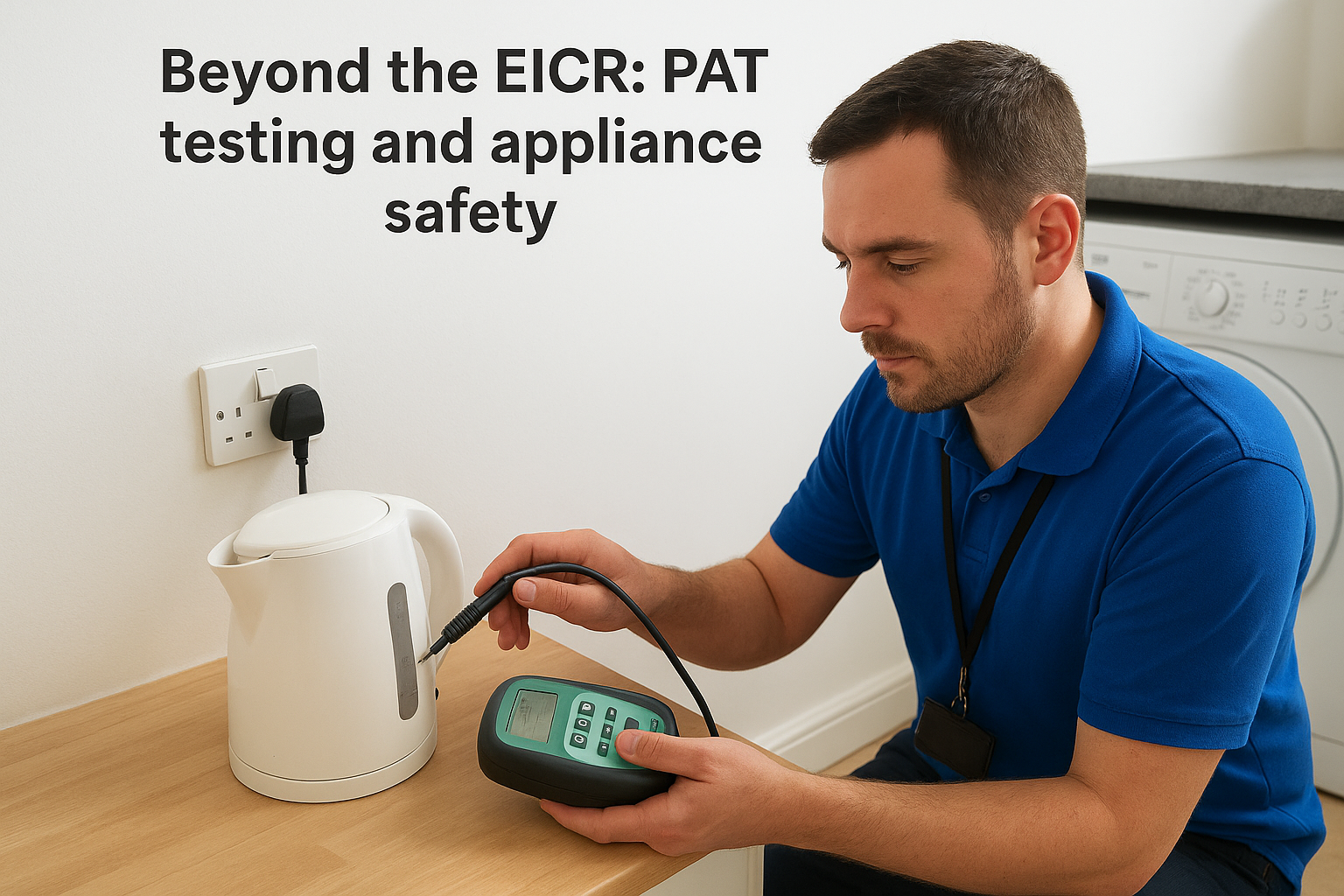
An EICR only covers the fixed wiring behind your walls and inside the consumer unit. It says nothing about the kettle, the washing machine, or the lamp you left in the property when the last tenant moved out. PAT testing (Portable Appliance Testing) fills that gap, checking that anything with a plug supplied by you as landlord is safe to use. It isn't a blanket legal requirement for landlords in the same way an EICR is, but if you furnish a property or supply any electrical items, you carry a duty of care under the Electrical Equipment (Safety) Regulations 2016 and general landlord safety obligations to make sure they don't injure a tenant.
PAT testing: what it covers and why it matters
During a PAT test, an engineer inspects the plug, cable, and casing of each appliance, then runs an earth continuity and insulation resistance check using a dedicated tester. Anything that fails gets labelled and removed from service immediately, rather than left plugged in until someone gets a shock from it.
A frayed cable behind a fridge is invisible to a tenant until it fails, which is exactly why appliance testing exists.
Common items landlords are expected to check include:
-
Kettles, toasters and microwaves supplied in furnished lets
-
Washing machines, dishwashers and tumble dryers
-
Lamps, extension leads and any portable heaters
-
Fridges, freezers and cookers where they're part of the fixtures
Which appliances actually need testing
Which appliances need PAT testing comes down to ownership more than anything else. If you supply an appliance as part of a furnished tenancy, it's yours to maintain and test. Tenant-owned items, such as their own laptop charger or personal television, sit outside your legal duty, though most tenancy agreements still encourage tenants to use appliances responsibly and report visible damage. HMOs and shared houses carry a stricter expectation, since you're supplying communal kitchen equipment used by multiple households, and a fault there affects more people at once.
Building appliance safety into your tenancy routine
Running PAT testing alongside your EICR renewal makes practical sense, since you already have an electrician on site and a maintenance schedule in motion. Landlords managing HMOs or serviced accommodation often test appliances annually given the higher turnover of tenants and heavier daily use, while a single rental property with a handful of white goods might only need testing every two years. Documenting each pass or fail, and replacing anything that fails rather than repairing it yourself, gives you a paper trail that mirrors the EICR evidence a local authority or insurer might request.
Our team carries out PAT testing in London rental properties, often on the same visit as an EICR, so appliance safety never becomes the item you forgot to book alongside the wiring inspection.
Choosing a qualified and competent electrician
Every duty covered so far hinges on one decision: who you hire to carry out the work. The 2020 regulations specifically require a qualified and competent person to carry out your EICR, and that phrase isn't just legal padding. A local authority reviewing your paperwork after an incident will ask exactly who did the inspection and what proves their competence, and "a bloke my mate recommended" won't satisfy anyone.
What qualified and competent actually means
Government guidance points landlords towards choosing a certified electrician registered with a recognised competent person scheme, such as NICEIC, NAPIT, or ELECSA, since registration confirms someone has been independently assessed against current wiring regulations (BS 7671). Membership isn't a one-off badge either. Registered engineers face periodic reassessment, which matters given how often regulations and best practice get updated. Beyond the certificate on the wall, ask how long the firm has worked in private rented property specifically, since domestic and commercial installations throw up different problems, and an engineer used to new-build wiring might miss issues typical of a 1930s conversion.
Hiring on price alone is how landlords end up paying twice, once for a cheap inspection and again for the fine when it turns out to be worthless.
What to ask before you book
A few direct questions before booking separate a genuinely competent contractor from someone chancing their arm:
-
Which competent person scheme are you registered with, and can you show current certification?
-
Do you carry public liability insurance, and at what level?
-
Will I get a written EICR with clear code explanations, not just a pass or fail stamp?
-
Can you carry out any remedial work flagged in the report, or will I need a second contractor?
-
How long have you worked on rented residential property in this area?
Any hesitation or vague answers on insurance or registration is worth treating as a reason to look elsewhere.
Red flags worth walking away from
Some warning signs come up repeatedly among landlords who've had a bad experience. Watch for engineers who quote a price without seeing the property first, refuse to explain codes in plain English, or offer to "pass" a report in exchange for a lower fee. None of that is how a genuinely competent electrician operates, and a report from someone cutting corners protects nobody, least of all you when a council or insurer scrutinises it later.
Our engineers at Electrical Testing London are fully qualified with at least ten years' experience, registered with the relevant competent person schemes, and used to explaining every code in a report before they leave your property. You get one contact for the inspection, the remedial work, and the follow-up certificate, rather than juggling separate firms for each stage of the process.
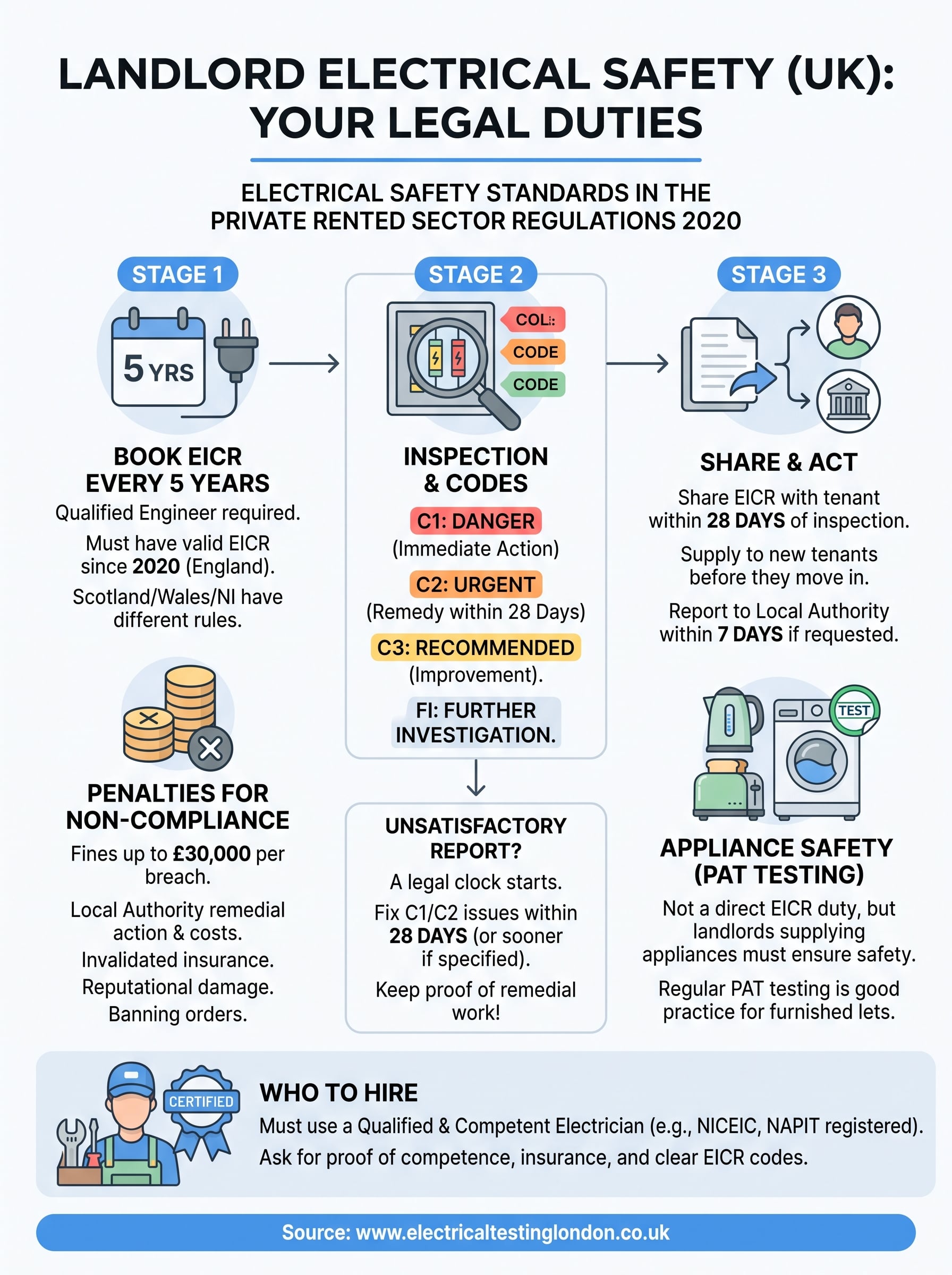
Keeping your rental property safe and compliant
Electrical safety for landlords boils down to a few unmissable habits: book your EICR every five years, act on any C1 or C2 code within 28 days, keep PAT testing current on anything you supply, and hire a properly qualified electrician for all of it. Skip any one of these steps and you're exposed to fines up to £30,000, invalidated insurance, and a genuinely unsafe property for whoever's living in it. None of that is worth the risk when compliance is straightforward once you've got the right person handling it.
Rather than juggling deadlines and paperwork yourself, get a professional team to manage the whole cycle for you, inspections, certificates, and remedial work included. Request a quote from Electrical Testing London and get your property properly assessed before your next deadline sneaks up on you.