






Electrical Visual Inspection Report: VIR vs EICR Explained



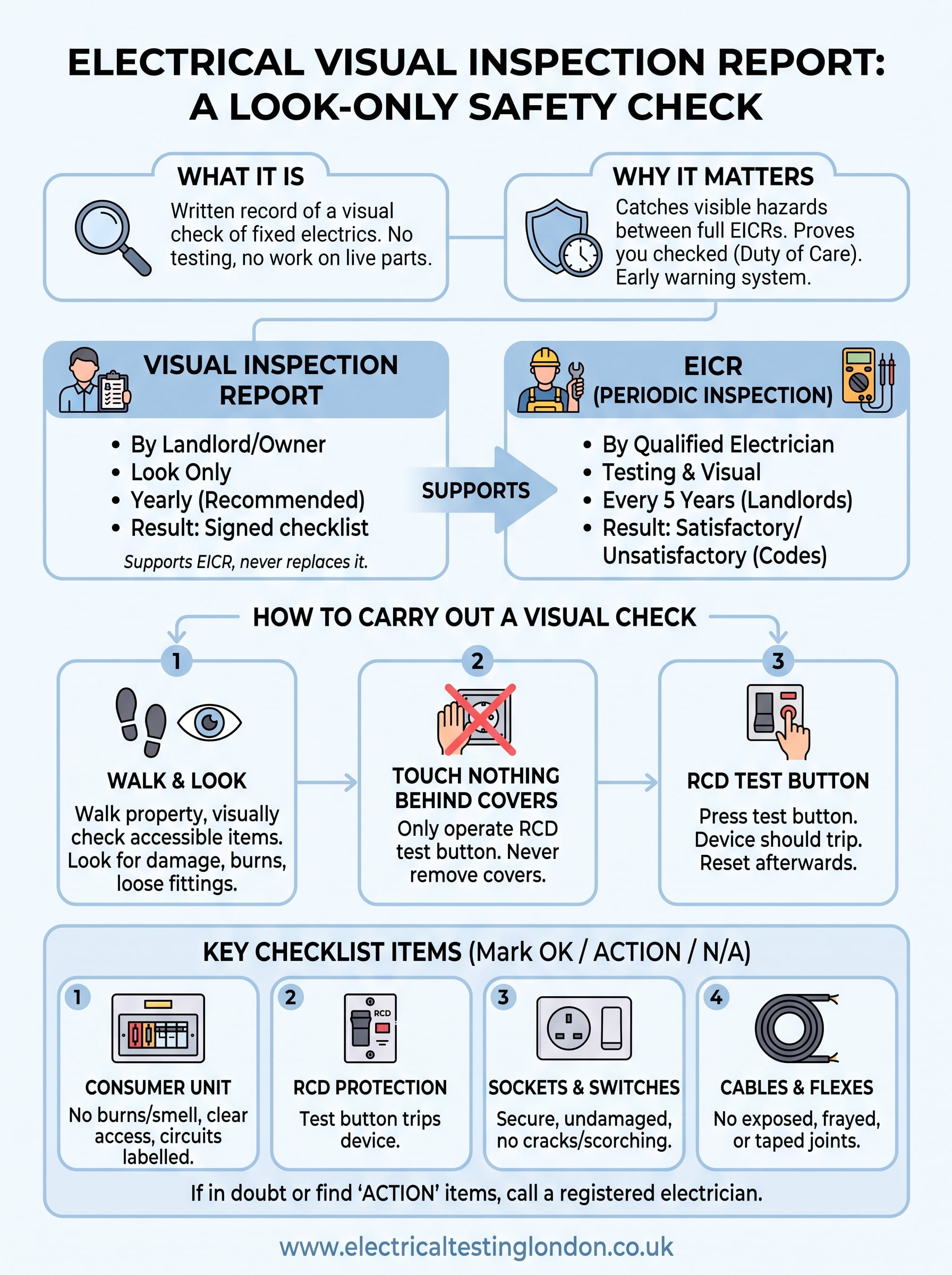
An electrical visual inspection report is a written record of a look-only check of a property's fixed electrics. Nobody tests anything or works on live parts. You look for burning, damage, loose fittings, missing covers and signs of DIY alterations, then record what you found, the date and who checked. It supports a full Electrical Installation Condition Report (EICR) but never replaces it.
This article explains why the report matters and how to carry out the check safely. It also gives you a form to copy into your own document, and shows when you need the formal periodic inspection report for an electrical installation instead.
Electrical Testing London carries out EICRs for landlords, homeowners and businesses across London and the South East, so we know where a visual check ends and testing has to begin.
Why a visual inspection report matters
A visual inspection report matters because it proves you checked, and it catches visible hazards in the years between full EICRs. For a landlord, that record is evidence of a duty of care to tenants. For a homeowner, it is a cheap early warning.
What the report does for you
Landlords should make visual checks at least once a year and ideally at every change of tenancy. A sensible check takes under an hour. The signed and dated record is what an insurer, mortgage provider or tenant may ask to see if something goes wrong.
Homeowners have no legal duty to produce one, but the habit pays off. Run a check after builders have been in, before you buy or sell, and whenever a socket feels warm or a breaker keeps tripping.
Visual inspection report vs EICR
The two documents answer different questions. A visual report says nothing looks wrong. An EICR says the installation has been tested and is safe to use.
|
|
Visual inspection report |
EICR |
|---|---|---|
|
Done by |
Landlord, owner or electrician |
Qualified, competent electrician |
|
Method |
Looking only |
Visual inspection plus testing |
|
Tests |
None |
Continuity, insulation resistance, polarity, earth fault loop impedance, RCD |
|
Frequency |
Yearly and at tenancy change (recommended) |
At least every 5 years for private rented homes in England, every 10 years recommended for owner-occupiers |
|
Legal standing |
Supports your duty of care |
Legally required for private landlords in England |
|
Result |
Signed checklist |
Satisfactory or Unsatisfactory, with C1, C2, C3 and FI codes |
A visual check shows you looked, and only an EICR shows that the wiring behind the wall is sound.
How to carry out a visual electrical inspection
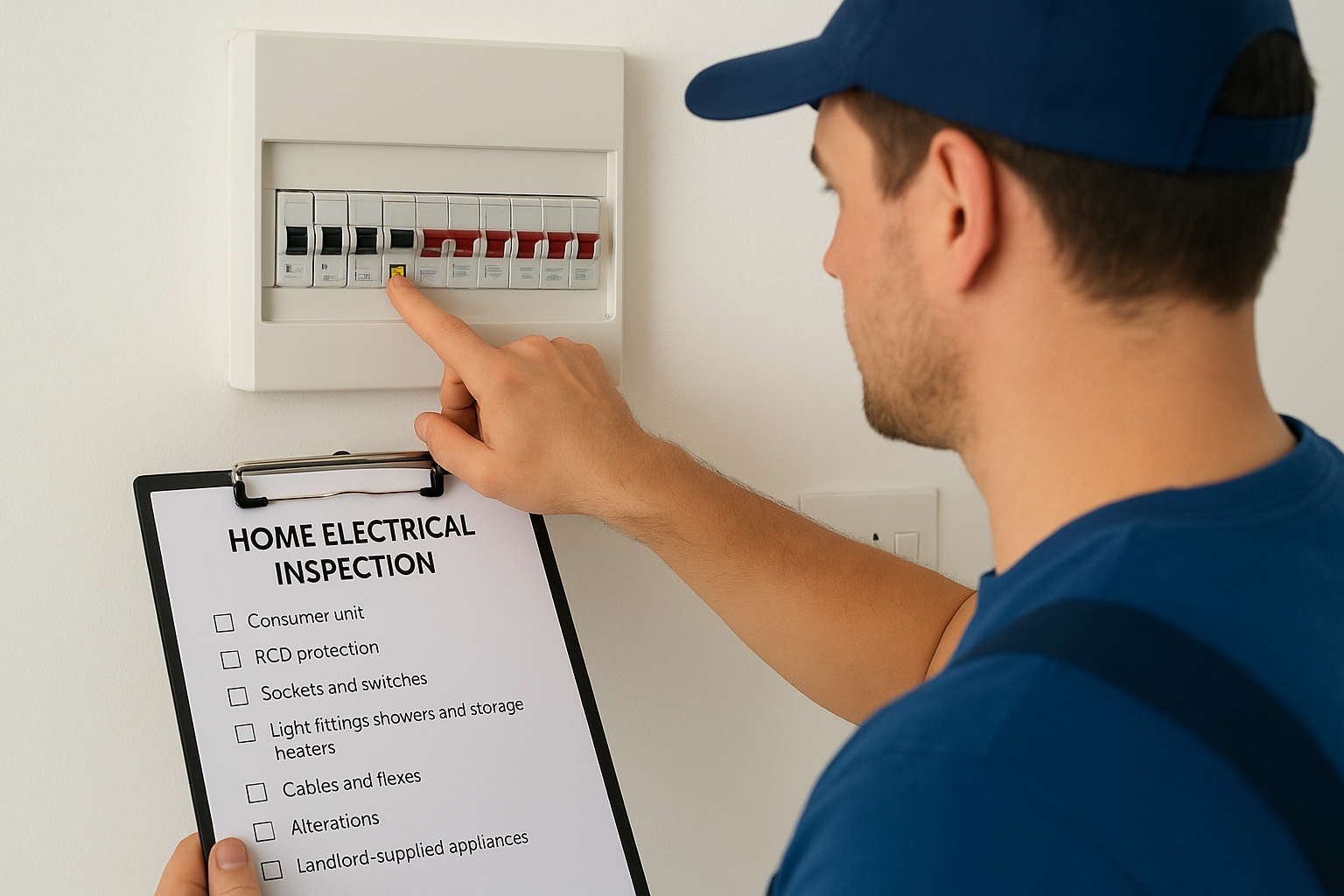
Walk the property with a home electrical inspection checklist, look at everything, and touch nothing that is behind a cover. The only control you should operate is the RCD test button. If you cannot confirm a point, call a registered electrician.
Before you start
Never remove the consumer unit cover or any faceplate. You are checking the outside of the installation only. If you smell burning or see scorch marks, switch off at the main switch if it is safe to reach and call an electrician before using that circuit again.
If the property is let, ask the tenant first. Frequent RCD tripping, flickering lights or warm sockets are things a tenant notices long before a landlord does.
What to check
Work through these areas in order:
-
Consumer unit: no missing blanks, circuits clearly labelled, no burn marks or smell, and clear access with nothing stored in front of it.
-
RCD protection: press the test button. The device should trip. Reset it afterwards.
-
Sockets and switches: no cracks, scorching or loose plates. Plug a lamp into each socket to confirm it works.
-
Light fittings, showers and storage heaters: securely fixed, with no discolouration or melted plastic.
-
Cables and flexes: nothing exposed, frayed or joined with tape.
-
Alterations: no new sockets, extension wiring or mismatched accessories that a previous occupant may have added.
-
Landlord-supplied appliances: undamaged leads and plugs, and no overloaded adaptors.
If you cannot confirm a point on your checklist, treat it as a fail and ask an electrician.
An electrical safety inspection form you can copy
A usable electrical inspection report form records the property, the date, who checked, each item's result and what happens next. Copy the template below into a document or spreadsheet and adapt it. It follows the same points as the checklist above.
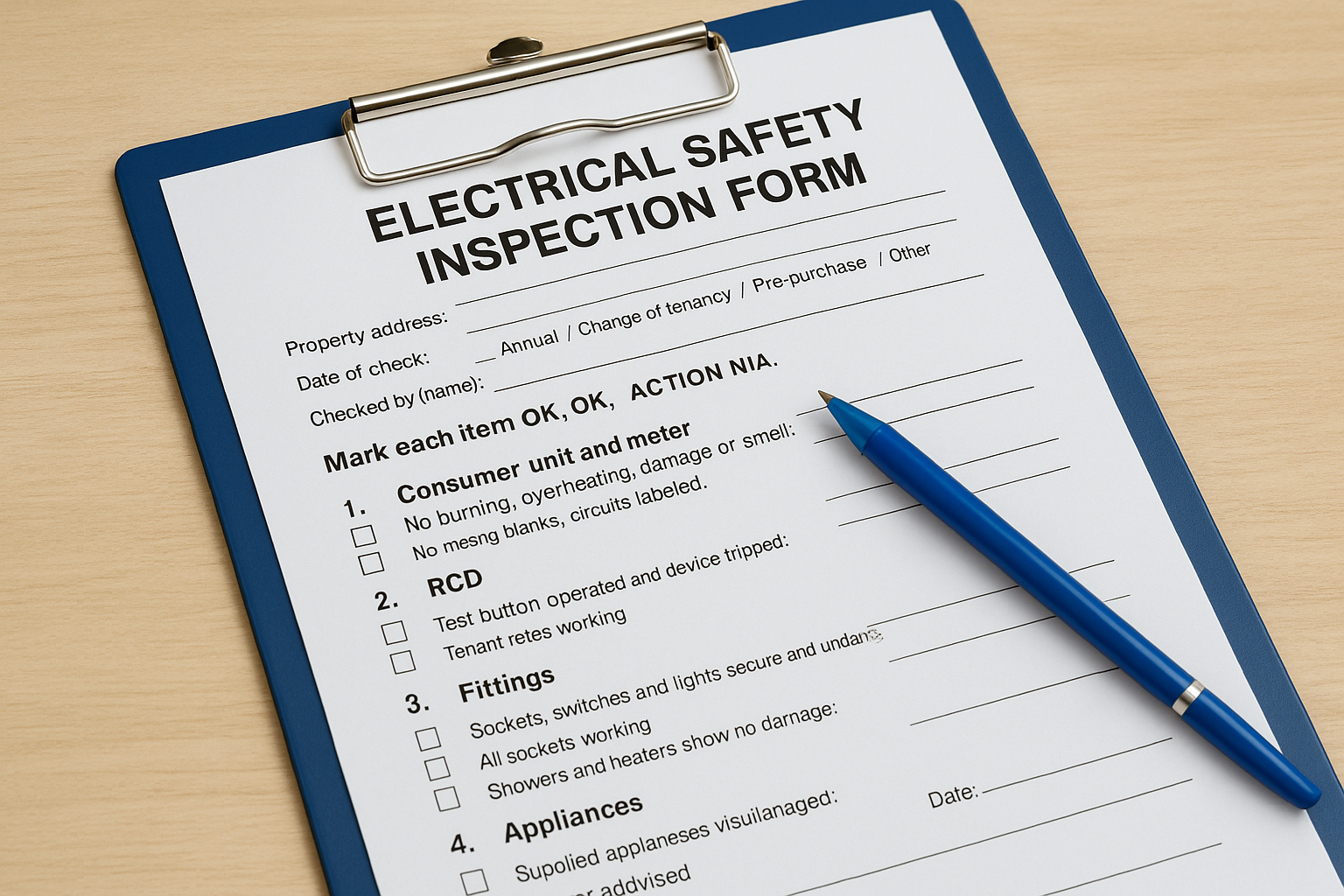
Copy-and-use template
ELECTRICAL VISUAL INSPECTION REPORT

Property address:
Date of check:
Checked by (name):
Reason: Annual / Change of tenancy / Pre-purchase / Other

Mark each item OK, ACTION or N/A.

1. Consumer unit and meter
   No burning, overheating, damage or smell: ___
   No missing blanks, circuits labelled: ___
   Access clear of storage: ___
2. RCD
   Test button operated and device tripped: ___
   Tenant reports no frequent tripping: ___
3. Fittings
   Sockets, switches and lights secure and undamaged: ___
   All sockets working: ___
   Showers and heaters show no damage: ___
4. Alterations and cables
   No exposed or damaged cables: ___
   No signs of DIY alteration: ___
5. Appliances
   Supplied appliances visually undamaged: ___
   Tenant advised not to overload sockets: ___

Items marked ACTION and date for remedial work:

Signature (checker):          Date:
Signature (tenant):           Date:
How to complete and store it
Use one form per property and one per visit. Mark every line, because a blank line looks like a missed check. Any ACTION entry needs a date next to it for the follow-up, and the form should say who will do the work.
Treat the form as valid for one year from the date of the check. Keep it with your tenancy paperwork, and get the tenant's signature, since a tenant's answers only count if they sign. This form is a record of your own check. It is not the formal periodic inspection report, which only a qualified electrician can complete.
A form with blanks proves nothing, so mark every line and date it.
When you need a full periodic inspection report
You need the formal report when the legal interval arrives, when your visual check turns up something you cannot explain, or when you are buying a property. A periodic inspection report for an electrical installation is the EICR, completed on the BS 7671 model form after real testing.
What the formal report records
The electrician inspects, tests the circuits, then codes every finding. C1 means danger present and needs immediate action. C2 means potentially dangerous and needs urgent remedial work. C3 is an improvement recommendation. FI means further investigation is required. Any C1 or C2 makes the report Unsatisfactory.
In England, private landlords must have an EICR at least every five years. They must also complete any required remedial work within 28 days, or sooner if the report says so. You cannot fill in this form yourself. Electrical Testing London prepares its EICR certificates electronically, so there is no blank form to complete.
What an EICR costs in London
Our domestic EICR prices depend on property size and include up to eight circuits:
|
Property |
Price |
|---|---|
|
Studio |
£115 |
|
1 bedroom |
£130 |
|
2 bedroom |
£145 |
|
3 bedroom |
£155 |
|
4 bedroom |
£170 |
|
5 bedroom |
£190 |
|
6 bedroom |
£210 |
Extra circuits cost £15 each plus VAT. Take a landlord with a two-bedroom flat and ten circuits. That is £145 plus two extra circuits at £15, which makes £175 before VAT on the extras. The certificate is valid for five years or until a change of tenancy. Over those five years your own visual checks cost only your time, while the EICR is the one paid test. A domestic inspection typically takes 2 to 4 hours.
Visual checks fill the gaps between EICRs, but they cannot stand in for one.
Keep the record, then book the test
An electrical visual inspection report is a simple, honest record that you looked. Do it yearly and at each change of tenancy, mark every line of the form, and act on anything marked ACTION. It protects your tenants and your paperwork, but it cannot see inside walls or measure how a circuit behaves under fault.
That is the job of the full periodic inspection. If your five years are up, your visual check raised doubts, or you are buying a home, book an EICR rather than waiting. If you are in London or the South East, you can request a quote for an EICR and get the price confirmed before any work is booked.