






Electrical Visual Inspection Report PDF: What to Include



If you are searching for an electrical visual inspection report PDF, you probably want a form you can fill in on site and hand over without fuss. The trouble is that many free templates are thin. They give you a tick-box list and a signature line, then leave you exposed when a landlord, insurer or client asks what was actually checked.
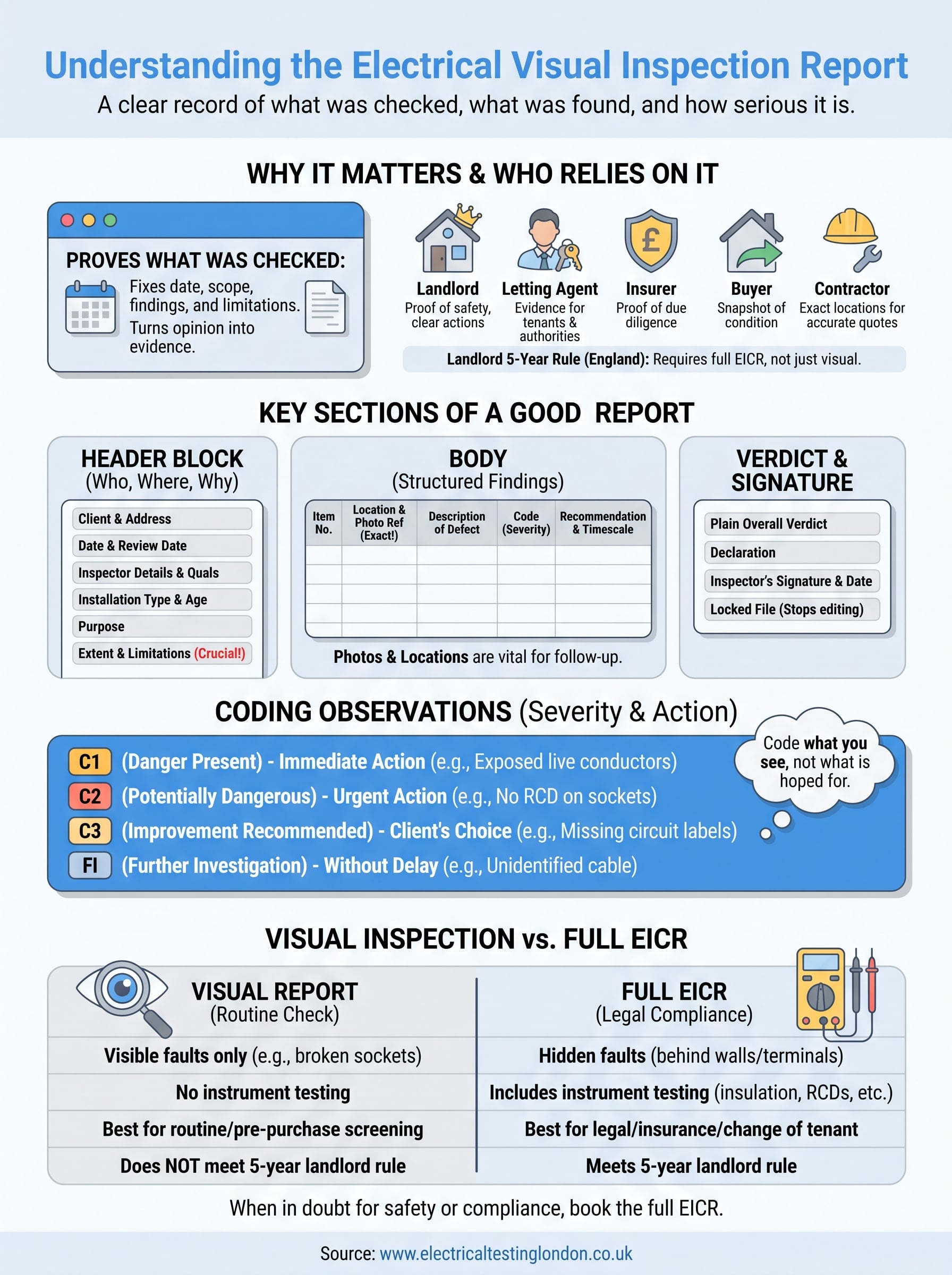
A good report records what you inspected, what you found, and how serious it is. That means the installation details, the extent and limitations of the inspection, observations with clear defect codes, and a plain overall verdict. It also needs the inspector's name, qualifications and date, so the document stands up if anyone questions it.
This article walks through each section a visual inspection report should contain, and explains why it matters. We carry out EICRs and visual inspections across London and the South East every week, so the advice comes from reports we write ourselves. You will also see where a visual-only record stops being enough and a full EICR becomes the safer route.
Why a visual inspection report matters
Most problems in an installation can be spotted before any test meter comes out. Scorched accessories, missing blanks in a consumer unit, damaged cable sheaths and DIY additions all show up to a trained eye. A written record turns an opinion into evidence, so the electrical inspection report PDF you choose deserves some thought.
It proves what was checked
Without a record, a visual inspection is just a conversation. A report fixes the date, scope and findings in one document. If a fault appears six months later, you can show what was visible on the day and what was outside the inspection.
Limitations matter as much as findings. Note which rooms were locked, which circuits could not be isolated and which areas sat behind fixed furniture. Recording limitations protects you from being blamed for something nobody could have seen.
A visual inspection you did not write down is a visual inspection you cannot prove.
Who relies on the document
Several people read the same report, and each wants something different from it. A weak form fails at least one of them.
|
Reader |
What they need from the report |
|---|---|
|
Landlord |
Proof of a safety check and a clear list of actions |
|
Letting agent |
Evidence to show tenants and local authorities |
|
Insurer |
Proof of due diligence after a claim |
|
Buyer |
A snapshot of condition before exchange |
|
Contractor |
Exact locations of each defect, so quotes are accurate |
The legal side is blunt for landlords. In England, the Electrical Safety Standards in the Private Rented Sector Regulations 2020 require inspection and testing at least every five years, with a copy of the report given to tenants within 28 days. A visual-only record is useful for routine checks between those dates, but it does not replace the full report that landlord electrical safety requirements ask for.
How to build an electrical visual inspection report
Whether you download an electrical visual inspection report PDF or draft your own, keep the structure fixed. A consistent layout means nothing gets skipped, and any reader can find what they need in seconds.
Start with the header block
Begin with who, where and why. An unsigned, undated form carries little weight, so the top of the page must identify the property and the person responsible. Put the extent and limitations here too, before any findings.
-
Client name and site address
-
Date of inspection and recommended next review date
-
Inspector's name, qualifications and company
-
Installation type and approximate age
-
Purpose of the report
-
Areas and circuits covered, and anything left out
Set out the body in a fixed order
Work through the rest in the order you inspect. Any good visual electrical inspection report template follows a sequence like this:
-
Extent and limitations
-
Observations table with item number, location, description, code and photo reference
-
Summary and overall verdict
-
Declaration and signature
Fillable fields keep the text legible, and a locked file stops anyone editing it after signing. Give every defect an exact location and a photo reference, for example "kitchen, socket behind the fridge, cracked faceplate". Contractors quoting from your electrical inspection report template PDF can then price the work without a second site visit.
A defect without a location is a defect nobody can fix.
What to check and record during the inspection
A visual inspection only works if you check the same things in the same order every time. Good electrical visual inspection report forms split the job into zones, so nothing slips through. Work from the supply intake outwards, and never remove covers from live equipment.
Consumer unit and main equipment
Start at the board, because it shows the most about an installation's age and upkeep. Look for scorch marks, missing blanks and mismatched breakers. Confirm the socket circuits have RCD protection and that the circuit labels match what is actually wired.

-
Main switch and enclosure condition
-
Earthing and bonding conductors present, labelled and clamped
-
Surge protection, where fitted
-
Signs of heat damage or water ingress
Circuits, accessories and wiring
Next, walk every room and check what a tenant or occupier touches daily. Cracked faceplates and loose fixings are the most common finds, so look at every one.
|
Item |
What to look for |
|---|---|
|
Sockets and switches |
Burn marks, cracks, loose fixings |
|
Cables and flex |
Damaged sheaths, exposed conductors, overloaded extensions |
|
Light fittings |
Overheating, missing covers, wrong lamp wattage |
|
Bathrooms |
Suitably rated fittings, visible bonding |
|
Outbuildings and gardens |
Correct cable type, RCD protection |
What to record for each item
Write down the location, the defect and a photo reference as you go, not afterwards from memory. Memory fills gaps with guesses, and guesses do not belong in a signed report.
If you could not inspect something, say so. Record "not inspected" with a reason rather than leaving a box blank.
A blank box says nothing, but "not inspected" tells the reader exactly where your responsibility ends.
How to code observations and write recommendations
Coding is where a report earns its keep. Every observation needs a code that shows how urgent it is, plus a recommendation that says what happens next. Use the same EICR certificate codes, so nobody has to learn a second system.
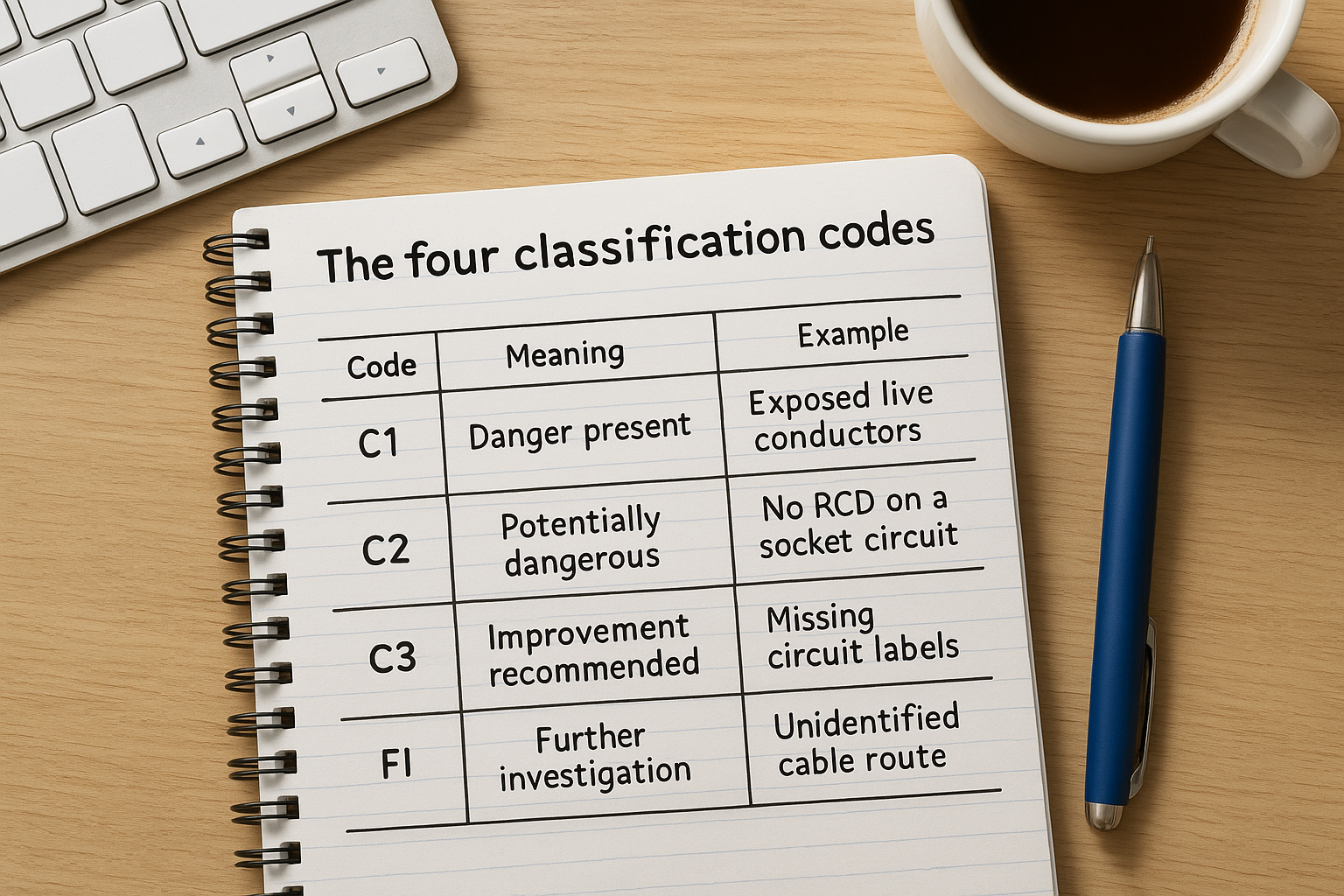
The four classification codes
Four codes cover almost every finding. C1 means danger is present, so you make it safe on the spot. FI means further investigation, because you cannot tell how serious the problem is from what you can see.
|
Code |
Meaning |
Action |
Example |
|---|---|---|---|
|
C1 |
Danger present |
Immediate |
Exposed live conductors |
|
C2 |
Potentially dangerous |
Urgent |
No RCD on a socket circuit |
|
C3 |
Improvement recommended |
Client's choice |
Missing circuit labels |
|
FI |
Further investigation |
Without delay |
Unidentified cable route |
Code what you see, never what the client hopes to hear.
Writing recommendations that get acted on
Good recommendations name the action, the location and the timescale. "Replace cracked faceplate, kitchen socket behind fridge, within 28 days" beats "socket needs attention". For rented homes in England, C1, C2 and FI items need remedial works within 28 days, or sooner if the report says so.
Finally, keep opinion out of the wording. State the fact, cite the code, give the fix. Whichever electrical inspection report PDF you use, add a code column and a recommendation column to every row, so the summary can be built from the table in minutes.
Visual report vs EICR and choosing the right PDF form
Both documents record the state of an installation, but they answer different questions. Before you rely on an electrical visual inspection report PDF, be clear about what it cannot tell you.
Where a visual report stops
Inspection by eye shows what is visible. An EICR adds instrument testing, including insulation resistance, continuity, earth fault loop impedance and RCD trip times. Those readings expose faults hidden in walls and behind terminals.
|
|
Visual report |
EICR |
|---|---|---|
|
Instrument testing |
No |
Yes |
|
Follows BS 7671 model forms |
Optional |
Yes |
|
Meets the landlord five-year rule |
No |
Yes |
|
Best for |
Routine checks, pre-purchase screening |
Legal compliance, insurance, change of tenant |
A visual report shows what looks wrong; only an EICR shows whether the installation is safe.
Choosing the right PDF form
Pick the form by purpose. A visual template is fine for a quick condition check between inspections. If a regulation, lender or insurer is involved, you need a full electrical installation condition report form completed by a qualified inspector. Whichever you choose, check it includes:
-
A section for extent and limitations
-
A code column using C1, C2, C3 and FI
-
A photo reference for every observation
-
The inspector's name, qualifications and signature
-
Fillable fields, with the option to lock the file after signing
When in doubt, book the full EICR. A thin form saves a few minutes on the day and costs far more if the report is rejected later.
Putting your report to use
A good electrical visual inspection report PDF does one job well. It records what was checked, what was found and what happens next, in a layout anyone can follow. Fixed headers, exact locations, photo references and consistent C1, C2, C3 and FI codes turn a quick look into evidence you can rely on.
Use the visual form for routine checks and pre-purchase screening. Once a landlord, insurer or lender is involved, move to a full EICR, because only instrument testing shows whether the installation is safe. Keep every signed report, share it with the people who rely on it and diary the next review date.
Not sure which document you need, or want a qualified engineer to write it for you? Request a quote from our London team and we will advise on the right inspection for your property.