


Emergency Light Testing Frequency Regulations in the UK


Section 1
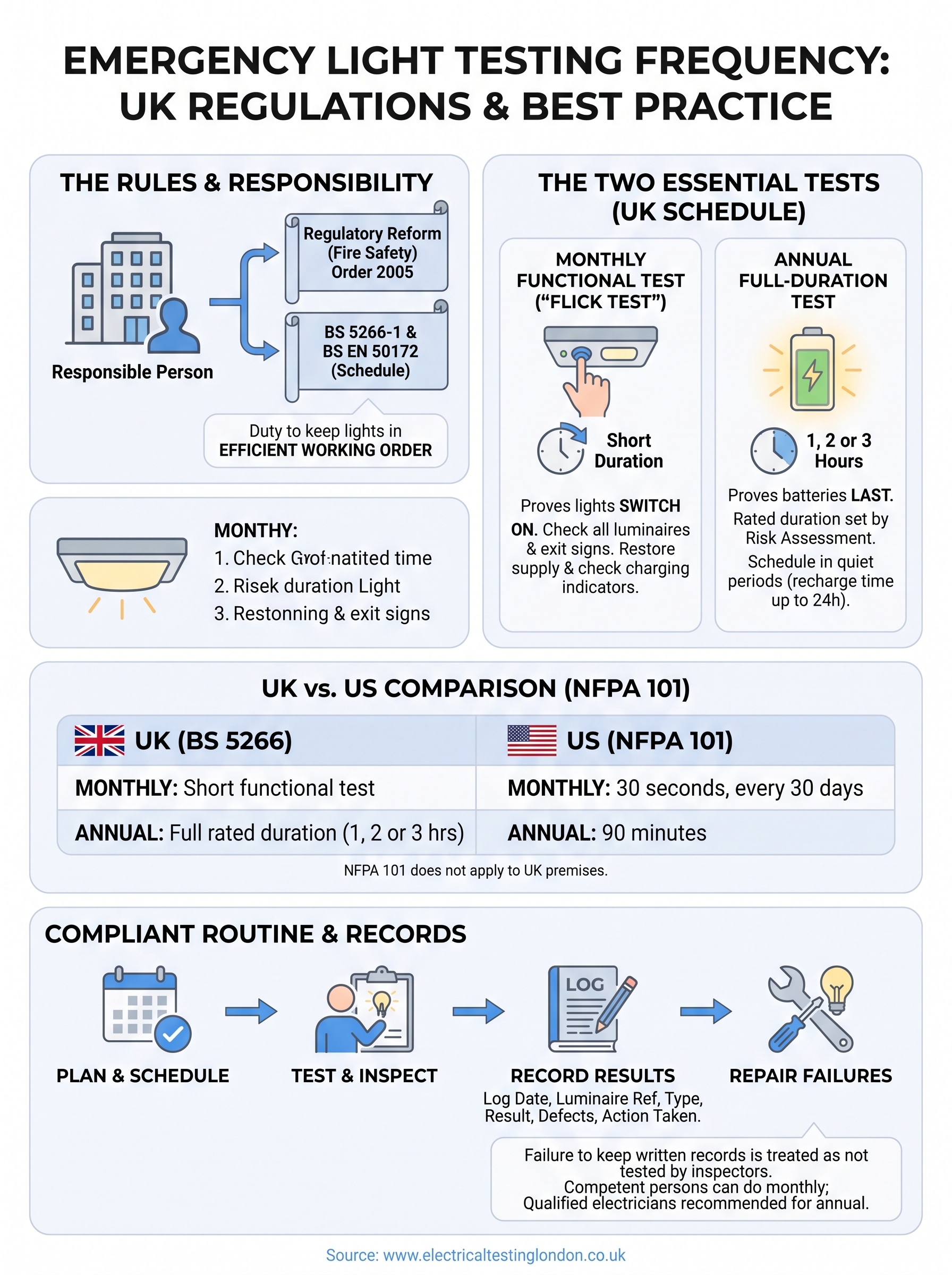
Emergency light testing frequency regulations come down to two routine tests: a short functional test every month and a full-duration test once a year. In the UK, BS 5266-1 and BS EN 50172 set that schedule, and the Regulatory Reform (Fire Safety) Order 2005 makes the person in charge of the premises responsible for keeping the lights working. In the US, NFPA 101 follows the same pattern, with a 30-second test every 30 days and a 90-minute test every year.
In plain terms, the rules tell you how often to prove that your escape lighting will switch to battery power and stay on long enough for everyone to leave. The monthly test proves the lights switch on. The annual test proves the batteries last.
This article explains why the frequency is regulated, what each test involves and how the UK rules compare with NFPA 101. It also shows how to run a routine that stands up to inspection. Electrical Testing London provides emergency light testing across London and the South East.
Why emergency light testing frequency is regulated
The frequency is regulated because emergency lights sit idle for months and are only needed once the mains has already failed. A dead battery gives no warning, so the rules force you to check on a fixed rhythm.
The legal duty on the responsible person
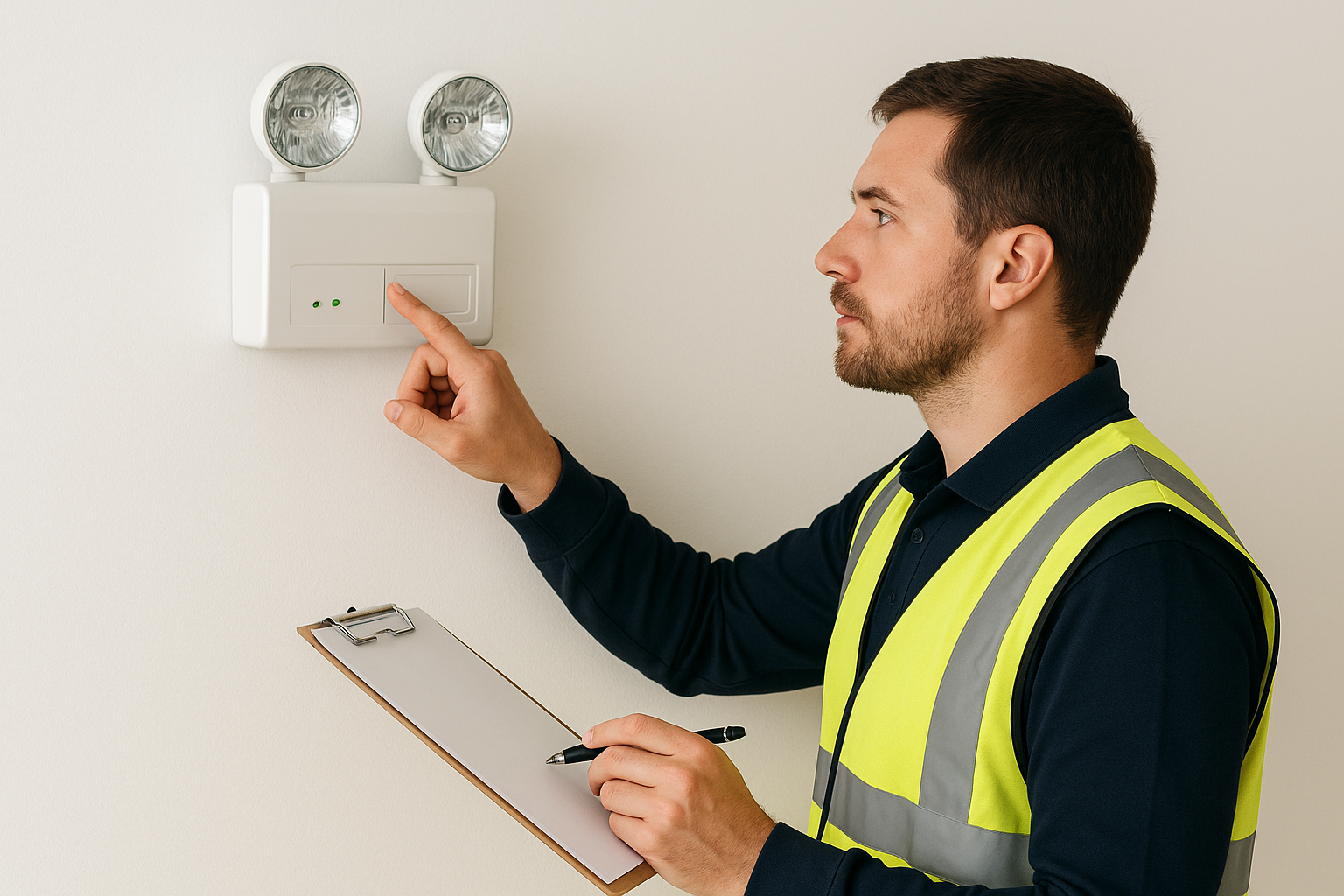
In England and Wales, the Regulatory Reform (Fire Safety) Order 2005 puts the duty on the responsible person. That is usually the employer, owner, landlord or managing agent who controls the premises. They must provide emergency lighting on escape routes where the fire risk assessment calls for it. They must also keep it in efficient working order.
The Order does not name a test interval. BS 5266-1 and BS EN 50172 (also published as BS 5266-8) do, and fire and rescue inspectors treat them as the benchmark. Scotland and Northern Ireland have their own fire legislation. Failures can lead to enforcement notices, fines and, in serious cases, prosecution.
The standards are not statute, but ignoring their schedule makes "efficient working order" very hard to defend.
What goes wrong when you skip tests
Batteries lose capacity with age and heat. Lamps fail. Chargers develop faults. Isolators get switched off during building work, and fittings get painted over or boxed in.
A monthly test catches the dead lamp or the missing charge while you still have time to fix it. Only the full-duration test catches a battery that lights for a minute and then fades at minute twenty. That is why the rules need both tests and not just one.
What the monthly and annual tests require
The UK schedule is a short functional test every month and a full rated-duration test every year, with both recorded in writing.
The monthly functional test
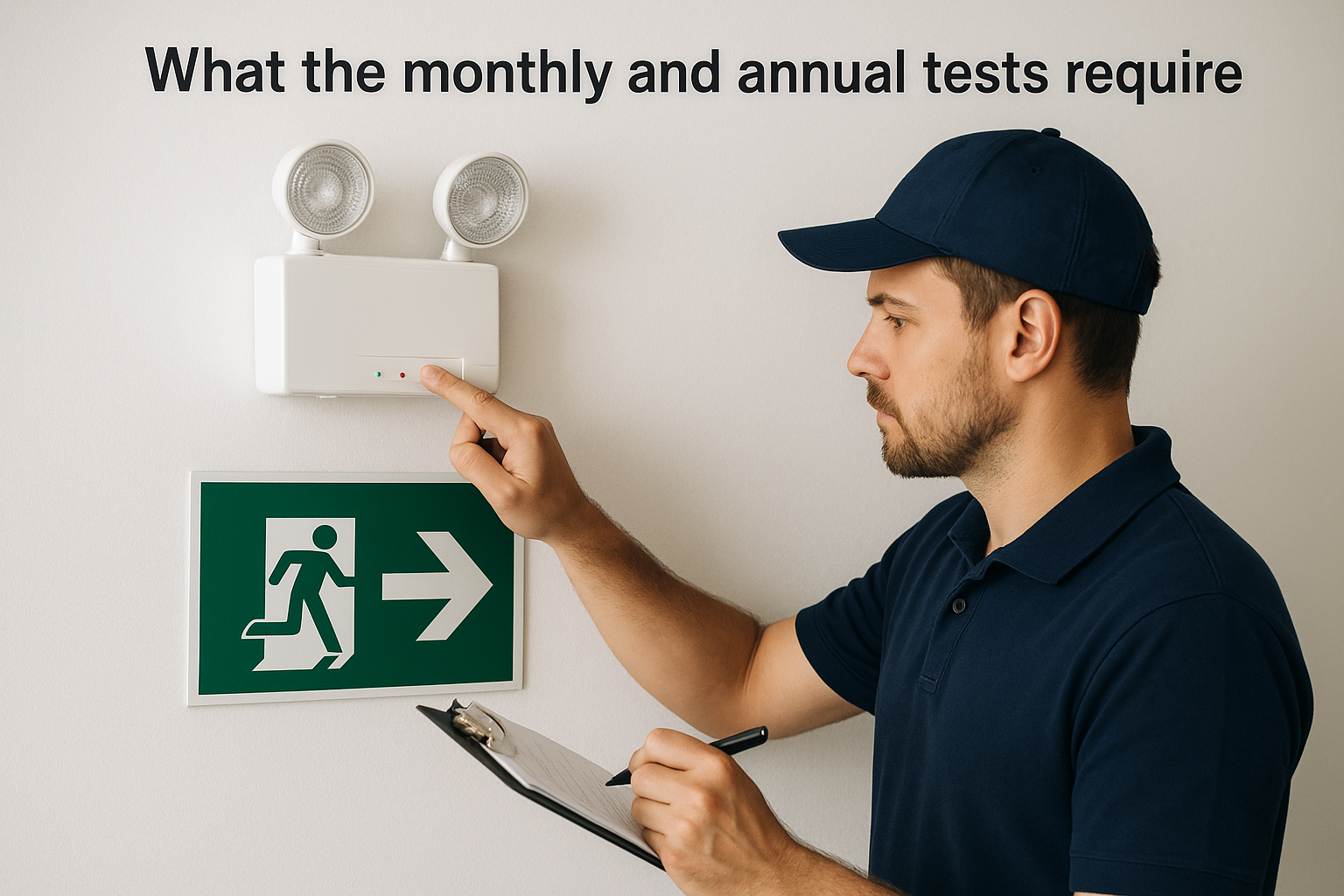
Each month you simulate a failure of the normal supply, usually with a key switch or test button, which is why it is called a flick test. Hold it long enough to confirm that every luminaire and exit sign lights. Then restore the supply and check the charging indicators. Central battery systems also need a daily glance at their indicator lamps.
The annual full-duration test
Once a year the lights must run for their full rated duration, which is one, two or three hours. Your fire risk assessment sets the rating. Three hours is common where people sleep on the premises or where the building may be reoccupied soon after a power failure. Every fitting must still be lit at the end.
Batteries can take up to 24 hours to recharge afterwards. Schedule the test for a quiet period, so you are not left with flat batteries while people are in the building.
The monthly test proves the light works. The annual test proves the battery lasts.
UK rules and NFPA 101 compared
|
|
UK (BS 5266 and BS EN 50172) |
NFPA 101 (US) |
|---|---|---|
|
Monthly test |
Short functional test |
30 seconds, every 30 days |
|
Annual test |
Full rated duration (1, 2 or 3 hours) |
90 minutes |
|
Records |
Written log book |
Written records |
|
Enforced by |
Fire and rescue authority |
Authority having jurisdiction |
NFPA 101 does not apply to UK premises. If a US-based tenant or insurer asks for it, a one-hour rated system would need a longer annual test to reach NFPA's 90 minutes.
How to run a compliant test routine
A compliant routine means fixing a calendar date, testing every fitting in the same order, recording every result and repairing failures straight away.
A repeatable monthly and annual routine
Follow the same steps each time:
-
Pick a quiet time and tell staff or occupants.
-
Work from a numbered schedule of every luminaire and exit sign on your escape routes.
-
Run the flick test each month, or the full-duration test once a year.
-
Check each fitting during and at the end of the test, and note any that are dim or dark.
-
Restore the supply and confirm the charge indicators come back on.
-
Log the results the same day.
-
Replace failed lamps or batteries and retest them.
Keep the numbered schedule up to date when you move walls, add rooms or change layouts. A fitting that is not on the schedule will never get tested.
If a test is not written down, an inspector will treat it as not done.
Log books and self-testing systems
Each entry in your emergency lighting log book should record the date, luminaire reference, test type, result, defects found and action taken, plus who carried out the test. Keep the log on site, where an inspector can ask for it.
Self-testing and automatic test systems (BS EN 62034) run the tests and store results for you. Someone still has to review the logs, act on failures and inspect the fittings visually, so automation reduces the legwork but not the responsibility.
What testing costs and who should do it
Anyone competent can run a monthly flick test. The annual test, the repairs and the certificate are better handled by a qualified electrician.
Who can carry out the tests
If you manage the premises, trained staff can do the monthly test in-house. Annual testing needs more time and a proper record, and it ends with a certificate for your file. Electrical Testing London's engineers are fully qualified, have at least 10 years of experience and issue an emergency lighting test certificate.
What the listed prices look like
Our current prices for London and the South East are:
|
Test |
Weekday 8am to 5pm |
Weekday 5pm to 10pm |
|---|---|---|
|
Monthly flick test |
£80 |
£95 |
|
Annual test (usually 3 hours) |
£199 |
£249 |
For a worked example, take a daytime schedule of twelve monthly tests and one annual test. That is 12 × £80 + £199 = £1,159 a year. The same schedule in the evening is 12 × £95 + £249 = £1,389. Ask for a quote so that you know exactly what it covers for your premises.
Keep the schedule and keep the log
Test monthly, test for the full rated duration once a year, and write down every result. That is what the standards ask for, and it is what an inspector will check. NFPA 101 sets near-identical intervals in the US, but for UK premises BS 5266 and the Fire Safety Order are the rules that count.
If you would rather hand the routine to qualified engineers, request a quote for emergency light testing and we will set up your monthly and annual tests.

