





Emergency Light Testing Key: How It Simulates a Power Cut



You need to test your emergency lighting, but you cannot switch off the whole building's power every month. That is exactly the problem an emergency light testing key solves. If you are searching for one to buy, you want to know what it does and which type fits your system.
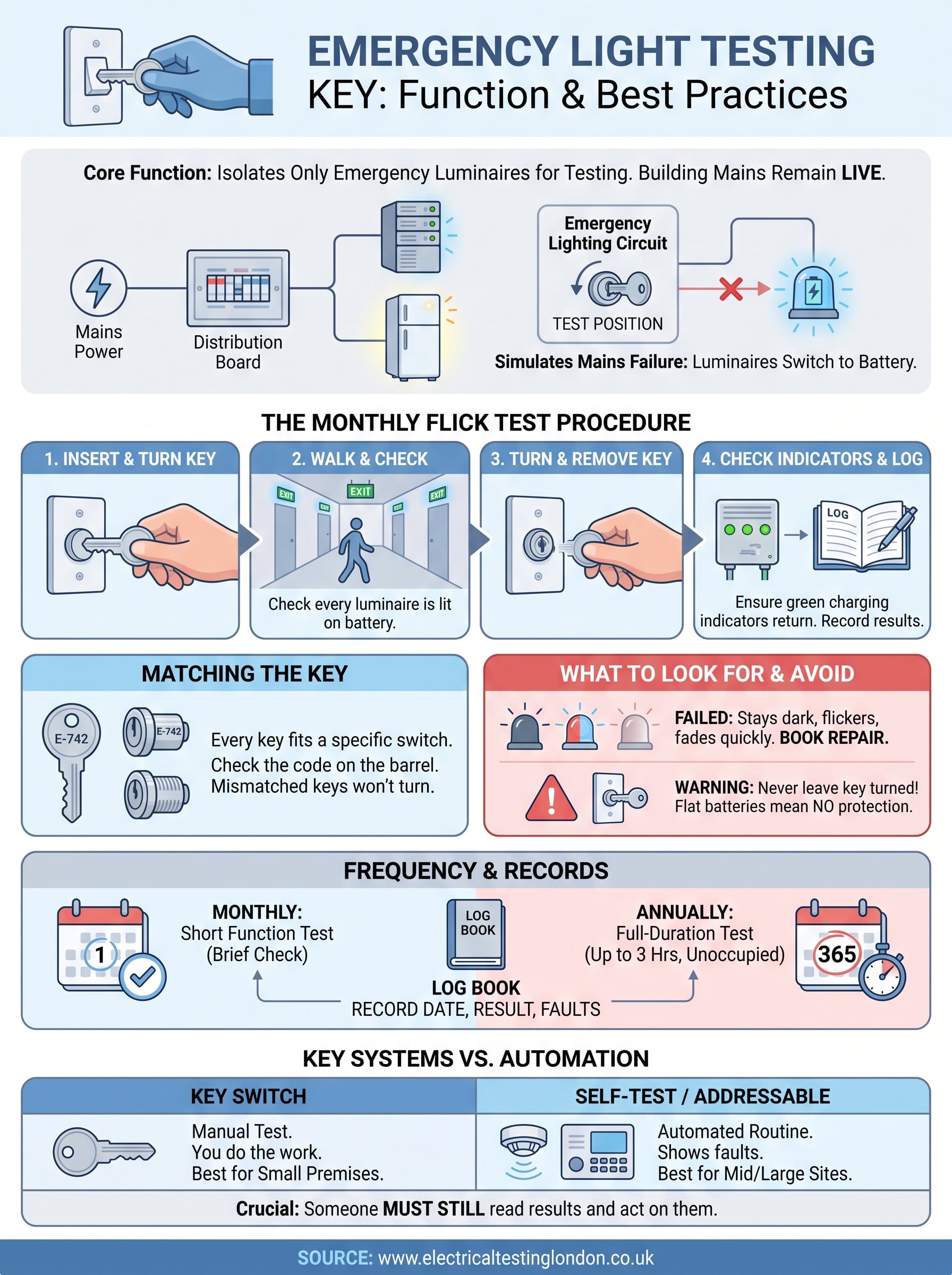
The short answer: a test key is a small key switch, usually fitted near the distribution board or the lighting circuit. Turning it cuts the permanent mains supply to the emergency luminaires, so they think there has been a power cut and switch to battery. The rest of the building stays live. Release the key and the lights return to mains and the batteries recharge.
Below, we explain how the key works in the circuit, the main types of key switch and how to check you are buying a compatible one. We also cover what the monthly flick test does not tell you. As electrical testing engineers working across London, we see this misunderstood on site often, so we have kept it practical.
Why the emergency light testing key matters
It isolates only the emergency fittings
Emergency luminaires monitor the normal lighting supply. When that supply drops, they switch to battery. A test key interrupts the supply they monitor, so you can simulate a mains failure on the emergency fittings alone. Everything else in the building keeps running.
The key also controls who can run a test. Because you remove it afterwards, only authorised people can trigger the lights, and nobody leaves the circuit isolated by accident. Facilities managers often keep the key with the fire log book.
A test key lets you prove the batteries work without switching off the building.
What goes wrong without one
Without a key switch, people improvise. They flip breakers at the consumer unit or distribution board, which is clumsy and often disruptive. Tests get skipped because nobody wants to cut power to a busy office, shop or block of flats. The usual problems look like this:
-
Switching off a whole circuit also drops equipment you did not mean to interrupt, such as servers, fridges and alarm panels.
-
Staff or tenants lose normal lighting, so the test is put off "until later".
-
Dead batteries and failed lamps stay hidden until a real power cut or fire.
That last point is the one that matters. Under the Regulatory Reform (Fire Safety) Order 2005, the responsible person must keep emergency lighting working. BS 5266-1 expects a monthly short function test, and a test key makes that practical rather than a chore.
How to test emergency lighting with a test key
Testing takes minutes once you know the emergency lighting test procedure. Warn occupants first, and pick a quiet moment, because the normal lighting stays on but the emergency fittings will light up.
The monthly flick test
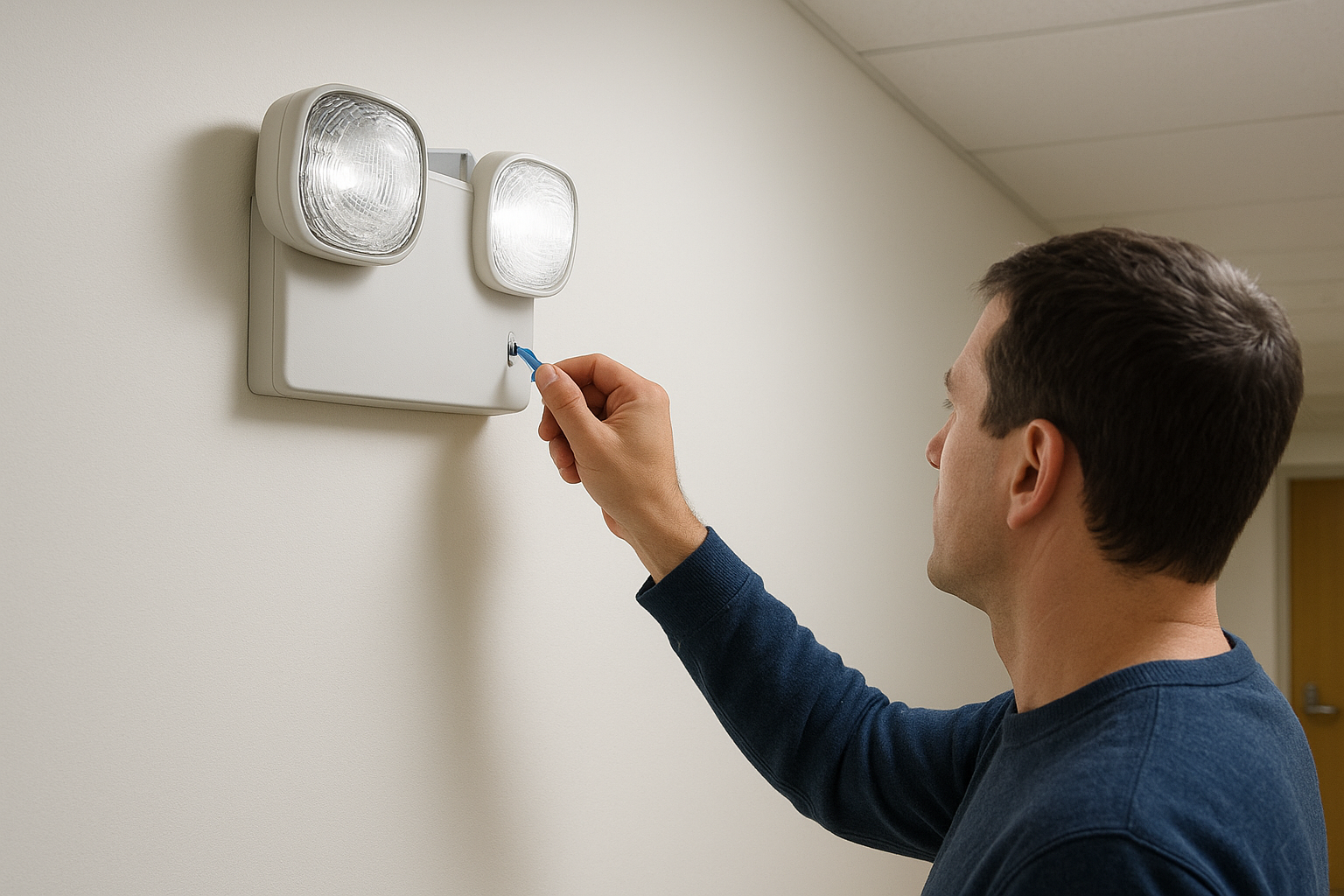
Follow these steps with your emergency light testing key. Keep the test short and, in large premises, work as a pair.
-
Insert the key and turn it to the test position.
-
Walk the escape routes and check every luminaire and exit sign is lit on battery.
-
Turn the key back and remove it.
-
Check the green charging indicators return.
-
Record the date, result and any faults in the log book.
What to look for
Any fitting that stays dark, flickers or fades quickly has a failed lamp or weak battery. Log it and book a repair.
Never leave the key turned. Flat batteries mean no protection if a real power cut follows, and the full-duration test is a separate annual job.
Always return the switch to normal, or the batteries will be flat when you need them.
How to choose the right key for your switch
Match the key to the switch
Start with the lock, not the shop. Every emergency light testing key fits a specific switch, so note the make and any code stamped on the barrel before you order. A mismatched key will not turn, and forcing it damages the lock.
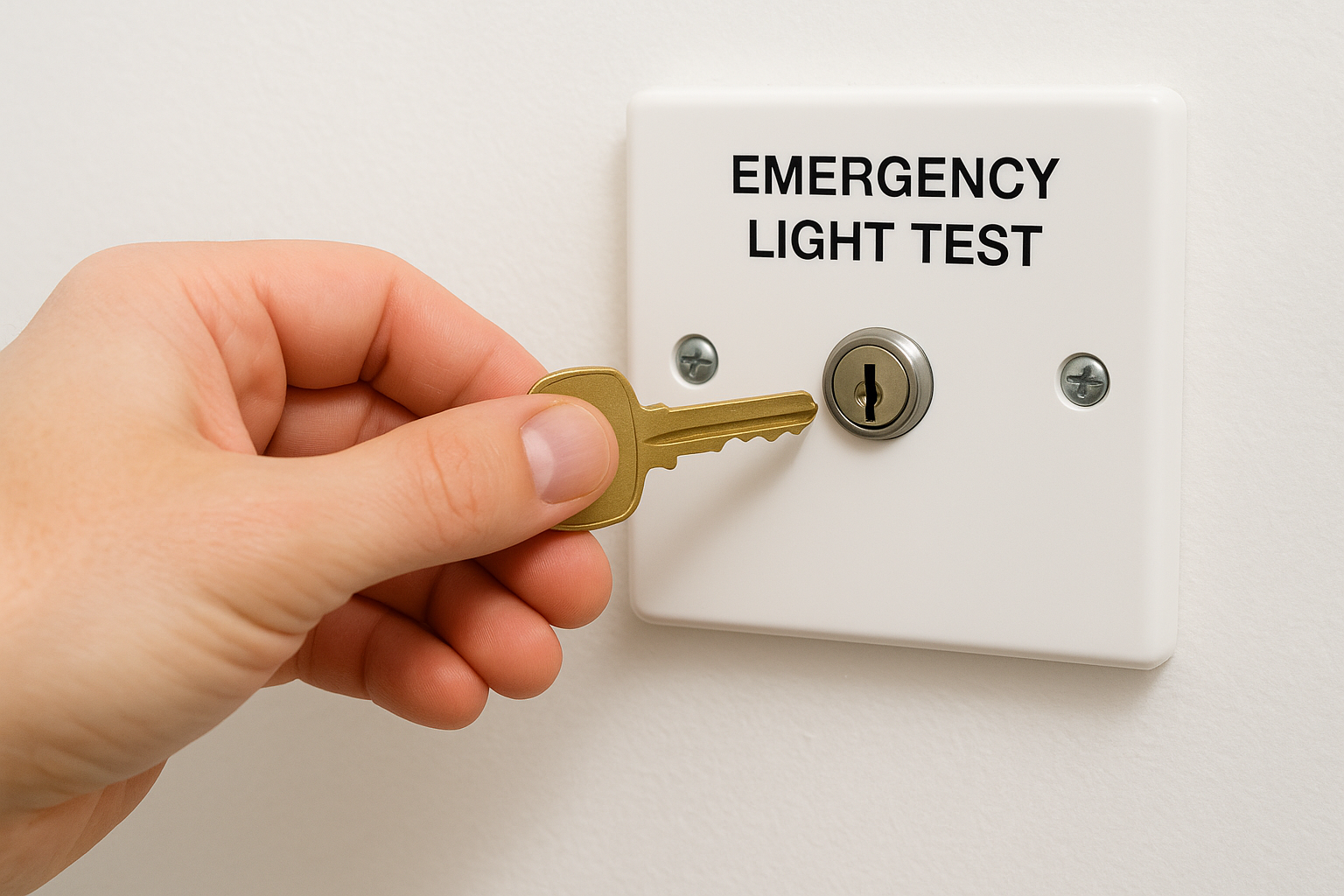
Buy the key to match the switch, never the other way round.
|
Switch type |
Typical use |
Check before buying |
|---|---|---|
|
Single key switch |
One test circuit |
Plate size, amp rating |
|
Multi-gang key switches |
Several lighting circuits |
Whether keys are common or unique |
|
Luminaire test key |
Fittings with a key test point |
Manufacturer and model |
If the key is lost
Lost keys are common in busy buildings. Never bridge or bypass the switch, because that removes the control you fitted it for. Ask the original supplier for a replacement using the code.
Where the code is unreadable, have an electrician fit a new switch and keys. The switch is wired into the lighting circuit, so it is not a job for guesswork.
Test keys versus self-test and addressable systems
Where a key switch still fits
Manual emergency lighting systems with a key switch are still common in older and smaller buildings. They are cheap, and your emergency light testing key gives you full control over when a test runs. The catch is that you do the work, so testing depends on someone remembering.
What self-test and addressable systems change
Self-test luminaires run their own routine and show faults with an LED. Addressable systems go further and report every fitting to a central panel. Both automate routine testing, but someone must still read the results and act on them.
|
System |
Who triggers the test |
Best suited to |
|---|---|---|
|
Key switch |
You |
Small premises, tight budgets |
|
Self-test |
The luminaire |
Mid-size sites with few staff |
|
Addressable |
Central panel |
Large or multi-site buildings |
Automation runs the test, but it never replaces a person checking the result.
Do not rip out a working key system just to follow fashion. Keep the key if your premises are small and your records are good, and consider self-test when you replace ageing fittings anyway.
Testing frequency, records and common mistakes
How often to test
Two tests cover most sites. The monthly function test uses your emergency light testing key, while the annual full-duration test proves the batteries last their rated time.
|
Test |
Frequency |
Method |
|---|---|---|
|
Short function test |
Monthly |
Key switch, brief check of every fitting |
|
Full-duration test |
Annually |
Key held for the rated time, usually 3 hours |
Records and common mistakes
Write every test in the emergency lighting log book with the date, the tester's name, the result and the action taken. An unrecorded test is hard to prove to a fire officer or insurer, and repeated faults show up only when you can look back through the entries.
If it is not in the log book, an inspector will assume it was not done.
Most failures come from a few habits:
-
Leaving the key in the switch, or the switch turned, after testing.
-
Running the annual test while the building is occupied. Batteries need up to 24 hours to recharge.
-
Logging faults but never booking the repair.
-
Checking only the fittings near the entrance.
Keeping your emergency lighting test-ready
An emergency light testing key does one job well. It simulates a mains failure on the emergency fittings alone, so you can prove the batteries and lamps work without shutting down the building. Buy the key that matches your switch, use it every month, and return the switch to normal each time.
The key is only half the routine. Testing works when you pair it with a written log, a yearly full-duration test and prompt repairs for every fault you find. Whether you stay with a key switch or move to self-test fittings, someone still has to read the results and act on them.
If you would rather leave testing and repairs to qualified engineers, request a quote for emergency light testing and we will cover your premises across London and the South East.