





Emergency Light Testing Near Me: Hire a Qualified Engineer



If you manage business premises, you need emergency light testing near me to lead to a qualified engineer who turns up, tests every fitting and leaves you with a valid certificate. A failed light on the night of a fire or power cut puts people at risk. It also leaves you exposed to enforcement action and insurance disputes.
The short answer is this. Hire a competent engineer who tests to BS 5266 and issues a dated certificate with a record of every luminaire. In practice that means a monthly flick test, which you can do in-house, and a full three-hour duration test once a year, which should be done by a professional. Under the Regulatory Reform (Fire Safety) Order 2005, the responsible person must keep these records.
Below, we explain what a proper test involves, what the certificate should show, and how to judge a local provider before you book. Our engineers at Electrical Testing London have at least 10 years of experience and work with businesses across London and the South East.
Why emergency light testing matters for your premises
What emergency lighting does when the power fails
When mains power drops, emergency lighting switches on automatically and lights the way out. It covers exit routes, exit signs, stairs, changes of direction, fire alarm call points and firefighting equipment. The fittings run from batteries, either inside each luminaire or from a central supply.
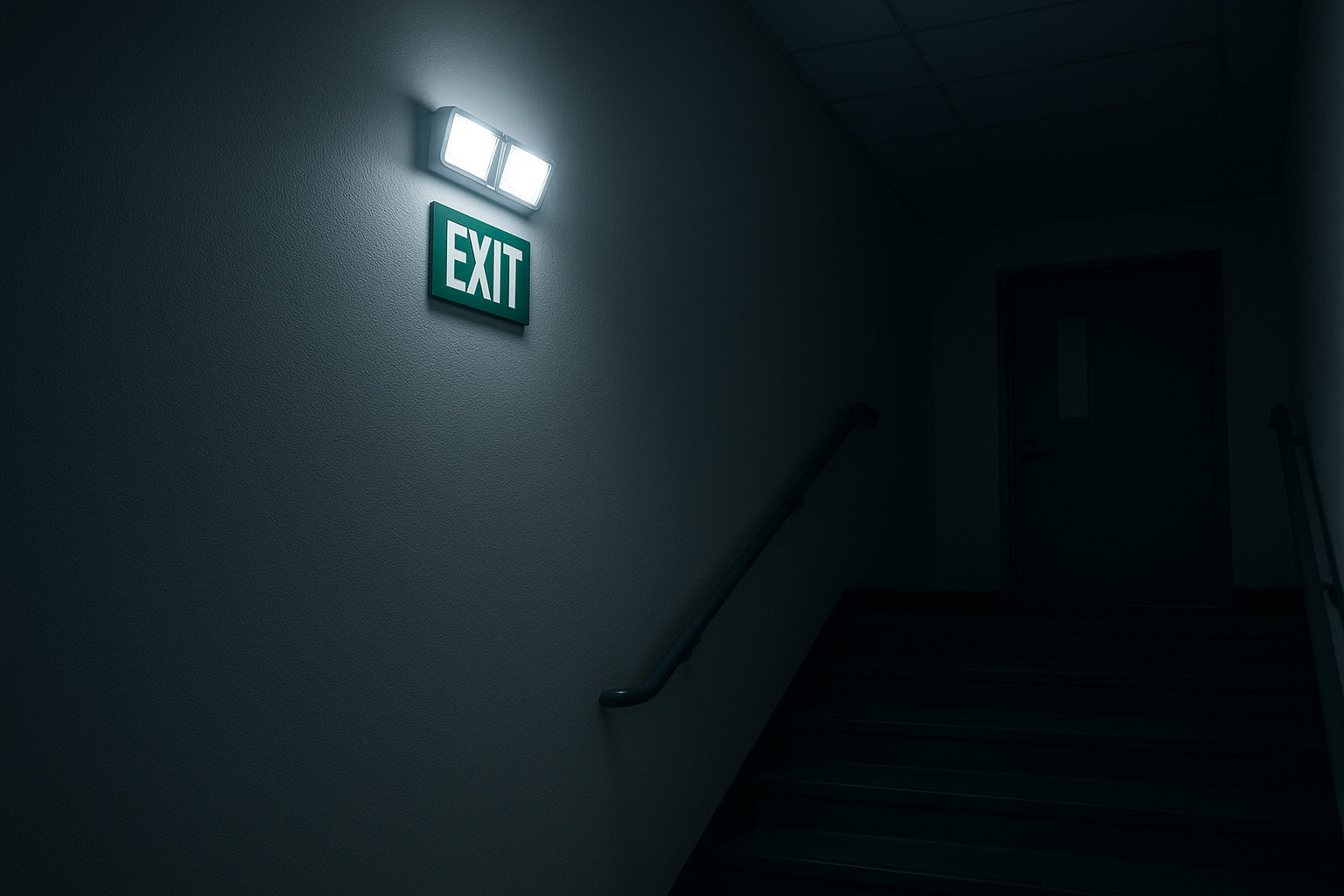
Fires often cut the power, and smoke reduces visibility within minutes. Staff may know the building well, but customers, visitors and contractors do not. One dead fitting can leave a staircase or corridor corner in the dark, and that is exactly where people hesitate, collide or fall.
Your legal duty as the responsible person
Under the Regulatory Reform (Fire Safety) Order 2005, which applies in England and Wales, the responsible person must make sure escape routes are lit where necessary. They must also keep that lighting in working order. That person is usually the employer, the building owner, the landlord or the managing agent. Inspectors judge your system against BS 5266 and BS EN 50172, so your testing and records need to follow those standards.
The fire and rescue service enforces the Order, and the consequences of poor records go beyond a warning letter:
|
Risk |
What it can mean for you |
|---|---|
|
Enforcement notice |
You must carry out remedial work within a set time |
|
Prohibition notice |
Use of part or all of the building can be restricted |
|
Prosecution |
Serious breaches can lead to unlimited fines and, in the worst cases, imprisonment |
|
Insurance dispute |
An insurer may question a claim if you cannot show testing records |
|
Injury claim |
Missing logbook entries weaken your defence |
Why failed lights often go unnoticed
Batteries fail quietly. A fitting can look perfect, with its green indicator lit, while the battery behind it holds charge for only a few minutes instead of the required duration. Sealed batteries commonly last around three to five years, then fade. Nothing about the fitting warns you while mains power is on.
In our experience, premises that have only ever had a quick monthly flick test often reveal several weak or dead units at their first full duration test. The flick test proves a lamp can light. It does not prove the battery will last through an evacuation.
An emergency light you have never tested for its full duration is an assumption, not a safety measure.
That is why searching for emergency light testing near me should lead you to an engineer who tests every fitting against the standard, records the result and flags weak batteries before they fail. The next sections explain how to find that engineer and what they should do on site.
How to find and hire a qualified emergency lighting engineer
Where to start your search
Typing emergency light testing near me into Google returns everyone from national facilities firms to sole-trader electricians. Size matters less than competence and proximity. A local engineer reaches you quickly and can come back within days to replace a failed battery, not weeks later.
From there, ask your managing agent or neighbouring businesses who they use. Shortlist two or three firms and request written quotes. If you run several sites, ask whether the same engineer can visit each one, so your records stay consistent and your renewal dates line up.
Questions to ask before you book
Put these questions to every firm. Straight answers tell you far more than a polished website.
-
Do you test to BS 5266 and BS EN 50172, and can I see a sample certificate?
-
Who will attend, and what training and experience do they have with emergency lighting?
-
Do you test every luminaire for the full duration, or only a sample?
-
Do you hold public liability insurance, and can you send me a copy?
-
Can you repair faults, replace batteries and retest, or will I need a second contractor?
-
Is the price fixed, and does it include the certificate and logbook entry?
Competence is the answer that matters most. Look for evidence of training and membership of a recognised body such as NICEIC or NAPIT. At Electrical Testing London, every engineer has at least 10 years of experience, and we are happy to show you a sample report before you commit.
A certificate is only as reliable as the engineer who signs it.
Red flags to avoid
Be wary of any quote given over the phone without a site survey or luminaire count. Emergency lighting systems vary widely, so a flat fee for an unseen building usually means corners will be cut, or extra charges will appear on the day.
Walk away from firms that cannot explain the duration test, or whose sample certificate lists no individual fittings. A single line saying "system tested, satisfactory" will not satisfy a fire inspector, and it will not help you in an insurance dispute.
What a professional emergency light test includes
Before the test begins
A proper visit starts with paperwork, not a switch. The engineer reviews your logbook and floor plans to work out how many luminaires you should have, then walks the building to confirm each one is there. This matters because missing, blocked or relocated fittings are common after a refit. When you book emergency light testing near me, ask for this survey step. It separates a genuine inspection from a tick-sheet exercise.
The test, step by step
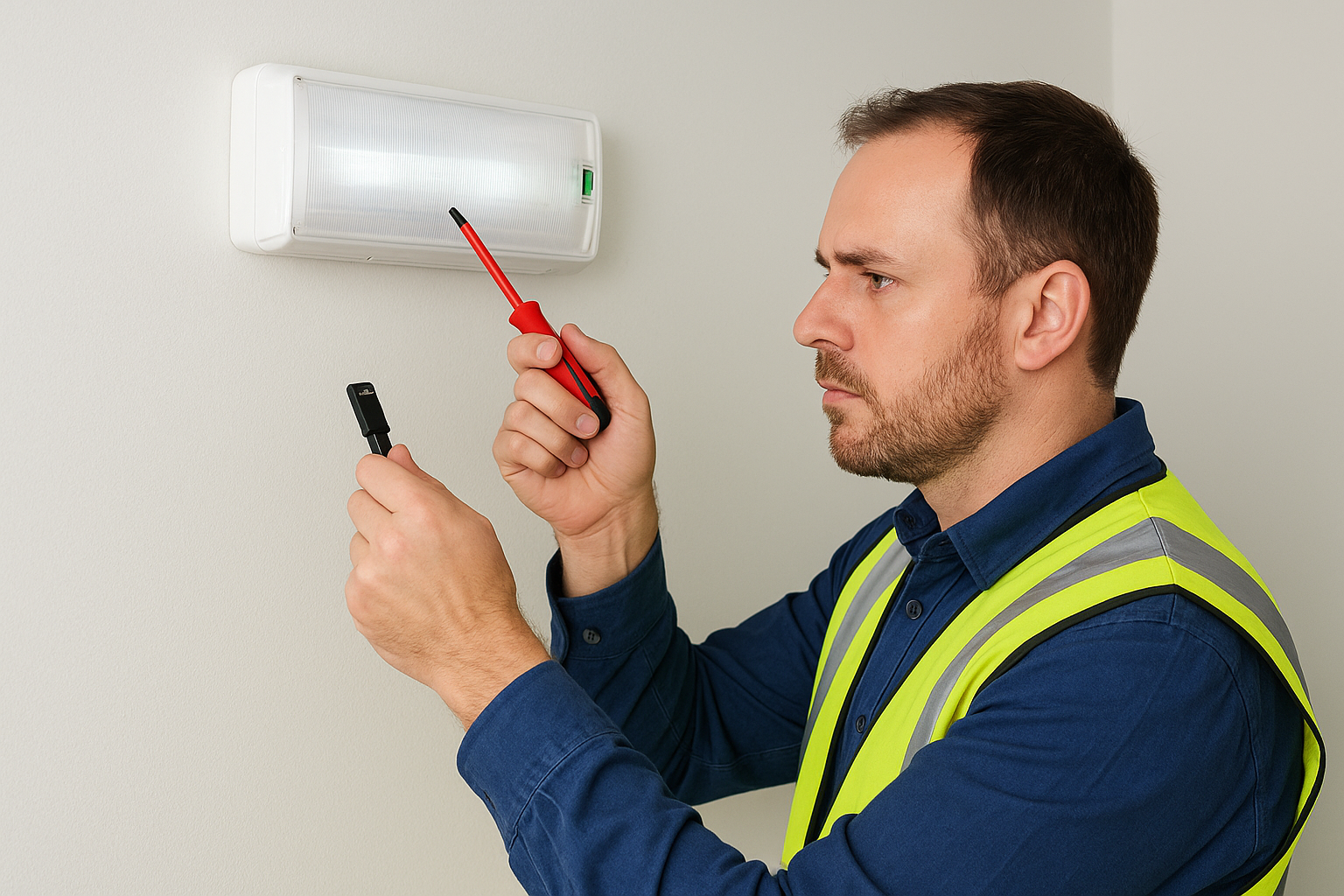
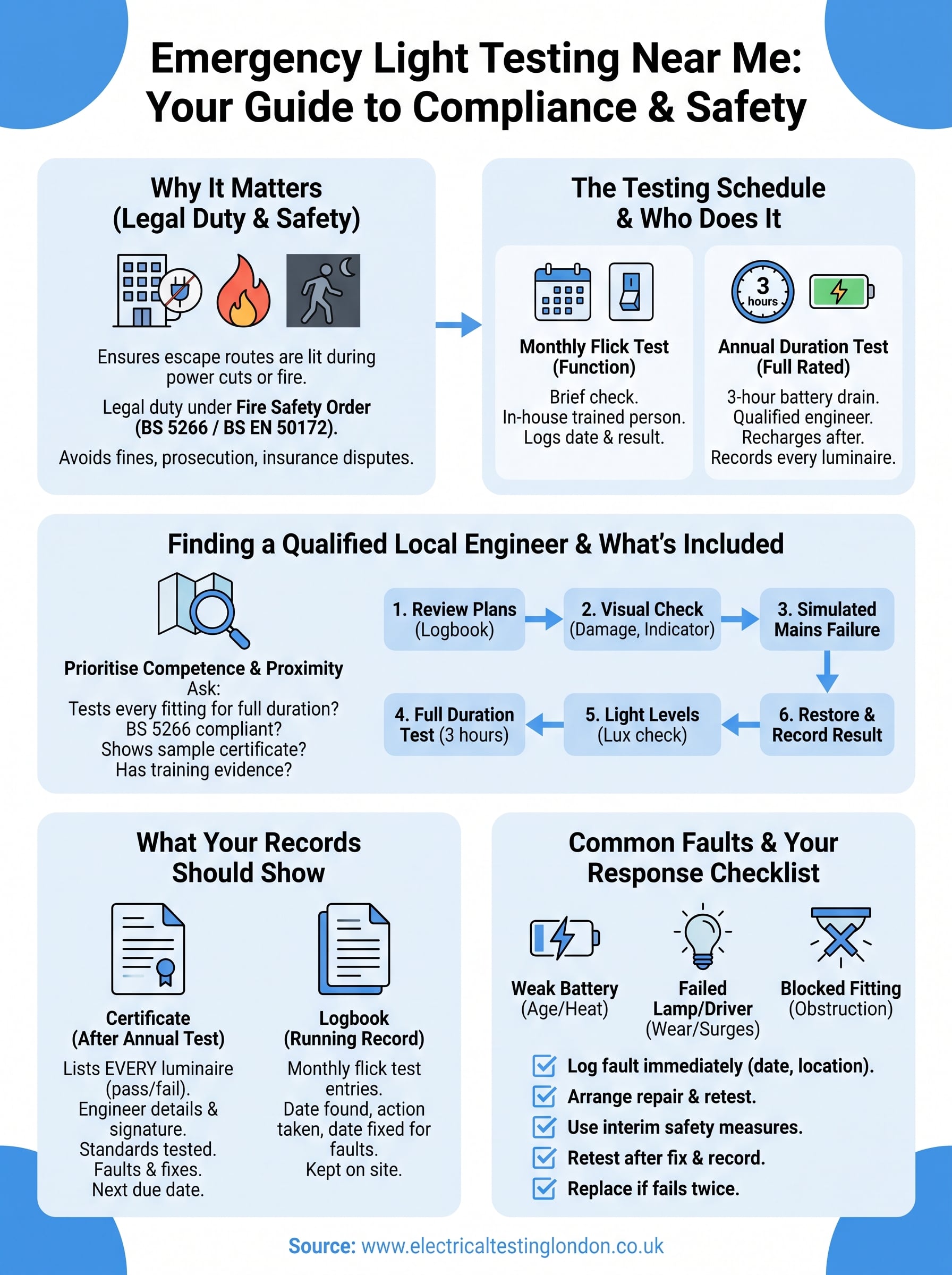
A competent engineer follows the same sequence on every fitting, in line with BS EN 50172:
-
Visual check. Look for damage, dirt, obscured lenses, faded signs and a working charge indicator.
-
Simulated mains failure. Use a test key or switch to cut the supply and confirm each fitting changes over to battery.
-
Full duration test. Keep the supply off for the rated period, usually three hours, then check every lamp is still lit at the end.
-
Light levels. Spot check that escape routes reach at least 1 lux along the centre line, as BS EN 1838 requires.
-
Restore and record. Switch power back on, confirm the charging indicators return and log the result for each luminaire.
Central battery systems need extra checks. The engineer should also test the charger, the battery voltage and the changeover to the standby supply.
If the engineer never switches the power off for the full duration, the test has not really happened.
Recharge time and scheduling
Batteries are drained by the duration test and can take up to 24 hours to recharge. During that window your escape routes are not fully protected. Good engineers plan for this. They test out of hours or zone by zone, so most of the building stays covered while the rest recharges.
Expect the engineer to flag any failed fittings before they leave, with a price to fix them. At Electrical Testing London, we can replace batteries or lamps and retest, so you do not need a second contractor.
How often emergency lights must be tested
The testing schedule
The Fire Safety Order does not state a test frequency. BS EN 50172 and BS 5266-8 do, and fire inspectors treat them as the benchmark. When you search for emergency light testing near me, you are really looking for someone who can deliver this schedule and record every result.
|
Test |
Frequency |
What it checks |
Who does it |
|---|---|---|---|
|
Flick (function) test |
Monthly |
Each fitting switches to battery and lights |
Trained person on site |
|
Full duration test |
Annually |
Battery lasts the full rated period, usually 3 hours |
Competent engineer |
|
Commissioning test |
After installation or alteration |
System matches the design |
Installer |
Who should carry out each test
Monthly checks are quick. A trained member of staff can run them with a test key, as long as they log the date, the result and any faults. Arrange cover for holidays, because a missed month shows up as a gap in your logbook.
Annual testing is different. It drains every battery, leaves the building under-protected while they recharge, and needs someone who can judge pass or fail against the standard. Use a qualified engineer and book the visit for the same month each year so it never slips.
Monthly checks build the habit, but the annual duration test is the one that proves your lights will last an evacuation.
When to test more often
Some events justify an extra test between the scheduled ones. Layout changes alter coverage, and ageing batteries fail without warning, so treat these as triggers:
-
After a refit, new partitions or any change to escape routes.
-
After repairing or replacing a fitting, to confirm the fix.
-
When batteries reach three to five years old, even if they still pass.
-
After a power cut or a fire alarm activation that left lights running on battery.
Automatic self-test systems reduce the manual work, but they do not remove your duty. Someone still has to read the panel or indicators, act on reported faults and keep the records up to date.
What your certificate and logbook should contain
What the certificate should show
Once the test is finished, you should receive a certificate that a fire inspector can read without phoning anyone. When you book through a search for emergency light testing near me, ask for a sample certificate first. A proper one lists every luminaire, not a single line saying the system passed.
Check that it includes:
-
The premises address and the date of the test.
-
The engineer's name, signature and competence details.
-
The standards tested against, BS 5266 and BS EN 50172.
-
The system type, self-contained or central battery.
-
Each luminaire's reference, location and pass or fail result.
-
The duration achieved, for example three hours.
-
Any defects found and what was repaired or replaced.
-
The date of any retest and the next test due date.
A certificate that does not name each fitting cannot prove that each fitting was tested.
What belongs in the logbook
Your logbook is the running record between annual visits, and it stays with you, not the engineer. Keep it on site where staff and inspectors can find it quickly. Every monthly flick test needs an entry with the date, the name of the person who tested and the result.
Also record every fault with the date you found it, the action taken and the date it was fixed. Add battery and lamp replacements, plus any change to the layout or escape routes. File each annual certificate behind the log, because older reports show whether the same fittings keep failing.
Gaps are what inspectors look for first. A missed month, an undated entry or a fault with no recorded fix suggests the system is not being managed. Ask your engineer to sign and date the logbook at each visit and to note battery ages. That way you can budget for replacements before units fail, instead of finding out at the next duration test.
Common faults and what happens when lights fail
The faults engineers find most often
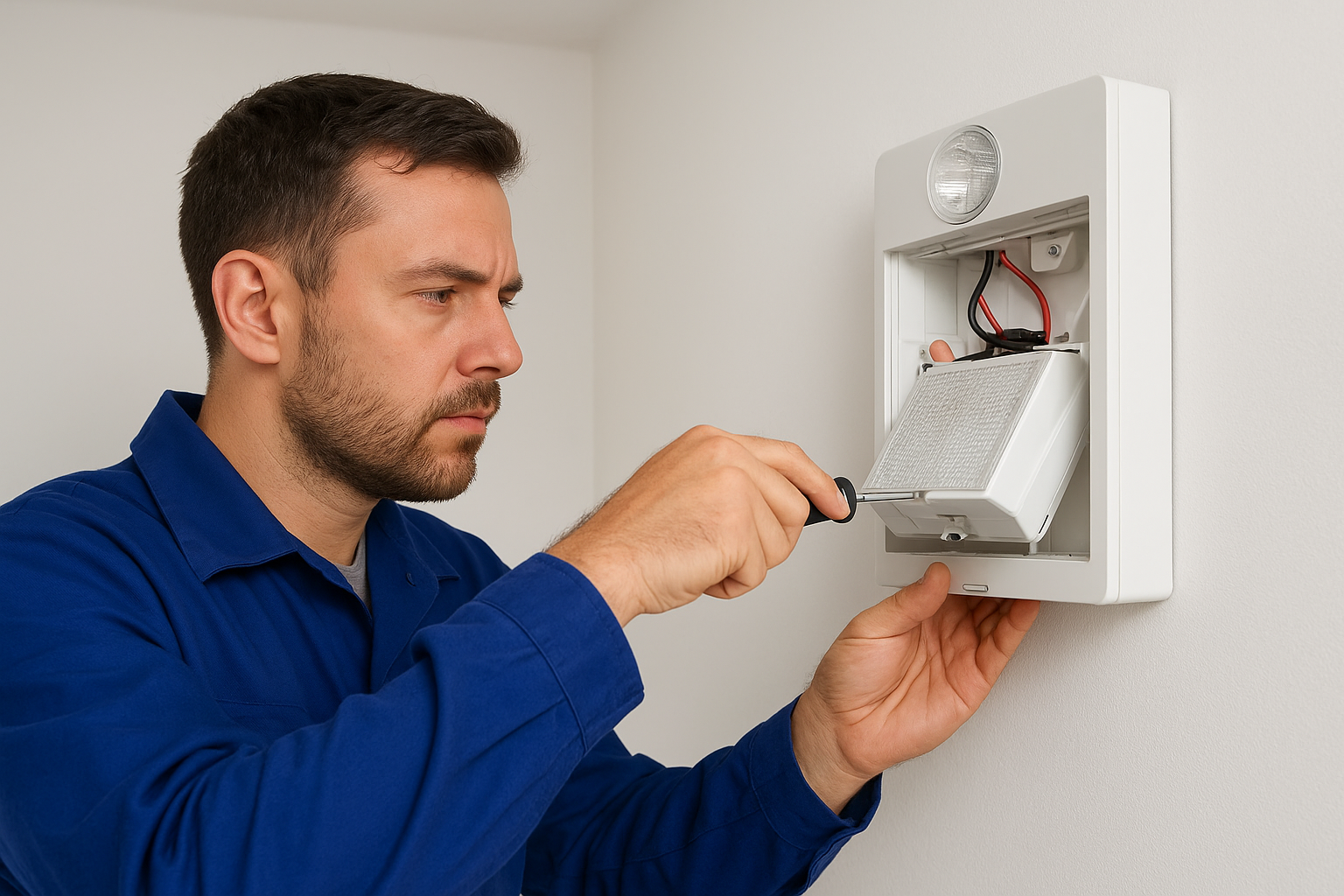
Most failures are dull and predictable. Batteries top the list, followed by lamps, wiring and simple obstruction. Whoever you find through a search for emergency light testing near me should check for each of these on every fitting, not just a sample.
|
Fault |
Usual cause |
Typical fix |
|---|---|---|
|
Dead or weak battery |
Age, heat, three to five years of service |
Replace battery, retest |
|
Failed lamp or LED driver |
Wear, moisture, power surges |
Replace lamp or driver |
|
Charge indicator off |
Tripped circuit or lost live feed |
Restore supply, check wiring |
|
Blocked or dirty fitting |
Stock, paint, dust, new signage |
Clear and clean |
|
Missing or moved luminaire |
Refit or partition changes |
Reinstate, update the plan |
What happens when a fitting fails
A failed light is recorded as a fail. It is not quietly fixed and forgotten. Until the repair is done, that escape route is only partly protected, and you are the one who knows it. Put interim measures in place straight away, such as extra fire marshals, or restrict use of the affected area if people could not leave it safely in the dark.
A failed fitting is a known risk, and a known risk left unfixed becomes a legal problem.
Inspectors also look harder at a recorded fault with no recorded fix than at the fault itself. A fail in the logbook shows the system is being managed. A fail with no follow-up suggests it is not.
Your response checklist
Speed matters once a fault appears, and a clear routine stops it drifting. Follow the same steps each time, so nothing depends on one person's memory and the paper trail is complete.
-
Log the fault the same day, with the location, date and who found it.
-
Arrange a repair, ideally with the engineer who can also retest.
-
Put interim safety measures in place until the fitting works again.
-
Retest after the repair and record the result against that luminaire.
-
Replace rather than patch any fitting that fails twice.
At Electrical Testing London, we can carry out these repairs and retests on the same visit where parts are available, which shortens the time your building is exposed.
Choosing the right local engineer
Searching for emergency light testing near me is the easy part. The harder part is picking someone who will test every fitting for the full duration and hand you a certificate that names each one. Proximity helps, but competence decides whether your records stand up to a fire inspector or an insurer.
Keep the routine simple. Run the monthly flick test in-house, book the annual duration test with a qualified engineer, and log every fault and fix. Do that, and your escape routes will work when people need them, and your paperwork will protect you.
If you want one engineer who can test, repair, retest and certify in one visit, request a quote from Electrical Testing London. We will survey your premises first, so you get clear pricing before any work starts.