






Emergency Lighting Periodic Inspection Certificate: BS 5266



If you need an emergency lighting periodic inspection and testing certificate pdf, you are probably standing in front of a finished inspection with nothing to record it on. A handwritten note will not satisfy a fire risk assessor, an insurer or a building control officer. You need a proper certificate that matches BS 5266-1.
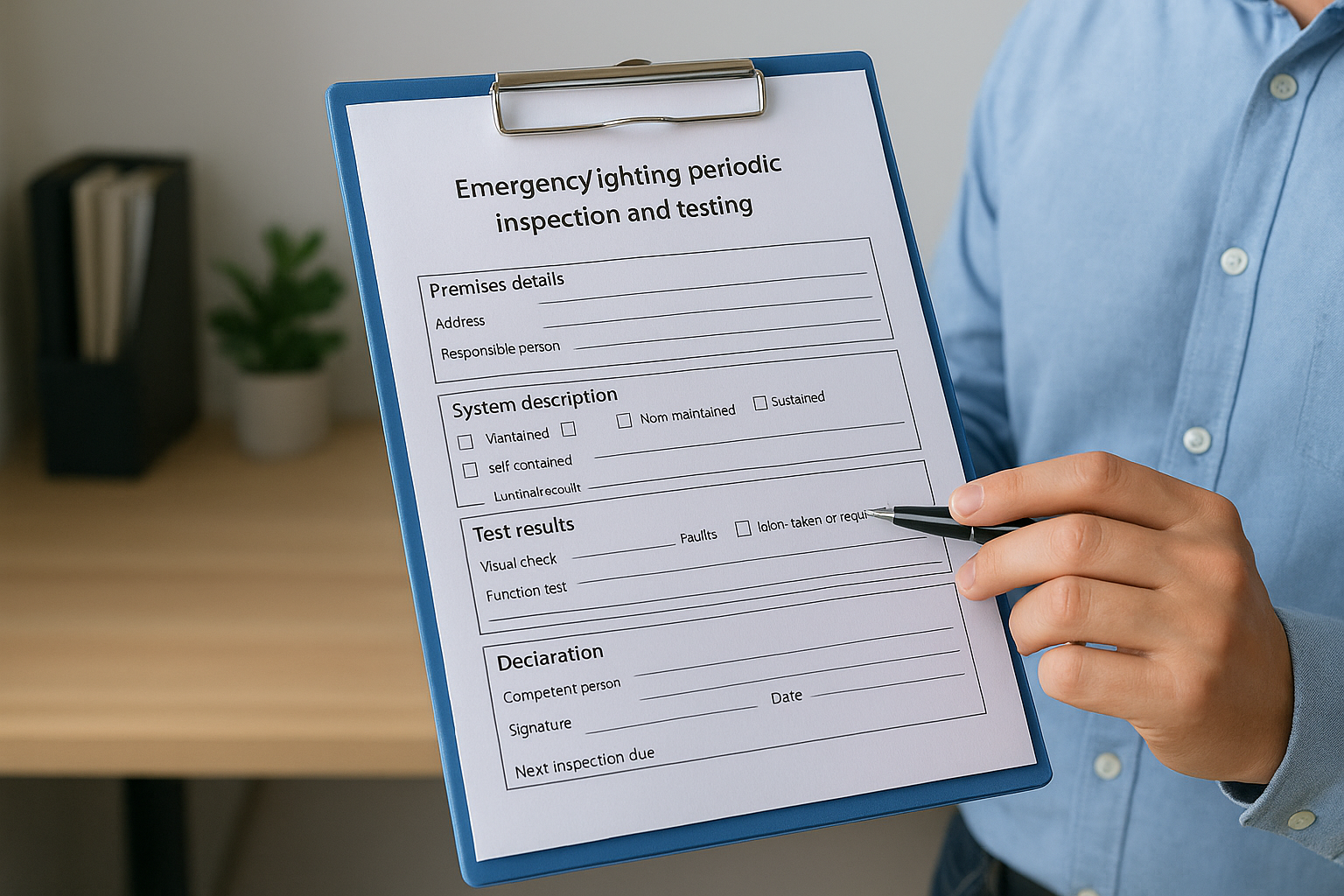
The short answer is that the certificate is a standard form. It records the premises, the system type, the tests carried out and any defects found. Anyone completing it must be competent, and the result must be signed and dated. A blank PDF is only useful if you know what goes in each section.
This article explains what a BS 5266 periodic certificate must contain, how the monthly flick test and the annual full-duration test feed into it, and what to do when a luminaire fails. We test emergency lighting across London and the South East, so we also cover the mistakes we see most often on completed certificates.
Why the periodic inspection certificate matters
A legal duty with a paper trail
Under the Regulatory Reform (Fire Safety) Order 2005, the "responsible person" for non-domestic premises in England and Wales must keep escape routes safe to use, including in a power cut. That means working emergency lighting. The responsible person carries the legal duty, whether that is the employer, landlord or managing agent. Hiring a contractor does not hand the liability over to them.
Enforcement officers do not take your word for it. When a fire inspector visits, they ask for the log book and the latest certificate. Missing or out-of-date records are often the first thing written up, and serious breaches can lead to unlimited fines and, in the worst cases, prison.
A system you cannot prove was tested is, in an inspector's eyes, a system that was not tested.
What the certificate does for you in practice
Beyond the law, the certificate is a working document. Several people rely on it, and each wants something different:
-
Fire risk assessors use it to confirm the system matches the escape strategy and that defects have been dealt with.
-
Insurers ask for it at renewal or after a fire, and a gap in the records can weaken a claim.
-
The next engineer reads it to see previous deviations, battery ages and any luminaires that have failed repeatedly.
A good certificate also saves money. When a failed luminaire is recorded with its location and the date it was fixed, you spot the fittings that keep failing and replace them before the next annual test, not during it.
So a blank form is only a starting point. Whether you search for an emergency lighting periodic inspection and testing certificate download or ask an engineer to issue one, the value lies in accurate entries and a competent signature, not in the file itself.
How to complete an emergency lighting certificate
Completing an emergency lighting periodic inspection and testing certificate pdf is easier when you treat it as the last step, not the first. Fill it in from your test notes and never from memory, because details like luminaire locations and fault descriptions fade quickly.
Work through it in order
-
Identify the premises and system. Enter the address, the responsible person and the system type: maintained, non-maintained or sustained, self-contained or central battery.
-
Check the records. Read the log book and drawings for earlier deviations, so you know which luminaires need the closest look.
-
Inspect and test. Check every luminaire visually, then run the full-duration test at its rated duration, usually three hours. Note each result against its location.
-
Reinstate and recharge. Confirm every unit is back on mains and charging before you leave, because a flat battery after your visit defeats the purpose.

Recording results and signing
Next, list every failed unit under deviations, with its location, the fault and the action taken or still required. If nothing failed, write "none" in the box. A blank box looks like an omission, and an assessor will question it.
Finally, the competent person signs, dates the form and states when the next inspection is due. Only sign what you have actually tested. If a locked plant room or a tenant's unit stopped you reaching some luminaires, say so on the certificate.
Record what you tested, and state plainly what you could not.
What a BS 5266-1 certificate contains
The core sections
Any emergency lighting periodic inspection and testing certificate pdf worth using follows the same basic structure. If a template lacks one of the parts below, pick another, because a gap in the form becomes a gap in your evidence.
|
Section |
What it records |
|---|---|
|
Premises details |
Address, responsible person, inspection date |
|
System description |
Maintained, non-maintained or sustained; self-contained or central battery; luminaire count |
|
Test results |
Visual check, function test and full-duration test outcomes |
|
Deviations |
Failed units, locations, faults, action taken or required |
|
Declaration |
Competent person's name, signature, date, next inspection due |
Declarations and the right form
Look closely at the declaration of competence. The signatory confirms the system was inspected and tested to BS 5266-1 and that every departure is listed. Check, too, that the form refers to the drawings and log book the inspection relied on.
The deviation list and the signed declaration are what make a certificate worth keeping.
Finally, make sure you have the right document. BS 5266-1 provides separate model certificates for new work and for existing systems. A completion certificate covers design, installation and commissioning. A periodic certificate covers an installation already in use, which is what you need after inspecting it.
Testing schedule, validity and the 2025 BS 5266-1 update
The routine behind the certificate
Testing follows BS EN 50172 (also published as BS 5266-8), which sits alongside BS 5266-1. The rhythm is simple, and the certificate captures the annual step.
|
Test |
Frequency |
What it involves |
|---|---|---|
|
Function (flick) test |
Monthly |
Briefly simulate mains failure and check every luminaire lights |
|
Full rated duration test |
Annually |
Run each unit for its rated time, usually one or three hours |
|
Periodic inspection and certificate |
Annually |
Inspect, test, record deviations, sign and date |
Record each monthly test in the emergency lighting log book. Monthly tests keep the system honest, and the annual certificate then summarises the year.
How long the certificate stays valid
The emergency lighting certificate has no legal expiry date. It describes the system on the day you tested it. Most assessors and insurers expect a fresh one every 12 months, so state the next inspection date clearly on the form.
Retest sooner if you alter the layout, replace batteries or fix a serious failure. A certificate only covers the system as it was tested, so a changed installation needs fresh evidence.
A certificate records one day, and the log book proves the other 364.
What the 2025 update means for your form
BS 5266-1 was revised in 2025, replacing the 2016 edition. Check that your emergency lighting periodic inspection and testing certificate pdf cites the edition you work to. An old template may still name the 2016 version.
Before you rely on any form, compare its wording with the current published standard or ask your engineer which edition they certify against. Never assume a downloaded file is up to date.
Common errors and example deviation entries
Mistakes we see on completed certificates
Most problems on an emergency lighting periodic inspection and testing certificate pdf are not technical. They are gaps in the record. The same errors turn up on certificates from London offices, shops and residential blocks:
-
The deviations box is left blank, with no "none" entered.
-
Locations are vague, such as "first floor" instead of "Stair B, landing 1".
-
The full-duration test is ticked, but no duration or date is recorded.
-
The next inspection date is missing.
-
The form is signed although some luminaires were not reached, with no note saying so.
Each one gives an assessor a reason to reject the form. Vague wording is the worst, because nobody can trace the luminaire later. Specific entries can be checked.
Example deviation entries
Good entries name the location, the fault and the action. Use these as a model, not as text to copy.
|
Location |
Fault |
Action |
|---|---|---|
|
Stair B, landing 1 |
Lamp did not light on test |
Replaced, retested satisfactory |
|
Ground floor corridor |
Failed after 40 minutes of a 3 hour test |
Battery replacement required, quote issued |
|
Plant room |
No access, keys unavailable |
Not tested, arrange access before next visit |
Notice the third row. Untested units are a deviation too, and writing them down protects you as much as the client. Where a fault stays open, the certificate should say so plainly, and the log book should record the date it was cleared.
A deviation entry is only useful if a stranger could find the luminaire and understand the fault.
Getting your certificate right
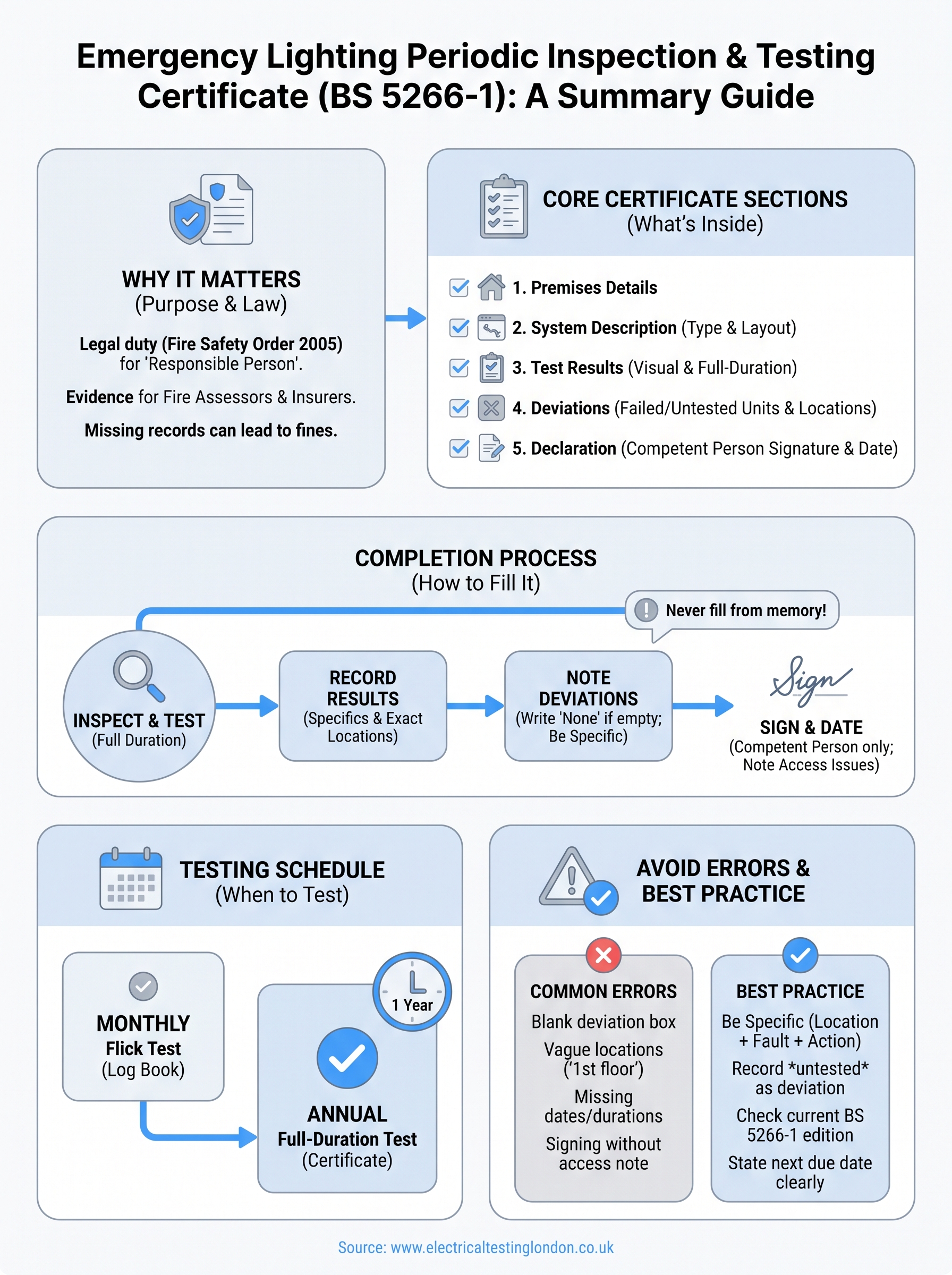
An emergency lighting periodic inspection and testing certificate pdf is only as good as the work behind it. The form gives you the structure, but accurate entries and a competent signature turn it into evidence. Record the premises, the system type, every test result and each deviation, with exact locations. Write "none" where nothing failed, and say plainly what you could not reach.
Keep the monthly log book up to date, retest every 12 months, and check that your template cites the current edition of BS 5266-1. Those habits keep you on the right side of the Fire Safety Order and give assessors and insurers nothing to question.
If you would rather hand the testing to someone who does it every day, our engineers can inspect your system and issue the certificate. Request a quote for emergency lighting testing and we will cover your premises in London and the South East.