






Emergency Lighting Periodic Inspection Certificate Example



Section 1
An emergency lighting periodic inspection and testing certificate is the signed document a competent person issues after inspecting and testing an existing emergency lighting system. It confirms the system has been checked against BS 5266-1 and is suitable for continued use, or it lists the defects that must be fixed first. It is not for new installations, which need a completion certificate instead.
At Electrical Testing London, we test emergency lighting in offices, shops, flats and other commercial buildings across London and the South East. We issue this certificate at the end of every visit. The questions we hear most are what it should contain, who can sign it, and what a proper one looks like.
This article covers why the certificate matters, what it must record and how to complete it step by step. It also gives a model layout you can copy to see how the fields fit together, and the mistakes that make a certificate fail an inspection.
Why the certificate matters for your premises
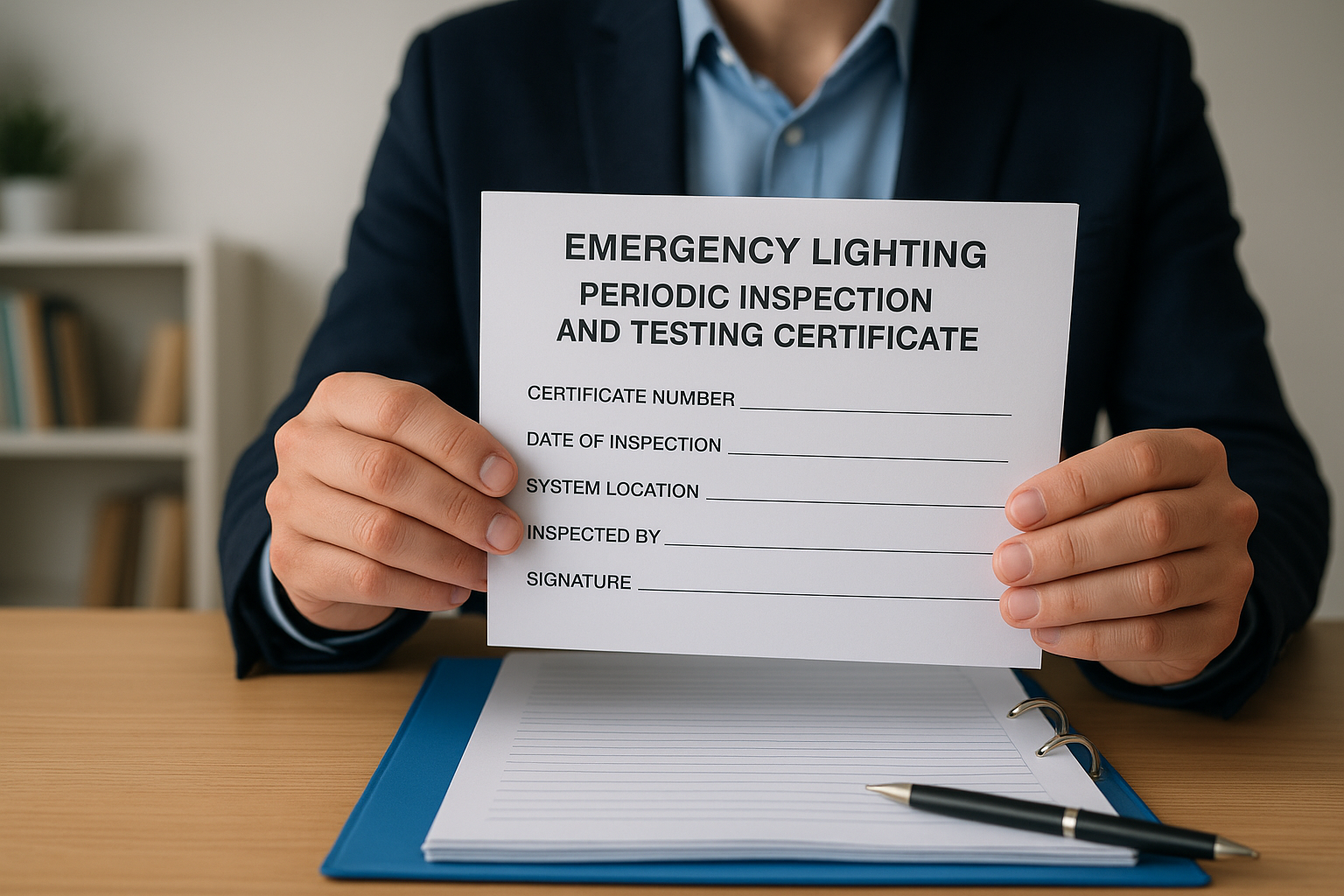
This certificate matters because it is the one document that proves a competent person has inspected and tested your whole system and judged it fit for continued use. Without it, you rely on scattered log book entries when a fire risk assessor, insurer or enforcing authority asks questions. For any office, shop or block of flats, the emergency lighting periodic inspection and testing certificate is the paperwork they expect to see.
The legal duty behind the paper
In England, the Regulatory Reform (Fire Safety) Order 2005 requires the responsible person to provide emergency lighting on escape routes and keep it in efficient working order. The Order does not name a certificate. BS 5266-1 is the code of practice most assessors measure against, and a dated certificate is the clearest evidence that you followed it.
The duty covers workplaces and the common parts of multi-occupied residential buildings. That includes landlords of flats, where stairwells and corridors depend on emergency lighting during a power failure. A missing or out-of-date certificate is an easy gap for a fire risk assessment to flag.
Certificate, completion certificate and log book
Three documents get confused, so it helps to separate them. Each answers a different question, and only one of them is the periodic certificate.
|
Document |
Used for |
Issued when |
|---|---|---|
|
Completion certificate |
A new installation or alteration |
Once, at handover |
|
Periodic inspection and testing certificate |
An existing system |
After each full inspection, usually yearly |
|
Log book |
Every routine test and defect |
Continuously |
The certificate is the verdict, and the log book is the evidence behind it.
What a BS 5266-1 certificate must contain
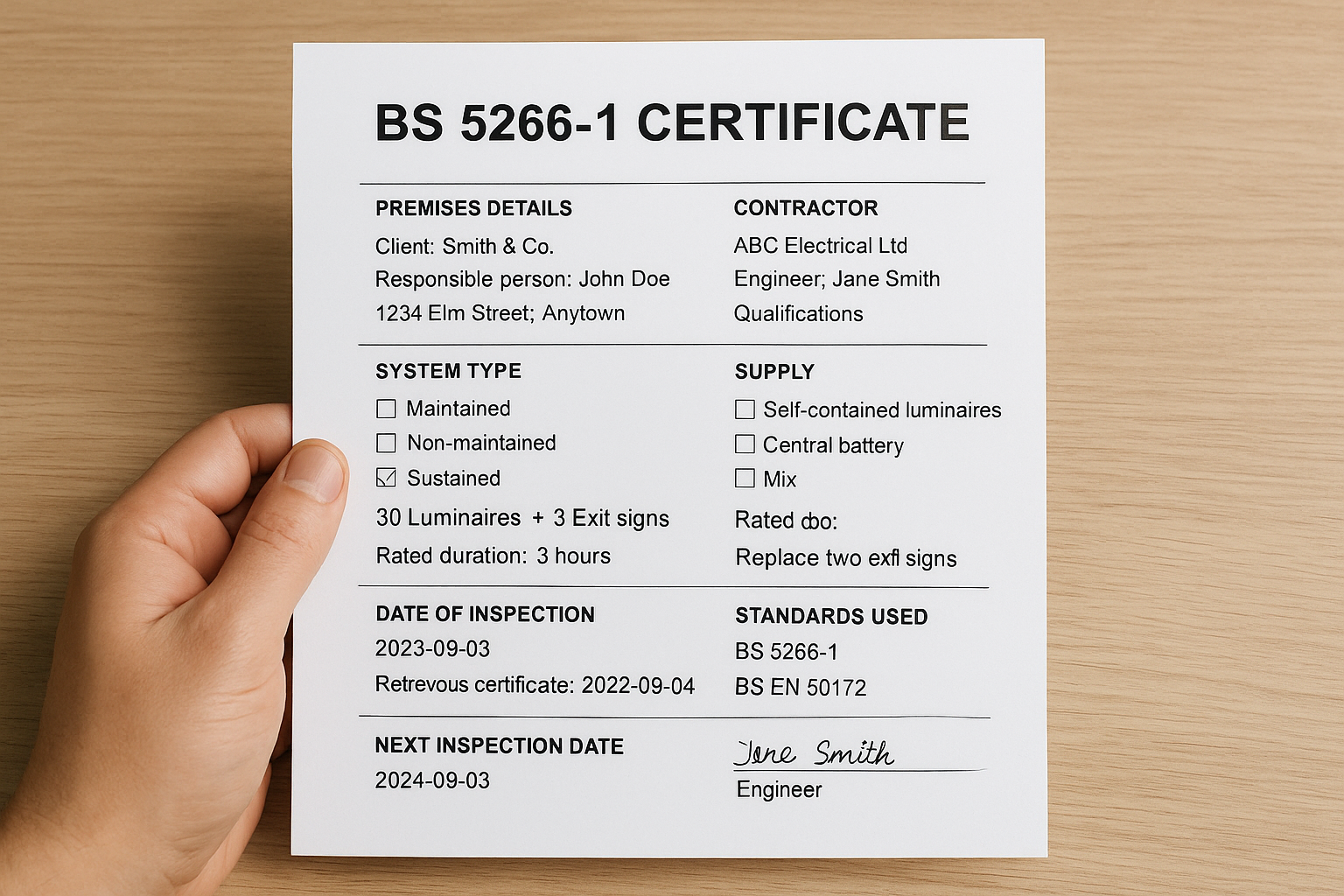
A valid certificate identifies the premises, the system, the person who tested it, what was tested and what was found. Anything less is a receipt, not a certificate. The layout varies between forms, but the content below is what an inspection certificate should always record.
The details every certificate records
Start with the people and the place, then describe the system, then state the findings. Keep the order consistent so a reader can find each item quickly.
-
Client, responsible person and full premises address
-
Contractor's company name, the engineer's name and their qualifications
-
System type: maintained, non-maintained or sustained
-
Supply: self-contained luminaires, central battery or a mix
-
Number of luminaires and exit signs, and the rated duration (1, 2 or 3 hours)
-
Date of inspection and the reference of the previous certificate
-
Standards used: BS 5266-1 for the system, BS EN 50172 (also published as BS 5266-8) for inspection and test routines
-
Departures from the standard, defects found and recommendations
-
Next inspection date, plus signature, name and position
Competence is the point people overlook. The standard asks for a competent person, and competence rests on training and experience, so check the engineer's qualifications before you accept the signature.
The schedule of results
Behind the front page sits a schedule. It lists each luminaire or group by reference and location, with a result against each check. Typical columns are visual condition, charging indicator, full-duration test result and remarks.
A certificate that says "all lights tested" without a schedule is hard to defend. Luminaire references should match your escape plan or drawing, so the next engineer can find every fitting and see which ones failed last year.
If the certificate cannot show which luminaire passed, it cannot prove that any of them did.
How to complete the certificate after a test
You complete the certificate only after the full-duration test is finished and every result is entered in the schedule. Work in a fixed order and the paperwork takes minutes. Skip steps and you end up certifying a system you have not fully tested, which is the most common failure of the emergency lighting periodic inspection and testing certificate.
Tests that feed the certificate
Two routine tests sit behind the certificate. Automatic test systems log their own results, but they still need a visual inspection.
|
Test |
Frequency |
What it checks |
Recorded in |
|---|---|---|---|
|
Short functional test |
Monthly |
Each luminaire lights when the mains supply is simulated |
Log book |
|
Full rated duration test |
Annually |
Batteries last the rated duration and the lamp still works at the end |
Log book and certificate |
Batteries need time to recharge after a full-duration test, commonly up to 24 hours. Plan the test for a quiet period, because cover is reduced until the batteries recover. Never test a whole building at once if people sleep there or escape routes are in use.
Step by step
-
Collect the previous certificate, the log book and the escape plan.
-
Inspect each luminaire and sign visually: position, damage, cleanliness, correct legend.
-
Run the full rated duration test and note any unit that fails early.
-
Enter every result in the schedule against its reference.
-
Record departures, defects and recommendations in plain words.
-
Confirm the batteries are charging again before you leave.
-
Complete the declaration, sign it and set the next inspection date.
What to do when units fail
Do not declare the system suitable for continued use while an escape route has no working light. Replace the failed battery or lamp, retest it and record the retest result. If the work cannot be done on the day, the certificate must list the defect clearly and the declaration must be qualified accordingly.
Certify what you tested and found, never what you expect to be true.
Emergency lighting inspection and test certificate example
The layout below is a working model of an emergency lighting inspection and test certificate for an existing system. It is an illustration of the fields, not a copy of the forms published with the standard. If a client or insurer asks for a specific form, use that one and carry the same information across.
A model certificate layout
Copy the text below into your own document and adapt it to the premises.
EMERGENCY LIGHTING PERIODIC INSPECTION AND TESTING CERTIFICATE
(Existing system. Not for new installations.)

Certificate reference: ________   Date of inspection: ________
Previous certificate date and reference: ________

1. CLIENT AND PREMISES
Client / responsible person: ________
Premises address: ________
Areas covered: ________

2. CONTRACTOR
Company: ________
Engineer name and qualifications: ________
Contact details: ________

3. SYSTEM DESCRIPTION
Type: Maintained / Non-maintained / Sustained
Supply: Self-contained / Central battery / Mixed
Luminaires: ____   Exit signs: ____
Rated duration: 1 hour / 2 hours / 3 hours
Log book present and up to date: Yes / No

4. STANDARDS
System assessed against BS 5266-1. Inspection and test carried
out to BS EN 50172 (BS 5266-8).

5. SCHEDULE OF INSPECTION AND TEST RESULTS (attached)
Ref | Location | Visual | Charge indicator | Full duration test | Result | Remarks

6. DEPARTURES, DEFECTS AND RECOMMENDATIONS
________

7. DECLARATION
I certify that the system has been inspected and tested as above
and, subject to the items in section 6, is suitable for continued use.
Signed: ________   Name: ________   Position: ________
Date: ________   Next inspection due: ________
Adapting the model
Add a tick box for each rated duration if your building mixes 1-hour and 3-hour units. For large sites, split the schedule by floor or zone and number the pages. Add a line for any areas you could not access, since an untested area must never be left silent on the certificate.
Keep the declaration wording close to the model. It makes two claims only: the system was inspected and tested, and it is suitable for continued use subject to the listed items.
A good model certificate is short on the front page and thorough in the schedule.
Mistakes that make a certificate worthless
A certificate fails when it cannot be relied on, and most failures come from a handful of habits. Spotting them early saves a rejected certificate and a repeat visit.
Errors to avoid
-
Signing off without a full rated duration test
-
No schedule, or luminaires without references
-
Vague defects such as "some lights failed"
-
No next inspection date, or no signature
-
Using a completion certificate for an existing system
-
Leaving batteries discharged and unrecorded
Each of these leaves the responsible person exposed, because the paper no longer matches the building.
When to bring in an engineer
If you manage a building with more than a few luminaires, hand the annual test to a qualified engineer. The full-duration test takes planning, the schedule takes care, and the signature carries real accountability. In-house staff can still run the monthly tests and keep the log book current.
The person who signs the certificate owns every statement on it.
Keeping your emergency lighting paperwork in order
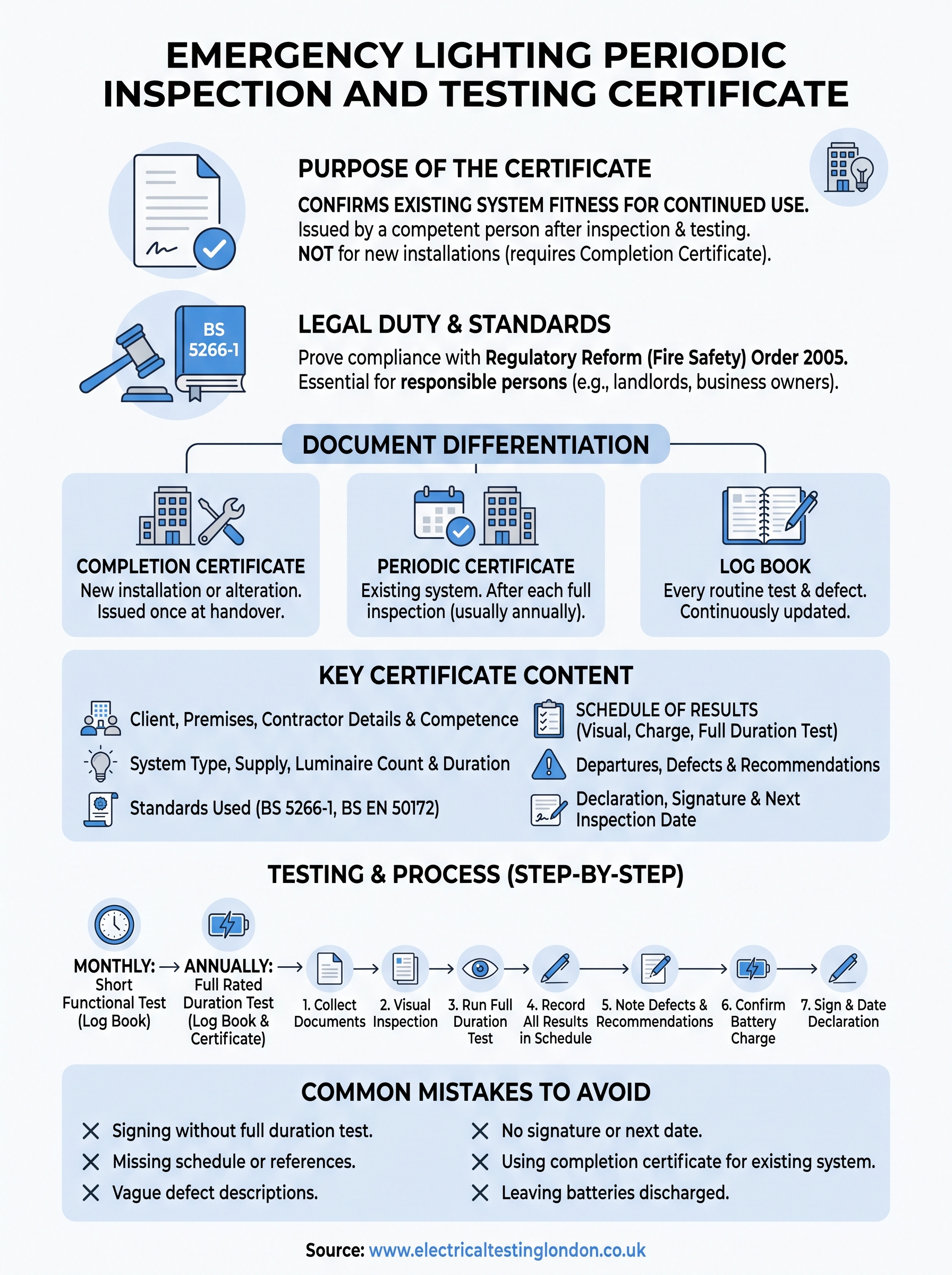
A proper certificate names the premises, describes the system, shows every result in a schedule, lists defects honestly and carries a competent signature and a next due date. Run monthly tests, keep the log book, and have a full inspection and test each year. Then the certificate is a record of what already happens.
If your building needs a full-duration test and a certificate you can rely on, request a quote for emergency lighting testing from our London engineers.