






Free Electrical Inspection Report Template in Word: 7 Types



The right free electrical inspection report template Word file depends on the job. Use an Electrical Installation Condition Report layout for periodic checks, an Electrical Installation Certificate for new work, a Minor Works certificate for small alterations, and simpler logs for PAT testing and emergency lighting. A good template has fixed sections for site details, scope, limitations, test results, coded observations and a signed verdict. Landlords and homeowners will get most from the EICR and visual checklist. Commercial managers will want the PAT and emergency lighting logs.
The problem is that many free templates are too thin to satisfy a tenant, insurer or enforcing authority. Others imitate a certificate that only a qualified person can legally issue. This article gives you seven report types, what each one must record, who can complete it, and the exact headings to paste into a Word document.
We are Electrical Testing London. Our engineers write these reports every week for landlords, businesses and homebuyers across London and the South East, so the field lists below come from what those reports actually need. A template is a record-keeping aid. It never replaces a signed report from a competent person.
1. EICR template for periodic inspections
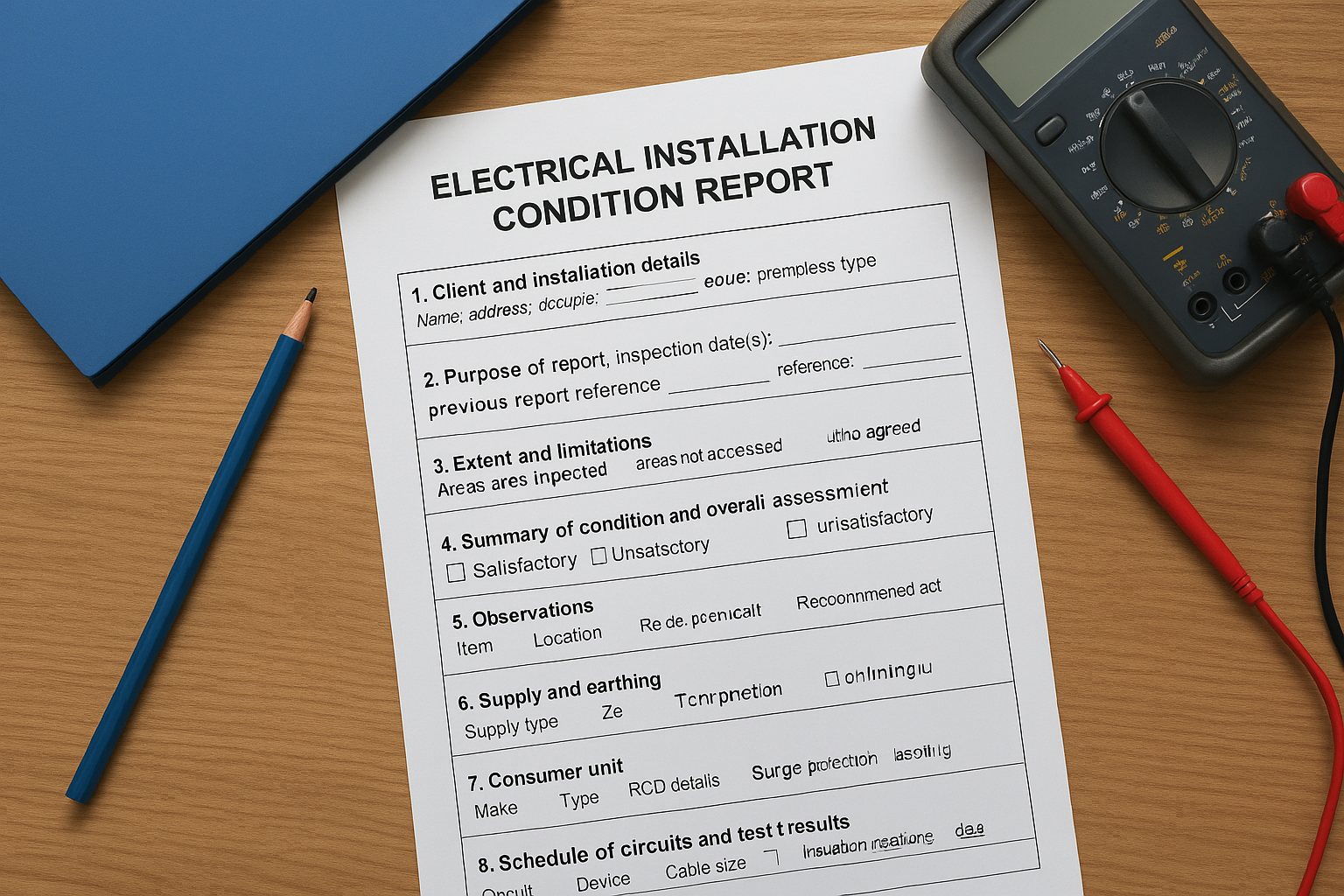
An EICR template suits an existing installation, which makes it the first pick for landlords, homeowners and commercial occupiers. Its layout follows the model forms in BS 7671, which the IET publishes on its model forms page. Any free electrical inspection report template in Word should copy that order, because inspectors, insurers and local authorities all expect to read it that way.
What it records
The report records the condition of the fixed wiring, consumer unit, earthing and bonding, plus test results for every circuit. Each defect gets a code. C1 means danger is present, C2 means potentially dangerous, C3 means improvement recommended, and FI means further investigation is required. The overall verdict is satisfactory or unsatisfactory.
A single C1, C2 or FI observation is enough to make the whole report unsatisfactory.
Who can complete it
Only a competent person with calibrated test instruments should fill in the results. In England, private landlords must have the installation inspected and tested by a qualified and competent person at least every five years under the Electrical Safety Standards in the Private Rented Sector (England) Regulations 2020. Tenants must receive a copy within 28 days. The local authority can ask for a copy too, and you then have seven days to supply it. Remedial work must be finished within 28 days, or sooner if the report says so.
Sections to copy into Word
Paste these headings into a blank document, then turn each into a table.
ELECTRICAL INSTALLATION CONDITION REPORT
1. Client and installation details (name, address, occupier, premises type)
2. Purpose of report, inspection date(s), previous report reference
3. Extent and limitations (areas inspected, areas not accessed, who agreed)
4. Summary of condition and overall assessment: Satisfactory / Unsatisfactory
5. Observations (item, location, code C1 / C2 / C3 / FI, recommended action)
6. Supply and earthing (supply type, Ze, prospective fault current, earthing arrangement)
7. Consumer unit (make, type, RCD details, surge protection, labelling)
8. Schedule of circuits and test results (circuit, device, cable size, insulation resistance, continuity, polarity, Zs, RCD trip time)
9. Declaration (inspector name, qualifications, signature, date, next inspection due)
2. Electrical installation certificate
An Electrical Installation Certificate (EIC) is the template for new work, such as a new circuit, a rewire or a consumer unit replacement. It is not an inspection report, so never use it for an existing installation. A free electrical inspection report template Word pack is incomplete without it, because it is the document that proves new work met BS 7671 on the day it was finished.
What it records
It records the design, construction, and inspection and testing of the new work. It also lists any departures from BS 7671, the recommended date for the first periodic inspection, and the same circuit schedules and test results as an EICR. There are three signatures, one each for design, construction and inspection and testing. On a small job one person can sign all three.
Who can complete it
The person responsible for the work signs. Most new circuits and consumer unit changes in England are notifiable under Part P of the Building Regulations. That means the work needs notifying through a competent person scheme or to building control.
If the work changed the installation, you need an EIC. If you only looked at it, you need an EICR.
Sections to copy into Word
ELECTRICAL INSTALLATION CERTIFICATE
1. Client, installation address and description of work
2. Extent of the installation covered by this certificate
3. Design, construction, and inspection and testing declarations (name, signature, date for each)
4. Departures from BS 7671 and agreed limitations
5. Supply characteristics and earthing arrangement
6. Particulars of installation (distribution equipment, main protective device, bonding sizes)
7. Schedule of inspections (checklist with tick, N/A or limitation)
8. Schedule of circuit details and test results
9. Recommended interval to next inspection
3. Minor works certificate
A minor works certificate covers a small job on an existing circuit. It applies to an addition or alteration that does not create a new circuit, for example adding a socket outlet to an existing ring final circuit or moving a light switch. It is short, quick to fill in and the most common certificate that a free Word template should include.
What it records
It describes the work, names the circuit affected and states the earthing arrangement. It then records the tests carried out on that circuit only: continuity, insulation resistance, polarity, earth fault loop impedance and RCD operation where one protects the circuit. It also records any defects found on the existing circuit, which the engineer must flag whatever the size of the job.
Who can complete it
The engineer who did the work must test and sign it. Replacing a consumer unit or adding a circuit is too big for this form and needs a full EIC. Keep a copy with the property records, because a later EICR inspector will ask for evidence of past alterations.
Sections to copy into Word
MINOR ELECTRICAL INSTALLATION WORKS CERTIFICATE
1. Client and installation address
2. Description of the minor works, date completed
3. Circuit affected, protective device type and rating
4. Earthing arrangement and presence of RCD protection
5. Test results (continuity, insulation resistance, polarity, Zs, RCD trip time)
6. Defects noted on the existing installation
7. Declaration (name, qualifications, signature, date)
4. Visual inspection checklist for landlords and homeowners
A visual inspection checklist is the right template for a quick walk-through between formal reports. It is a non-certified record of what you can see, not a test result. It helps a landlord spot trouble before it reaches the next EICR, and it gives a homeowner a way to describe a problem clearly when calling an engineer.
What it records
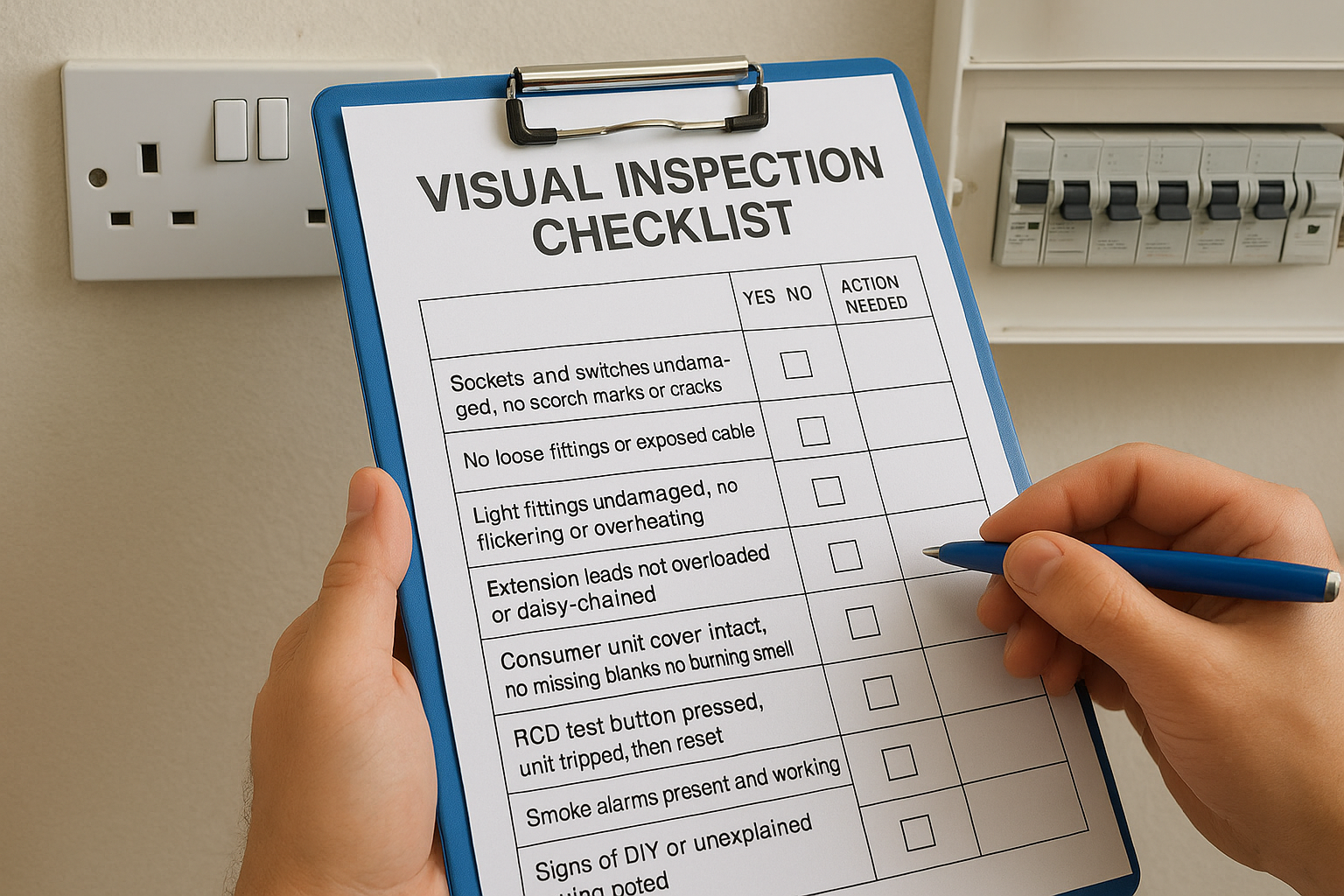
It records visible signs only: cracked or scorched sockets and switches, loose fittings, exposed cable, missing blanks in the consumer unit, warm or buzzing accessories, signs of DIY wiring and overloaded extension leads. It can also note that the RCD test button was pressed and that smoke alarms were present and working. Each line gets a yes, no or action marker.
A visual checklist tells you when to call an engineer. It never tells you the installation is safe.
Who can complete it
Anyone can complete it, provided they do not remove covers or touch live parts. Never open the consumer unit or test anything beyond pressing the RCD test button. If a line shows a problem, stop and book an engineer.
Sections to copy into Word
ELECTRICAL VISUAL CHECK RECORD (NOT A CERTIFICATE)
Property address / room / date / person completing
Room by room, mark Yes / No / Action needed:
- Sockets and switches undamaged, no scorch marks or cracks
- No loose fittings or exposed cable
- Light fittings undamaged, no flickering or overheating
- Extension leads not overloaded or daisy-chained
- Consumer unit cover intact, no missing blanks, no burning smell
- RCD test button pressed, unit tripped, then reset
- Smoke alarms present and working
- Signs of DIY or unexplained wiring noted
Actions required, engineer booked (date), date of last EICR
5. PAT testing record
A PAT testing record is the template for portable electrical equipment, such as kettles, power tools, monitors and extension leads. It works as an equipment register plus a results log. This free electrical inspection report template in Word format suits offices, shops, workshops and landlords who supply furnished lets with appliances.
What it records
Each row covers one appliance: an asset number, description, location, equipment class (I or II), and the results of the visual check, earth continuity and insulation resistance where relevant. It then records pass or fail, the test date and the next test due date. There is no single legal interval. The Electricity at Work Regulations 1989 require equipment to be maintained to prevent danger, so the frequency should follow how the item is used and where.
Who can complete it
A competent person with a PAT tester should complete it. The visual check is the most valuable part, and many faults are found before any test. Failed items should be labelled, removed from use and logged with the action taken.
Most PAT failures show up at the visual check, so never skip that column.
Sections to copy into Word
PORTABLE APPLIANCE TEST REGISTER
Site / date / tester / test instrument and calibration date
Columns: Asset ID | Description | Location | Class I / II | Visual check | Earth continuity | Insulation resistance | Result Pass / Fail | Action taken | Next test due
Summary: total items tested, items failed, items removed from use
Tester signature and date
6. Emergency lighting test log
An emergency lighting test log records the routine tests on escape lighting in commercial buildings. It is the template that shows you are meeting your duty under the Regulatory Reform (Fire Safety) Order 2005, which applies in England and Wales. A free Word template for electrical inspection reports in a business should always include one.
What it records
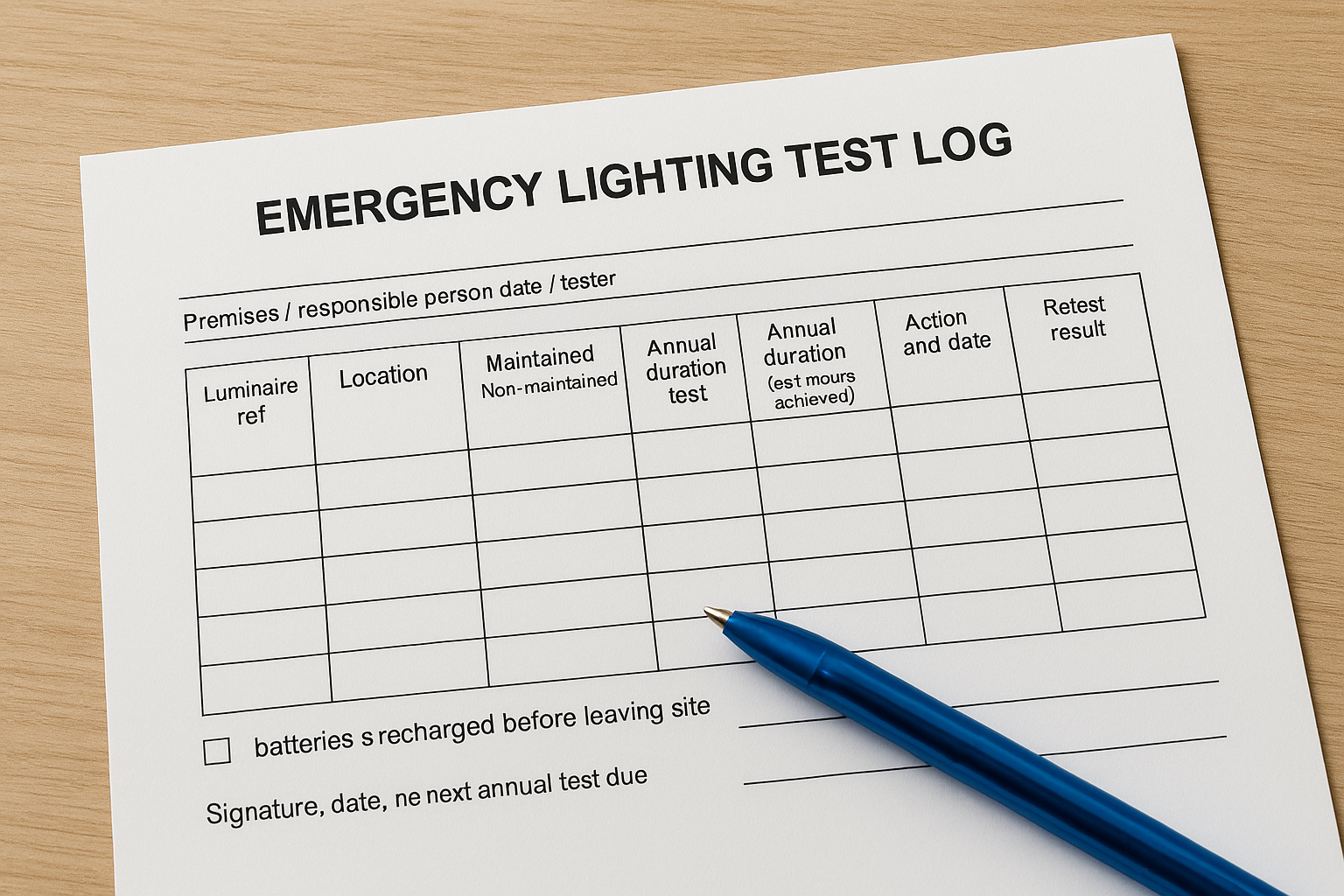
BS 5266-1 sets out the routine pattern. That is a short monthly function test and a full rated duration test once a year, usually three hours. The log records each luminaire's reference, location and type, the result of each test, any defect, and the repair or replacement that followed. Self-testing luminaires record results automatically, but you still need a written record that someone reviewed them.
Who can complete it
A trained person can run the monthly checks. The annual duration test and the formal certificate should come from a competent person, since the building must be left safe while batteries recharge. Do not leave a site with luminaires still discharged.
Sections to copy into Word
EMERGENCY LIGHTING TEST LOG
Premises / responsible person / date / tester
Columns: Luminaire ref | Location | Maintained / Non-maintained | Monthly function test Pass / Fail | Annual duration test (hours achieved) | Defect found | Action and date | Retest result
Notes: batteries recharged before leaving site Yes / No
Signature, date, next annual test due
7. Homebuyer's electrical report
A homebuyer's electrical report is a plain-English summary of an installation before you commit to a purchase. It is built on EICR inspection and testing, but the write-up speaks to a buyer rather than an electrician. Use it when you are buying and want to know what the wiring might cost you.
What it records
It records the age and type of wiring, the consumer unit and its protection, earthing and bonding, and visible defects. It then summarises the findings in order of urgency: fix before you move in, fix soon, or monitor. The buyer can use that list to negotiate or to plan work.
A buyer does not need every test result. A buyer needs to know what to fix and how soon.
Who can complete it
The inspector must be qualified and must have the seller's permission to access the property. Be aware that an inspection on an occupied property will be limited by what can be reached and what can be switched off, and the report should state those limits plainly.
Sections to copy into Word
HOMEBUYER'S ELECTRICAL REPORT
1. Property address, buyer, date of inspection
2. Age and type of wiring, consumer unit make and type
3. Earthing and bonding summary
4. Findings by urgency: Fix before occupation / Fix soon / Monitor
5. Limitations (areas not accessed, circuits not tested)
6. Whether a full EICR is recommended
7. Inspector name, qualifications, signature, date
How to build the template in Word
Build the template once as a locked Word form, then save a copy for every job. A good build takes about an hour and stops the common faults of free templates, namely missing fields, edited headings and mixed-up versions. Keep the structure fixed and the content free.
Set up the document
Work through these steps in order:
-
Start with a blank document and paste the headings for your chosen report type.
-
Turn the schedules into tables with fixed columns, so that results line up and print cleanly.
-
Add content controls from the Developer tab for dates, dropdowns (Satisfactory, Unsatisfactory, C1, C2, C3, FI) and tick boxes.
-
Add a header with the report title and a footer with page numbers and the property address, so loose pages can be matched.
-
Restrict editing so that only the form fields can be changed, then save as a template file.
Keep records you can defend
Save each finished report as a PDF with a consistent name, such as the address, report type and date. Keep the editable copy too. Record the instrument serial numbers and calibration dates on every report with test results, because a result is only as reliable as the meter that produced it. Store reports for as long as you own the property or run the business.
Which template to use and when to call an engineer
Choose the template by what happened to the installation: inspected, newly installed, altered, or checked visually. A Word template can organise your records, but three situations always need a qualified engineer. These are an inspection that produces test results, any new or altered circuit, and any report you will hand to a tenant, buyer or authority.
Which template fits your situation
|
Situation |
Template |
Who signs |
Typical interval |
|---|---|---|---|
|
Rented home in England |
EICR |
Qualified inspector |
At least every 5 years |
|
Owner-occupied home |
EICR |
Qualified inspector |
Commonly every 10 years, and on sale |
|
Business premises |
EICR |
Qualified inspector |
Often 5 years, shorter in higher-risk settings |
|
New circuit or consumer unit |
EIC |
Designer, installer and tester |
At completion |
|
Small change to an existing circuit |
Minor works certificate |
Engineer who did the work |
At completion |
|
Between inspections |
Visual check record |
Anyone, no certificate |
As often as you like |
|
Appliances |
PAT register |
Competent tester |
Set by risk |
|
Escape lighting |
Emergency lighting log |
Trained person, then engineer |
Monthly and annually |
|
Buying a property |
Homebuyer's report |
Qualified inspector |
Before exchange |
What to check before you rely on a template
Check that the template uses current BS 7671 terminology and carries observation codes, not free-text opinions. Check there is a space for limitations, because an unrecorded limitation is the quickest way for a report to be challenged later. Finally, ask whether the person completing it is qualified for the task. A perfect template filled in by an unqualified person is still an invalid report.
Putting the right template to work
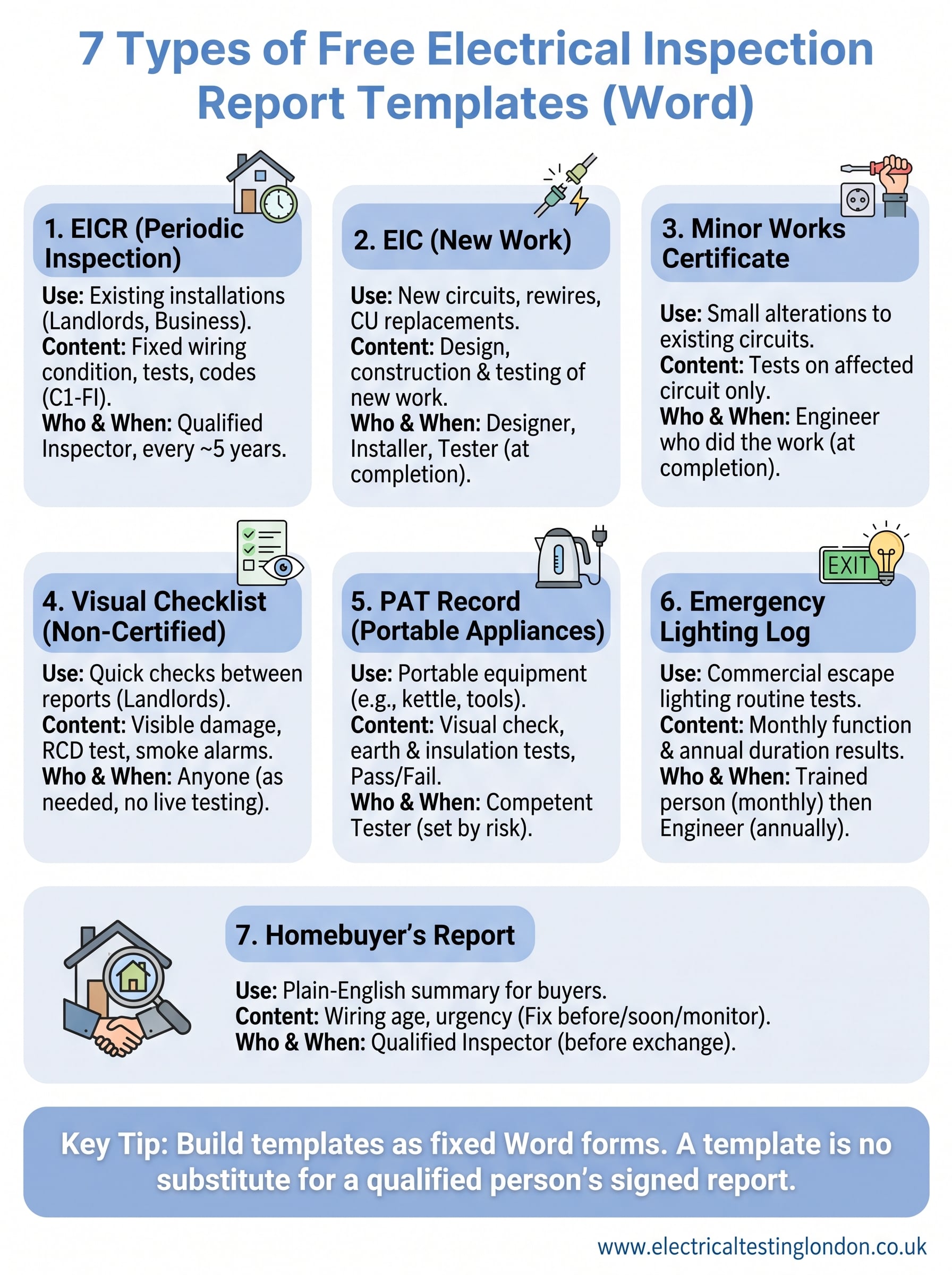
The right free electrical inspection report template in Word is the one that matches the job: EICR for existing installations, EIC and minor works for new or altered ones, and simple logs for appliances, escape lighting and day-to-day visual checks. Build it with fixed tables and locked fields, and keep every report with its test instrument details.
A template organises your records, but it cannot carry out the testing. If you need a signed report for a London or South East property, you can request a quote from Electrical Testing London and we will price the inspection, testing and any remedial work for you.