


House Rewiring Cost: UK Prices by Property Size


If you're trying to work out how much does house rewiring cost, you've probably already had a shock from a couple of vague quotes or scare stories online. Rewiring a house is one of those jobs where the price swings wildly depending on who you ask, and without knowing what actually drives the cost, it's hard to tell whether a quote is fair or way off.
The short answer is that most UK homes cost somewhere between £2,500 and £7,000 to rewire, though the final figure depends heavily on your property size, the number of rooms, floors, and how accessible the wiring is. A one-bed flat and a five-bed period house are simply not comparable jobs, and treating them as such is where budgets go wrong.
In this guide, we'll break down costs by property size, from flats to large detached homes, and explain what pushes a quote up or down, including age of the property, floor coverings, and consumer unit upgrades. We'll also cover what a fair quote should include, so you can compare estimates properly before booking any work.
Why rewiring costs vary so much across UK homes
Ask five electricians for a rewiring price and you'll likely get five different numbers, and that's not because anyone's trying to rip you off. Rewiring involves ripping out old cabling, running new circuits, fitting a new consumer unit (a job with its own replacement cost), and making good afterwards, and every one of those steps changes depending on the property in front of the electrician. Two houses of the same size on the same street can cost hundreds of pounds apart to rewire once you factor in how the walls are built, what's under the floors, and how many sockets and light fittings the previous owner decided to cram in.
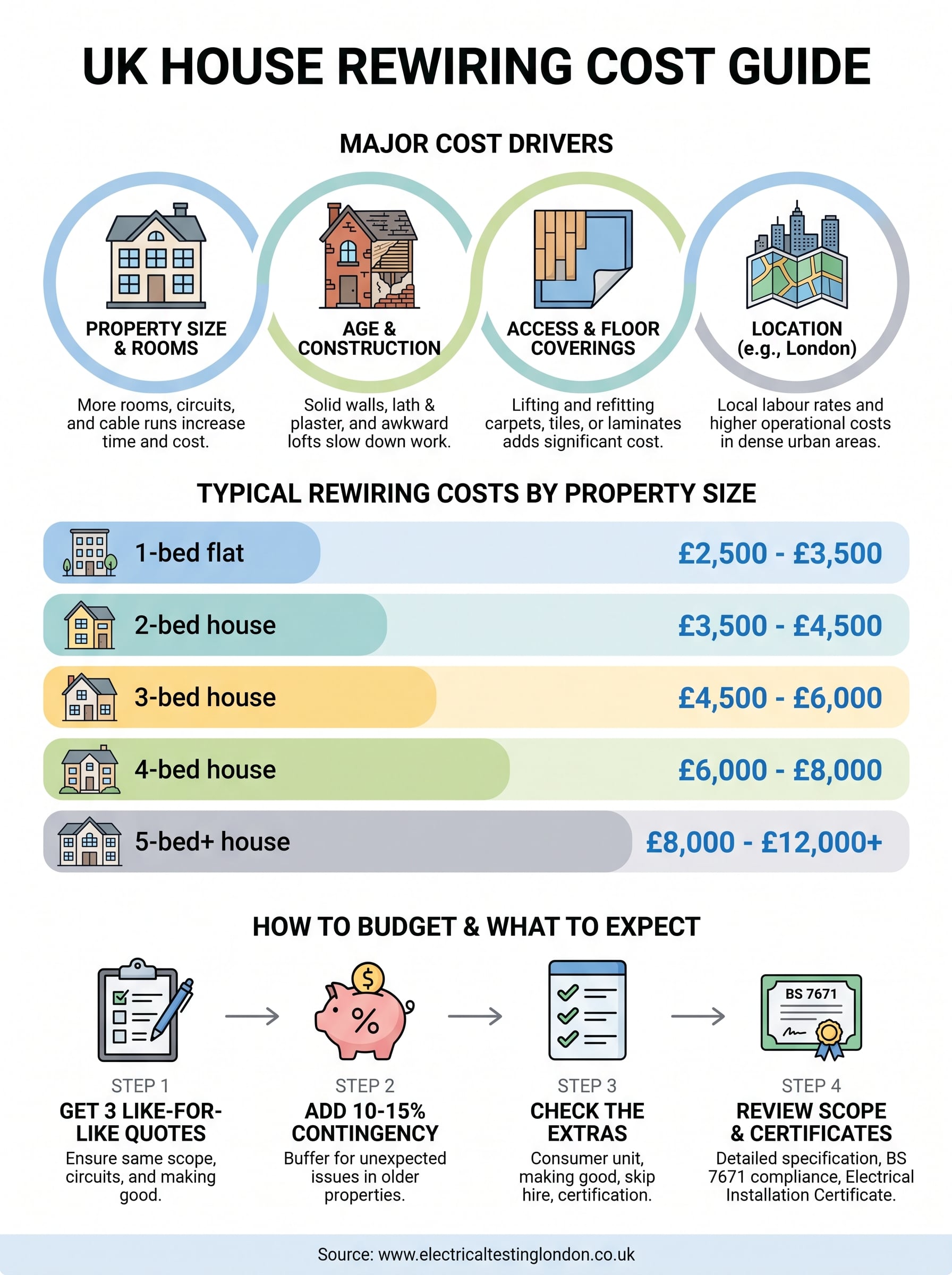
Property size and number of rooms
Size is the single biggest factor, because more rooms mean more circuits, more cable runs, and more time on site. A one-bedroom flat with straightforward access might take an electrician two to three days, while a five-bedroom detached house can take two to three weeks with a team of two or three engineers, so it pays to know how long a house rewire takes before you book. Here's roughly what UK homeowners pay by property size:

|
Property size |
Typical rewiring cost |
|---|---|
|
1-bed flat |
£2,500 - £3,500 |
|
2-bed house |
£3,500 - £4,500 |
|
3-bed house |
£4,500 - £6,000 |
|
4-bed house |
£6,000 - £8,000 |
|
5-bed+ house |
£8,000 - £12,000+ |
These figures assume a full rewire, meaning every circuit is replaced, not a partial job covering just one or two rooms.
Age and construction of the property
Older properties almost always cost more to rewire than new builds of the same size. Victorian and Edwardian houses often have solid walls, lath and plaster ceilings, and awkward loft spaces, all of which slow down cable runs and increase the amount of making good needed afterwards, like patching plaster or lifting and relaying floorboards. A 1990s house with cavity walls and easy loft access, by contrast, is a much faster and cheaper job for the same number of rooms.
The age and layout of your property often affects the final price more than its size does.
Access, floor coverings, and disruption
How easy it is to get cables where they need to go matters enormously. A house with exposed floorboards and an accessible loft is far quicker to rewire than one with fitted carpets throughout, solid concrete floors, or boxed-in ceilings. Lifting and refitting carpets, tiles, or laminate adds both time and cost, and some electricians will quote separately for this rather than build it into the headline price. If you're renovating anyway and floors are already exposed, that's the cheapest possible time to get a rewire done, because the access costs that usually inflate a quote simply don't apply.
Location and local labour rates
Where you live in the UK also shifts the price, and London is consistently at the higher end of the national range. Labour costs, congestion charges, parking restrictions, and the sheer density of period properties across areas like Islington, Camden, and Wandsworth all push up what electricians need to charge to make a job viable. If you're comparing a quote from a national price guide against one from a London-based electrician, expect the London figure to sit noticeably above the national average, sometimes by 15-20%, purely down to these local factors rather than any difference in the quality of work.
How to budget accurately for a house rewire
Getting a realistic budget together before you start calling electricians saves you from either overpaying or being caught out by a job that balloons halfway through. The trick is to build your figure from the ground up, using the property size table above as a starting point, then layering on the specific quirks of your home rather than accepting a single number at face value.
Get at least three like-for-like quotes
Ask each electrician to quote for exactly the same scope, so you're comparing apples with apples rather than one quote that includes making good and another that doesn't. A written quote should specify the number of circuits, whether the consumer unit is being replaced, and what happens to floors and walls afterwards. If prices vary by more than a few hundred pounds for the same scope, ask why, because it usually points to a difference in materials, warranty, or how much snagging work is included.
Build in a contingency
Older properties especially throw up surprises once walls are opened up, from crumbling plaster to wiring that doesn't match what's on the original drawings. Set aside 10-15% on top of your quoted price as a buffer, and treat it as a genuine contingency rather than spare cash to spend elsewhere.
Budget for the job you can see, then add a buffer for the wiring you can't.
Don't forget the extras
A full rewire often triggers other jobs that aren't always in the headline price:
-
Consumer unit replacement, usually included but worth confirming
-
Making good plaster, flooring, and decorating
-
Skip hire or waste removal
-
An Electrical Installation Condition Report once work is finished, to certify the new installation
Asking your electrician to itemise these separately, rather than folding them into one lump sum, makes it far easier to spot what you're actually paying for and to trim costs if your budget is tight.
Time your rewire around other work
If you're already having floors lifted or a kitchen refitted, book the rewire during the same window. Access costs drop sharply when floorboards and walls are already exposed, which is often the single biggest saving available to anyone planning a wider renovation.
What a typical rewiring quote should include
A good rewiring quote reads like a detailed specification, not a single number scribbled on a business card. Before you sign anything, you should be able to see exactly what work is covered, what materials are being used, and what happens if the electrician finds something unexpected once the walls are opened up. This is where you separate a professional operation from someone quoting off the cuff, and it's often the difference between a quote that holds and one that doubles once work starts.
The core scope of work
Every written quote should spell out the number of circuits being installed, whether the consumer unit is being replaced or reused, and which rooms are included if it's a partial rewire rather than a full one. It should also state the cable type and standard being followed, since UK rewiring work must comply with the BS 7671 wiring regulations. You can check the current edition and amendments on the Institution of Engineering and Technology website if you want to verify what your electrician is referencing.
A quote that doesn't specify circuits, cable, and certification isn't a quote, it's a guess.
Certification and paperwork
Once the rewire is finished, you should receive an Electrical Installation Certificate, confirming the work meets current regulations. Many homeowners also ask for an Electrical Installation Condition Report at the same time, particularly if the property is being sold, let out, or insured shortly after. A reputable electrician will register the work with a relevant competent person scheme, which matters if you ever need to prove compliance to a buyer or insurer.
What a fair quote breakdown looks like
Ask for the quote in itemised form rather than one lump sum. A clear breakdown typically includes:
-
Labour costs, broken down by number of days or engineers on site
-
Materials, including cable, sockets, switches, and the consumer unit
-
Making good, covering plaster, flooring, and any redecoration
-
Waste removal or skip hire
-
Certification and testing on completion
Itemising the cost of a house rewire this way makes it far easier to spot where one quote is cheaper than another, and whether that saving comes from genuinely lower prices or from cutting corners on materials or making good.
Signs your home may need rewiring soon
Most homeowners don't wake up one day and decide to rewire for fun. Something usually prompts the call, whether that's a flickering light, a survey report, or a scorch mark behind a socket that's been bothering you for months, and it helps to recognise the warning signs a house needs rewiring. Knowing the warning signs early means you can plan the work and the budget on your own terms, rather than being forced into an emergency job when something fails.
Warning signs at the consumer unit and sockets
Start by looking at your fuse box and asking whether you need a new consumer unit. If yours still has a wooden back, cast-iron switches, or a row of rewireable fuses rather than modern circuit breakers, that's a strong sign the whole installation predates current safety standards. Round-pin sockets, black rubber-coated cabling, or sockets that feel warm to the touch when appliances are plugged in are all signs the wiring behind the wall is well past its expected life. Frequent tripping, scorch marks around switches, or a persistent burning smell near sockets should never be ignored, since these point to faults that can develop into a genuine fire risk.
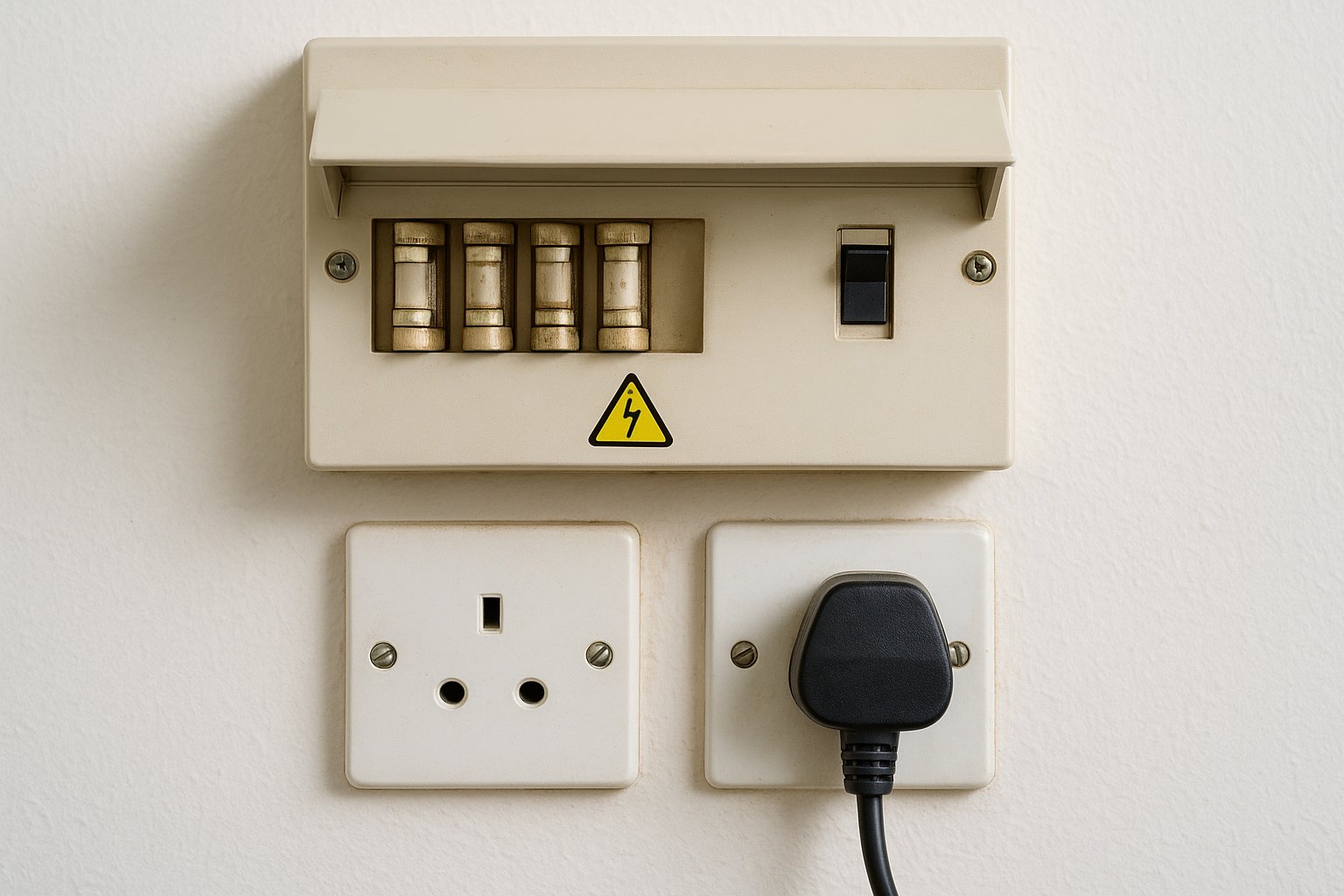
A consumer unit with rewireable fuses is one of the clearest signs your home is overdue for a rewire.
Age and history-based red flags
Wiring has a practical lifespan of around 25 to 30 years, so if you don't know when your home was last rewired and it's an older property, that alone is worth investigating. Homes with aluminium wiring, cloth-insulated cables, or any trace of the old colour coding (red and black rather than brown and blue) are almost certainly running on an installation from decades ago. If you're buying a property and want clarity before you commit, a Homebuyers Electrical Report will flag exactly this kind of ageing cabling before you're locked into a purchase.
Practical checklist before you call an electrician
Run through this list before booking an inspection:
-
Fuse box has rewireable fuses or no RCD protection
-
Sockets are round-pin, cracked, or loose in the wall
-
Lights flicker or dim when other appliances switch on
-
You smell burning or see scorch marks near outlets
-
No rewiring has happened in the last 25-30 years
Any one of these on its own is worth a professional look, and several together usually mean a full rewire is the sensible option rather than patching individual faults as they appear.
Deciding what's right for your home
Working out how much does house rewiring cost always comes back to the same few factors: property size, age, access, and where you live. A one-bed flat with exposed floorboards is a different job entirely from a five-bed period house with fitted carpets throughout, and no single price guide can account for the quirks hiding behind your own walls. Use the ranges in this guide as a starting point, but treat a proper site visit as the only way to get a genuinely accurate figure.
Rather than guessing from national averages, get a qualified electrician into your property to assess the wiring, the consumer unit, and the access involved before you commit to anything. If you'd rather skip the guesswork altogether, request a quote from our team and get a price built around your actual home, not someone else's.

