






Is an Electrical Certificate a Legal Requirement?



If you're renting out a property, selling a home, or just wondering whether your wiring needs checking, you've probably asked yourself is an electrical certificate a legal requirement. The honest answer depends on who you are and what you're doing with the property, and the rules aren't always as clear as they should be.
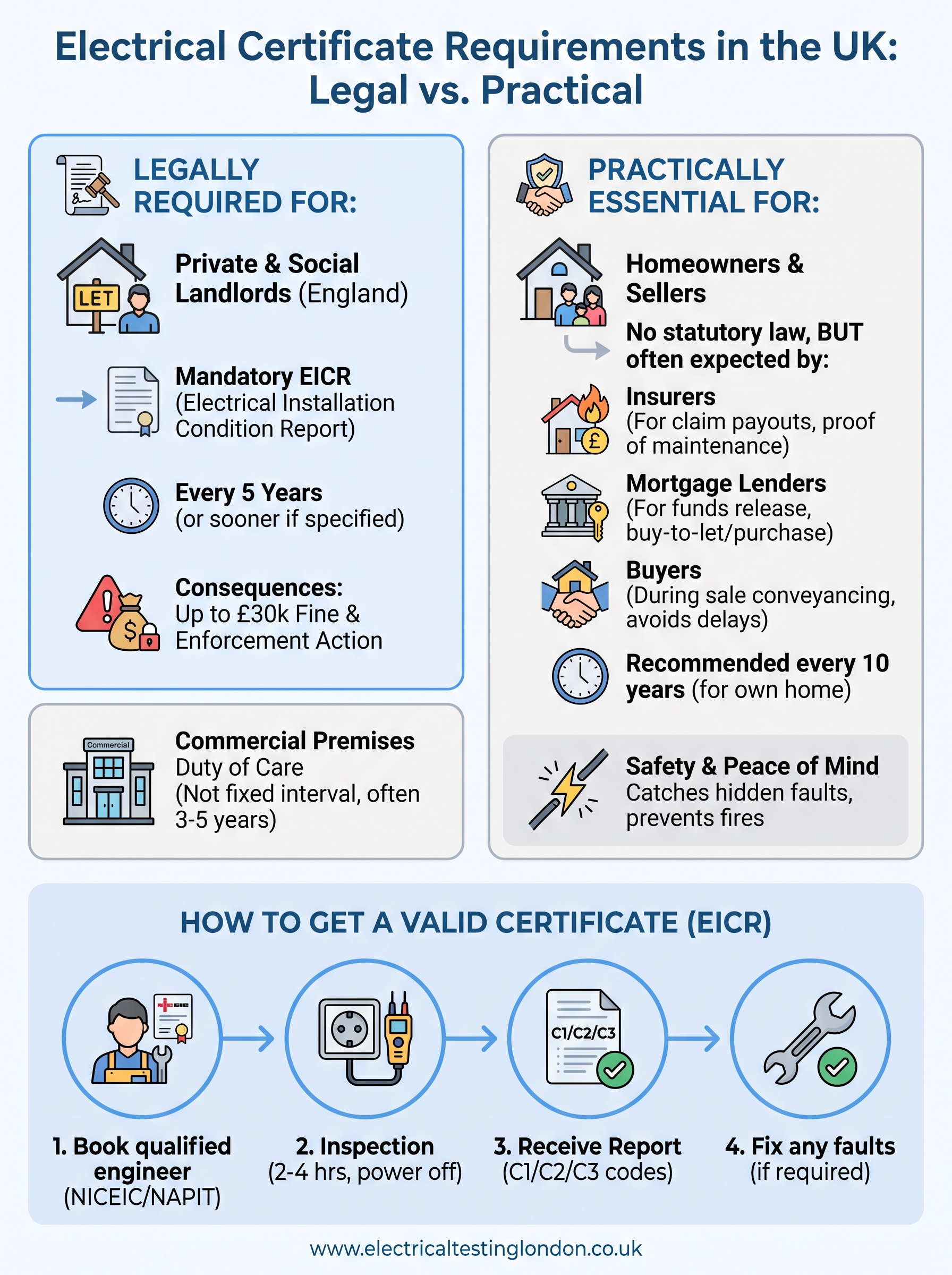
For landlords in England, the answer is straightforward: yes. Since 2020, an EICR (Electrical Installation Condition Report) has been a legal requirement for private rented properties, renewed every five years. For homeowners and sellers, there's no equivalent law forcing you to get one, but that doesn't mean it's optional in practice, especially when insurers, mortgage lenders, and buyers start asking questions.
This article breaks down exactly where the legal obligation applies, where it doesn't, and why an electrical safety check still matters even when the law stays silent. We'll cover landlord duties, homeowner expectations, commercial requirements, and what happens if you skip testing altogether.
Why electrical safety certification matters
Electrical faults aren't a hypothetical risk you can shrug off. Government fire statistics show faulty electrics cause thousands of house fires across the UK every year, and many start in wiring that hasn't been checked in over a decade. A periodic inspection catches deterioration you can't see from the living room: scorched connections behind sockets, overloaded circuits, or an old fuse board that can't cope with modern appliance loads. This is exactly why the question "is an electrical safety check a legal requirement" comes up so often among landlords and homeowners alike, because the risks are real even when the rules aren't always spelled out.
Ageing housing stock makes inspection more urgent
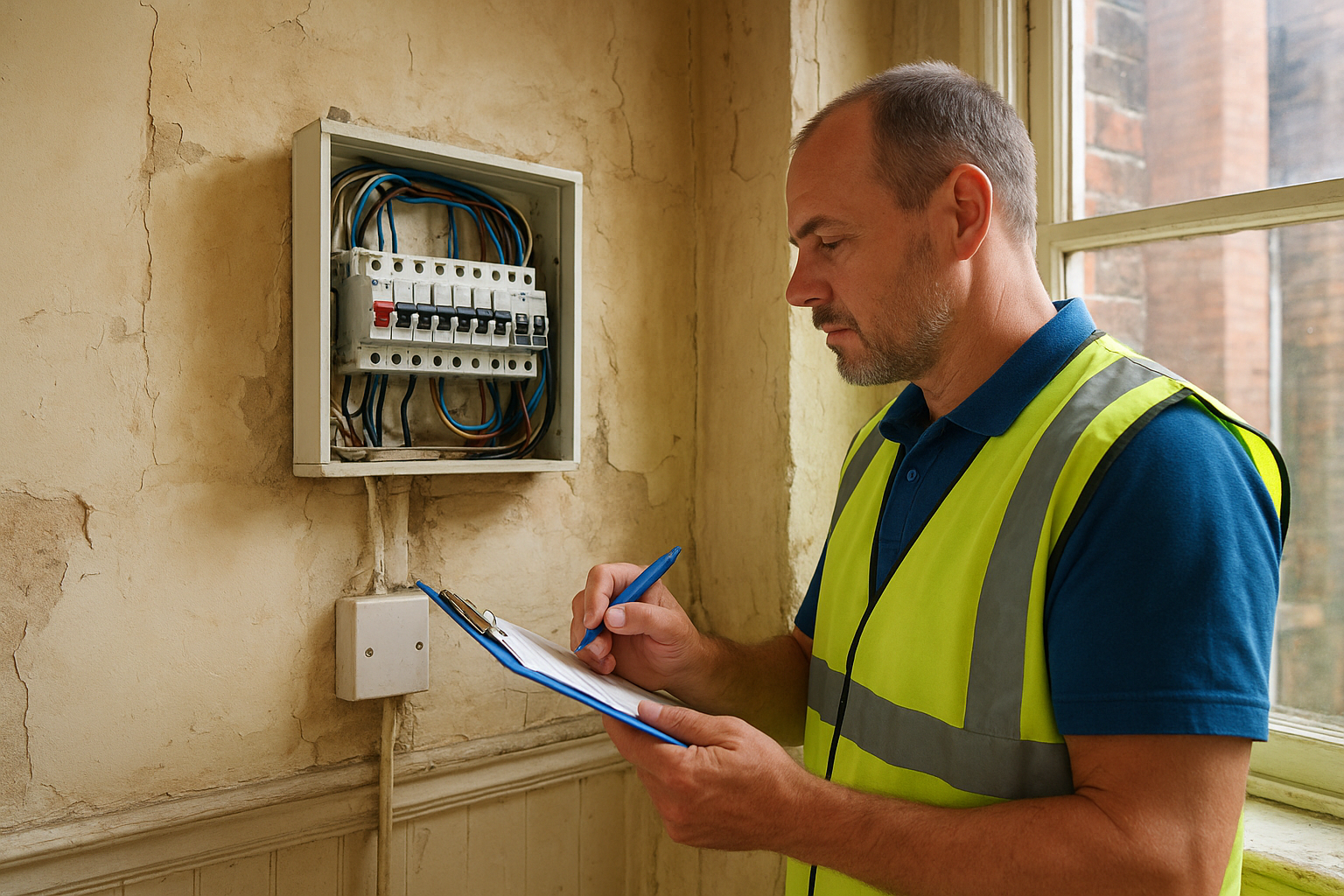
London's housing stock skews old. Terraced houses from the 1930s, Victorian conversions, and ex-council flats often still run on wiring installed decades before modern safety standards existed. Rewiring doesn't happen automatically when a property changes hands, so a fuse board fitted in the 1980s might still be doing the job today. An EICR flags exactly where that wiring has degraded and whether it still meets current wiring regulations.
Insurers and lenders expect proof, not promises
Insurance policies increasingly hinge on documented safety checks. If a fire or electrical fault causes damage and you can't produce a valid electrical installation condition report, some insurers will reduce or refuse a payout, arguing you failed to maintain the property to a reasonable standard. Mortgage lenders on buy-to-let properties often insist on the same paperwork before releasing funds, and conveyancers now routinely ask sellers for it during the sales process.
A missing certificate rarely causes problems until the moment you need one, and by then it's too late to fix.
The financial cost of skipping it
Beyond safety, there's a straightforward money argument. Catching a loose connection or a degraded cable early costs a fraction of what you'd pay after it causes a fire, a tenant injury claim, or a failed insurance payout. Testing is cheap insurance against a genuinely expensive outcome, which is one reason more homeowners are booking inspections voluntarily rather than waiting to be told they must.
Who needs an electrical certificate by law
Legal obligation in the UK isn't a blanket rule, it depends entirely on your relationship to the property. Landlords letting a property in England have the clearest duty: the Electrical Safety Standards in the Private Rented Sector (England) Regulations 2020 make an EICR mandatory, with a new report required at least every five years or sooner if the previous one recommends it. Housing associations and local authorities fall under the same regulations, so social landlords can't opt out either.
Commercial landlords and business owners face a slightly different framework. The Electricity at Work Regulations 1989 don't specify a fixed testing interval, but they do place a legal duty of care on employers and building owners to keep electrical systems safe, which in practice means regular inspections, documented maintenance, and testing intervals that reflect how the building is used.
Whether the law forces your hand or not, an untested electrical system is a risk you're carrying either way.
Homeowners occupying their own property sit outside any statutory testing requirement. Nobody's going to prosecute you for skipping an inspection on a house you live in yourself. That said, mortgage providers, home insurers, and buyers during a sale increasingly expect the same paperwork landlords are legally bound to produce.
|
Property type |
Legal requirement |
Typical interval |
|---|---|---|
|
Private rented (England) |
Mandatory EICR |
Every 5 years |
|
Social housing |
Mandatory EICR |
Every 5 years |
|
Commercial premises |
Duty of care under law |
Risk-dependent, often 3-5 years |
|
Owner-occupied home |
No statutory requirement |
Recommended every 10 years |
Understanding which category you fall into, and how often an EICR is needed by property type, is the first step before booking any inspection.
How to obtain an electrical certificate or safety check
Getting an electrical certificate isn't complicated once you know who to call. To get an electrical safety certificate you need a qualified electrician registered with a recognised body such as NICEIC or NAPIT, since only their reports carry weight with insurers, letting agents, and local councils. Booking one is straightforward: contact a testing firm, describe the property type and its size, and check what a certificate should cost so you get a fixed quote before anyone turns up on site.
The certificate itself is only as good as the person who signs it, so credentials matter more than price.
Finding a qualified engineer
Don't just search for the cheapest quote and book blind. A few checks before you commit save headaches later:
-
Confirm the engineer holds current NICEIC or NAPIT registration
-
Ask how many years they've worked on properties similar to yours
-
Request a fixed price upfront, not a vague estimate
-
Check they carry public liability insurance
-
Ask how quickly you'll receive the written report
At Electrical Testing London, every engineer on the team has at least a decade of hands-on experience, and quotes are transparent from the first call.
What happens during the test
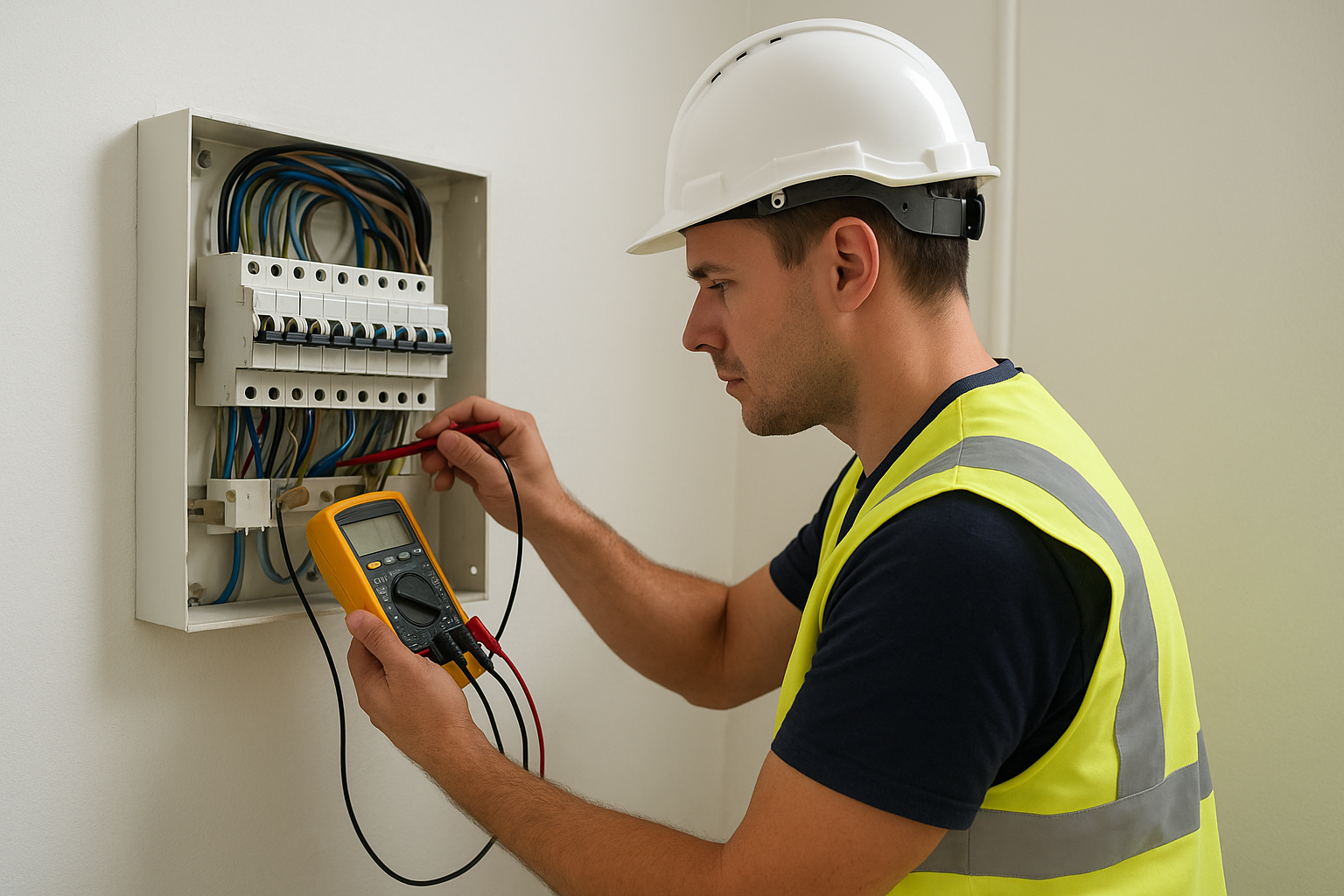
Once booked, the actual inspection is fairly quick for most homes, usually two to four hours depending on the number of circuits. The electrician isolates the supply, tests each circuit for continuity and insulation resistance, checks earthing and bonding, and inspects the consumer unit for wear or outdated components. Landlords asking whether an electrical safety check is a legal requirement should note that this same process underpins the EICR they're legally obliged to hold. You'll receive a written report within a few days, coded C1, C2, C3, or FI depending on severity, which tells you exactly what, if anything, needs fixing if the EICR fails before the certificate can be marked satisfactory.
What happens without a valid electrical certificate
Skipping the paperwork doesn't just leave you exposed to fire risk, it opens up legal and financial consequences that can hit far harder than the cost of an inspection. Landlords who let a property without a valid EICR are breaking the Electrical Safety Standards in the Private Rented Sector Regulations 2020, and local councils have real enforcement powers to back that up.
Fines and enforcement for landlords
Councils can issue a remedial notice giving you 28 days to fix identified issues, and if you ignore it, they can carry out the work themselves and bill you for it. Persistent non-compliance carries a civil penalty of up to £30,000 per breach, and that's before you consider what happens if a tenant is injured in a fire linked to unchecked wiring.
Ignoring the requirement doesn't remove the risk, it just delays the bill until the consequences are worse.
-
Remedial notice with a 28-day deadline
-
Council-arranged repairs billed to the landlord
-
Civil penalty up to £30,000
-
Invalidated insurance if a claim follows an electrical incident
-
Difficulty selling or remortgaging a non-compliant rental
Consequences for homeowners and sellers
Homeowners face no direct fine, but a missing electrical installation condition report still causes real problems. Buyers' solicitors increasingly request one during conveyancing on a house sale, and a sale can stall for weeks while you arrange a last-minute inspection under pressure. Insurers may also reduce a payout after a fire or fault if you can't demonstrate the property was maintained to a reasonable standard, leaving you covering repair costs yourself. Whether you're legally obliged or not, the practical cost of not having a certificate rarely disappears, it just resurfaces at the worst possible moment, usually during a sale, a claim, or a tenancy dispute.
Staying compliant and keeping your property safe
So, is an electrical certificate a legal requirement? For landlords, yes, without question, and the EICR rules aren't going away. For homeowners, the law stays quiet, but insurers, buyers, and common sense all point the same direction. Waiting until something goes wrong is the most expensive way to find out your wiring needed attention years ago.
Whether you're renewing a landlord certificate, selling a period property, or just want peace of mind about a fuse board nobody's touched since the 1990s, booking an inspection now costs far less than dealing with a fire, a failed sale, or a rejected insurance claim later. A qualified inspection takes a few hours and gives you a clear, documented answer instead of a guess.
If you're ready to sort this properly, request a quote from Electrical Testing London for a fixed price, a qualified engineer, and a certificate you can actually rely on.