


Is an Electrical Safety Certificate a Legal Requirement?


If you're a landlord, homeowner, or business owner in London wondering is an electrical safety certificate a legal requirement, the honest answer depends on who you are and what you're doing with the property. Rules differ for rented homes, owner-occupied houses, and commercial premises, and getting it wrong can mean fines, invalid insurance, or worse if something goes wrong with the wiring.
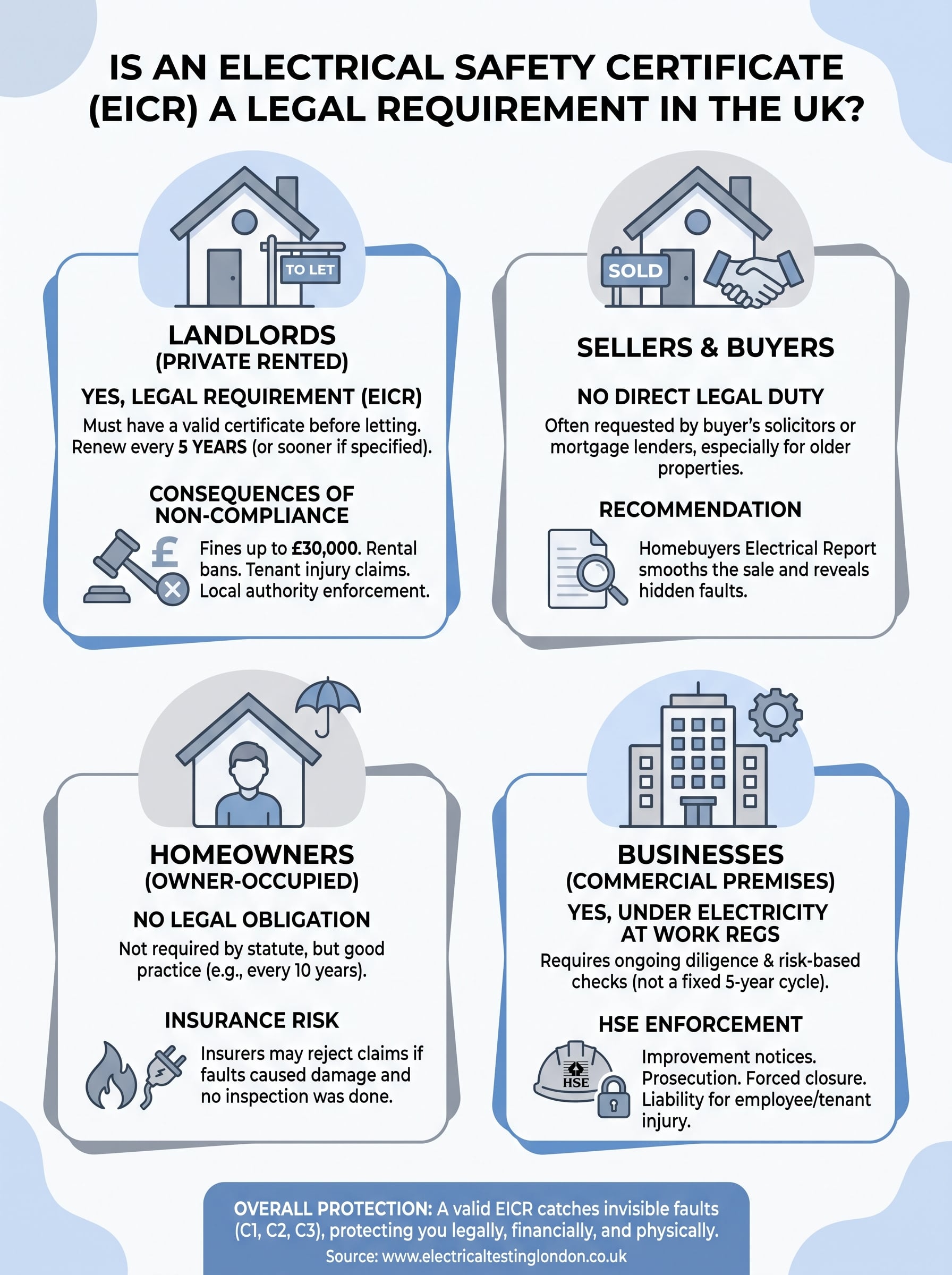
For private landlords in England, the answer is a firm yes: an EICR is a legal requirement under the Electrical Safety Standards regulations, renewed at least every five years. Homeowners face no such legal duty, but mortgage lenders, insurers, and common sense often make one essential anyway. Businesses sit somewhere in between, guided by the Electricity at Work Regulations rather than a fixed certificate cycle.
In this article, we'll break down exactly where the legal obligations sit for landlords, homeowners, sellers, and commercial clients across London and the South East, so you know precisely what's required, what's simply good practice, and what could land you in trouble if ignored.
Why electrical safety certificates matter
Electrical faults are one of the leading causes of house fires in the UK, and most of them start with damage that's invisible until you go looking for it: a scorched socket behind a fridge, insulation perished by heat, or a consumer unit that's simply too old to trip safely. An electrical safety certificate, most commonly an Electrical Installation Condition Report (EICR), exists to catch these problems before they turn into an emergency. It's not a box-ticking exercise dreamed up by regulators; it's a genuine health check on the wiring that runs behind every wall in your home or business.
The safety risk hiding behind the walls
Wiring doesn't announce that it's failing. A property can look perfectly normal while carrying overloaded circuits, missing earth bonding, or DIY additions that were never inspected. Government fire statistics consistently show electrical distribution and installation faults among the top causes of accidental dwelling fires, which is exactly why the question of legal compliance carries real weight beyond paperwork. An EICR, carried out by a qualified engineer, identifies these faults using a standard classification system of EICR codes:
-
C1 – Danger present, immediate risk to life, requires urgent action
-
C2 – Potentially dangerous, requires urgent remedial work
-
C3 – Improvement recommended, not currently dangerous
-
FI – Further investigation required
An electrical safety certificate isn't paperwork for its own sake, it's the difference between finding a fault on paper and finding it in a fire.
The financial and legal fallout of skipping it
Beyond the physical risk, there's a financial one. Insurers can refuse a claim outright if a fire or electrical incident is traced back to a fault that a valid EICR would have caught, particularly if you never had one done or let it lapse. Mortgage lenders increasingly ask for evidence of electrical safety before completing on a sale, and commercial landlords can face liability claims from tenants or employees injured by faulty wiring that was never checked. For rented properties specifically, the certificate isn't optional at all, it's a legal document local authorities can demand to see, and its absence is treated as a compliance failure in its own right, not just a safety oversight.
Taken together, the safety case and the legal case point the same direction: getting an EICR isn't about satisfying a form, it's about knowing, with evidence, that the electrics in your property won't be the reason something goes badly wrong. Our team at Electrical Testing London carries out EICR inspections across London and the South East precisely because so many faults only surface once someone qualified goes looking.
How to obtain an electrical safety certificate
Getting a valid electrical safety certificate isn't complicated once you know the process, but it does need to be done by someone properly qualified. Only a registered electrician, ideally one certified by NICEIC, NAPIT, or a similar body, can legally sign off an EICR. Trying to cut corners with an uncertified tradesperson or a certificate bought online without an inspection ever taking place will leave you exposed the moment anyone checks its validity.
What actually happens during the inspection
Here's what to expect when an engineer arrives to carry out the test:
-
Visual inspection of the consumer unit, sockets, switches, and visible wiring for damage or wear
-
Dead testing of circuits with the power off, checking insulation resistance and earth continuity
-
Live testing once power is restored, confirming RCDs trip correctly and polarity is correct throughout
-
Classification of any faults found, using the C1 to C3 and FI system, with a pass or fail outcome recorded
-
Written report issued, detailing every circuit tested and any remedial work needed
Most domestic properties take between one and three hours, depending on size and the number of circuits, while larger commercial units can take longer.
A genuine EICR always involves someone physically testing your circuits, if nobody's been near your consumer unit, you don't have a valid certificate.
Booking and cost expectations
Before booking, check that whoever you're using can produce proof of qualification and insurance, since this protects you if a dispute ever arises over the report's accuracy. Pricing varies by property size and location, but for a typical London flat you're usually looking at a fixed fee rather than an hourly rate, which makes budgeting straightforward. If the inspection turns up C1 or C2 faults, ask for a quote on remedial work at the same visit, since many engineers, including our team at Electrical Testing London, will arrange the fix and reissue the certificate once repairs are complete, saving you a second appointment and a second invoice.
Legal requirements for landlords, sellers and homeowners
Landlords in England have the clearest legal position of anyone in this article. Since 2020, the Electrical Safety Standards in the Private Rented Sector Regulations require every private landlord to have a valid EICR before letting a property, renewed at least every five years or sooner if the report specifies. Councils can issue fines of up to £30,000 for non-compliance, and tenants have every right to request a copy of the certificate.
Sellers face no direct legal duty, but expect questions
Selling a house doesn't trigger a legal requirement for an EICR, yet plenty of buyers' solicitors ask for one anyway, especially where the wiring looks dated or the property hasn't been rewired in decades. Mortgage lenders sometimes make an inspection a condition of the loan, particularly on older housing stock across London. A Homebuyers Electrical Report covers this exact scenario and can smooth a sale that might otherwise stall over uncertainty about the wiring.
No law forces a homeowner to get an EICR, but no insurer will look kindly on skipping one after a fire.
Homeowners aren't legally obliged, but insurers notice
Owning your own home means there's no statute demanding a certificate, unlike the position for landlords. That said, home insurance policies frequently include small-print clauses about maintaining the electrical installation, and a claim can be reduced or refused if a fault traces back to wiring nobody ever checked.
|
Property type |
Legal requirement |
Renewal |
Enforced by |
|---|---|---|---|
|
Private rented home |
Yes |
5 years |
Local council |
|
Property sale |
No, but often requested |
N/A |
Buyer/lender |
|
Owner-occupied home |
No |
Recommended 10 years |
Insurer/self |
|
Commercial premises |
Yes, under Electricity at Work Regs |
Risk-based |
HSE |
Whichever category applies to you, treating the certificate as optional rarely ends well once something goes wrong.
What happens if you don't have a valid certificate
Skipping a certificate rarely causes trouble the same day, but the consequences build quietly until something forces the issue, a tenant complaint, an insurance claim, or an inspector's visit. Once that happens, the lack of a valid electrical safety certificate stops being an oversight and starts being a liability that's hard to undo after the fact.
Landlords face the harshest penalties
Councils in England can fine private landlords up to £30,000 for renting a property without a valid EICR, and repeat offenders risk being banned from letting altogether. Local authorities also have the power to arrange remedial work themselves and bill the landlord for it, on top of any fine. Tenants who suffer injury or property damage from an unchecked electrical fault can pursue a landlord for damages separately from any council action, which means the legal requirement for landlords carries both a regulatory and civil dimension.
Ignoring the certificate doesn't remove the risk, it just delays who finds out about it and how expensive that discovery becomes.
Homeowners and businesses face quieter but costly fallout
Homeowners without a valid certificate won't face a fine, but insurers can and do reject claims where an electrical fault caused a fire or damage and no inspection had ever taken place. Sellers risk a stalled or collapsed sale if a buyer's solicitor asks for evidence of electrical safety and none exists, particularly on older properties across London's housing stock. Businesses operating without proper checks on commercial property electrics under the Electricity at Work Regulations can face enforcement action from the Health and Safety Executive, including improvement notices, prosecution, or a forced closure of premises until faults are fixed. In every case, the missing certificate turns a manageable problem into a much bigger one, usually at the worst possible moment.
Keeping your property electrically safe
So, is an electrical safety certificate a legal requirement? For landlords, yes, without question. For homeowners and sellers, it's not written into law, but insurers, lenders, and buyers increasingly treat it as essential anyway. For businesses, the Electricity at Work Regulations demand ongoing diligence rather than a single certificate. Whichever category you fall into, the pattern is the same: a valid EICR protects you legally, financially, and physically, while going without one only ever delays a problem rather than avoiding it.
Don't wait for a tenant complaint, a stalled sale, or a rejected insurance claim to find out where you stand. A qualified inspection settles the question properly and gives you a document you can actually rely on. If you need an EICR, a Homebuyers Report, or remedial work carried out anywhere across London or the South East, get a quote from our team and get it sorted properly, the first time.

