






NICEIC Electrical Safety Certificate: What It Is and How to Get One



If someone has asked you for a NICEIC electrical safety certificate, you're probably not entirely sure what you're being asked for, or why it matters. That's a fair question, because the terminology gets muddled all the time. NICEIC isn't actually the certificate itself. It's the accreditation body that regulates and inspects the electricians qualified to issue one, and the document people usually mean is an EICR (Electrical Installation Condition Report).
This guide clears up exactly what the certificate covers, who legally needs one, and how it differs from related paperwork like a PAT testing record or a minor works certificate. You'll also get a realistic idea of inspection timescales and what influences the price you're quoted.
We'll walk through the whole process: how a NICEIC-registered engineer carries out the inspection, what a satisfactory versus unsatisfactory result means for your property, and the steps to take if remedial work is flagged. Whether you're a landlord meeting a legal deadline, a homeowner selling up, or a business checking compliance, you'll finish this article knowing precisely what to book and why.
Why an NICEIC electrical safety certificate matters
Getting this sorted isn't just a box-ticking exercise. Faulty wiring causes thousands of house fires in the UK every year, and outdated consumer units, damaged sockets, and unearthed circuits often go unnoticed until something fails. An EICR from a NICEIC-registered contractor gives you documented proof that a qualified pair of eyes has checked the fixed electrical installation and confirmed it's safe to keep using, or flagged exactly what needs fixing before it becomes dangerous, and it helps to know what an EICR certificate checks and the legal rules behind it.
Legal duties for landlords and businesses
Under the Electrical Safety Standards in the Private Rented Sector (England) Regulations 2020, landlords must have a valid EICR for every rented property, renewed at least every 5 years, and hand a copy to tenants within 28 days of the inspection, which is the core of the landlord electrical safety certificate requirements. Commercial landlords and employers carry a similar duty under the Electricity at Work Regulations 1989, which requires that electrical systems be maintained to prevent danger. Skipping this isn't a minor paperwork slip:
-
Local councils can issue fines of up to £30,000 for non-compliant rental properties.
-
Insurers can refuse a claim if a fire or fault is traced back to an installation that was never inspected.
-
Tenants can report unsafe conditions directly to the council, triggering an inspection you don't control the timing of.
A certificate isn't paperwork for its own sake, it's the difference between proving your property is safe and hoping it is.
Protecting yourself with insurance and resale value
Homeowners often assume this only applies to rented property, but that's not quite right. Many home insurance policies now ask whether the electrical installation has been inspected within a set period, particularly on older properties, and a missing or lapsed report can complicate a claim after an electrical fire or fault. Selling a house with an out-of-date or non-existent EICR can also slow a sale, since buyers' solicitors increasingly ask for one as standard due diligence.
Catching problems before they become dangerous
Unchecked systems don't announce themselves. A loose connection behind a socket or a consumer unit without RCD protection can sit quietly for years before it causes a shock, a fire, or an appliance failure. Regular testing through what used to be called a periodic inspection report catches these issues early, while they're still a straightforward fix rather than an emergency call-out. If you're due one, our EICR testing service covers residential and commercial properties across London and the South East.
How to get an NICEIC electrical safety certificate
Finding a genuine NICEIC-registered engineer is the first step, and it's worth doing properly rather than trusting a van sign-written with the logo. Anyone can print a logo on a leaflet, but NICEIC's own online database lets you search by postcode and confirm the contractor's registration is current, which matters because a certificate issued by an unregistered electrician carries no real weight with insurers, councils, or letting agents. You can check this directly through NICEIC's Find a Contractor tool.
A certificate only carries weight if the person signing it is genuinely registered, not just wearing the badge.
What to check before you book
Once you've shortlisted a contractor, confirm a few practical details before committing:
-
Their NICEIC registration number, which you can cross-check on the database, along with how the NICEIC Approved Contractor Scheme vets its members
-
Whether they've inspected properties of your type before (domestic, commercial, or rented)
-
A written quote that specifies the number of circuits covered
-
Their availability against any legal deadline you're working to, such as a tenancy renewal
Booking and what happens next
Getting a quote is usually straightforward. Most registered engineers ask for the property size, number of circuits or consumer units, and whether it's occupied during the inspection, since some testing requires circuits to be switched off briefly. You'll typically get a written report within a few days of the visit, not on the spot, because the engineer needs time to write up findings and assign observation codes. If you'd rather skip the searching altogether, you can request a quote directly from our NICEIC-registered engineers, who cover both domestic and commercial properties across London.
What happens during the inspection and what the codes mean
During the visit, the engineer works through the property circuit by circuit, checking the consumer unit, socket outlets, light fittings, and earthing arrangements against the current wiring regulations (BS 7671). Some tests are visual, like checking for scorch marks or loose connections, while others involve switching off the supply briefly to test insulation resistance and earth continuity with calibrated equipment. Expect the whole process to take anywhere from one to four hours depending on property size and the number of circuits, and see our step-by-step guide to how an EICR is carried out for the full sequence.
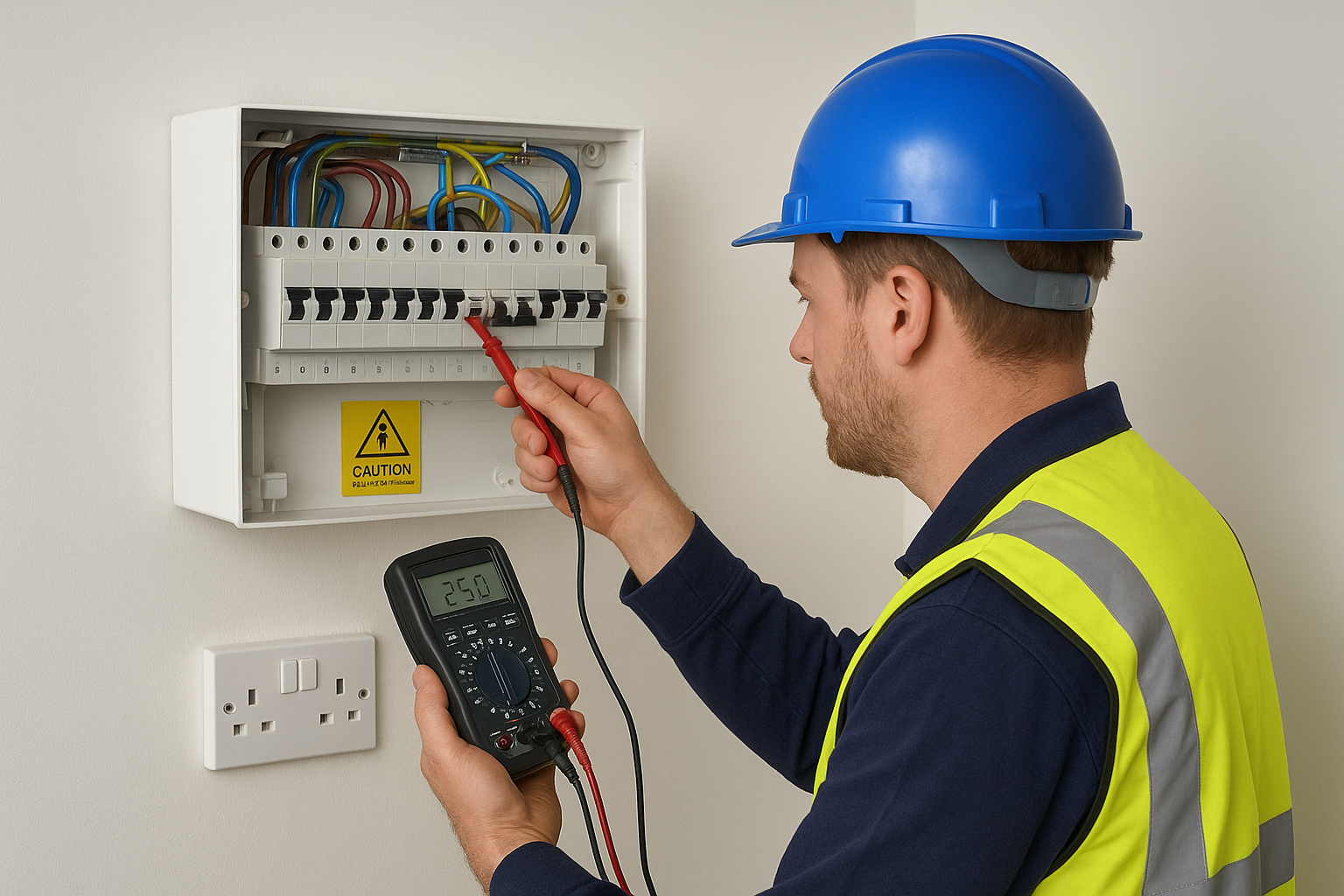
Reading the observation codes
Every issue found gets logged against a specific circuit and assigned a code, which is what actually determines whether your report comes back satisfactory or not. Understanding these codes saves you from panicking over minor findings or, worse, ignoring something serious.
|
Code |
Meaning |
What it means for you |
|---|---|---|
|
C1 |
Danger present |
Immediate risk of injury, requires urgent action |
|
C2 |
Potentially dangerous |
Needs remedial work without delay |
|
C3 |
Improvement recommended |
Not dangerous now, but worth upgrading |
|
FI |
Further investigation |
More testing needed to confirm a suspected fault |
A C1 or C2 code doesn't mean your property is unsafe forever, it means you now know exactly what to fix.
Satisfactory versus unsatisfactory outcomes
Any C1 or C2 finding automatically makes the overall report unsatisfactory, which matters if you're a landlord facing that 28-day tenant deadline or a homeowner mid-sale. C3 observations don't affect the outcome but still get noted for your records. Only once the flagged remedial electrical work has been carried out and verified does the property return to a satisfactory status, sometimes requiring a follow-up visit to confirm the fix before the certificate is finalised.
How much it costs and how often you need one
Pricing for an EICR varies more than most people expect, mostly because it depends on the size of the property and the number of circuits rather than a flat fee, as our breakdown of electrical safety certificate prices shows. A one-bedroom flat with a modern consumer unit takes far less time to test than a five-bedroom house with an outbuilding and multiple distribution boards, and the invoice reflects that. Genuine NICEIC-registered engineers should give you a written quote before booking, not a vague estimate over the phone, so you know exactly what you're paying for.

What affects the price
Several factors push the cost up or down, and it helps to know them before you compare quotes:
|
Factor |
Effect on price |
|---|---|
|
Number of circuits |
More circuits mean more testing time |
|
Property type |
Commercial units often cost more than domestic flats |
|
Access to the consumer unit |
Difficult access adds time |
|
Age of the installation |
Older wiring usually needs closer inspection |
The cheapest quote rarely reflects the thoroughness a proper inspection requires.
Our own EICR pricing is transparent from the outset, covering both domestic properties and commercial premises across London and the South East, so you're not guessing at the final bill.
How often you need a new inspection
How often you need an EICR depends on the property type and what it's used for:
-
Rented residential property: every 5 years, or at each change of tenancy if sooner
-
Owner-occupied homes: every 10 years, though older wiring may need checking sooner
-
Commercial premises: typically every 5 years, though higher-risk environments may need more frequent checks
Sticking to these intervals keeps you compliant and catches faults before they turn into costly repairs or dangerous failures.
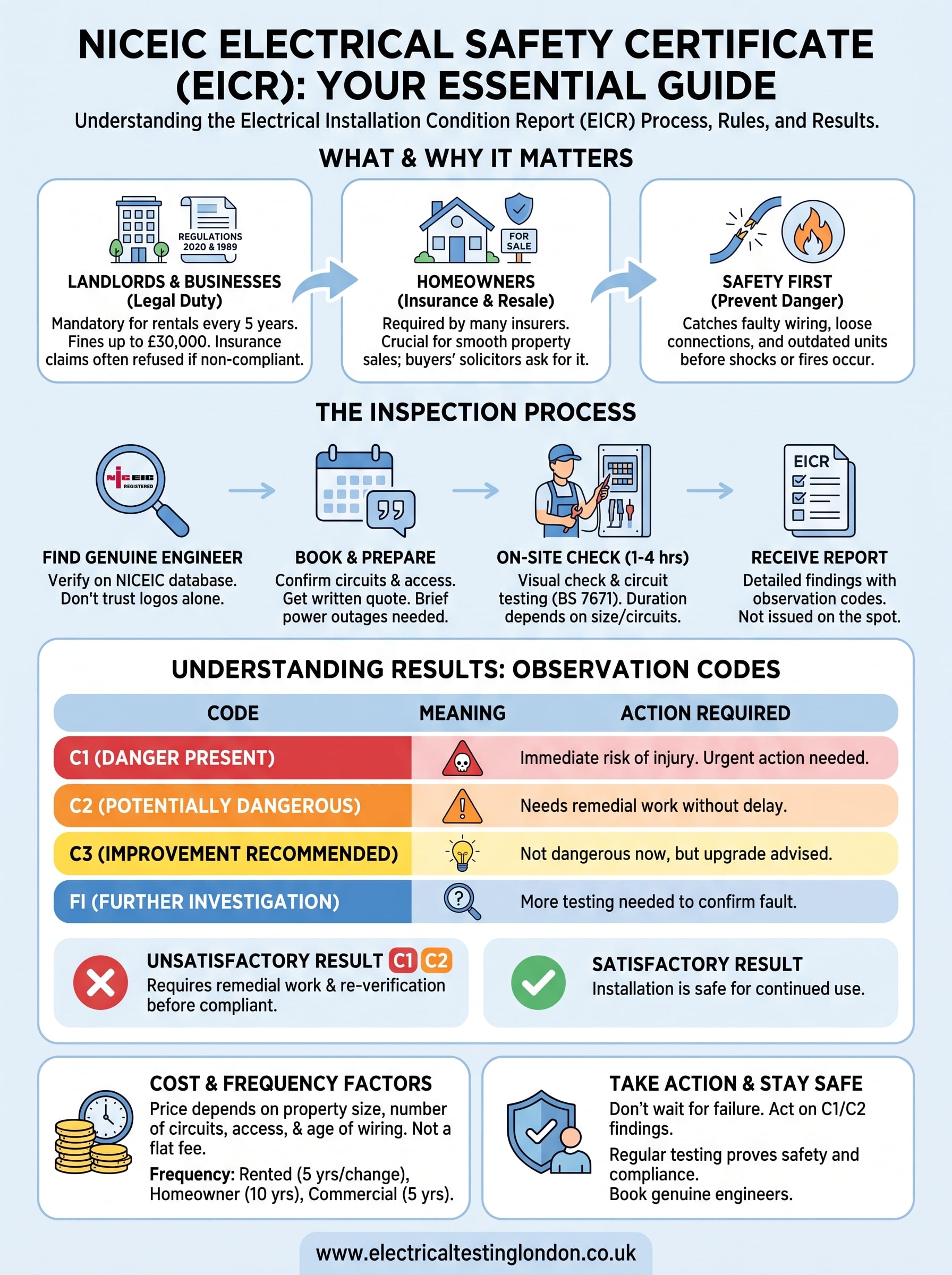
Keeping your property safe and compliant
An NICEIC electrical safety certificate boils down to one thing: proof that a qualified engineer has checked your fixed wiring and confirmed it's safe, or told you precisely what needs fixing before it isn't. Whether you're a landlord facing that 5-year deadline, a homeowner reassuring an insurer, or a business owner covering your legal duty of care, the process is the same. Find a genuinely registered contractor, understand what the codes mean when the report lands, and act on any C1 or C2 findings without delay.
Circuits don't fail on a convenient schedule, so don't wait for a warning sign before booking one. If you're due an inspection, or you've inherited a report full of codes you'd rather have explained properly, request a quotation from our NICEIC-registered engineers and get it sorted before it becomes a bigger problem.