


PAT Testing Certificate Template: What It Should Include


Search for a PAT testing certificate template and you will find dozens of free downloads that look fine until you actually try to use one on a job. Half are missing fields an insurer or fire officer will ask about, and the other half are so cluttered they take longer to fill in than the testing itself. If you are a landlord juggling several properties or a business owner trying to keep records straight, that gap matters.
This article answers the practical question behind the search: what does a proper portable appliance testing certificate template actually need to contain, and why. We break down each section, from appliance details and pass/fail results to retest dates and engineer sign-off, so you can judge any template against a working standard rather than guessing.
We also cover how portable appliance testing records fit into your wider compliance paperwork, what commercial clients typically expect to see, and where a template falls short of what a qualified engineer would actually check. Whether you are building your own record sheet or reviewing one supplied by a contractor, you will finish this article knowing exactly what belongs on the page.
Why a PAT testing certificate matters
A PAT testing certificate is the only proof you have that a portable appliance was actually checked, not just glanced at, so it's worth knowing what these certificates are and how to get one. Without it, you're relying on memory or a verbal assurance from whoever plugged in the tester, and that doesn't hold up when an insurer, a fire officer, or a tenant's solicitor asks for evidence. The certificate turns a five-minute test into a permanent record you can produce on demand, which is exactly why so many landlords and business owners get caught out when they've skipped this step.
What the certificate actually proves
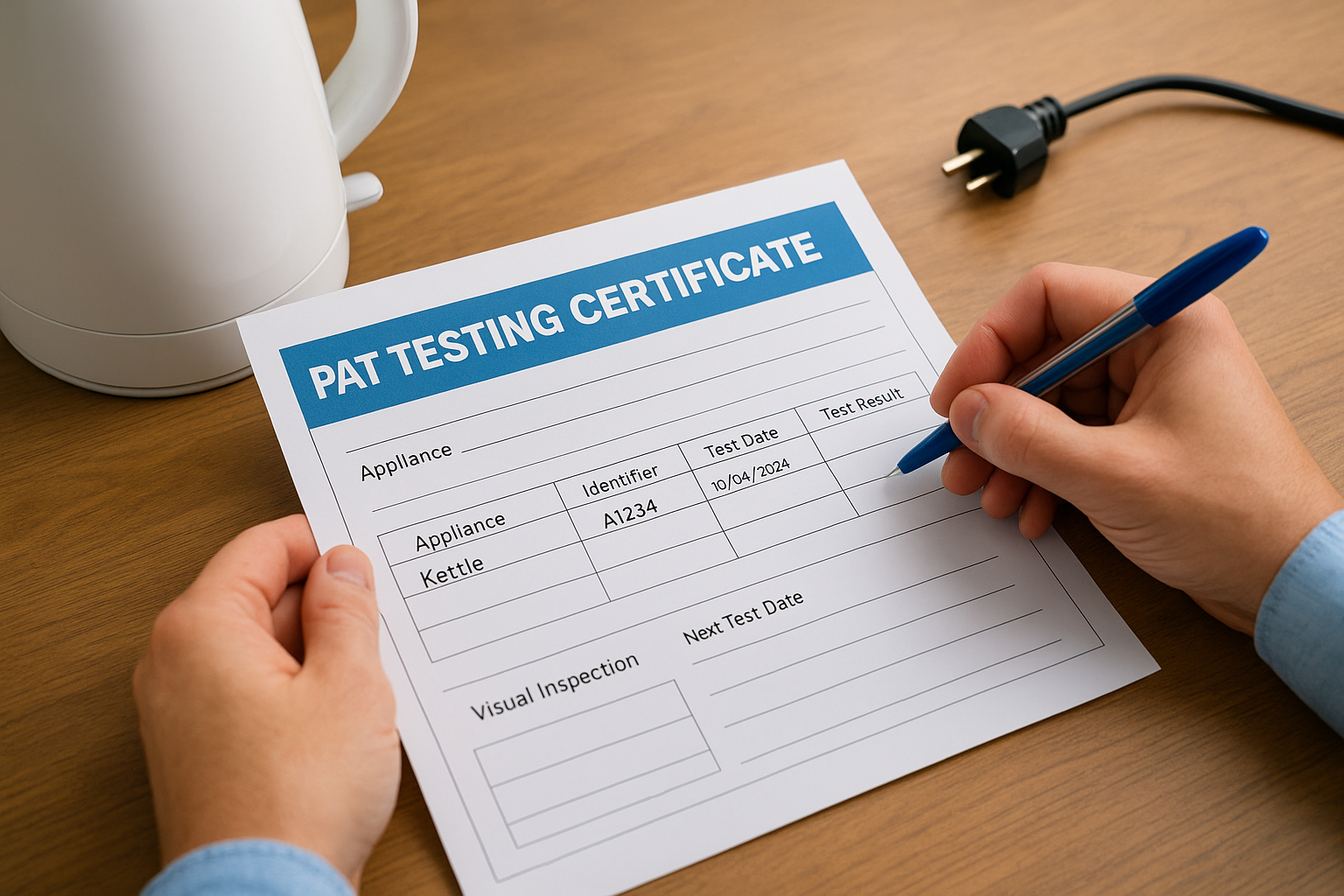
Properly filled in, the document confirms three things: which appliances were tested, when they were tested, and whether each one passed or failed. That sounds basic, but it's the detail insurers and duty holders actually need. Under the Electricity at Work Regulations 1989, employers and landlords have a legal duty to maintain electrical equipment in a safe condition, and PAT testing is the standard way to demonstrate that duty has been met. The certificate is your paper trail showing you took reasonable steps, not just that you own a tester.
A PAT certificate is worthless as evidence if it can't be traced back to a specific appliance, date, and result.
Who actually asks to see this paperwork
You might not think about your PAT records until someone else does, and by then it's often urgent. Here's who typically wants sight of them and why:
-
Insurers reviewing a claim after a fire or electrical fault, checking whether appliances were maintained per policy conditions.
-
Letting agents and tenants confirming a rental property meets its safety obligations before or during a tenancy, in line with the PAT testing rules landlords have to follow.
-
Health and safety inspectors carrying out a workplace check, particularly in offices, retail units, and hospitality venues, where PAT testing at work is a legal requirement.
-
Fire risk assessors cross-referencing electrical equipment against a building's fire safety measures.
-
Commercial clients or contractors who require proof of compliance before allowing your equipment onto their site.
Each of these groups wants the same thing: a document that's specific enough to verify, not a generic sign-off saying "all appliances tested."
The real cost of skipping proper records
Getting this wrong isn't just inconvenient, it can be expensive. If an appliance fault causes a fire or injury and you can't produce a certificate showing it was tested, you're exposed to liability you could otherwise have avoided. Insurance claims have been reduced or rejected because a business couldn't demonstrate a reasonable testing regime, and landlords have faced disputes with tenants over exactly this gap. None of this requires the appliance to have actually caused harm through negligence on your part, it's the absence of evidence that creates the problem.
Landlords in particular should treat this as part of the same compliance package as an Electrical Installation Condition Report, and it helps to see what a completed EICR report looks like. An EICR covers the fixed wiring, while PAT testing covers everything plugged into it, kettles, fridges, portable heaters, office equipment. Together they give a tenant or inspector a full picture of electrical safety in the property, and a missing half of that picture looks like negligence even if the wiring itself is sound.
Why templates matter more than they seem
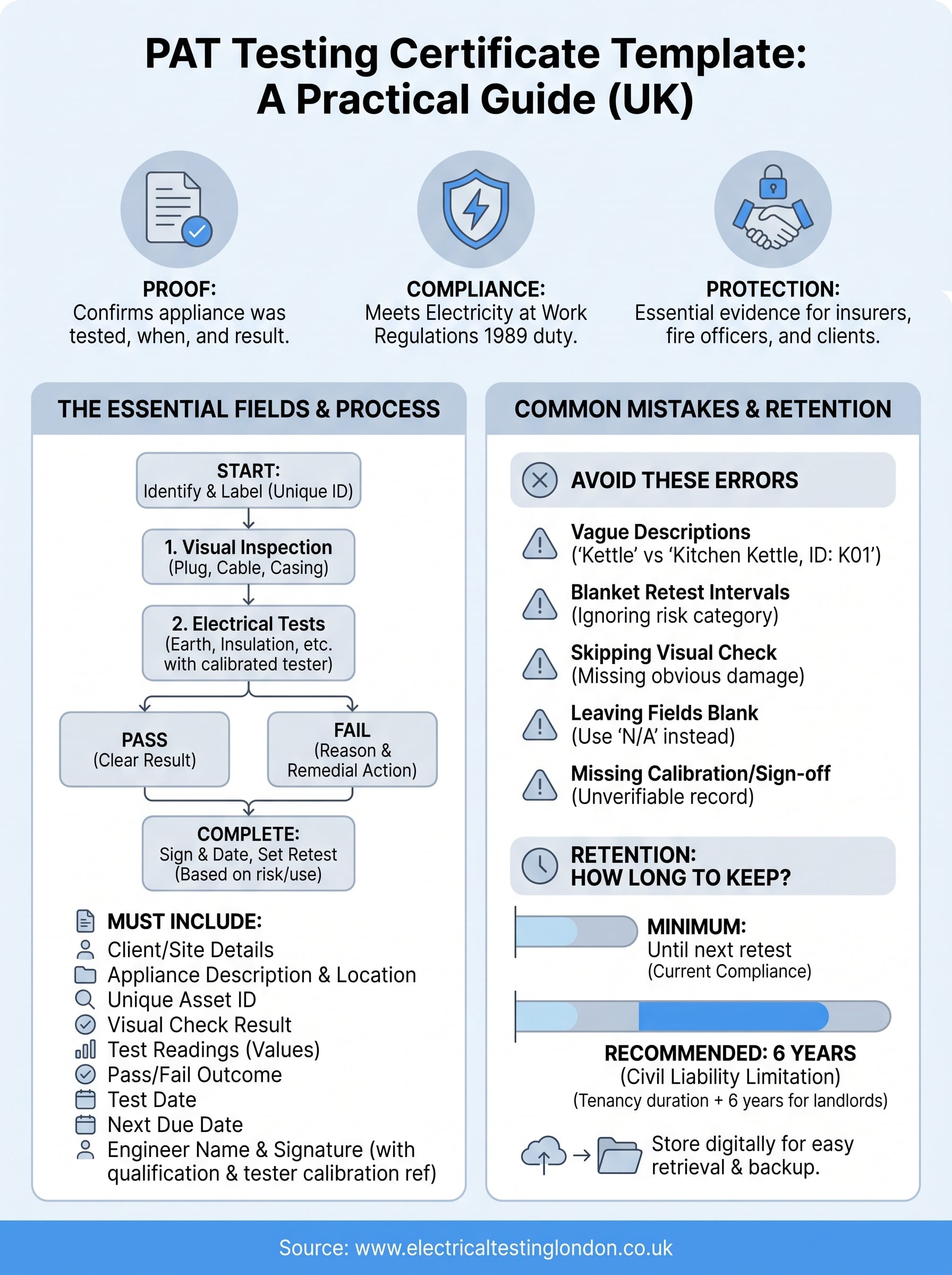
This is where the template itself becomes more than paperwork. A well-built PAT testing certificate template forces you to capture the right fields consistently, appliance description, unique identifier, visual inspection result, test result, date, and next due date, every single time. Skip a field once and you might not notice. Skip it across fifty appliances in a commercial building and you've got a record set that won't survive scrutiny. Consistency is the whole point of using a template rather than a blank sheet of paper.
Commercial clients with hundreds of appliances across multiple sites feel this most acutely, which is why commercial PAT testing requirements are worth reading in full. Without a standard template, different staff members or contractors end up recording information differently, appliance names get shortened inconsistently, locations get left blank, and retest dates drift. That inconsistency is exactly what an auditor or insurer's assessor picks up on first. A portable appliance testing record sheet doesn't just save time, it protects the integrity of the whole record set.
Ultimately, the certificate matters because it's the difference between "we test our appliances" and "here's proof we test our appliances, on this date, with this result." Only one of those statements holds up when it's actually tested.
How to complete a PAT testing certificate template
Filling in a PAT testing certificate template properly takes a routine, not guesswork. Engineers who test hundreds of appliances a month follow the same sequence every time, because skipping steps or doing them out of order is how gaps creep into the record, so it pays to understand how the PAT testing process works from start to finish. Get the order right and each entry takes seconds; get it wrong and you end up back-filling details from memory, which defeats the purpose of the certificate.
The step-by-step process
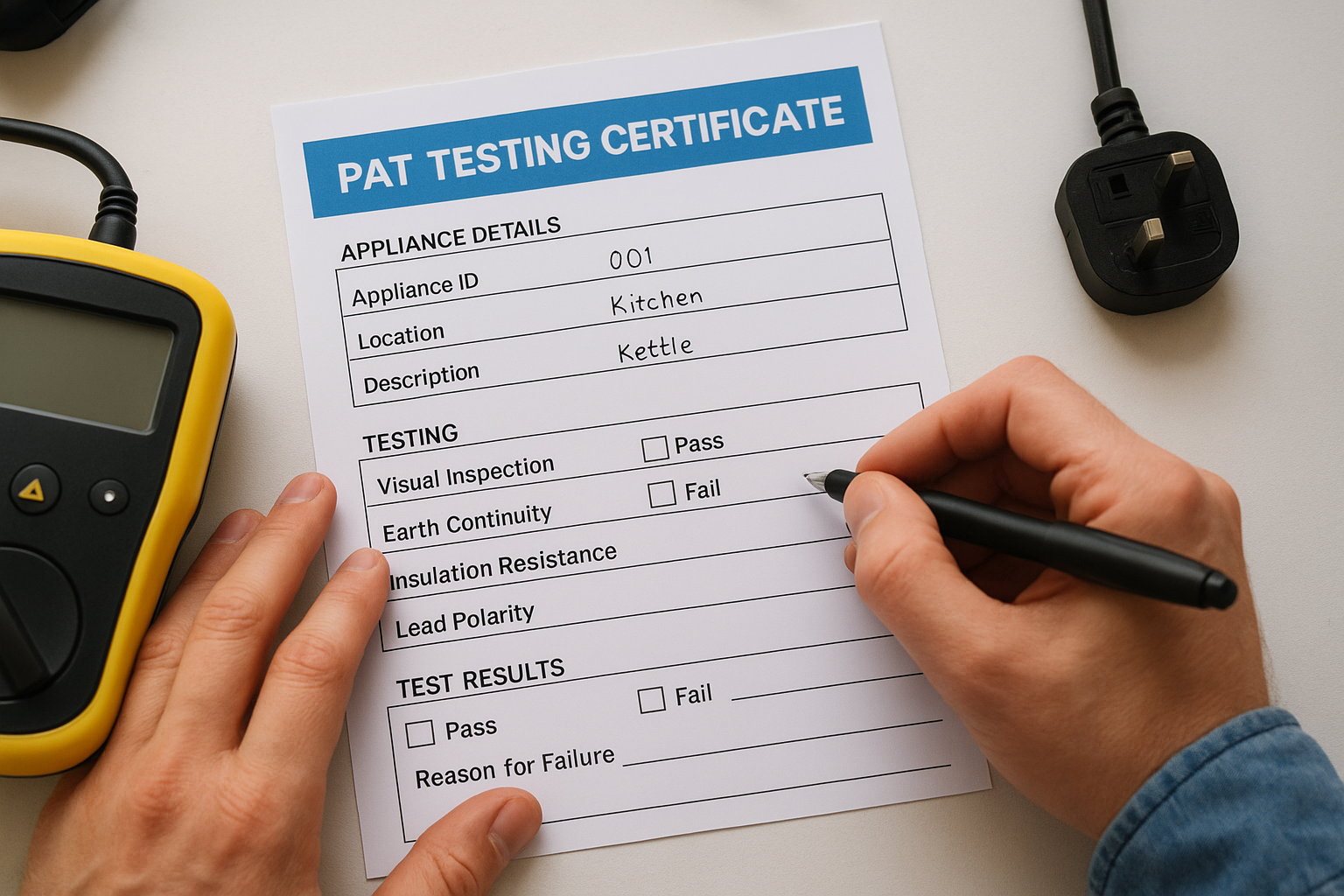
Before you touch a tester, walk the room and note what needs checking. Then work through each appliance in the same order every visit:
-
Identify and label the appliance with a unique reference number if it doesn't already have one, so it can be tracked across future tests.
-
Record the location and description, such as "kitchen, kettle" rather than just "kettle", so the certificate is useful when checked against the property later.
-
Carry out a visual inspection first, checking the plug, cable, and casing for obvious damage before any electrical test, following a checklist for inspecting plugs and cables safely.
-
Run the appropriate electrical tests using a calibrated PAT tester, recording earth continuity, insulation resistance, and lead polarity where relevant, as covered in our guide to the individual PAT tests and how they work.
-
Log the result as pass or fail, never anything vaguer, and note the reason for any fail.
-
Set the next test date based on the appliance type and its risk category.
-
Sign and date the certificate, confirming who carried out the test and when.
Doing these in sequence means nothing gets left blank because you moved on to the next appliance too quickly.
Recording results without ambiguity
Ambiguity is the enemy of a good record. Every appliance needs a clear pass or fail against each test performed, not a general comment like "okay" or "fine". If an appliance fails, the certificate should state exactly why, whether that's a damaged cable, a failed insulation test, or a missing earth connection, and what action was taken afterwards, whether that's repair, replacement, or removal from service.
If a result can be read two different ways, it isn't a result, it's a guess written down.
Quantify your notes where you can. "Insulation resistance below threshold" tells the next engineer far more than "failed test", and it gives you something concrete to check against if the appliance is retested after repair.
Setting retest dates correctly
Getting the retest date right is where a lot of templates fall down, because people either apply one blanket interval to everything or guess based on how the appliance looks. Neither approach holds up. The correct interval depends on the appliance's risk category and how it's used, which is why the HSE's guidance on maintaining portable electrical equipment exists in the first place, and why a good template includes a dedicated field for the next due date rather than leaving it to be worked out later.
Handheld tools on a construction site need testing far more often than a desk lamp in an office, and our guide to how often PAT testing should be done sets out the intervals in detail. As a rough guide:
|
Appliance type |
Typical interval |
|---|---|
|
Handheld power tools (construction) |
3 months |
|
Portable equipment (offices) |
12-24 months |
|
Extension leads and cables |
12 months |
|
Fixed IT equipment |
24-48 months |
Work through these fields methodically, and the portable appliance testing certificate template you use becomes a reliable record rather than a form you rushed to finish before the next job.
What every PAT testing certificate template should include
A complete PAT testing certificate template covers three areas: who did the work, what was tested, and what happened when it was. Miss any one of these and the document stops being useful as evidence, no matter how neat it looks. Think of it as a checklist you're filling in against, not a form you're decorating with details you happen to remember.
The essential fields
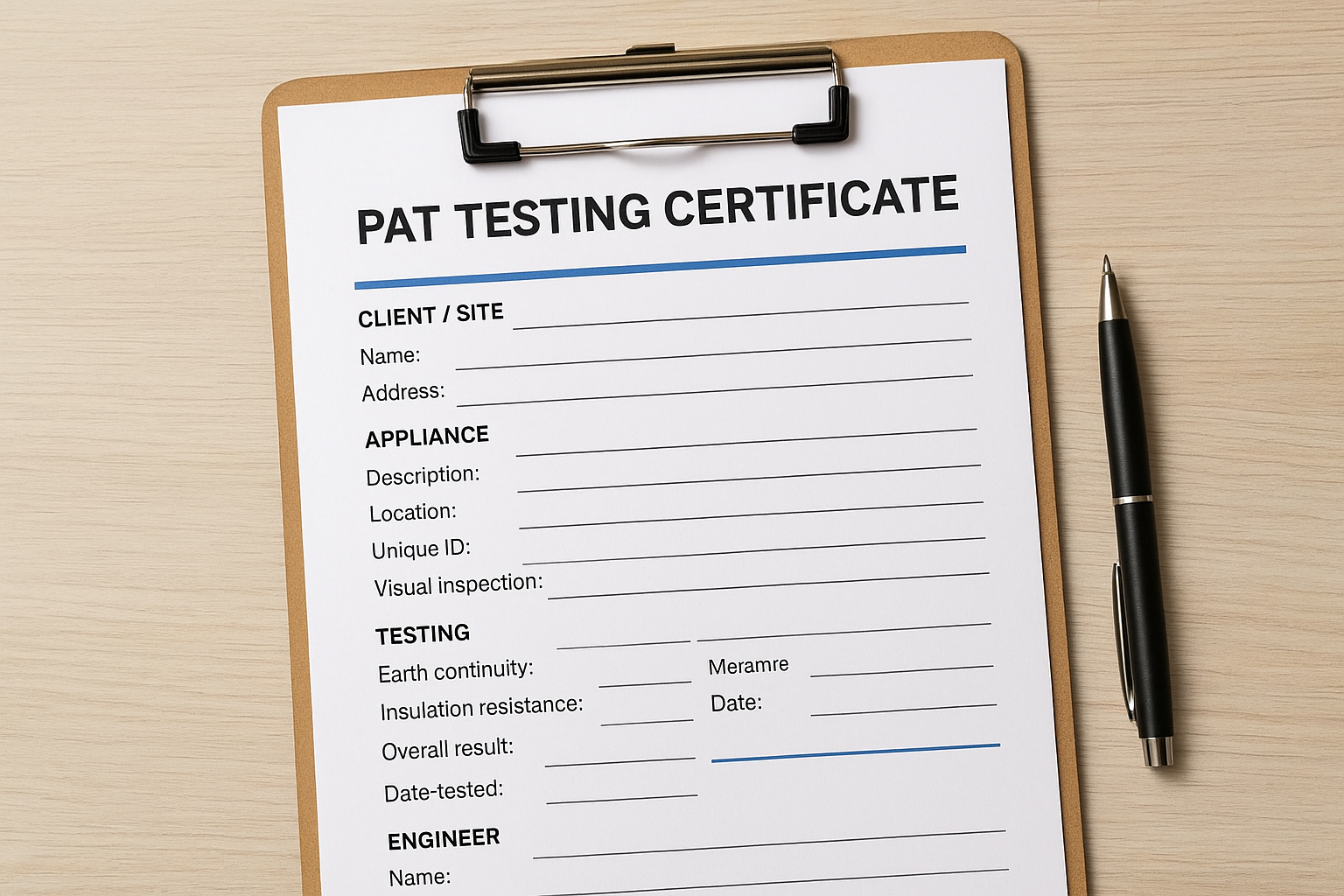
Every portable appliance testing pat test certificate template should carry the same core fields, regardless of who supplies it or what industry it's used in. These aren't optional extras, they're what makes the certificate traceable and defensible if it's ever questioned.
|
Field |
Why it matters |
|---|---|
|
Client/site name and address |
Ties the record to a specific property or premises |
|
Appliance description and location |
Identifies exactly what was tested and where |
|
Unique appliance ID or asset number |
Allows tracking across multiple test cycles |
|
Visual inspection result |
Catches damage a meter alone won't detect |
|
Earth continuity and insulation resistance readings |
Provides the measurable data behind a pass/fail |
|
Overall pass/fail result |
Gives a clear, unambiguous outcome |
|
Date tested |
Establishes when the duty of care was met |
|
Next test due date |
Sets the schedule for ongoing compliance |
|
Engineer name and signature |
Confirms accountability for the result |
A certificate missing even one of these fields is a form, not a record.
Business and engineer details
Beyond the appliance-level data, the template needs to identify who actually did the work. That means the testing company's name, contact details, and the engineer's name and qualification, not just an initial or a stamp, so it's worth checking the rules on who is allowed to carry out PAT testing. If your business ever needs to demonstrate competence, whether to an insurer or a client's compliance officer, this is the section they'll check first. Commercial clients in particular expect this detail as standard, since they're often building their own supplier compliance files and need to show every contractor on site was properly qualified.
Certificates should also state the standard the testing was carried out against, typically the IET Code of Practice for In-Service Inspection and Testing of Electrical Equipment. Referencing this on the template signals that the work followed a recognised methodology rather than an informal check, which matters if the certificate is ever scrutinised alongside an insurance claim or a workplace incident report.
Equipment used and calibration
Often overlooked, but genuinely important: the template should record which PAT tester was used and confirm it was in calibration on the day of testing. Readings from an uncalibrated tester are unreliable regardless of how carefully the rest of the form was completed, so a calibration reference or serial number gives the certificate an extra layer of credibility. Many portable appliance testing forms skip this field entirely, which is a mistake if the results are ever challenged.
Finally, leave space for notes on any remedial action taken. If an appliance failed and was subsequently repaired, replaced, or withdrawn from use, that outcome belongs on the certificate, not in a separate email or a verbal update to the client. A template that captures the full lifecycle of a fault, from detection to resolution, gives you a record that actually closes the loop rather than leaving an open question hanging over a failed item.
PAT testing forms, records and registers explained
Search for PAT testing forms and you'll find the terms certificate, record, and register used almost interchangeably, but they're not the same document and mixing them up causes real problems when someone actually needs the paperwork. Each one serves a different stage of the process, and knowing which is which helps you build a filing system that actually holds together instead of a folder of loosely related PDFs.
What separates a form from a certificate
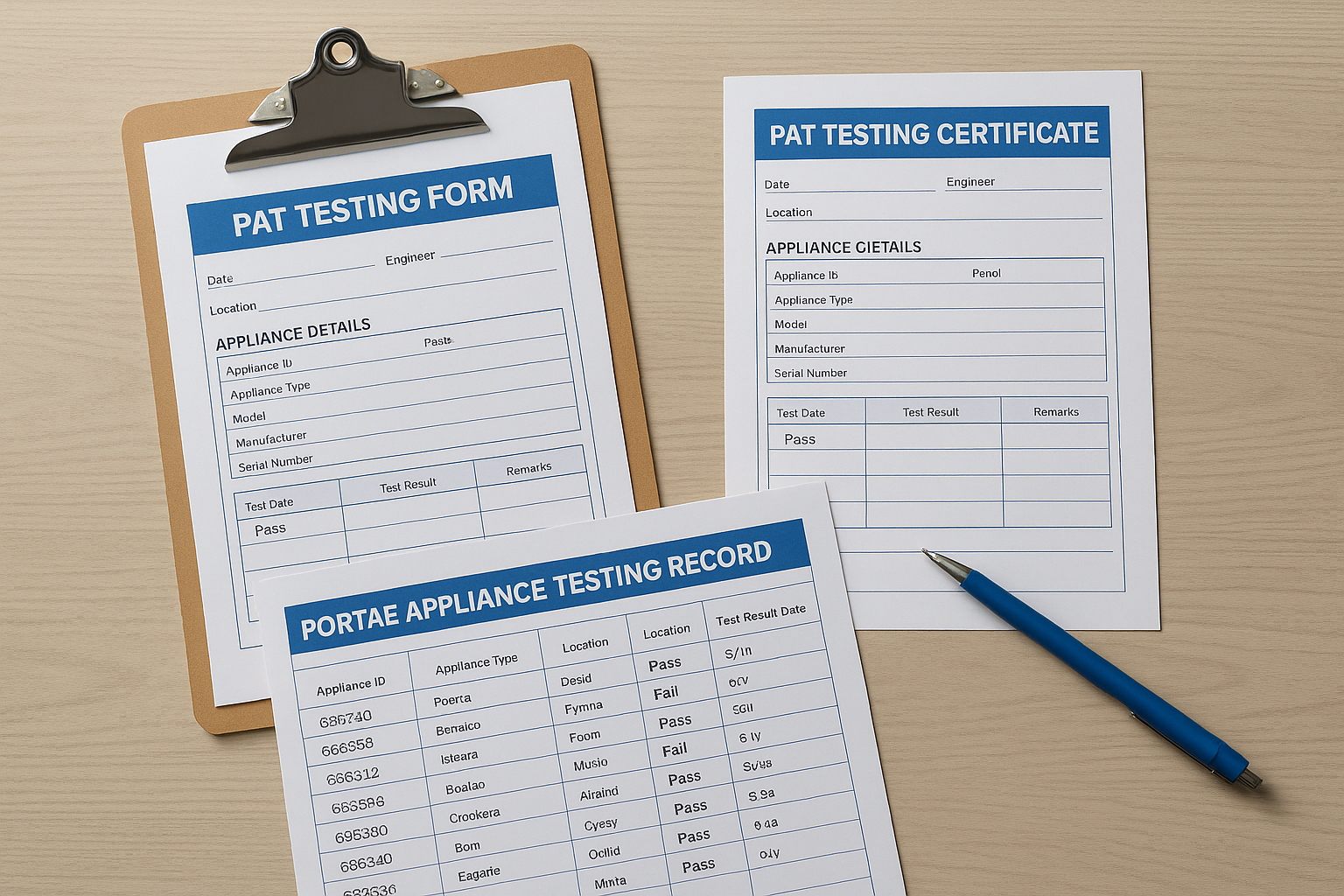
A PAT testing form is the blank template an engineer fills in on site, appliance by appliance, while testing is underway. It's a working document, often handwritten or entered on a handheld device, capturing raw readings before anything is finalised. The certificate is what that form becomes once it's completed, checked, and signed off. Think of the form as the draft and the certificate as the published version you'd hand to a client or file for compliance. If your business only ever produces forms and never converts them into signed certificates, you've got data but not proof, and that distinction matters the moment anyone asks for evidence.
A form is what you fill in on the day; a certificate is what you can still produce five years later.
Records versus registers
Once you move beyond a single visit, individual certificates need to sit inside something bigger. Portable appliance testing records refer to the complete history for one appliance, every test it's ever had, tracked against its unique ID so you can see whether it's been reliable or a repeat offender. A register, by contrast, is the master list across an entire site or client, showing every appliance, its current status, and its next due date in one place. You use the register to plan your next visit and spot what's overdue; you use the individual record to answer a specific question about one item.
For a commercial client with several hundred appliances, this distinction isn't academic. Here's how the three documents typically relate to each other:
-
Form: completed on site during testing, one per visit
-
Certificate: the finalised, signed version of that form, issued per appliance or per batch
-
Record: the full test history for a single appliance, built up over multiple certificates
-
Register: the master overview of every appliance across a site, showing status and due dates at a glance
Why the distinction matters in practice
Getting this structure right saves you from the most common paperwork failure: having certificates scattered across email inboxes with no register pulling them together. Insurers and inspectors don't just want to see that individual appliances were tested, they want to see that you're managing the whole estate, and a register is the only document that demonstrates that at a glance. Without one, you're stuck manually cross-referencing dozens of certificates every time someone asks whether a particular floor or department is up to date.
Maintaining all four levels doesn't need to be complicated. A simple spreadsheet register linked to a folder of signed certificates covers most landlords and small businesses perfectly well. Larger commercial sites often move to dedicated software, but the principle stays the same: forms feed certificates, certificates build records, and records populate the register. Skip a level and the whole structure starts to fall apart under scrutiny.
Common mistakes to avoid on a PAT testing certificate
Even experienced engineers slip into bad habits when they're testing appliance after appliance under time pressure, and the certificate is where those shortcuts show up first. Most of the problems below aren't complicated to fix, but they're common enough that reviewing existing paperwork against this list is worth doing before you rely on it. Spotting these errors early saves you from discovering them only when an insurer or inspector asks a pointed question, rather than when it's too late to fix.
Vague descriptions and missing IDs
Writing "kettle" or "extension lead" without a location or unique identifier is one of the most frequent mistakes on a PAT testing certificate template, and it quietly undermines the whole record. If you can't tell which of three identical kettles in a staff kitchen was tested, the certificate can't be matched back to the physical item when it's checked again next year. Unique asset numbers solve this in seconds, either a printed PAT testing label or a written code cross-referenced against your register, and they should be non-negotiable on any form you use.
A description that could apply to five different appliances protects nobody.
Blanket retest intervals
Applying the same testing interval to everything on site, regardless of appliance type or how it's used, is another mistake that looks efficient but isn't defensible. A handheld drill on a building site and a desk fan in a quiet office don't carry the same risk, and treating them identically either over-tests low-risk equipment or, more dangerously, under-tests high-risk equipment. Setting the interval based on actual use, referencing the guidance covered earlier in this article, keeps the schedule realistic rather than arbitrary.
Skipping the visual check
Rushing straight to the electrical test and skipping, or barely glancing at, the visual inspection is a mistake that undermines the entire point of PAT testing. Most appliance faults, cracked casings, frayed cables, scorch marks around a plug, are caught visually before a meter ever gets involved, so a certificate showing a pass with no visual inspection notes should raise questions. Visual inspection results belong on the form as their own field, not folded into the overall result, so anyone reviewing the portable appliance testing certificate template later can see the check actually happened.
Leaving fields blank instead of marking them not applicable
Blank fields are ambiguous by design. A gap where a reading should be could mean the test wasn't done, the result wasn't recorded, or the field simply didn't apply to that appliance, and nobody reviewing the certificate months later can tell which. Marking a field "N/A" where genuinely not applicable, rather than leaving it empty, closes that gap and shows the omission was deliberate rather than accidental.
Missing sign-off or calibration references
Handing over a certificate without a named engineer, signature, or calibration reference for the tester used is a mistake that's easy to overlook because it doesn't affect the test itself, only the paperwork's credibility. Common gaps worth checking on any certificate before you file it:
-
No named, signed-off engineer, just a company stamp
-
No calibration date or serial number for the tester used
-
No reference to the testing standard followed
-
No record of remedial action after a failed appliance
-
No next due date, leaving the schedule to memory
Reviewing your paperwork against this list before filing it away catches most of the errors that cause problems later, and it takes far less time than untangling a dispute after the fact.
How long to keep PAT testing certificates and records
There's no single law that tells you exactly how many years to keep a PAT testing certificate, or indeed how long a PAT testing certificate stays valid, which is exactly why so many landlords and businesses either bin them too soon or hoard boxes of paperwork they no longer need. The honest answer depends on why you're keeping the record in the first place: proving compliance at the time of testing is one goal, defending yourself against a claim years later is another, and each calls for a different retention period.
The minimum you actually need
At the bare minimum, keep each certificate until the appliance has been retested and a new certificate replaces it. That covers the day-to-day compliance question of whether an appliance is currently safe to use. But that minimum isn't enough if you ever face a liability claim, because civil claims for negligence in England and Wales can generally be brought up to six years after the event under the Limitation Act 1980. If an appliance causes a fire or injury and someone alleges it wasn't properly maintained, you need to produce a certificate from years earlier, not just the most recent one.
Keep the certificate as long as someone could still reasonably ask you to prove the appliance was safe.
Recommended retention by situation
Different clients face different exposure, so the sensible retention period varies a bit depending on who you are and what the record is protecting you against:
|
Client type |
Recommended retention |
Reason |
|---|---|---|
|
Landlords |
Full tenancy plus 6 years |
Covers disputes raised after a tenant leaves |
|
Commercial/employers |
Minimum 6 years |
Aligns with civil liability limitation period |
|
Homeowners |
Until next test, plus insurance renewal cycle |
Supports insurance claims if raised |
|
Sold or disposed appliances |
Retain the final certificate indefinitely |
Evidence of condition at point of sale/disposal |
Commercial clients with insurance policies that specify their own retention clauses should check those terms directly, since some insurers ask for records to be kept longer than the general six-year guideline.
Keeping records you can actually retrieve
A retention period is only useful if you can find the certificate when someone asks for it, and paper files stuffed in a drawer rarely survive a house move, an office relocation, or a change of letting agent. Storing scanned copies alongside your portable appliance testing records register means you can pull up a specific appliance's history in seconds rather than searching through years of paperwork. Cloud storage with a simple folder structure by property or site works for most landlords and small businesses, while larger commercial operations often link certificates directly to their asset register software.
It's also worth keeping a backup outside your main filing system, since a lost laptop or a flooded office shouldn't mean losing years of compliance evidence. If you use a professional testing service, ask whether they retain copies of certificates on their own system as a matter of course. At Electrical Testing London, every certificate we issue is logged against the property and appliance, so clients can request a copy of past results without having to dig through their own archives first.
Getting your PAT testing paperwork right
A good PAT testing certificate template isn't complicated, it just needs the right fields captured consistently: appliance details, visual and electrical results, retest dates, and a named engineer's sign-off. Get that structure right and your paperwork holds up whenever an insurer, tenant, or inspector asks to see it. Skip fields or apply them inconsistently, and you end up with a stack of forms that look fine until someone actually tests them against a real query.
Building your own template from what we've covered will cover most situations, but if you're managing multiple properties or a commercial site with hundreds of appliances, getting a qualified engineer to handle testing and record-keeping removes the guesswork entirely. Our engineers issue traceable certificates as standard, logged against the property and appliance from day one. If you'd rather hand this over than manage it yourself, get a quote from our PAT testing team and we'll sort the paperwork alongside the testing.

