






PAT Testing Certificate Template: What It Should Include



Searching for a portable appliance testing pat report certificate template usually means one thing: you've got a stack of appliances to test and no proper way to record the results. Maybe you're a landlord doing PAT testing between tenancies, a small business owner covering your own equipment, or an office manager who's just been told compliance paperwork is missing. Whatever the reason, a scrappy spreadsheet or handwritten note won't cut it if an insurer, fire officer, or HSE inspector ever asks to see proof.
This article explains exactly what a proper certificate needs, so you can build one yourself or spot the gaps in a free portable appliance pat testing record sheet free download you've found online. We cover the fields that matter, from appliance details and test dates to pass/fail results and the engineer's signature, and why leaving any out weakens the document's value.
We also look at when a template is genuinely fine to use and when you're better off getting a qualified engineer to test and certify your equipment properly, particularly for higher-risk items or larger commercial sites where a poorly documented record could cost you far more than the testing itself.
Why a PAT testing certificate template matters
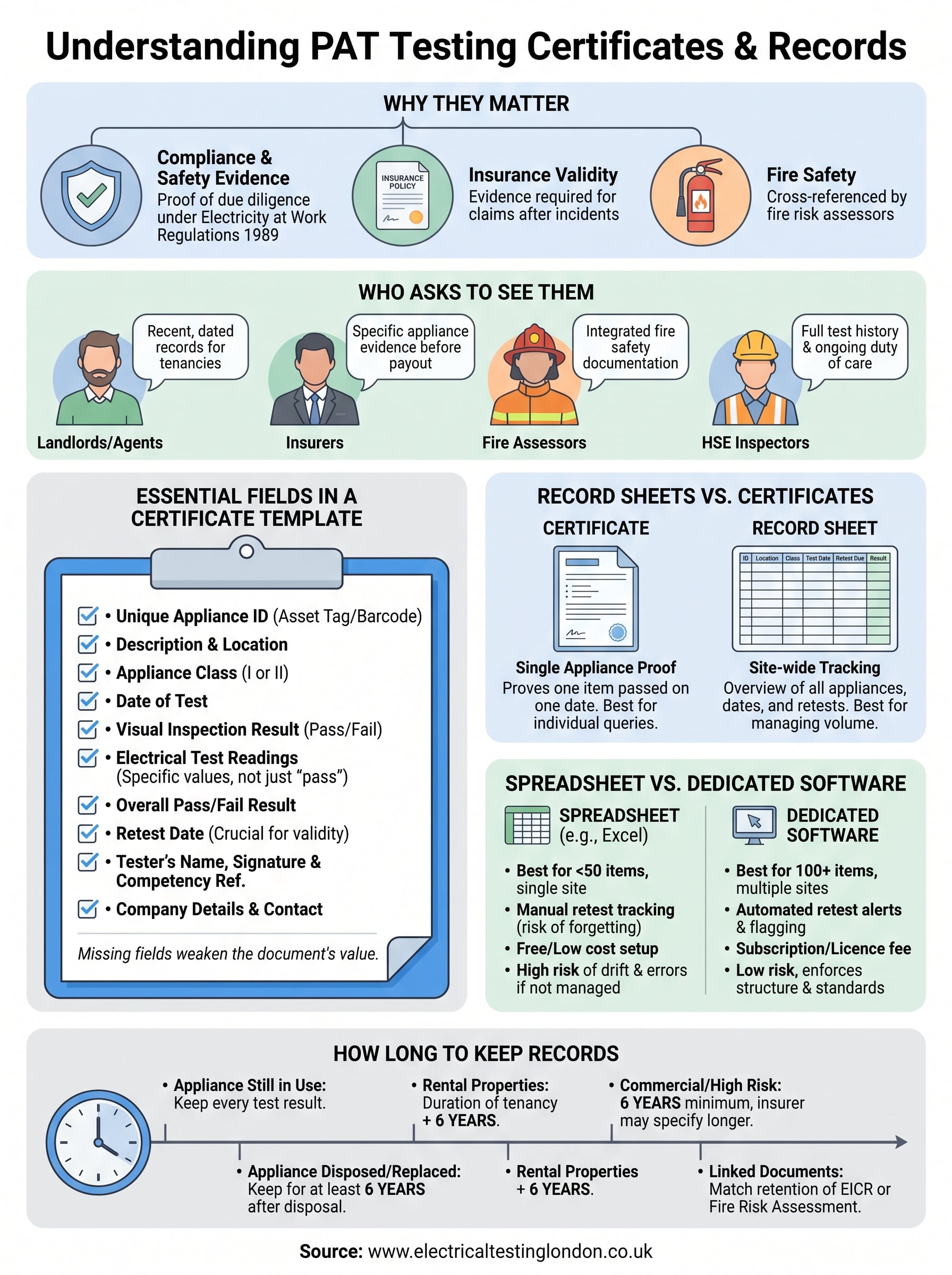
Getting a PAT testing certificate template right isn't just admin box-ticking. It's the difference between having usable evidence when something goes wrong and having a pile of paper that falls apart the moment anyone examines it. Portable Appliance Testing itself isn't a legal requirement in the workplace, but the Electricity at Work Regulations 1989 do require you to keep electrical equipment safe, and a properly completed record is how you prove you've done that. Without it, you're relying on memory and good faith, which counts for nothing after a fire, an electric shock incident, or a failed insurance claim.
Who actually asks to see your PAT records
Landlords, letting agents, insurers, fire risk assessors, and HSE inspectors all have reasons to request your paperwork, and what UK landlords must know differs from what each of the others is looking for. A letting agent wants proof before renewing a tenancy. An insurer wants evidence of due diligence if you make a claim after an electrical fire. A fire risk assessor cross-checks your PAT records against your fire safety documentation. None of them will accept a vague statement that "everything was tested last year" if you can't show dates, results, and who did the work.

|
Who asks |
What they want to see |
Why it matters |
|---|---|---|
|
Letting agents/landlords |
Recent dated records per appliance |
Tenancy compliance, safety obligations |
|
Insurers |
Evidence of testing before a claim |
Can void a claim without it |
|
Fire risk assessors |
Cross-referenced PAT and fire records |
Part of overall fire safety compliance |
|
HSE inspectors |
Full test history, not just a summary |
Demonstrates ongoing duty of care |
|
Tenants/employees |
Visible proof of a safe environment |
Builds trust, reduces complaints |
The cost of sloppy paperwork
Insurers are the group that catches most people out. If a fire starts because of a faulty appliance and your insurer discovers your PAT records are incomplete, missing appliance identifiers, or clearly filled in after the fact, they can refuse to pay out. That's not a hypothetical. Loss adjusters routinely ask for the specific record for the appliance involved, not just a general certificate saying
How to fill in a PAT testing certificate template
Filling in a PAT testing certificate template properly takes minutes per appliance once you have a system, but skipping steps is exactly how gaps creep in. The template itself doesn't protect you. How consistently you complete it does. Treat every appliance as its own mini-record, even when you're testing forty items in one office in a single afternoon.
Step-by-step: what order to complete the fields
Work through each appliance in the same order every time so nothing gets missed halfway through a long list.
-
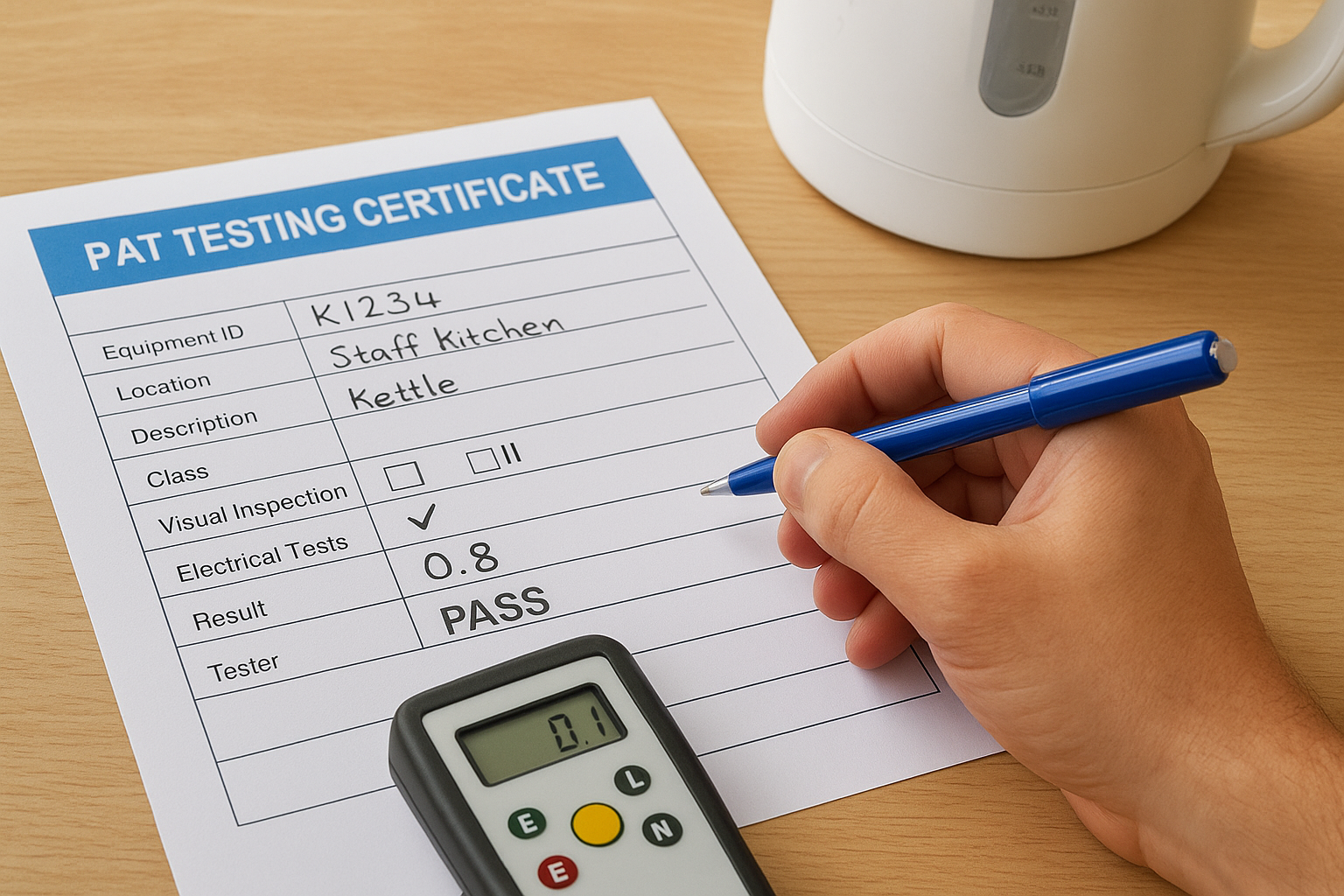
Identify the appliance with a unique reference number or asset tag before you test anything. If it doesn't already have one, write it on with a permanent marker or attach a PAT testing label.
-
Record the location and description, for example "Kettle, staff kitchen" or "Desk lamp, Room 3, Desk 12". Vague descriptions like "appliance 1" make records useless later.
-
Note the appliance class (Class I or Class II), since this determines which tests apply and what a pass actually means.
-
Carry out the visual inspection first, checking the plug, cable and casing safely for any obvious damage, before connecting a test meter. Most failures are caught here, not on the electrical test.
-
Run the electrical tests appropriate to the appliance class, such as earth continuity and insulation resistance tests, and write down the actual readings, not just "pass".
-
Mark the overall result clearly as pass or fail, and if it fails, note what happens next: repaired, removed from service, or replaced.
-
Sign and date the record with the tester's name and, ideally, a qualification or competency reference.
A PAT record is only as trustworthy as the detail behind the pass or fail mark.
Skipping the visual inspection is the single most common shortcut, and it's also the step most likely to catch a genuinely dangerous appliance, so don't rush it just to get to the meter reading.
Formatting choices that make records easier to check later
How you lay the template out affects how quickly you or anyone else can audit it afterwards. A portable appliance pat testing record sheet free download often arrives as a single flat table, which works fine for small batches but gets unwieldy past a hundred appliances. Grouping by location or department, then listing appliances underneath, makes it far easier to spot which room hasn't been done yet.
|
Formatting approach |
Best suited to |
Downside |
|---|---|---|
|
One row per appliance, flat list |
Small offices, under 50 items |
Hard to scan by location |
|
Grouped by room/department |
Larger sites, multiple floors |
Needs consistent naming |
|
Separate sheet per visit date |
Ongoing annual testing programmes |
More files to manage over time |
Whichever layout you choose, keep the column headings identical across every sheet you produce. Changing the format year to year makes it much harder to compare results and spot appliances that keep failing, which is often the first sign something needs replacing rather than repairing again.
What every PAT testing certificate must include
A proper PAT testing certificate needs a fixed set of fields, not a rough summary of "tested and passed." Leave one out and you weaken the whole document, because anyone checking it later, whether that's an insurer or a new tenant, needs to trace a single appliance from identification through to result without guessing. Below is the minimum a certificate should contain, regardless of whether you're using a free spreadsheet or paying for PAT testing in London.
The non-negotiable fields
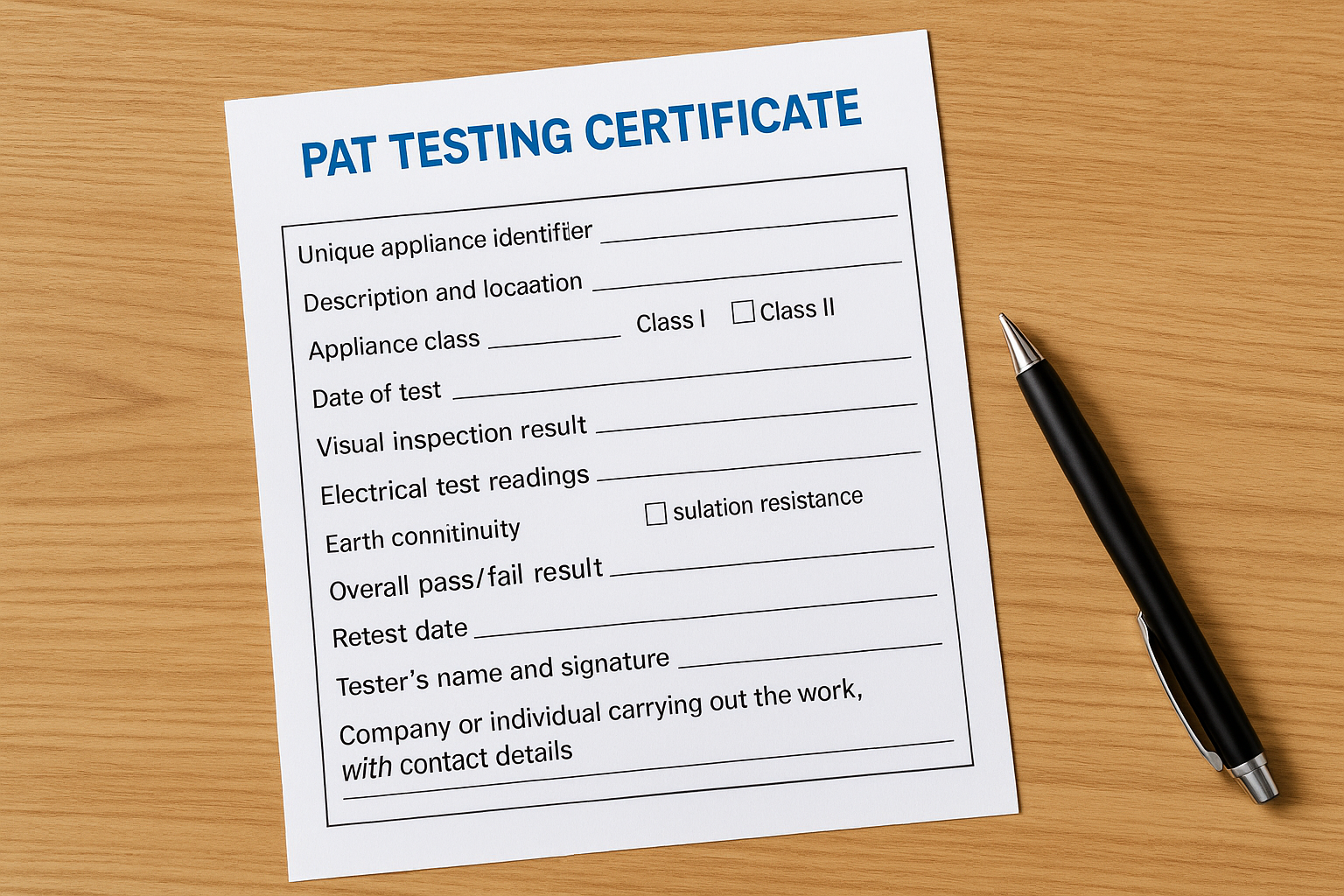
Every certificate, no matter how simple, needs these details recorded against each appliance:
-
Unique appliance identifier (asset number or barcode)
-
Description and location of the appliance
-
Appliance class (Class I or Class II)
-
Date of test
-
Visual inspection result
-
Electrical test readings (earth continuity, insulation resistance, where applicable)
-
Overall pass/fail result
-
Retest date
-
Tester's name and signature
-
Company or individual carrying out the work, with contact details
Leave out the retest date and even a perfect result becomes useless within a year.
Missing any of these turns the certificate into a rough log rather than a document you can rely on if something goes wrong. Retest dates are the field people forget most often, yet how long a PAT certificate stays valid is what tells anyone checking the file whether the equipment is currently covered or overdue.
Fields that separate an adequate certificate from a genuinely useful one
Beyond the basics, a few extra fields make a real difference when you're managing more than a handful of appliances. Noting the test equipment used, including its own calibration date, shows the readings are trustworthy rather than pulled from a meter nobody's checked in years. Recording fault details on any failure, not just "failed," tells you whether the problem was a damaged cable, a cracked plug, or an internal fault, which matters if the same appliance model keeps failing across a site.
|
Field |
Minimum requirement |
Adds real value |
|---|---|---|
|
Appliance ID |
Present |
Barcode/asset tag for scanning |
|
Test date |
Present |
Linked to a retest schedule |
|
Result |
Pass/fail |
Specific fault description if failed |
|
Tester details |
Name |
Qualification or competency reference |
|
Equipment used |
Not always recorded |
Meter model and calibration date |
Qualifications matter more than people assume. Recording that the tester holds a recognised PAT testing competency, such as a City & Guilds qualification or equivalent in-house training record, gives the certificate weight if it's ever challenged, so it's worth knowing who can carry out PAT testing. Simply signing a name proves someone was present, not that they knew what they were checking.
Regulatory bodies don't set a single mandatory format for PAT certificates, but the Health and Safety Executive is clear that whatever record you keep needs to demonstrate a proportionate, ongoing approach to electrical safety. A certificate with every field above does exactly that. One with gaps invites the question of what else was skipped during the actual testing.
PAT testing record sheets: what to include
A record sheet does a different job than an individual certificate. Where a certificate proves one appliance passed on one date, a PAT testing record sheet gives you the whole picture across a site: every appliance, every test date, every retest due. Landlords with several properties and businesses with dozens of desks lean on the record sheet as their master document, then hand out individual certificates only when someone specifically asks for proof on a single item.
Why the record sheet is the document you'll actually use day to day
Because you're managing volume rather than a single appliance, the record sheet needs to work as a live tracking tool, not just an archive. Owners who search for a portable appliance pat testing record sheet free template are usually trying to solve exactly this problem: they need one file that shows, at a glance, what's covered and what's overdue. A good sheet lets you filter or sort by retest date so you can plan next year's testing round before anything lapses, using how often PAT testing should be done as your guide rather than discovering gaps when a tenant or inspector asks.
A certificate proves one appliance is safe. A record sheet proves your whole system is under control.
The columns a proper record sheet needs
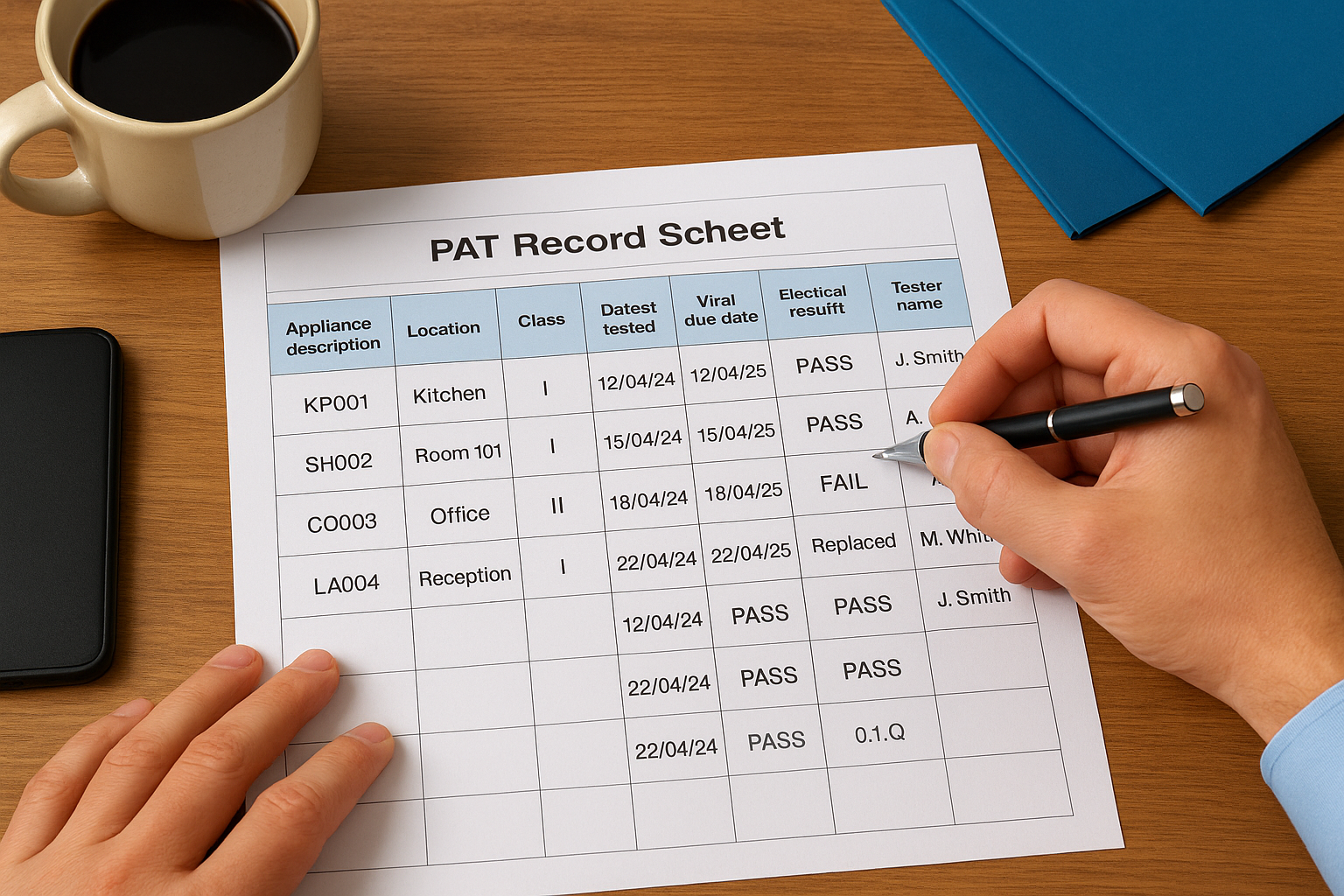
Build the sheet so each row is one appliance and each column captures a field you'd otherwise have to chase down later:
-
Appliance ID and description (asset tag plus a plain-English name)
-
Location (building, floor, room, or department)
-
Class (I or II)
-
Date tested and retest due date
-
Visual inspection result
-
Electrical test result (pass/fail with readings where relevant)
-
Action taken on failure (repaired, binned, replaced)
-
Tester name
-
Date record last updated
Keeping the retest due date as its own column, rather than calculating it manually from the test date each time, is what actually stops appliances slipping through unnoticed.
Structuring a sheet that scales
A sheet with ten appliances barely needs structure. One with two hundred across three sites falls apart fast without it. Splitting the sheet by property or department, and keeping a summary tab that pulls together total pass/fail counts and upcoming retest dates, turns a flat list into something you can actually manage.
|
Sheet element |
Small site (under 30 items) |
Larger site (100+ items) |
|---|---|---|
|
Layout |
Single flat table |
Tabs per building or floor |
|
Retest tracking |
Manual date check |
Sorted/filtered by due date |
|
Summary view |
Not needed |
Dedicated summary tab |
|
Update frequency |
Annually |
Rolling, as appliances are added or removed |
Regardless of scale, treat the sheet as a living document rather than something you fill in once and file away. Every new appliance that comes into the building, every laptop charger someone brings from home and plugs into a shared socket, needs adding before it becomes a gap in your paperwork rather than an oversight you catch during the next round of portable appliance testing PAT report certificate template reviews.
Spreadsheet template or dedicated software
Once you know what fields belong on a PAT testing certificate template, the next decision is what to build it in. Most people start with a spreadsheet because it's free and familiar, and for a landlord with one flat or a sole trader with a handful of tools, that's genuinely the right call. Others reach for dedicated PAT testing software the moment appliance numbers climb past a few dozen, because chasing retest dates manually across multiple tabs stops being realistic. Neither option is wrong on its own. The mistake is sticking with a spreadsheet long after your appliance count has outgrown it.
When a spreadsheet does the job
Spreadsheets work well when the volume is low and one person is responsible for keeping the file updated. A single landlord testing appliances in two or three rental properties can manage everything in one workbook, with a tab per property and a shared column layout across all of them. Downloading a portable appliance pat testing record sheet free template and adapting it yourself costs nothing and takes an afternoon to set up properly. The catch is that spreadsheets rely entirely on the person filling them in remembering to update retest dates, back up the file, and keep formatting consistent. Miss one of those and the sheet quietly becomes unreliable without anyone noticing until it's checked.
When dedicated software earns its cost
Dedicated software starts to pay for itself once you're managing more than a couple of hundred appliances, multiple sites, or several testers working independently. It automatically flags overdue retests, stores photos of failed items, and produces a certificate on demand without anyone retyping the same appliance details twice. For a commercial site with rolling staff turnover and constant new equipment arriving, that automation removes the single biggest cause of gaps in the paperwork: human forgetfulness.
A spreadsheet only protects you if someone remembers to keep it current. Software removes that dependency.
|
Factor |
Spreadsheet |
Dedicated software |
|---|---|---|
|
Setup cost |
Free or near-free |
Subscription or licence fee |
|
Best suited to |
Under 50 appliances, single site |
100+ appliances, multiple sites |
|
Retest tracking |
Manual, relies on the user |
Automated alerts |
|
Certificate generation |
Manual formatting each time |
Instant, standardised output |
|
Risk of drift over time |
High if not reviewed regularly |
Low, structure is enforced |
Commercial clients booking commercial PAT testing in London for dozens of desks, kitchens, and workshops across several buildings almost always find software cheaper in practice than the hours lost chasing spreadsheet errors before an insurance renewal or a fire risk assessment. For a smaller portfolio, though, a well-built spreadsheet with locked column headings and a shared naming convention will hold up perfectly well, provided someone actually owns the task of keeping it accurate rather than assuming it looks after itself.
How long to keep your PAT testing records
There's no single legal retention period written into the Electricity at Work Regulations 1989, and that gap causes more confusion than almost anything else in PAT paperwork. The HSE guidance simply says records should demonstrate an ongoing, proportionate approach to safety, which leaves the actual timeframe up to you. In practice, that means working backwards from why you're keeping the record in the first place: proving compliance if something goes wrong, not just filing paperwork for its own sake.
Insurance claims drive most of the practical advice you'll hear. Under the Limitation Act 1980, someone injured by faulty equipment generally has three years from the date of injury to bring a personal injury claim, though that clock can start later if the harm wasn't immediately obvious. Many insurers and risk advisers recommend keeping full PAT testing records for a minimum of six years to stay safely inside that window, and longer again for higher-risk commercial environments where equipment sees heavy daily use, which sits comfortably with HSE requirements on PAT testing records.
Keep the record until the appliance is gone, not just until the certificate feels out of date.
Retaining records beyond the appliance's working life matters more than people expect. If an appliance is disposed of, don't delete its history straight away. Hold onto the last few years of its test results in case a claim or query comes up referencing equipment you no longer own. This is especially relevant for landlords, where a tenant might raise a concern about an appliance months after it's already been replaced.
A practical retention schedule
Rather than guessing case by case, apply a consistent rule across your whole property or business:
|
Situation |
Recommended minimum retention |
|---|---|
|
Appliance still in use |
Every test result since it entered service |
|
Appliance disposed of or replaced |
At least 6 years after disposal |
|
Rental property, tenant records |
Duration of tenancy plus 6 years |
|
Commercial site, high appliance turnover |
6 years minimum, longer if insurer specifies |
|
Records tied to an EICR or fire risk assessment |
Match the retention period of the linked document |
Linking your PAT retention period to related documents is worth doing deliberately. If you're also holding an Electrical Installation Condition Report for the same property, checking how long an EICR certificate lasts and keeping both sets of records on the same schedule means anyone auditing your compliance sees a consistent, complete picture rather than mismatched dates that raise more questions than they answer.
Finally, don't treat retention as a filing problem alone. Back up digital records somewhere other than the single laptop that created them, and keep paper certificates somewhere they won't get lost in a move or an office reshuffle. A record that technically exists but can't be produced when asked for is barely better than no record at all.
Common mistakes that undermine your paperwork
Even a well-designed PAT testing certificate template falls apart in practice if the person filling it in cuts corners. Most paperwork problems aren't dramatic. They're small, repeated shortcuts that quietly erode the value of the whole record, and they usually only get noticed when someone challenges the document months or years later.
The errors that show up again and again
Few of these mistakes are deliberate. They creep in because testing feels routine, especially once you've worked through the same list of appliances for the third or fourth year running. The most common ones include:
-
Writing "pass" without recording readings, so there's no way to verify the test actually happened properly
-
Reusing last year's description word for word, even when the appliance has been swapped for a different model
-
Leaving the retest date blank, assuming someone will calculate it later
-
Skipping the visual inspection section entirely because the electrical test passed
-
No unique identifier, making it impossible to match a certificate to a specific appliance during an audit
-
Batch-signing a whole sheet at once, rather than confirming each appliance individually
A certificate filled in from memory is barely different from no certificate at all.
Getting these details right isn't about perfectionism. It's what separates a document an insurer will accept from one they'll pick apart.
Why these mistakes slip past unnoticed until it's too late
Owners rarely spot gaps in their own paperwork because the sheet looks complete at a glance, full of ticks and dates, even when the substance underneath is thin. It's only when a loss adjuster or fire risk assessor asks a pointed question, like what the actual insulation resistance reading was for a specific kettle, that a vague "pass" mark exposes itself as unverifiable. By then, there's no way to go back and check, because the appliance may already have been replaced or the tester long gone.
Repairing this after the fact costs far more than doing it properly the first time. A retest across a whole site, redone simply because the original records can't stand up to scrutiny, wastes both time and money that a careful first pass would have avoided. If a fault does turn up during testing, get it addressed properly and documented through a qualified remedial electrical works service, rather than noting "fixed" on the sheet with no detail of what was actually done.
Training the person doing the testing matters just as much as the template itself. A form with every field imaginable still produces weak records if whoever fills it in doesn't understand why each field exists. Treat the paperwork as part of the safety check itself, not an afterthought once the meter's put away, and most of these mistakes disappear on their own.
Getting your PAT testing paperwork right
A good PAT testing certificate template only works if you treat it as part of the safety check, not paperwork bolted on afterwards. Get the fields right, fill them in consistently, and keep records long enough to matter, and you've got a document that actually protects you when an insurer or inspector comes asking. Skip steps or rely on a vague portable appliance pat testing record sheet free download you've never checked properly, and you're left with paper that looks fine until someone tests it.
Building your own system makes sense for small numbers of appliances. Once you're managing multiple sites, tenants, or staff, the time saved by getting qualified engineers to handle testing and certification properly usually outweighs the DIY route. If you'd rather hand this over to people who do it every day, get a quote for PAT testing and let us sort the paperwork alongside the testing itself.