


PAT Testing in Schools: When It Must Be Undertaken


If you manage premises for a school, you've probably asked whether portable appliance testing must be undertaken in schools by law, or whether it's just good practice. The honest answer sits somewhere between the two, and getting it wrong can mean anything from a failed insurance claim to a genuinely dangerous classroom appliance going unchecked for years.
There's no single piece of legislation that names PAT testing directly, but the Electricity at Work Regulations 1989 and general health and safety law put the duty on schools to keep electrical equipment safe, and PAT testing is the recognised way to prove that. What changes school to school is the testing frequency, which depends on how equipment is used, by whom, and how often, from kettles in the staff room to laptops wheeled between classrooms.
This article sets out exactly when PAT testing becomes a legal necessity for schools, how often different categories of equipment should be checked, who's responsible for arranging it, and what inspectors and insurers actually expect to see on record. By the end, you'll know precisely where your school stands and what to do next.
Why PAT testing matters for school safety and compliance
The legal duty behind the paperwork
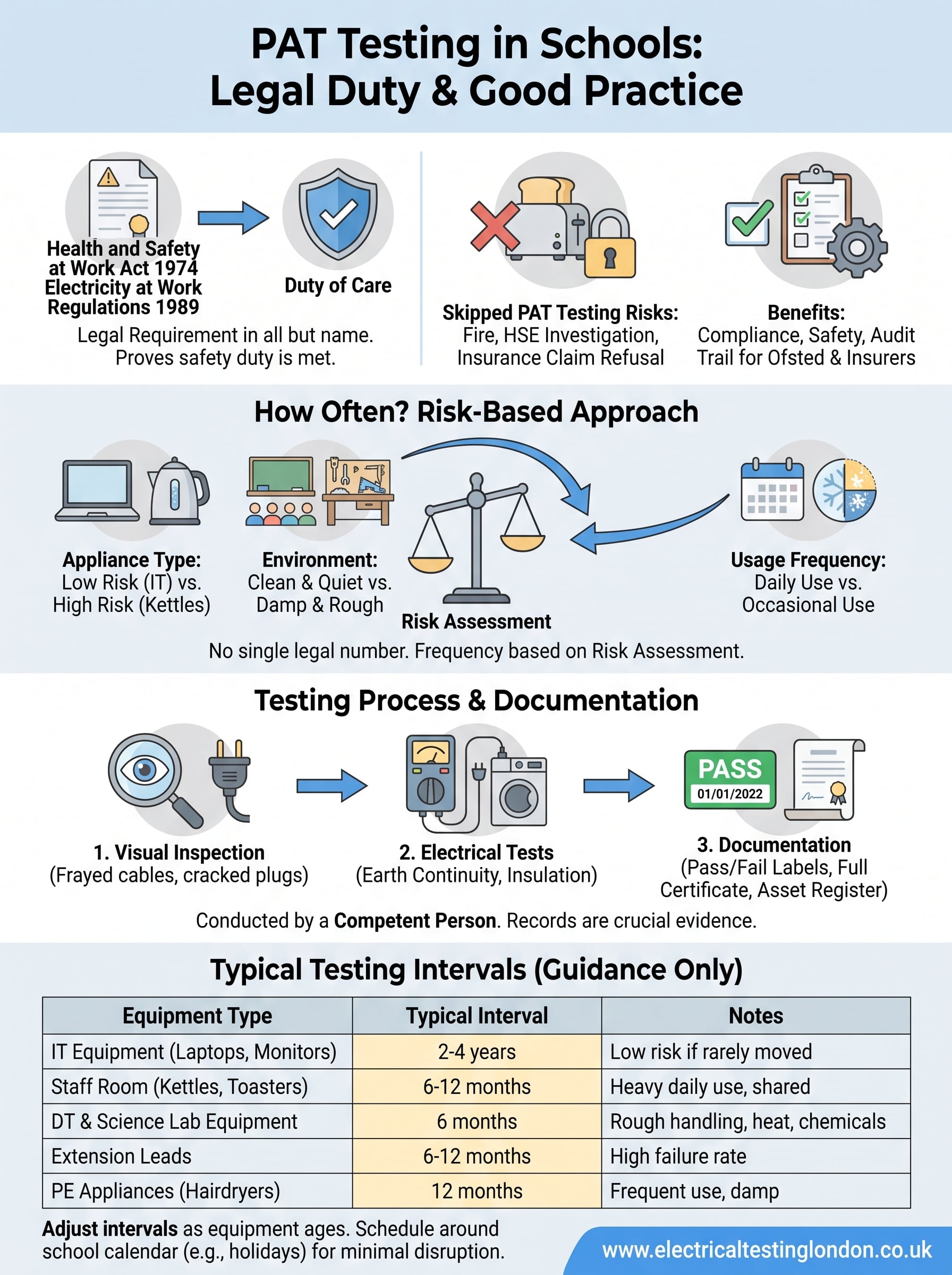
Schools run more portable electrical equipment than almost any other building type outside a hospital. Kettles in the staff room, laptops on trolleys, projectors bolted to ceilings, hot glue guns in the DT block, and hairdryers in the PE changing rooms all sit under the same duty of care that governors and headteachers hold for staff, pupils, and visitors. The Health and Safety at Work Act 1974 requires employers to keep work equipment safe, and the Electricity at Work Regulations 1989 back that up specifically for anything with a plug, which is why PAT testing in the workplace is treated as a legal requirement in all but name. PAT testing is simply the accepted method of proving that duty has been met, which is exactly why portable appliance testing must be undertaken in schools on a schedule that matches how the equipment gets used.
What happens when schools skip PAT testing
Skipping it doesn't just risk a faulty toaster starting a fire, though that happens more often than most staff realise. It also exposes the school to a Health and Safety Executive investigation if an incident occurs, and investigators will ask for testing records within the first hour of any site visit. Without them, you're relying on luck rather than evidence.
A school without PAT records isn't following good practice by chance, it's exposed by default.
Insurance, Ofsted, and the paper trail
Insurers increasingly treat PAT testing as a condition of cover rather than an optional extra, and a claim following an electrical fire can be reduced or refused outright if there's no evidence of routine checks. Ofsted inspectors don't test wiring themselves, but they do ask leadership teams to demonstrate that health and safety systems, including electrical safety, are managed properly as part of the safeguarding and premises standards. Testing regularly, and keeping the paperwork somewhere accessible, turns a vague policy statement into something you can hand over on request. If your school hasn't had a formal check recently, our PAT testing London service covers exactly this kind of scheduled inspection across the capital and the South East.
How to work out when PAT testing must be undertaken
Factors that decide your testing schedule
Working out how often PAT testing should be done in your school starts with looking at three things: the type of appliance, how often it moves, and who's using it. A laptop charger that stays plugged in behind a teacher's desk carries far less risk than a kettle handled daily by dozens of staff in a shared kitchen. Environment matters too, equipment in a DT workshop or science lab faces more wear than a printer in a quiet office. There's no single national interval written into law, which is exactly why HSE PAT testing guidance points schools towards a risk-based approach rather than a fixed timetable.
The right testing interval isn't a legal number, it's whatever your risk assessment says keeps people safe.
A simple risk-based checklist
Getting this right doesn't need a consultant. Run through this before setting your schedule:
-
Identify every portable appliance across classrooms, offices, and workshops
-
Classify each by risk: low (rarely moved, IT equipment), medium (staff room appliances), high (workshop tools, hired-in equipment)
-
Check usage frequency, since daily-use kettles need checking more often than a seasonal fan heater
-
Note the environment, as damp, dust, or heavy handling all shorten safe intervals
-
Record your decisions so an inspector or insurer can see the reasoning, not just the results
Once you've mapped this out, the actual inspection process becomes far more straightforward to schedule and budget for.
How to carry out PAT testing in a school setting
Booking the inspection around the school calendar
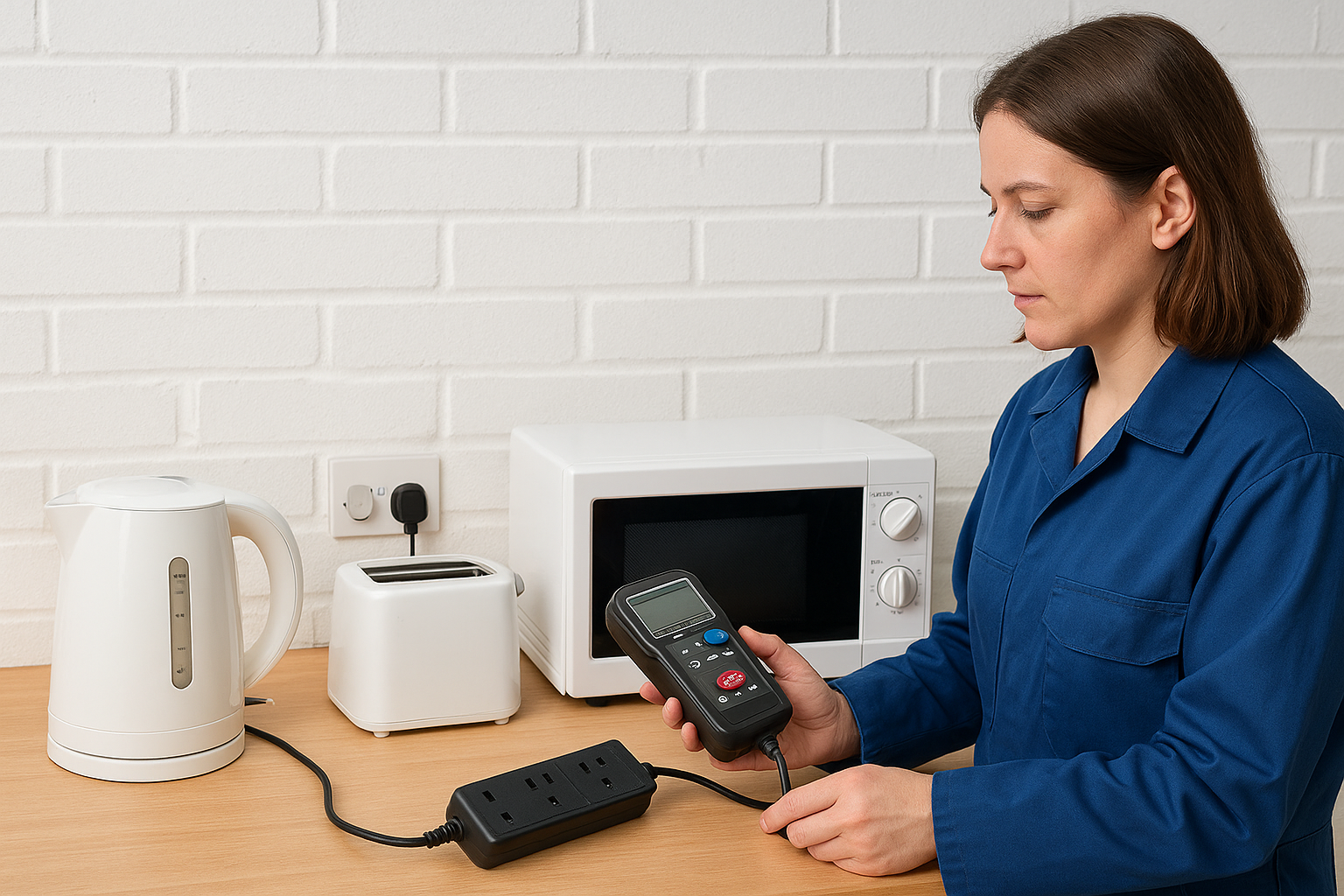
Most schools schedule PAT testing during half-term or the summer holidays, when classrooms sit empty and an engineer can move freely between rooms without disrupting lessons. This isn't a legal requirement, but it's the practical way to test hundreds of appliances without pulling a projector out from under a teacher mid-lesson. A competent person, either a trained member of staff or a qualified engineer, carries out the work using a PAT tester that checks earth continuity, insulation resistance, and lead polarity depending on the appliance class, and the rules on who can carry out PAT testing are worth checking before you delegate it in-house.
What a competent tester actually checks
Every appliance gets a visual inspection first, since cracked plugs, frayed cables, and scorch marks fail on sight before any meter is even connected. Class 1 appliances, anything with an earth pin like a kettle or laptop charger, need a full electrical test including earth continuity. Class 2 appliances, the double-insulated items like most modern laptops and phone chargers, need a simpler insulation check. Each item gets a pass or fail label with a visible test date and a unique reference number logged against the school's asset register.
A test result only counts if it's written down and dated, not just remembered by whoever held the meter.
Documentation you should expect afterwards
After testing, you should receive:
-
A full PAT testing certificate covering every appliance tested
-
A list of any failed items removed from service
-
Recommendations for repair or replacement
-
A record you can hand to insurers or inspectors on request
Keep this alongside your risk assessment for a complete audit trail.
Typical testing intervals for common school equipment
Recommended intervals at a glance
Guidance from the IET Code of Practice for In-Service Inspection and Testing gives most schools a sensible starting point, though your own risk assessment should always have the final say. The table below reflects what we see working well across the schools we test in London and the South East.
|
Equipment type |
Typical interval |
Notes |
|---|---|---|
|
IT equipment (laptops, monitors) |
2-4 years |
Low risk if rarely moved |
|
Staff room appliances (kettles, toasters, microwaves) |
6-12 months |
Heavy daily use, shared handling |
|
Extension leads and multi-way adaptors |
6-12 months |
High failure rate from overuse |
|
DT and science lab equipment |
6 months |
Rough handling, exposure to heat and chemicals |
|
Hired-in or visiting equipment |
Before first use |
Unknown maintenance history |
|
PE and changing room appliances (hairdryers) |
12 months |
Frequent use, damp environment |
Treat these intervals as a starting point, not a ceiling, since your busiest appliances always deserve the shortest gap between checks.
Adjusting intervals as equipment ages
Older appliances need closer attention regardless of category, since cables stiffen, plugs loosen, and insulation degrades faster once a kettle or heater passes the five-year mark. Newer purchases can often stretch to the longer end of the interval, provided they pass a visual check between formal tests. Reviewing your asset register annually lets you spot which items are approaching end of life before a failure forces the decision for you, keeping your PAT testing schedule realistic rather than reactive.
Staying on top of electrical safety in schools
Getting this right isn't about chasing a single legal clause, it's about building a risk-based schedule that matches how your equipment actually gets used, then keeping the paperwork to prove it. Schools that treat PAT testing as a rolling routine, rather than a box-ticking exercise before an inspection, rarely find themselves scrambling to explain a gap in their records. Whether you're setting up your first schedule or reviewing one that's drifted, the goal stays the same: portable appliance testing must be undertaken in schools often enough that nobody's relying on luck to keep classrooms safe.
Understanding the requirements is one thing, arranging reliable, fully documented testing across an entire site is another. If you'd rather hand that job to engineers who test schools across London and the South East every week, get a quote for school PAT testing and we'll build a schedule around your term dates and budget.

