






PAT Testing West London: Coverage, Pricing, and Booking



If you're searching for pat testing west london, you're probably a landlord with a tenancy deadline, a small business owner covering health and safety, or a homeowner who just wants faulty plugs and chargers checked before they cause a problem. Whatever the reason, you need someone qualified, local, and clear about what they charge before they turn up.
That's exactly what this article sorts out. We cover which areas we test in across West and pat testing north west london, from Ealing and Hammersmith through to Harrow and Wembley, what a typical job costs depending on the number of appliances, and how quickly you can get an engineer booked in. No vague estimates, just the actual numbers landlords and businesses ask us for every week.
Below you'll find our coverage map, a straightforward pricing breakdown, and the booking steps we use for both one-off visits and ongoing contracts. By the end, you'll know exactly what to expect and how to get a certified engineer out to your property or premises without the usual back-and-forth.
Why PAT testing matters in West London
Portable Appliance Testing checks that plugs, leads, and electrical equipment are safe to use, catching frayed cables, damaged casings, and internal faults before they cause a fire or shock. PAT testing West London properties matters more than most people realise because so much of the housing stock here is old, converted, or split into multiple lets, which means appliances get shared, moved, and abused far more than in a single-family home. A kettle that's been through three tenants in a Victorian conversion in Acton has had a harder life than one sitting in a brand-new flat, and it shows.
The legal and insurance angle
Landlords in London have a duty under the Electrical Equipment (Safety) Regulations to make sure appliances they provide, kettles, toasters, washing machines, are safe. There's no fixed legal interval for PAT testing itself, but insurers, letting agents, and housing associations increasingly ask for proof of an annual check as a condition of cover or contract, which is worth reading alongside the UK rules on when landlords must test. Businesses have it slightly clearer: under the Health and Safety at Work Act, employers must maintain equipment used by staff, and PAT testing is the recognised way to demonstrate that, as set out in the legal guide to PAT testing requirements for businesses. Skip it, and you're not just risking a fault, you're risking a rejected insurance claim after the fact.
A five-minute PAT check costs far less than a rejected insurance claim after a fire.
Why West London specifically
West London mixes some very different property types, and each brings its own risk profile:
|
Property type |
Common risk |
Why testing matters |
|---|---|---|
|
Converted Victorian terraces (Ealing, Acton) |
Overloaded sockets, aged wiring behind walls |
High appliance turnover between tenants |
|
HMOs and shared houses (Hammersmith, Shepherd's Bush) |
Multiple users, communal kitchen equipment |
Wear happens faster with shared use |
|
Commercial units and offices (Park Royal, Wembley) |
Heavy-use kit like printers, kettles, power tools |
Legal duty of care to staff and visitors |
|
New-build flats (Harrow, Wembley Park) |
Fewer faults, but insurers still ask for records |
Compliance paperwork for leaseholds |
Each of these needs a slightly different approach, but the underlying goal is the same: catch the fault before it becomes an incident.
The cost of getting it wrong
Faulty appliances are one of the more common causes of accidental house fires reported by London Fire Brigade, and a huge share of those faults would have shown up on a basic visual and electrical check. For landlords, an incident traced back to an untested appliance can mean disputes with tenants, voided insurance, and in the worst cases, prosecution. For businesses, it can mean a Health and Safety Executive investigation and reputational damage that outlasts the actual repair bill.
Getting ahead of this isn't complicated or expensive. Most properties and small offices can be tested in under an hour, and the certificate you're left with is proof you took safety seriously before anything went wrong. That paper trail matters just as much as the test itself, particularly if a tenant, insurer, or inspector ever asks for it. If you're weighing up whether it's worth booking, the honest answer from ten years of doing this across London is straightforward: it's cheaper, faster, and far less stressful than dealing with the alternative.
How to book PAT testing for your property or business
Booking a PAT testing visit shouldn't take more than a couple of minutes on the phone or a short form online. Most landlords and business owners just want a date, a rough number of appliances, and a price before they commit, so we keep the process short and skip the sales pitch. You can request a quote directly through our site, and for repeat customers with multiple properties, we set up rolling annual reminders so testing never falls off the schedule.
What to have ready before you call
Getting a fast, accurate quote depends on giving us a few basics upfront. Have this ready when you contact us:
-
Property or premises type, flat, HMO, office, retail unit
-
Approximate appliance count, kettles, laptops, extension leads, power tools
-
Preferred date range, especially if you're working to a tenancy or insurance deadline
-
Access details, keys, tenant contact, or site manager if it's a commercial unit
With that in hand, we can usually confirm a price on the same call rather than sending someone out to guess.
The fastest bookings happen when you know your appliance count before you call.
One-off visits versus ongoing contracts
Single-property landlords and homeowners typically book a one-off visit timed around a tenancy renewal or a house sale. Businesses and portfolio landlords more often set up an annual contract, where we test on the same date each year and send a reminder a few weeks out. Contracts work well if you're managing several flats across Ealing, Harrow, or Wembley, since it means one engineer visit covers everything in a single trip rather than scattered ad hoc calls.
What happens after you book
Once a date's confirmed, our engineer arrives with all testing equipment already calibrated, so there's no setup delay on site. For domestic properties, we usually need access to plug sockets and any appliances the landlord provides, kettles, toasters, washing machines. For commercial premises, we work around your operating hours where possible, testing before opening or after close if disruption is a concern. You'll get a certificate the same day or within 24 hours, listing every appliance tested, its result, and the retest date, so you've got the paperwork ready if a tenant, insurer, or inspector ever asks.
Areas covered across West and North West London
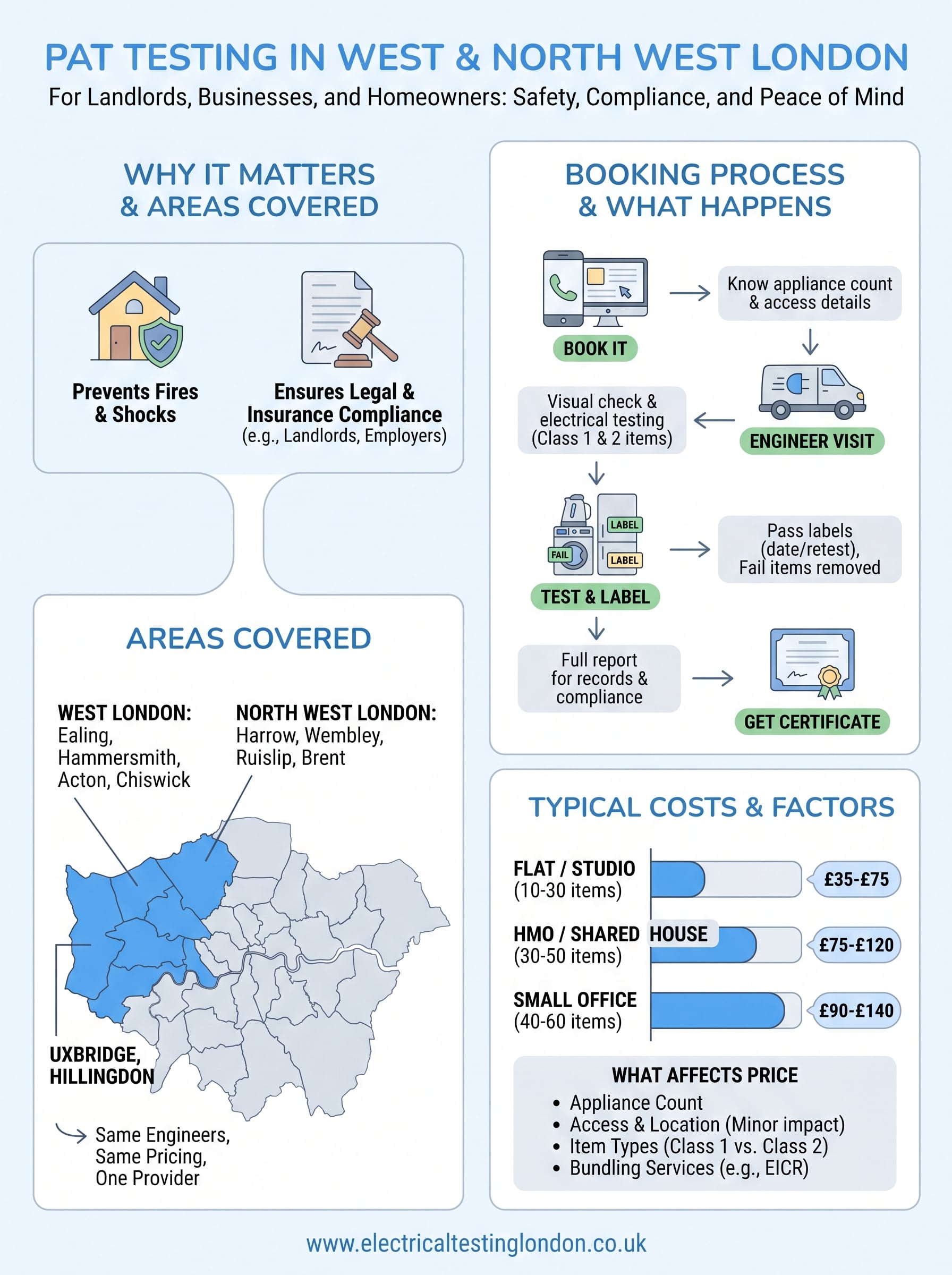
Coverage across this part of the city runs wide, and that's deliberate. We built the business around West London postcodes because that's where most of our landlord and commercial clients sit, and we've kept expanding north as demand grew from Harrow, Wembley, and the surrounding boroughs. If you're searching for pat testing north west london specifically, you're covered under the same booking process, same engineers, same pricing structure, just a different postcode on the job sheet.
Boroughs and areas we test in
Getting a feel for our patch is easier with a list than a paragraph full of place names, so here's where we regularly work:
-
Ealing, Acton, Chiswick (W3, W4, W5)
-
Hammersmith, Shepherd's Bush, Fulham (W6, W12, SW6)
-
Harrow, Wealdstone, Pinner (HA1, HA2, HA5)
-
Wembley, Wembley Park, Sudbury (HA0, HA9)
-
Uxbridge, Hillingdon, Ruislip (UB8, UB10)
-
Brent, Willesden, Kilburn (NW10, NW2, NW6)
One engineer, one booking system, whether you're in Chiswick or Wembley Park.
Why one provider across both areas works better
Having a single provider cover both West and North West London matters most if you manage properties spread across the boundary between the two. Landlords with a flat in Acton and another in Harrow don't want two separate contractors, two invoices, and two sets of paperwork to keep straight. Portfolio landlords tell us this is the single biggest reason they stick with one PAT testing provider rather than shopping around borough by borough: one contact, one certificate format, one renewal date to track.
Travel time and same-week availability
Staying within a compact, well-mapped patch also means we're rarely more than 30 to 40 minutes from any job in the coverage area, which keeps travel costs off your invoice and makes same-week booking realistic rather than a promise we can't keep. Uxbridge to Wembley, or Fulham to Harrow, both sit comfortably within a single day's route for one engineer, so multi-property visits get scheduled back to back instead of spread across separate weeks. That efficiency is part of why our pricing stays competitive even for smaller jobs, since we're not passing on wasted travel time. Testing in a location outside this list isn't necessarily a problem either, so it's worth asking when you request a quote rather than assuming you're out of range.
PAT testing costs and what affects the price
Money is usually the first question, so let's deal with it plainly. PAT testing costs in West London come down almost entirely to how many appliances you need checked and how quickly you can get us into a room to test them. A one-bedroom flat with a dozen items costs a fraction of what a shared office with forty pieces of kit costs, and that's before you factor in whether it's a single visit or part of an annual contract that spreads the cost across the year.
Typical price ranges
Giving you a number without context isn't much use, so here's a rough guide based on jobs we quote every week across Ealing, Harrow, and Wembley:
|
Job type |
Typical appliance count |
Approx. price range |
|---|---|---|
|
Studio or one-bed flat |
10-15 items |
£35-£50 |
|
Family home |
20-30 items |
£50-£75 |
|
HMO or shared house |
30-50 items |
£75-£120 |
|
Small office |
40-60 items |
£90-£140 |
|
Larger commercial unit |
60+ items |
Quoted individually |
Exact figures depend on access and location, but these ranges hold for the vast majority of jobs we do across the coverage area, and you can check the 2026 cost guide and packages for PAT testing in London before you commit to a date.
Appliance count drives the price far more than postcode does.
What pushes the price up or down
Several factors shift the final figure beyond a straight per-item rate and minimum call-out charge. Access matters, a tenant who's home to let the engineer straight in costs less time than chasing keys through a letting agent. Location within our coverage area rarely changes the price, since travel time stays low across West and North West London, but jobs outside our usual patch may carry a small callout adjustment. Class 1 appliances with earthed metal casings, kettles and toasters, take slightly longer to test than Class 2 double-insulated items like laptop chargers, so a kitchen-heavy inventory can nudge the price up compared to an office full of IT equipment.
Bundling for better value
Bundling helps more than most people expect. Landlords with several flats in one building, or businesses combining PAT testing with a domestic EICR in London or emergency lighting check on the same visit, generally pay less per item than booking each service separately, simply because one engineer visit covers everything in a single trip.
What happens during and after your PAT test
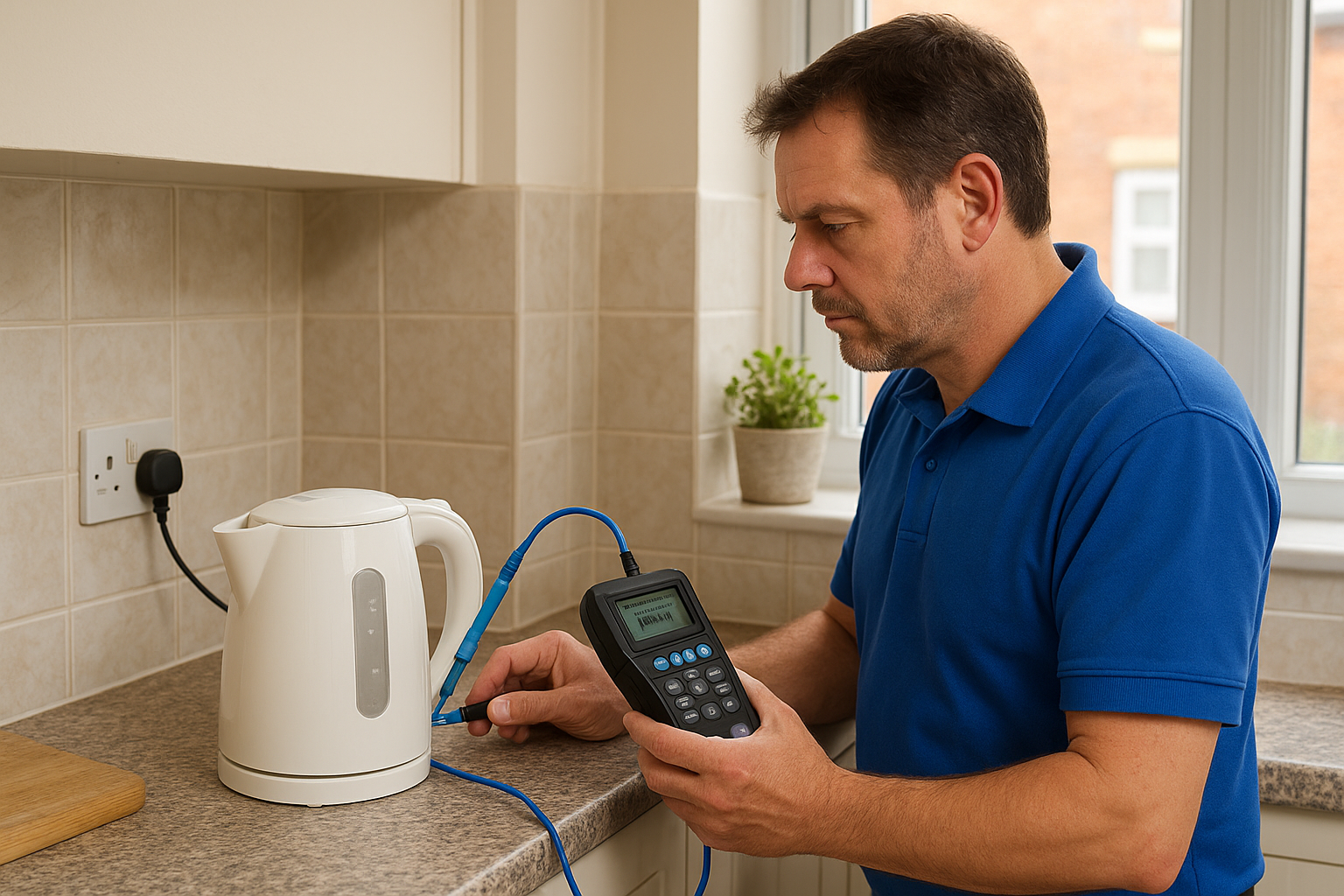
Walking into a property or office, our engineer starts with a visual inspection before any equipment gets plugged into a tester. Plugs get opened to check the wiring inside, cables get checked along their full length for nicks or fraying, and casings get checked for cracks that might expose live parts. A surprising number of faults get caught right here, before the electrical test even begins, which is why a rushed job that skips this step isn't doing a proper PAT test at all, as the full breakdown of the steps and checks involved makes clear.
The electrical test itself
Once the visual pass is done, each item goes through a portable appliance tester that checks earth continuity, insulation resistance, and lead polarity depending on the appliance class. Class 1 items, kettles and toasters with metal casings, get an earth check that Class 2 double-insulated items like laptop chargers don't need. Every result gets logged against the appliance as it's tested, so nothing gets missed and nothing gets guessed at afterwards.
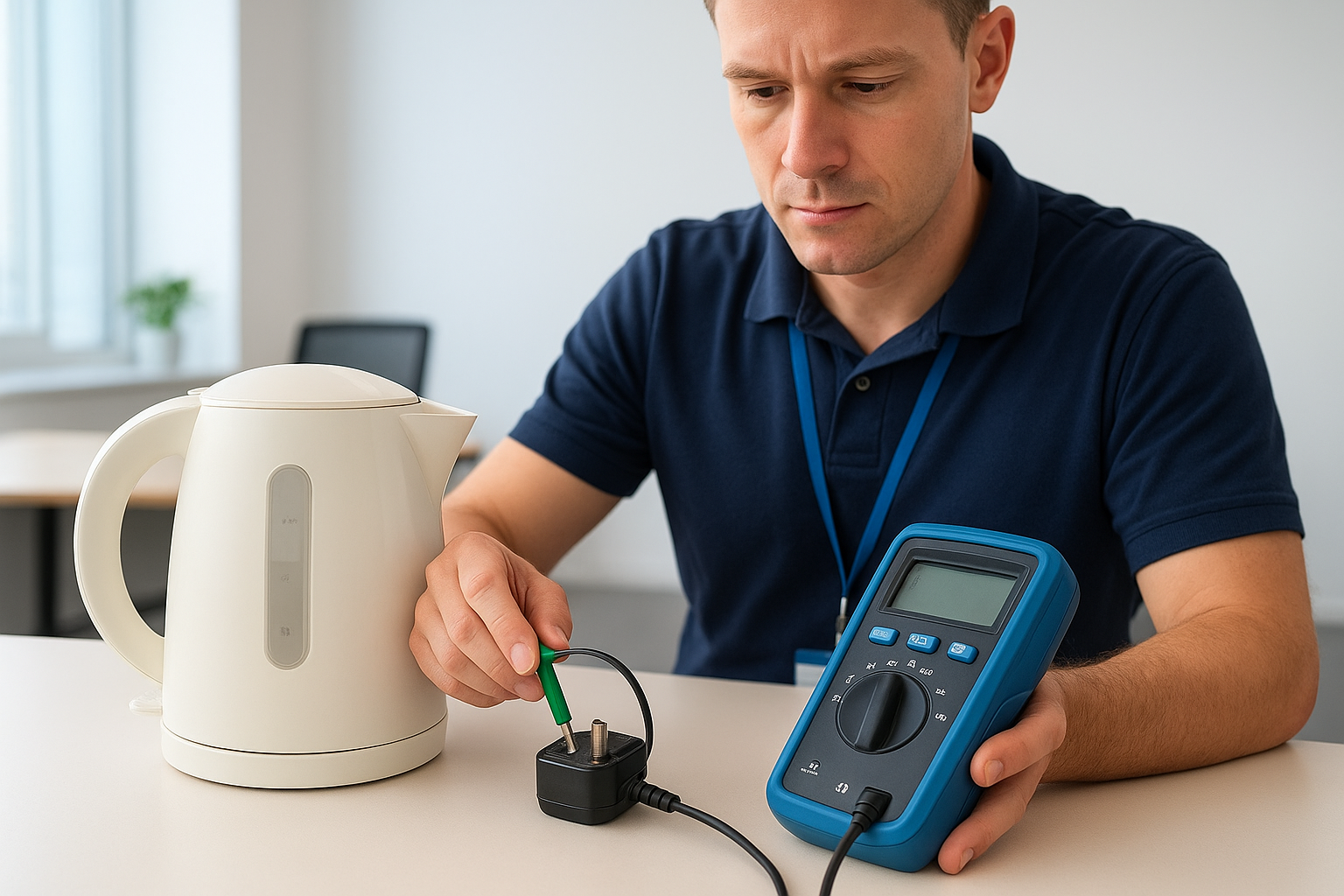
A proper PAT test catches faults with your eyes first and the tester second.
Labelling and what a failed item means
Every appliance that passes gets a small PAT testing label with the test date and the next retest due date, so anyone glancing at a kettle or extension lead in six months knows exactly where it stands. If something fails, it gets a clear fail label and gets removed from service on the spot, we don't leave a faulty item plugged in and hope someone remembers to deal with it later. You'll get a straight answer on whether it's worth repairing or replacing, based on the fault found and the age of the item.
Your certificate and next steps
Following the test, you receive a full PAT testing certificate listing every appliance, its result, and its retest date, giving you the paperwork insurers, letting agents, or a Health and Safety Executive inspector might ask for. How often PAT testing should be done varies by appliance type and how heavily it's used, kitchen equipment in an HMO gets tested more often than an office monitor that barely moves, and we'll tell you what interval makes sense for your setup rather than applying a blanket rule that doesn't fit. Storing that certificate somewhere accessible, alongside your EICR if you have one, means you're never scrambling to find proof of compliance when someone actually asks for it.
Keeping your appliances safe and compliant
Getting PAT testing sorted isn't complicated once you know the process, what it costs, and who covers your postcode. Whether you're a landlord juggling flats across Ealing and Harrow, a business owner ticking off a health and safety duty, or a homeowner wanting peace of mind before winter kicks in, the steps are the same: know your appliance count, pick a date, and get a qualified engineer out before a fault turns into a claim.
Holding off doesn't save you money, it just moves the risk further down the line. A faulty kettle or frayed extension lead doesn't wait for a convenient time to fail, and the paperwork you skip today is the paperwork an insurer or inspector will ask for tomorrow. If you're ready to get a date in the diary, request a quotation and we'll have an engineer booked in before the week's out.