






PME Earthing Explained: How TN-C-S Differs from TN-S and TT



You have probably seen "PME" or "TN-C-S" on an EICR, a consumer unit label or an EV charger quote, and wondered what it actually means. It is a question we get on site often. PME earthing explained in one line: it is a system where your earth connection comes from the supplier's neutral conductor, rather than from a separate cable or a rod in the ground.
Here is the short answer. PME is the UK name for TN-C-S, and it is the most common earthing arrangement in homes built since the 1960s. The supplier combines neutral and earth in the incoming cable, then you split them at your property. TN-S uses a separate earth, usually the lead sheath of an older cable. TT relies on an earth electrode in the ground, common in rural properties. Each behaves differently when a fault occurs.
Below, we cover how PME works, how it compares with TN-S and TT, and how to tell which you have. We also explain what it means for bonding, EV charger installation and safety, so you know what to ask your electrician.
Why PME earthing matters for your property's safety
Most people never think about earthing until an inspector flags it. PME earthing explained properly starts with safety, because the system only protects you when it is installed and bonded correctly.
What earthing does when something goes wrong
Earthing gives fault current an easy route back to the supply. If a live conductor touches a metal casing, the earth path lets a large current flow, and the breaker or RCD trips. That gives a low-resistance path so the device can disconnect within the time BS 7671 allows, instead of leaving the metalwork live for you to touch.
In a PME installation, that return path runs along the supplier's combined neutral and earth conductor. It is cheap to provide and usually gives a low earth fault loop impedance, with the external value (Ze) typically no higher than 0.35 ohms. That is why distributors fit it to most new connections.
The one risk you need to understand
Because earth and neutral share one conductor outside your property, a break in that conductor can cause trouble. This is called an open PEN fault. Your earth terminal can then rise towards mains voltage, and that voltage reaches every bonded pipe, tap and radiator, as well as any metal appliance on the circuit. Nothing trips, because there is no fault current to detect.
A PME earth is only as safe as the supplier's neutral and the bonding inside your property.
Where this shows up in practice
Three situations are where the risk becomes real, and where we see mistakes most often:
-
Main protective bonding: gas and water services must be bonded within 600 mm of where they enter, typically with at least 10 mm² copper on a domestic PME supply (BS 7671, Table 54.8). Undersized or missing bonding is a common EICR observation.
-
EV chargers: a car charged outdoors is a person standing on earth, touching metal. BS 7671 Regulation 722.411.4.1 requires extra protection on PME, either open-PEN detection or an earth electrode.
-
Outbuildings and garden metalwork: do not extend a PME earth to a metal shed, pool or caravan point without checking the design first.
How PME earthing works in a TN-C-S supply
TN-C-S means the supply is combined (C) in the street and separate (S) inside your property. In protective multiple earthing, the supplier's cable carries one combined PEN conductor that does the job of neutral and earth until it reaches you.
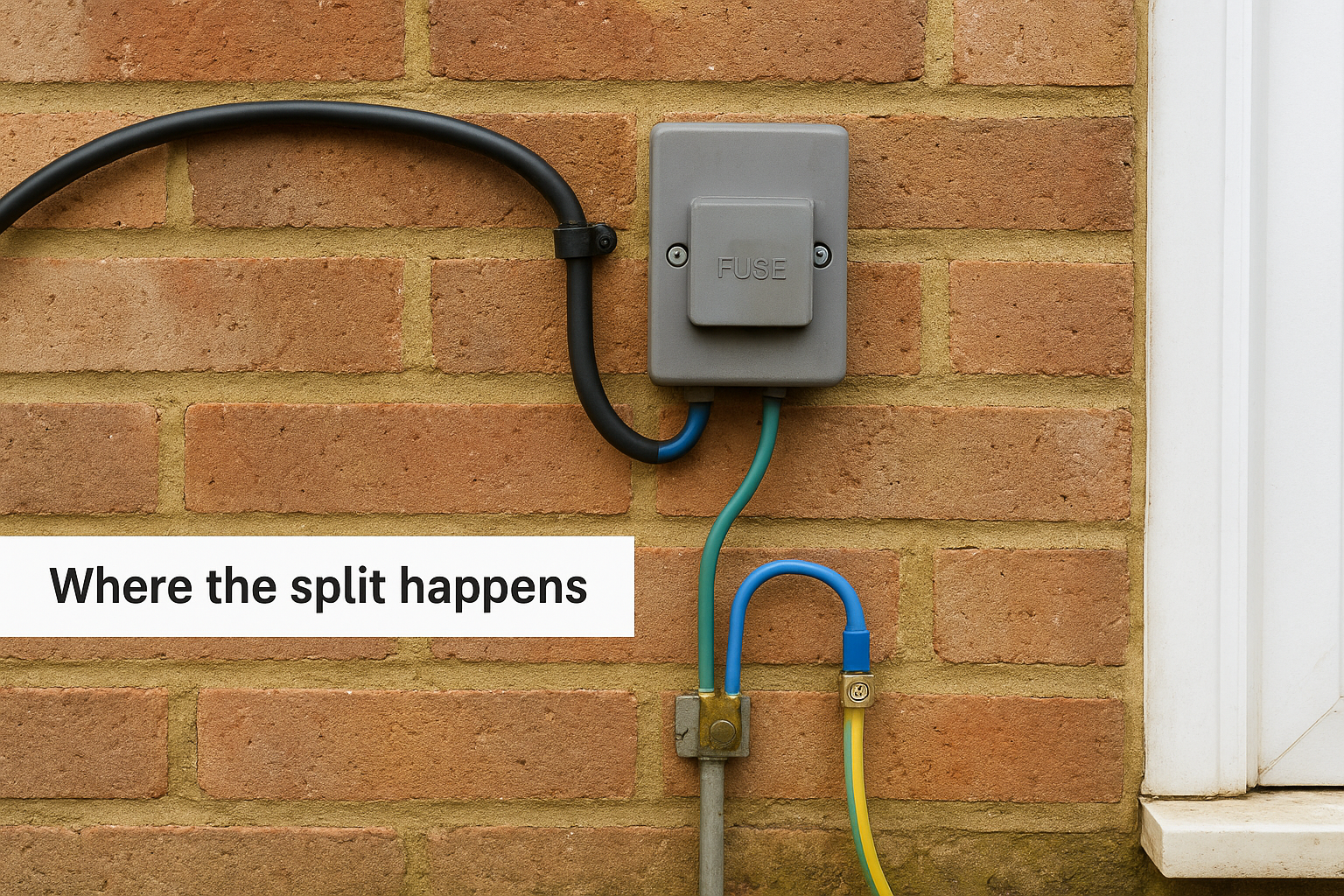
Where the split happens
The split happens at the supplier's cutout, the sealed fuse unit before your meter. The distributor links neutral to earth there and provides an earth terminal. Beyond that point you have separate neutral and earth conductors, and they must never be joined again downstream. Here is the path:
-
The substation transformer's star point is earthed.
-
The PEN conductor runs along the street, earthed at several points.
-
The cutout splits it into a neutral and an earth terminal.
-
Your earth runs to the main earth terminal, where the bonding connects.
Why the "multiple" matters
During a fault, current travels from the faulty appliance along the circuit protective conductor to your main earth terminal. It then returns through the cutout and the PEN to the transformer. The "multiple" refers to the distributor connecting the PEN to earth electrodes at many points along the network. That means a broken neutral rarely leaves your earth completely floating, although it can still lift your earth above safe voltage.
The "multiple" in PME is a network of earth connections that makes a broken neutral less likely to be dangerous, not impossible.
PME vs TN-S vs TT: how the systems differ
All three types of earthing systems satisfy BS 7671, but each takes its earth from a different place. That changes how a fault is cleared and what protection you must add.
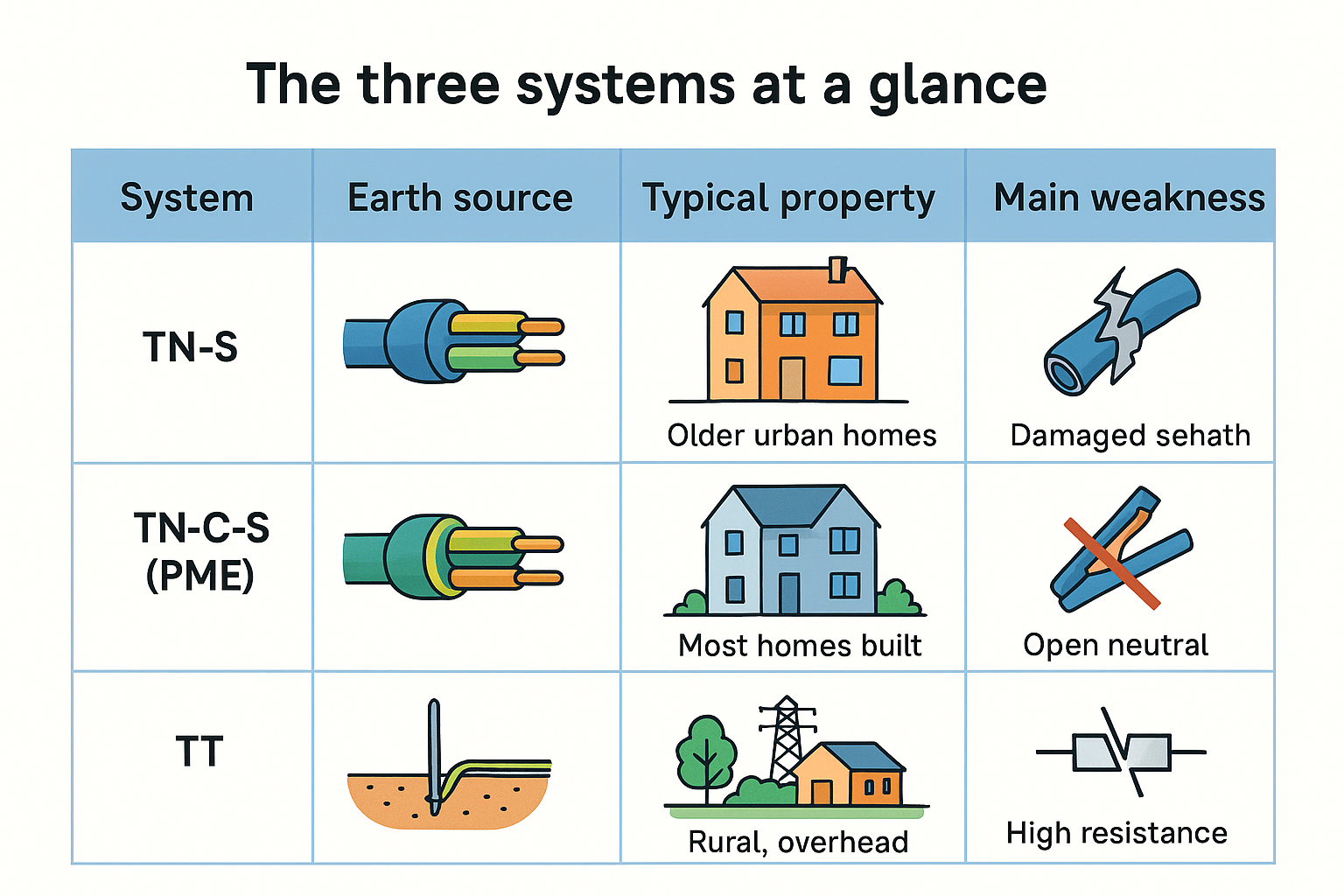
The three systems at a glance
Use this table to see where the earth comes from and where each system is weakest.
|
System |
Earth source |
Typical property |
Main weakness |
|---|---|---|---|
|
TN-S |
Supplier's cable sheath or separate conductor |
Older urban homes |
Ageing or damaged sheaths |
|
TN-C-S (PME) |
Supplier's combined neutral and earth |
Most homes built since the 1960s |
Open PEN fault |
|
TT |
Your own earth electrode |
Rural, overhead supplies |
High earth resistance |
What the differences mean for you
PME is the cheapest to provide and gives low impedance, but it is the only one of the three that can lift your earth if the supply neutral breaks. That is why it demands correct main bonding and extra measures for EV chargers.
PME gives you the best fault path and the one failure mode the other systems avoid.
TN-S keeps earth and neutral separate back to the substation, so an open neutral cannot raise your earth. The catch is age. Corroded or cut lead sheaths can push Ze up, so we always measure it rather than assume.
TT depends on soil, which resists current. A breaker alone will not clear a fault quickly, so you need an RCD and an electrode resistance ideally under 200 ohms.
How to identify your earthing system and check PME is safe
You can often guess your system in minutes, but a guess is not a verification. Start with what you can see, then have an electrician confirm it.
Clues you can spot yourself
Look at the supply where it enters the property. Never open the sealed cutout, because that is the supplier's equipment.
-
TN-C-S (PME): a thick earth cable runs from the cutout to your main earth terminal, often with a PME warning label.
-
TN-S: an old lead-sheathed cable with an earth clamp on the sheath.
-
TT: no supplier earth terminal, just a cable to an earth rod in a small inspection pit.
How to check PME is safe
Ask for an EICR, which should record the earthing arrangement and the measured Ze. A PME supply typically reads 0.35 ohms or less, while TN-S often reads up to 0.8 ohms. Anything far higher suggests a fault, or a TT supply.
Never assume your earthing type; have it measured and written down.
The inspector should also check the main bonding to gas and water, including conductor size and continuity. If you plan to fit an EV charger or a metal outbuilding supply, ask whether the design needs open-PEN protection or an electrode. Where bonding is missing or undersized, get it corrected before any other work.
How to install or upgrade to PME earthing
You cannot simply choose PME for your property, and that is the first thing to understand before you ask for a quote.
Start with your distributor
Installing PME is not a DIY decision. Your distributor decides whether to provide a PME earth terminal, such as UK Power Networks across much of London and the South East. Nobody should ever link neutral to earth at the cutout themselves, because that breaks the supplier's rules and can put dangerous current on exposed metalwork.
Only the distributor can give you a PME earth, and you can never make one yourself.
The upgrade steps
Switching from TN-S or TT to PME, or fitting PME on a new connection, follows a clear order:
-
Have your electrician confirm the current system and measure Ze.
-
Apply to the distributor for a PME earth terminal.
-
Upgrade main protective bonding to gas and water, usually 10 mm² copper.
-
Check the consumer unit keeps neutral and earth separate.
-
Test everything, then keep the paperwork.
Finally, ask for an Electrical Installation Certificate once the work is done. Alterations like this are notifiable under Part P in England, so a registered electrician should handle it. If you have an old TT electrode you no longer need, let the electrician decide whether to keep it, because it can still help with outdoor supplies.
Key points to remember about PME earthing
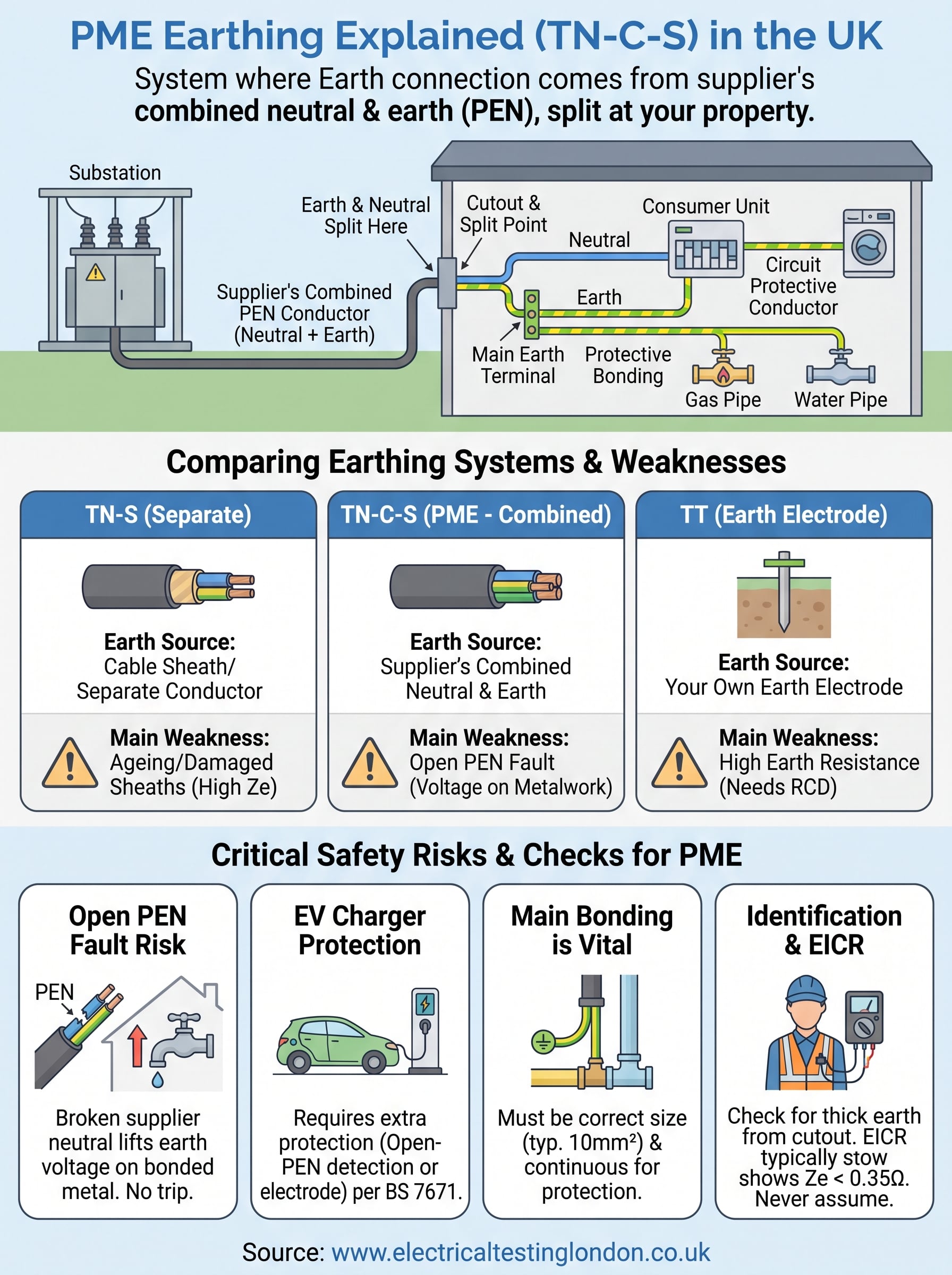
PME earthing explained simply: your earth comes from the supplier's combined neutral and earth conductor, split at the cutout. It gives a low-resistance fault path and suits most homes built since the 1960s. It also carries one failure mode, the open PEN fault, that TN-S and TT avoid.
Everything else follows from that. Correct main protective bonding keeps your metalwork safe, EV chargers and outbuildings need extra protection, and only your distributor can provide a PME terminal. Never assume your system. Have Ze measured and the earthing arrangement recorded on an EICR.
If you want an engineer to confirm your earthing type and check your bonding, or to fit an EV charger safely, request a quote from Electrical Testing London and we will tell you exactly what your installation needs.