


Portable Appliance Testing Near Me: How to Find a Provider


Section 1
Typing portable appliance testing near me into Google usually means one thing: you've got appliances that need checking, a deadline looming, and no patience for endless quote requests. Maybe it's a landlord prepping a rental for new tenants, an office manager ticking off a health and safety audit, or a small business owner who just wants proof their kettle won't start a fire. Whatever the reason, you want a local engineer who turns up, tests properly, and hands you a valid certificate without the runaround.
This article answers that search directly. We'll walk through what makes a PAT testing provider worth hiring, what questions to ask before booking, and how to spot the difference between a rushed job and a thorough inspection that actually protects you legally and practically.
We'll also cover pricing expectations, turnaround times, and why choosing engineers with real, on-the-ground experience across London and the South East matters more than picking whoever ranks first on a map search. By the end, you'll know exactly what to look for and how to book a reliable service without the guesswork.
Why portable appliance testing matters for your property
Faulty appliances cause more workplace and rental property incidents than most people realise. A frayed kettle lead, a cracked plug, or a laptop charger with damaged insulation can spark a fire or deliver a shock long before anyone notices a problem. Portable appliance testing exists to catch these faults early, before they turn into an insurance claim, a tenant complaint, or worse. If you've searched for portable appliance testing near me, you're already aware that this isn't a box-ticking exercise, it's a genuine safety measure with legal weight behind it.
The legal and regulatory side
Under the Electricity at Work Regulations 1989, employers and landlords have a duty to maintain electrical equipment in a safe condition. PAT testing is the standard way to demonstrate that duty has been met. The Health and Safety Executive doesn't set a fixed legal frequency for testing, but it does expect businesses to carry out risk-based checks and keep records. For landlords, this sits alongside broader electrical safety obligations, including EICR requirements for fixed wiring. Skipping appliance checks entirely leaves you exposed if an incident happens and you can't show any evidence of due diligence.
A five-minute test now is cheaper than a fire investigation later.
Who actually needs it
Almost every type of property owner or manager benefits from regular testing, though who needs PAT testing and how often depends on the setting:
-
Landlords supplying furnished rentals with kettles, toasters, washing machines, or heaters
-
Office managers responsible for shared equipment like printers, extension leads, and desk fans
-
Retail and hospitality businesses running kitchen appliances, till systems, and display lighting
-
Care homes and schools where vulnerable people are at higher risk from electrical faults
-
Homeowners letting out rooms or running a home business who want documented proof of safety
Insurance and liability protection
Many commercial insurance policies now ask for evidence of routine electrical checks as a condition of cover. Without a valid PAT certificate, a claim following a fire or injury could be reduced or refused outright. Property managers handling multiple units find this especially relevant, since one uninspected appliance across dozens of tenancies represents a serious liability gap. Testing also protects you in disputes: if a tenant or employee is injured by faulty equipment, a dated, signed test record shows you took reasonable steps to prevent harm.
Practical safety beyond compliance
Quietly, the most convincing reason to test appliances has nothing to do with paperwork. Engineers regularly find damaged cables, incorrect fuses, and overheating components that owners never noticed because the appliance still "worked fine." Catching these faults during a scheduled visit is far less disruptive than dealing with a tripped circuit, a damaged appliance, or an emergency callout after something's already gone wrong. Whether you're managing one flat or fifty desks, portable appliance testing gives you a clear, documented answer to the question every landlord, employer, and homeowner should be asking: is this equipment actually safe to plug in?
How to find a reliable PAT testing provider near you
Searching for a local PAT testing provider brings up dozens of names, and most websites look identical: stock photos, vague promises, a phone number. What actually separates a solid engineer from a box-ticker is credentials, transparency, and how they answer questions before you've even booked. Finding a PAT testing company near me that fits your property type takes a bit more digging than clicking the top map result, so it helps to know how to compare local prices and reviews first.
Checking credentials and experience
Start by confirming the engineer holds a recognised qualification, such as City & Guilds 2377, carries public liability insurance, and meets the rules on who can carry out PAT testing. Ask how many years they've worked specifically on appliance testing rather than general electrical work, since the two skill sets overlap but aren't identical. A provider working across London and the South East for a decade or more has likely seen the full range of faults that turn up in flats, offices, and shop units, not just the textbook examples.
Ask for proof of qualification before you ask for a price.
Questions worth asking before booking
A short phone call or email exchange tells you almost everything you need to know about how a company operates:
-
Do you provide a PAT testing certificate immediately or within a set turnaround time?
-
What equipment classes and fault types are covered in your inspection?
-
Can you work around our opening hours or tenant access restrictions?
-
Is your pricing per item, per visit, or a fixed quote for the whole job?
-
Do you offer combined services, such as EICR or emergency lighting checks, on the same visit?
Reading reviews and checking local reputation
Genuine reviews mention specifics, like a technician spotting a damaged charger or explaining a fail result clearly, rather than generic five-star praise. Local reputation matters more than national brand recognition here, since a provider familiar with London's older housing stock and commercial units knows what to expect walking in. Weigh up response times too; a company that answers quickly and confirms a visit within days usually reflects the same efficiency on-site.
Combining a qualified engineer, clear pricing, and solid local reviews gives you a shortlist worth calling, and our roundup of the best PAT testing services in London is a useful starting point. If you'd rather skip the vetting process, our PAT testing London service covers all of the above as standard.
What to expect during a PAT testing appointment
Booking the visit is the easy part. Knowing what happens once the engineer arrives helps you plan around the appointment instead of hovering nearby wondering how long it'll take. A typical PAT testing appointment follows a predictable sequence, whether it's ten appliances in a rented flat or two hundred across an office floor.
The testing process step by step
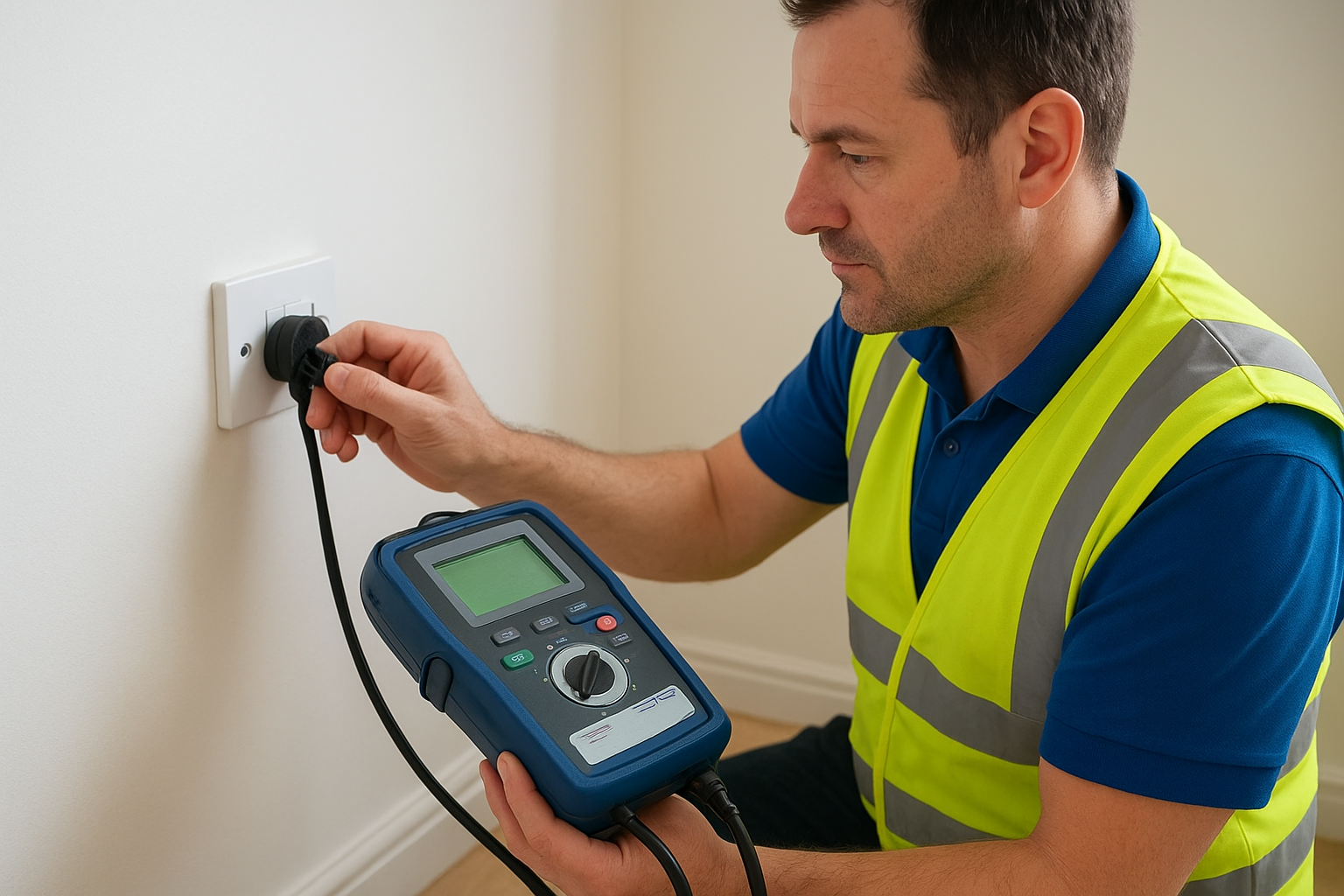
Most engineers work through a property systematically, testing each item and logging results as they go, and the PAT testing process explained in full follows these stages:
-
Visual inspection of the plug, cable, and casing for cracks, fraying, or scorch marks
-
Earth continuity and insulation resistance checks using a calibrated PAT tester
-
Polarity and load testing to confirm the appliance runs safely under normal use
-
Labelling each item with a pass or fail sticker showing the test date
-
Recording results in a digital or paper log tied to your property or business
A proper test takes minutes per item but catches faults that could take a life.
How long it takes and what disruption to expect
Small jobs, such as a one-bedroom rental with five or six appliances, usually wrap up within thirty minutes. Larger commercial sites take longer, but a good engineer works around your schedule rather than the other way round. Offices often book testing outside working hours or room by room, so staff aren't stuck without a kettle or a monitor for the day. Retail units sometimes prefer early mornings before opening. Ask your provider directly how they minimise disruption, since this varies more between companies than the testing method itself.
What happens if something fails
Occasionally an appliance fails, whether it's a damaged cable or a fault inside the casing. A competent engineer explains the specific issue rather than just handing you a fail sticker, and tells you whether it's repairable or needs replacing. Failed items get removed from service immediately, which protects everyone using the space. Once testing wraps up, you should receive a PAT testing certificate and know how to get one listing every item checked, its result, and the date of the next recommended test, giving you a paper trail for insurers, auditors, or tenants who ask.
How much does PAT testing cost in London
Price is usually the first question after safety, and it's a fair one. PAT testing costs vary depending on the number of appliances, the property type, and whether you're booking a single visit or an ongoing contract. Most reputable providers in London quote per item with a minimum call-out charge, rather than a flat fee that doesn't reflect the actual workload.
Typical price ranges
Homeowners and landlords with a handful of appliances pay far less than a commercial site running dozens of items. The table below gives a realistic starting point, though always confirm current rates with your chosen provider.
|
Property type |
Typical appliance count |
Approximate cost |
|---|---|---|
|
One-bed rental flat |
5-10 items |
£45-£65 |
|
Small office |
20-40 items |
£80-£150 |
|
Retail unit |
15-30 items |
£70-£130 |
|
Larger commercial site |
100+ items |
Custom quote |
Cheap testing that skips proper inspection costs more once something fails.
What pushes the price up or down
Several factors shift the final bill beyond a simple per-item rate:
-
Access difficulty, such as appliances stored behind furniture or in locked cupboards
-
Out-of-hours testing requested to avoid disrupting staff or tenants
-
Combined visits, where PAT testing is booked alongside an EICR or emergency lighting check
-
Repeat business discounts for landlords with multiple properties or ongoing contracts
Quotes should always state whether the price includes labelling, certification, and a retest reminder, since some providers charge extra for these as add-ons.
Getting an accurate quote
Rather than guessing from a website's headline figure, send the provider an appliance count and property type before booking. Vague quotes often balloon once the engineer arrives and finds double the expected items. Electrical Testing London publishes a transparent PAT testing prices London cost guide upfront, so landlords and businesses across London and the South East know the cost before agreeing to a visit. Fixed, itemised pricing also makes budgeting simple if you're managing several properties and need predictable annual costs rather than surprises on invoice day.
How often you should book a retest
There's no single legal number that applies to every appliance, which is exactly why so many landlords and office managers get this wrong. The retest frequency depends on how an item is used, where it lives, and how much wear it takes day to day. A kettle in a busy staff kitchen faces more risk than a lamp in a spare bedroom, so treating every appliance the same interval either wastes money or leaves genuine risks unchecked for too long.
Recommended intervals by appliance type
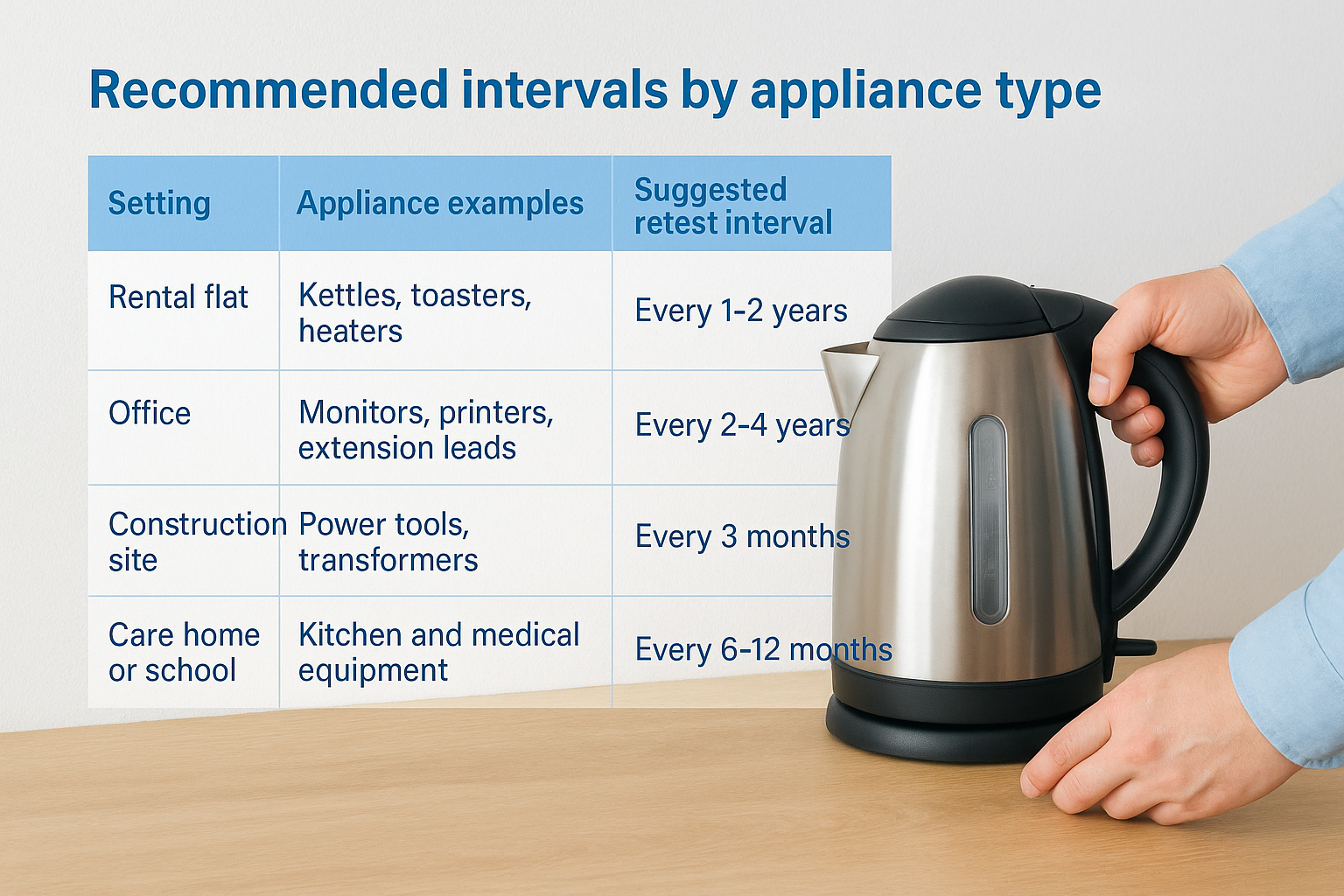
Most engineers work from HSE-aligned guidance rather than a fixed rulebook, adjusting how often PAT testing should be done based on environment and appliance class. The table below reflects typical intervals used across London properties:
|
Setting |
Appliance examples |
Suggested retest interval |
|---|---|---|
|
Rental flat |
Kettles, toasters, heaters |
Every 1-2 years |
|
Office |
Monitors, printers, extension leads |
Every 2-4 years |
|
Construction site |
Power tools, transformers |
Every 3 months |
|
Care home or school |
Kitchen and medical equipment |
Every 6-12 months |
The right interval matches the risk, not the calendar.
What shortens the retest interval
Certain conditions push testing forward regardless of the standard schedule:
-
Portable use, where cables get moved, coiled, or trodden on regularly
-
High-moisture environments, such as kitchens, bathrooms, or outdoor sites
-
Previous fail results, which flag an appliance or environment worth watching closely
-
New tenants or staff, since unfamiliar handling increases accidental damage risk
Setting reminders around these factors, rather than a generic annual date, keeps testing genuinely useful instead of routine paperwork.
Building a schedule that sticks
Landlords managing several properties benefit from staggering retests rather than booking everything on one date each year, since a single missed appointment then leaves an entire portfolio overdue. Ongoing contracts with a PAT testing provider solve this automatically, with reminders sent before certificates expire. Booking through a provider who already tracks your test history saves you from digging through old paperwork every time a certificate lapses.
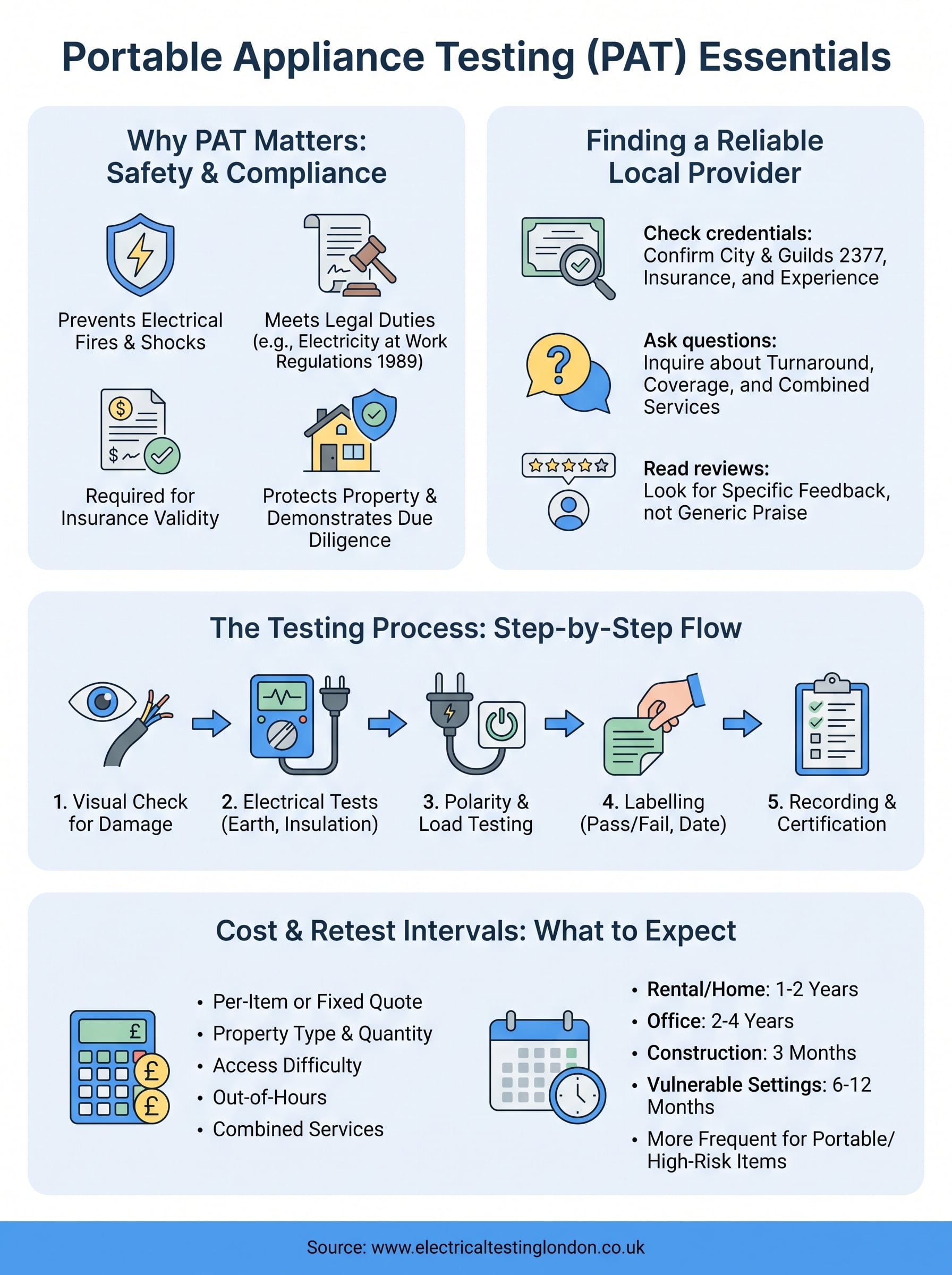
Keeping your appliances safe and compliant
Finding portable appliance testing near me shouldn't feel like a gamble. You now know what a proper inspection involves, what a fair price looks like, and how often retests actually need booking based on real risk rather than guesswork. None of this is complicated once you've got a provider who explains results clearly and keeps your certificates organised.
Getting this right protects tenants, staff, and customers from faults that hide behind a working appliance until they don't. It also protects you, whether that's satisfying an insurer, passing a health and safety audit, or simply knowing your kettle won't cause a problem at 2am. Skipping testing is the expensive option, even when it feels like the cheaper one today.
If you're ready to book, get a quote from our team and we'll confirm pricing and availability for your property before you commit to anything.

