






Portable Appliance Testing Report: What It Is and Should Include



Someone has asked you for a copy of your PAT records, or you've just paid an engineer to test your appliances and now you're staring at the paperwork wondering if it's actually correct. A portable appliance testing report is meant to prove your equipment is safe, but only if it contains the right information in the right format.
This document isn't just a pass/fail slip. A proper report lists each appliance tested, the results of visual and electrical checks, the date of testing, and the retest interval your business or property should follow. Insurers, landlords, and health and safety inspectors all know what a valid report looks like, and a vague or incomplete one won't hold up if something goes wrong.
In this article, we'll break down exactly what belongs in a compliant report, show you what a well-structured example looks like, and explain how to read the results if an engineer has already handed you one. We test appliances across London and the South East every week, so we know precisely where these reports fall short and what to check before you file one away as proof of compliance.
Why a PAT testing report matters for your property
A portable appliance testing report is the paperwork that turns a quick visual check into evidence you can actually rely on. Without it, you've paid for a service but you've got nothing to show an insurer, a tenant, or a fire investigator if the worst happens. Landlords and commercial property owners in particular need to treat this document as part of their legal toolkit, not just a receipt for work done.

Protecting yourself legally
Under the Electricity at Work Regulations 1989, employers and landlords have a duty to make sure electrical equipment is maintained in a safe condition. A PAT testing certificate is the clearest way to demonstrate you've met that duty. If an appliance causes a fire or an injury and you can't produce a report showing it was checked, you're exposed to prosecution and civil claims regardless of how careful you actually were. The Health and Safety Executive doesn't set a fixed legal requirement to test every appliance on a schedule, but it does expect you to show a reasonable system of maintenance is in place, and a dated report is the easiest way to prove that.
A PAT report only protects you if you can produce it, so treat the paperwork with the same seriousness as the testing itself.
Reassuring tenants, staff and customers
Landlords managing multiple properties rely on these reports to reassure tenants that appliances supplied with a rental, kettles, washing machines, microwaves, are safe to plug in and use, which is where the rules on when landlords must test appliances come in. Commercial clients booking PAT testing for a business in London need the same reassurance for staff and visitors, especially in offices, salons, gyms, and warehouses where dozens of appliances get used daily by people who have no idea whether that extension lead was ever tested. Handing over a clear report at the start of a tenancy, or displaying current PAT stickers and certificates in a workplace, builds trust without you having to say a word.
Satisfying insurers and inspectors
Insurance policies for rental and commercial properties frequently reference electrical safety compliance in their small print. If you make a claim after a fire linked to a faulty appliance and you can't produce a PAT testing certificate, insurers can refuse to pay out or reduce the settlement significantly. Fire and health and safety inspectors ask for the same paperwork during routine visits, and a missing or vague report is one of the fastest ways to trigger a follow-up inspection or an enforcement notice.
Who typically asks to see your report
Different people scrutinise this document for different reasons, and it helps to know what each of them is actually looking for:
-
Insurers: want proof of a maintenance system before they'll pay a claim involving electrical equipment.
-
Letting agents and tenants: expect current, dated records before move-in, particularly for furnished properties.
-
Health and safety inspectors: check that testing intervals match the risk level of the equipment and environment.
-
Fire investigators: use the report to establish whether an appliance was known to be safe before an incident.
-
Facilities managers: rely on it to plan retesting schedules across large sites without duplicating work.
Why a poor report is worse than no report at all
Here's something worth sitting with. A report full of gaps, missing serial numbers, no pass or fail marked against individual items, no engineer signature, can actually work against you. It suggests the testing was rushed or never properly carried out, which raises more questions than it answers. We've seen landlords in London hand over a stack of PAT stickers with no accompanying report and assume that's compliance. It isn't. The sticker tells you an appliance was tested; the report tells you what was tested, when, by whom, and with what result. Only the report holds up as evidence.
Getting this right from the start saves you time later. Our engineers issue a full report alongside every PAT testing visit in London and the South East, structured so it stands up to scrutiny from insurers, agents, and inspectors alike. That means every appliance gets a unique reference, every result gets recorded against clear pass or fail criteria, and you get a document you can actually hand over with confidence rather than one you have to explain or apologise for.
How to read and interpret your PAT testing report
Most people glance at a portable appliance testing report and see a wall of codes, numbers, and technical terms, then file it away without actually checking anything. That's a mistake. Once you know what the columns mean, you can read a report in under a minute and spot problems before they become someone else's emergency.
Making sense of the appliance details
Every line on the report should start with an asset reference or unique identifier, usually a number that matches a sticker physically attached to the appliance. Alongside it you'll see a description (kettle, monitor, extension lead), the location it was found in, and the appliance's class rating. Class I appliances have a metal casing and rely on an earth connection for safety, while Class II appliances are double-insulated and don't need one. This distinction matters because it changes which electrical tests apply, so don't be alarmed if a Class II appliance shows no earth continuity result. That's normal, not a gap in the testing.
Understanding the test results
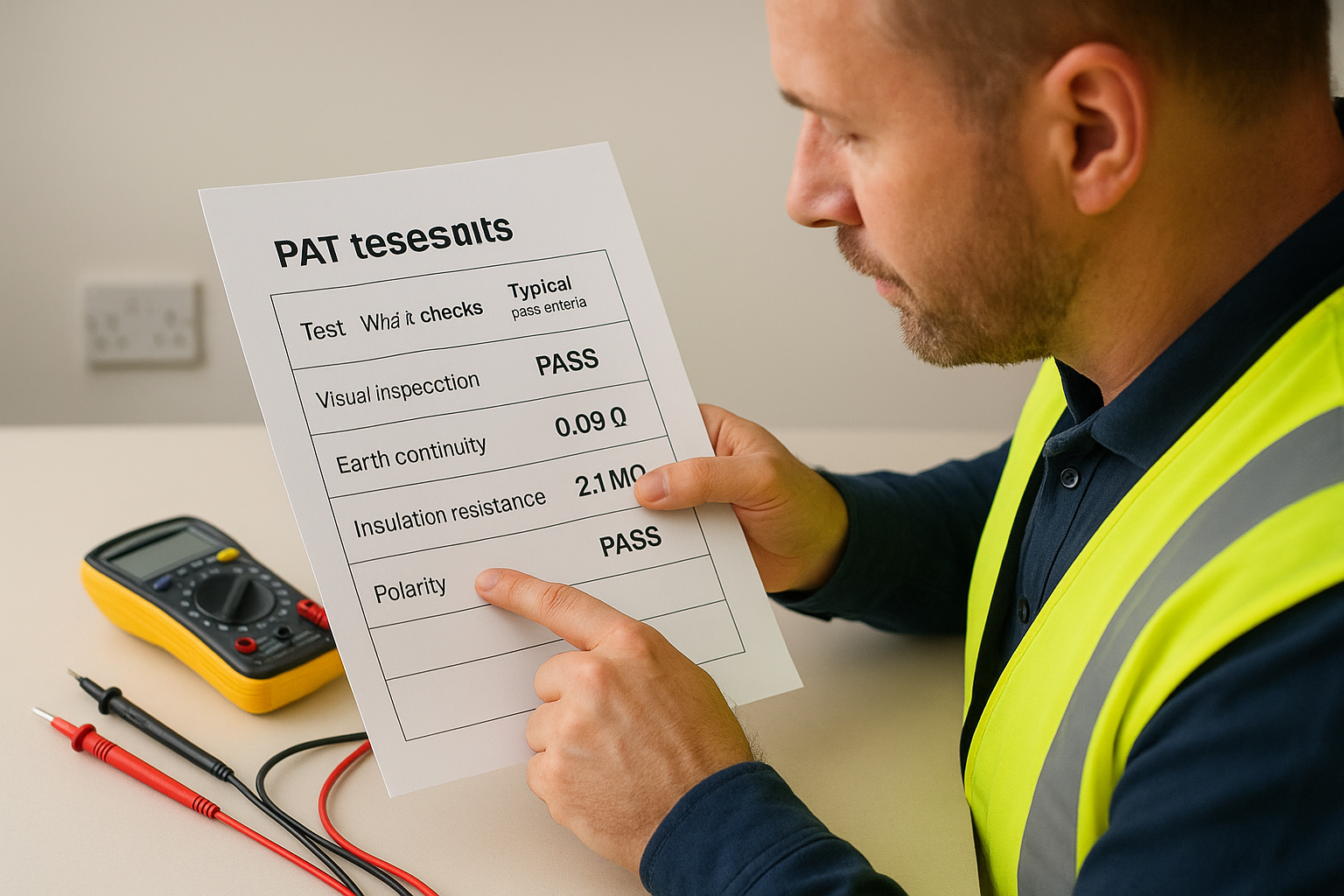
The electrical results section, where the individual PAT tests and how they work are recorded, is where most confusion happens. Engineers record readings against a few standard tests, and each has a pass threshold set out in the IET Code of Practice for In-service Inspection and Testing of Electrical Equipment. Here's what you're actually looking at:
|
Test |
What it checks |
Typical pass criteria |
|---|---|---|
|
Visual inspection |
Damage, wear, exposed wiring, correct fuse rating |
No visible defects |
|
Earth continuity |
Resistance of the earth path on Class I appliances |
Below 0.1 ohms plus lead resistance |
|
Insulation resistance |
Integrity of insulation between live parts and casing |
Above 1 megaohm |
|
Polarity |
Correct wiring of live, neutral and earth |
Correct polarity confirmed |
|
Leakage current |
Current escaping to earth during normal use |
Within manufacturer limits |
If you only remember one thing, remember this: a pass on paper means nothing if the visual inspection section was skipped, because most faults get caught by eye before a meter ever gets involved.
Interpreting pass, fail and further investigation
Against each appliance you'll see one of three outcomes, and knowing the difference matters. "Pass" means the appliance met every applicable test. "Fail" means it didn't, and the report should state exactly why, a damaged cable, a failed insulation reading, a missing fuse. "Further investigation required" flags something that needs a closer look before a final call can be made. Never accept a report where failed items aren't followed up with a note on what happens next, whether that's repair, replacement, or removal from service.
Checking the summary and recommendations
Spend real time on the summary page rather than skimming past it. This is where the engineer states the overall number of appliances tested, how many passed or failed, and the recommended retest interval based on the environment and equipment type. A well-written summary also flags any appliances taken out of service immediately due to a serious fault, which is exactly the kind of detail an inspector or insurer will ask about. Treat this page as the report's headline, because it tells you at a glance whether your property or business is actually compliant or whether you've got outstanding work to schedule before your next review.
What a compliant PAT testing report must include
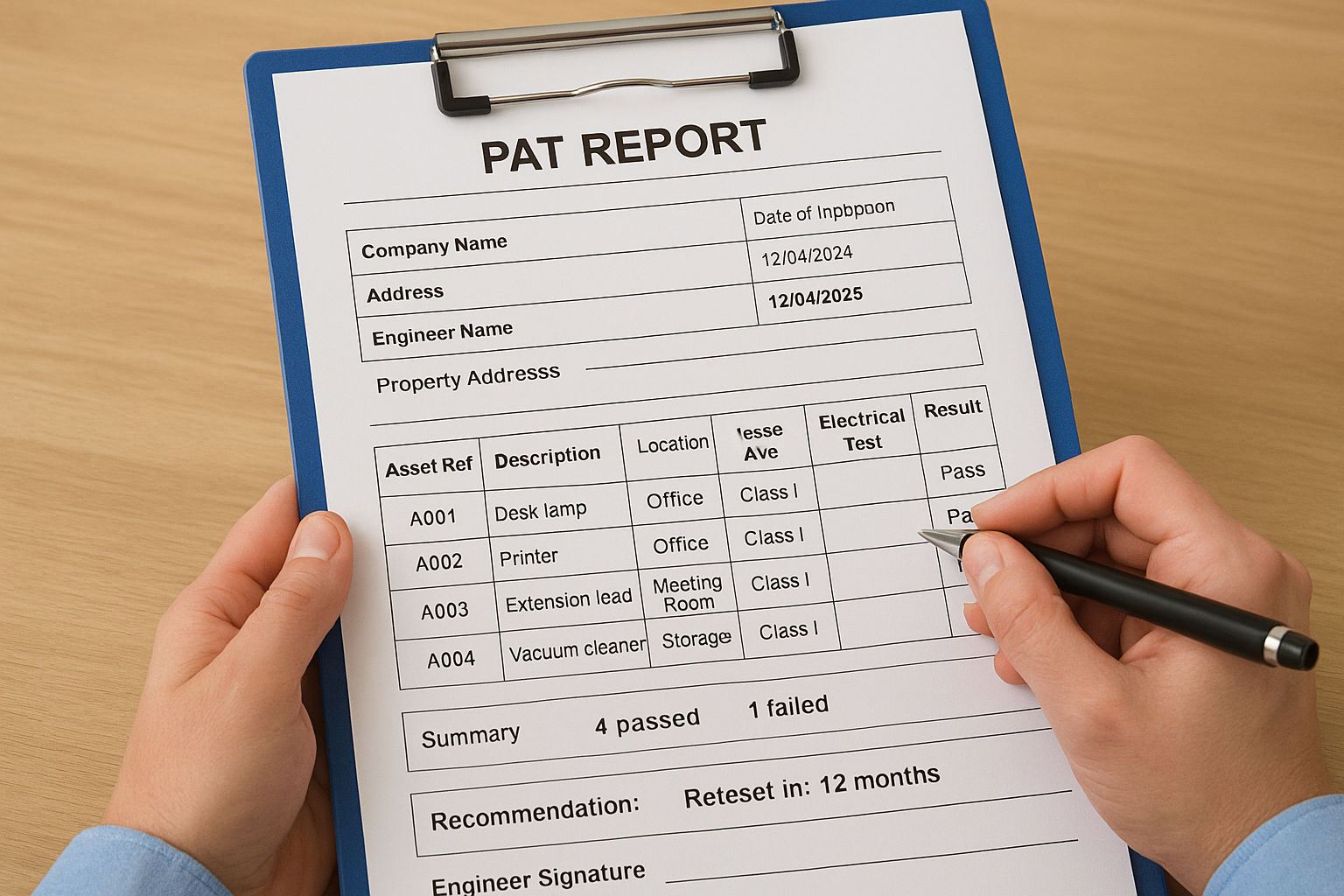
A portable appliance testing report isn't defined by a single legal template, but industry guidance and common sense both point to the same core content. Leave any of these elements out and you've got a document that looks official but won't survive a proper challenge from an insurer or inspector. Below is what should appear on every report you're handed, and it mirrors a PAT testing certificate template, whether it covers three appliances in a home office or three hundred across a warehouse.
Company and engineer identification
Before you even get to the appliance data, the report needs to identify who did the work. That means the testing company's name and address, the engineer's name, and ideally their qualification or membership number with a recognised body. Without this, there's no way to trace the report back to a competent person if a question ever comes up. Reports missing this detail should raise an immediate flag, because it suggests the paperwork was generated as an afterthought rather than as part of a proper inspection process.
Property and date details
Next, check that the report clearly states the property address, the date testing was carried out, and the date the next test is due. Vague date ranges or missing due dates make it impossible for you or an inspector to know whether you're actually still compliant six months down the line. A report dated but with no forward-looking retest date is only half finished.
Individual appliance records
Every appliance tested needs its own line with specific details attached to it, not a general statement that "all appliances passed". At minimum, expect the following against each item:
-
Unique asset reference matching a physical PAT testing label attached to the appliance
-
Description and location of the appliance
-
Class rating (Class I or Class II)
-
Visual inspection result
-
Electrical test results where applicable (earth continuity, insulation resistance, polarity, leakage current)
-
Overall pass or fail status
Grouping every appliance under one blanket result is one of the clearest signs of a rushed job, so don't accept it as good practice.
Fault descriptions and remedial notes
Where an appliance fails, the report should say exactly why, not just mark it as failed and move on. A proper entry names the specific fault, a cracked casing, a failed insulation reading, an incorrect fuse rating, and states what happens next, whether that's repair, replacement, or removal from service. This detail matters because it's what an inspector or insurer will actually read if there's ever an incident linked to that appliance.
A compliant report names every fault specifically; anything vaguer than that isn't worth the paper it's printed on.
Summary and sign-off
Finally, the report needs a summary section stating the total number of appliances tested, the pass and fail counts, and the recommended retest interval for the property or business type. It should carry the engineer's signature or digital equivalent, confirming they take responsibility for the results recorded. Our engineers include all of this as standard on every PAT testing report we issue, because a report that's missing any one of these sections isn't something we'd be comfortable putting our name to, and it isn't something you should accept either.
How often you need a new PAT testing report
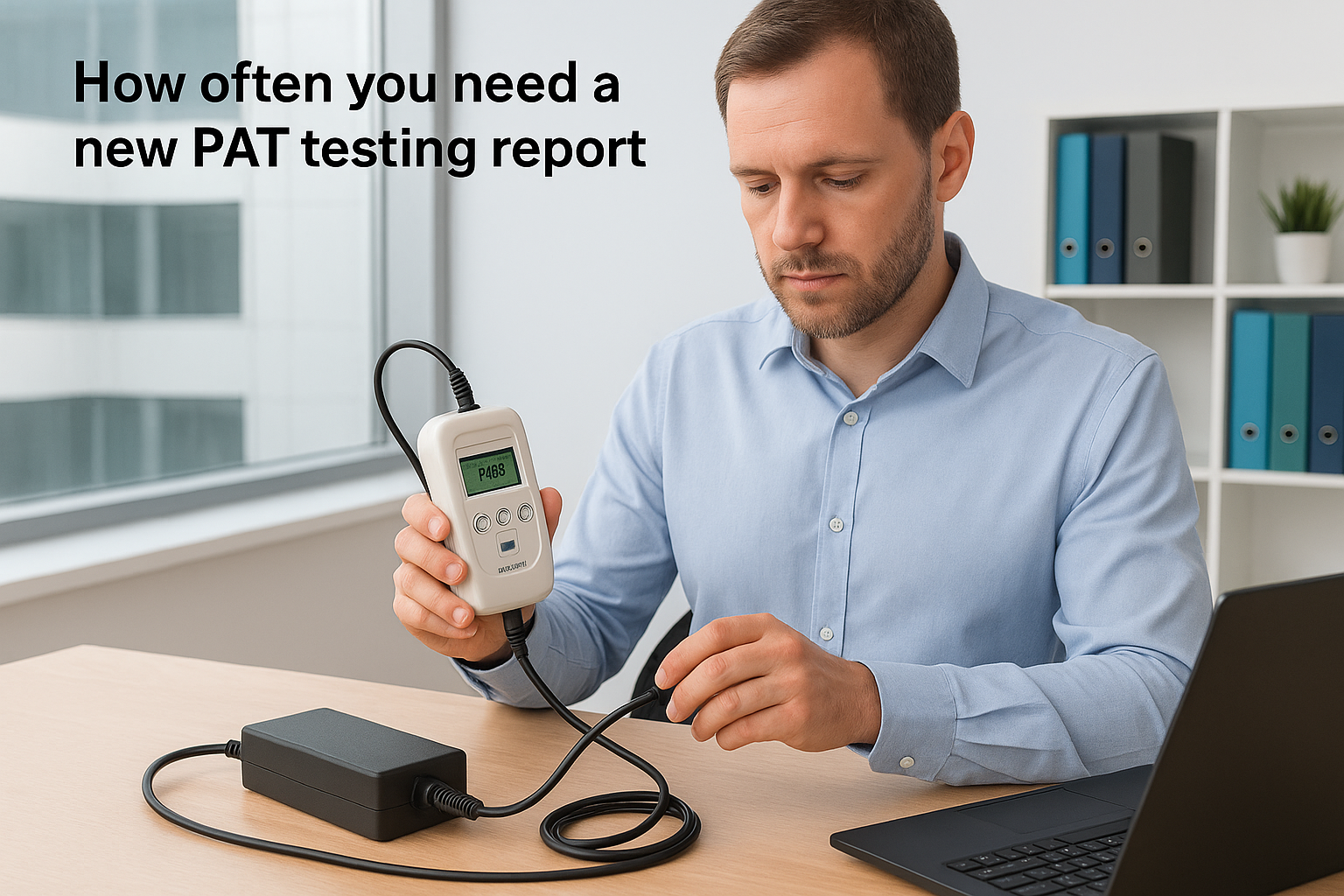
There's no single legal number that applies to every appliance in every setting, and anyone who tells you otherwise is oversimplifying. The retest interval stated on your last report should be based on the type of equipment, how it's used, and the environment it sits in. A laptop charger in a quiet office gets treated very differently to a power tool on a construction site, and your report should reflect that difference rather than applying one blanket rule to everything you own.
What actually determines the interval
Guidance from the IET Code of Practice and the Health and Safety Executive points to risk-based intervals rather than fixed dates. Three factors drive the decision every time: how often the appliance moves or gets plugged in and out, how harsh the environment is (damp, dust, heat, vibration), and how much handling it takes from staff or tenants who might not treat it carefully. An extension lead dragged across a warehouse floor daily needs far more frequent attention than a printer that sits untouched in a corner office.
The right retest interval isn't a fixed number, it's whatever matches how hard that specific appliance actually gets used.
Typical intervals by setting
Most engineers in London and the South East work from a version of the following table when deciding how often PAT testing should be done, adjusting up or down based on what they find during testing. Treat these as sensible starting points, not fixed rules carved into the report.
|
Environment |
Example equipment |
Typical interval |
|---|---|---|
|
Construction sites |
Power tools, extension leads |
3 months |
|
Commercial kitchens |
Kettles, toasters, microwaves |
6 to 12 months |
|
Offices |
Monitors, chargers, printers |
2 to 4 years |
|
Rental properties (furnished) |
Kettles, washing machines, TVs |
1 to 2 years |
|
Schools and public buildings |
Classroom equipment, projectors |
1 year |
|
Retail units |
Tills, display equipment |
1 to 2 years |
Surely you can see why a landlord with a furnished flat and a factory manager with a fleet of drills shouldn't be following the same schedule. Testing too often wastes money on equipment that rarely fails; testing too rarely leaves you exposed exactly when an inspector or insurer asks for proof.
Adjusting the interval after each test
Understand that the interval isn't set once and forgotten, because how long a PAT certificate stays valid depends on what each round of testing shows. If a batch of appliances comes back with a high fail rate, a competent engineer should shorten the next interval rather than leaving it unchanged. Conversely, appliances that consistently pass with no faults over several rounds of testing can sometimes move to a longer interval, provided the environment and usage haven't changed. Your report should state the reasoning here, not just repeat last year's date with twelve months added on.
Keeping track across multiple properties
Verify that every property or site has its own due date logged somewhere you'll actually check, not buried in a filing cabinet. Landlords managing several rental properties and facilities managers overseeing multiple sites both run into the same problem: retest dates slip because nobody owns the calendar. We schedule follow-up visits for our clients automatically once a report goes out, precisely because relying on memory or a spreadsheet nobody opens is how compliance gaps happen. Whatever system you use, the goal is the same: you should always be able to answer, without checking anything, whether your properties are currently within their PAT testing interval or overdue for one.
Who can legally issue a PAT testing report
No law names a specific qualification you must hold before you're allowed to test appliances, and that surprises most people. What the Electricity at Work Regulations 1989 actually require is that testing gets carried out by a "competent person", someone with enough training, knowledge, and practical experience to do the job safely and interpret the results correctly, which is the heart of who can carry out PAT testing. That's a broad definition, and it's exactly why so many low-quality reports end up in circulation. Anyone can buy a PAT tester and start ticking boxes, but that doesn't make the resulting paperwork worth anything.
What competence actually looks like
Building on that point, competence in this context means three things together: understanding how the equipment being tested actually works, knowing how to operate the test instrument correctly, and being able to interpret a borderline reading rather than just accepting whatever number the meter shows. Most professional engineers hold a recognised qualification such as the City & Guilds 2377 course in the requirements for the in-service inspection and testing of electrical equipment, or an equivalent scheme run through a body like the IET. Training alone doesn't guarantee good judgement, but it does mean the person holding the tester actually understands what a failed insulation reading means for that specific appliance, rather than just recording a number they don't know how to act on.
A qualification proves someone was trained; a good report proves they actually applied it.
In-house testing versus hiring a qualified engineer
Smaller businesses sometimes train a member of staff to carry out basic checks in-house, and that's not automatically wrong. Consider the difference in risk exposure, though, before you decide which route suits your property or business.
|
Approach |
Best suited to |
Main risk |
|---|---|---|
|
In-house trained staff member |
Small offices with low-risk equipment |
Limited experience with fault interpretation |
|
Independent qualified engineer |
Landlords, commercial sites, high appliance volumes |
Higher upfront cost, but far stronger evidence trail |
|
Untrained or unqualified tester |
Nowhere, frankly |
Report unlikely to hold up under scrutiny |
Only the middle option gives you a portable appliance testing report that stands up when an insurer or inspector actually asks hard questions about who did the work and what they were qualified to judge.
Why the person's background still matters to you
Someone handing you a stack of stickers with no explanation of their background should prompt questions, not gratitude. Ask what training they've completed, whether they carry professional indemnity insurance, and how long they've been testing appliances in commercial or rental settings specifically. A competent engineer won't hesitate to answer any of that, because it's exactly the information an insurer would want confirmed if a claim ever landed on their desk. Vague answers, or a reluctance to name a qualification at all, tell you everything you need to know before you've even seen the report itself.
Why we put experience front and centre
That's precisely why every engineer we send out across London and the South East has at least ten years of hands-on experience alongside recognised electrical qualifications, not just a tester and a laptop. Our PAT testing reports carry the engineer's name and background as standard, so you're never left guessing whether the person who signed off your appliances actually knew what they were looking at.
Spotting a poor quality or non-compliant report
Most people can't tell a solid portable appliance testing report from a poor one at a glance, and that's exactly why sloppy paperwork keeps circulating unchallenged. You don't need an electrical qualification to spot the warning signs though. A handful of checks, done in a couple of minutes, will tell you whether the document in front of you is worth keeping on file or worth sending back.
Red flags to check first
Before trusting any report, run through these points. If two or more apply, treat the document as unreliable until the issuer can explain the gaps.
-
No unique reference numbers against individual appliances, just a blanket "all items passed" statement
-
Missing engineer details, no name, no qualification, no company address
-
No retest interval stated anywhere on the summary page
-
Failed items with no explanation of the specific fault or what happens next
-
Undated or vaguely dated testing, with no clear next-due date
-
Stickers with no accompanying report, which proves nothing on its own
A report you can't fully explain to an inspector isn't a report, it's a piece of paper hoping nobody asks questions.
Missing information versus fabricated information
Spotting a gap is one problem; spotting a fabrication is a more serious one. Genuine gaps often come from rushed admin, an engineer who forgot to log a serial number, or a summary page left half-finished. Fabricated results are different and far more dangerous: readings that look suspiciously uniform across dozens of appliances, insulation figures that never vary regardless of appliance type, or pass marks against equipment that clearly wasn't even inspected for plug and cable faults. If every single item on a fifty-appliance list shows an identical reading down to the decimal point, that's not thoroughness, it's someone copying a number down the page without testing anything. Question it directly rather than assuming the engineer was just being efficient.
Checking against what you actually own
Take five minutes to walk round your property or office with the report in hand and match physical appliances against the list. Vague reports frequently list items that don't match what's actually on site, an extension lead that was replaced months ago, a kettle that's no longer in the building, or a printer nobody remembers owning. Discrepancies like this suggest the report was copied from a previous visit rather than generated from an actual walk-through, which defeats the entire purpose of paying for the service in the first place.
What to do if you receive a poor report
When a report doesn't hold up against these checks, don't just file it away and hope nobody ever asks to see it. Contact the issuer and ask them to correct the specific gaps, missing references, unexplained fails, absent retest dates, before you accept the document as proof of compliance. If they can't or won't fix it, treat that as your answer about whether to use them again. Reputable engineers welcome the scrutiny because they know their paperwork was solid to begin with; anyone who gets defensive about a straightforward question is telling you something important.
Why this matters more for landlords and businesses
For landlords and commercial clients specifically, a poor report is worse than useless because it creates a false sense of security. You believe you're covered, an insurer or inspector later proves you're not, and the gap between those two positions is exactly where prosecutions and refused claims happen. Building the habit of checking every report properly, rather than trusting the sticker on the kettle, is the single easiest way to avoid that gap ever opening up.
Keeping your electrical safety records in order
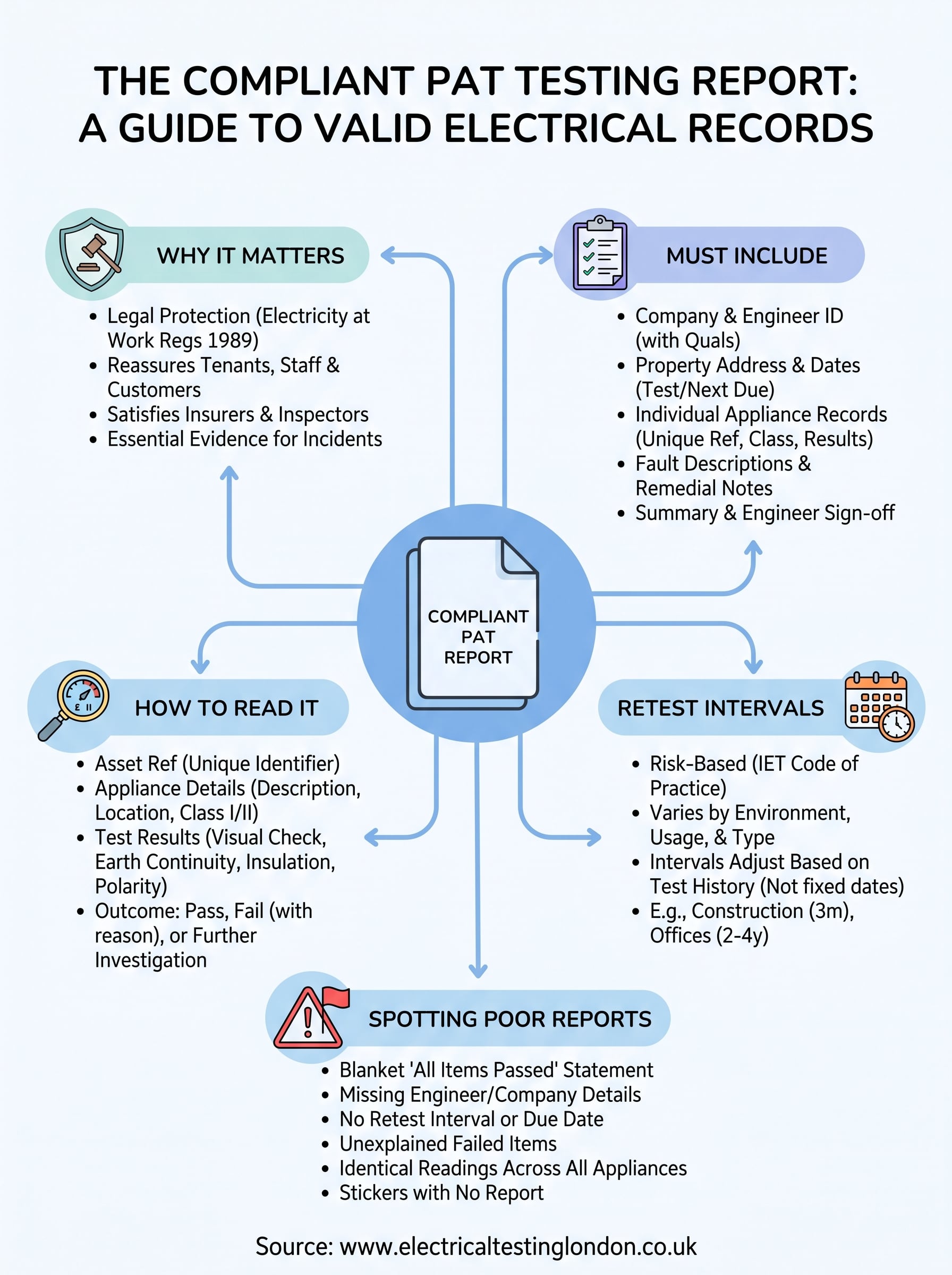
A portable appliance testing report only earns its keep when it's complete, dated, and easy to explain to whoever asks for it. You now know what belongs on a compliant report, how to read the results, and how to spot the gaps that turn paperwork into a liability rather than proof of safety. That knowledge matters whether you're a landlord filing records for one flat or a facilities manager tracking hundreds of appliances across several sites.
Don't wait until an insurer or inspector asks the hard questions to find out your existing reports won't hold up. Get your appliances tested by engineers who put every result, every reference number, and every retest date on paper properly the first time. Request a PAT testing quote and we'll sort out a testing schedule that actually matches how your property or business runs.