


RCBO Consumer Unit Cost in London: Fitted or Supply Only


The RCBO consumer unit cost for a typical three-bed home is £485 to £600 fully fitted, while the board on its own costs roughly £120 to £250 ex VAT. An RCBO consumer unit is a modern fuse box that gives every circuit its own breaker, combining overload protection and earth-leakage (shock) protection in one device. RCBO stands for residual current breaker with overcurrent protection. Flats start nearer £350 to £450, and large houses run from £750 to £1,000.
Those ranges hide a lot of variation. A quote depends on how many circuits you have, what condition your wiring is in, and whether the price includes testing and certification. Comparing a supply-only price with a fitted price is the most common way people misjudge a quote. This article separates the two, works through an example, lists the extras that push the bill up, and explains what a fair quote should contain.
At Electrical Testing London we replace consumer units for homeowners and landlords across London, Greater London and the South East, and we test the wiring that sits behind them. That experience shapes the advice below, so you can compare quotes with confidence and avoid paying for work you do not need.
Why an RCBO board costs more than a dual RCD board
An RCBO board costs more because it fits a separate combined breaker on every circuit, where a dual RCD board shares two earth-leakage devices between all your circuits. Expect to pay about £150 to £300 more for the RCBO version of the same job. For most homes that premium is worth paying.
What an RCBO does differently
Every circuit in your home needs two kinds of protection. An MCB cuts the power when a circuit overloads or short circuits. An RCD cuts the power when current leaks to earth, which is what happens when someone touches a live part. An RCBO combines both in a single device for one circuit.
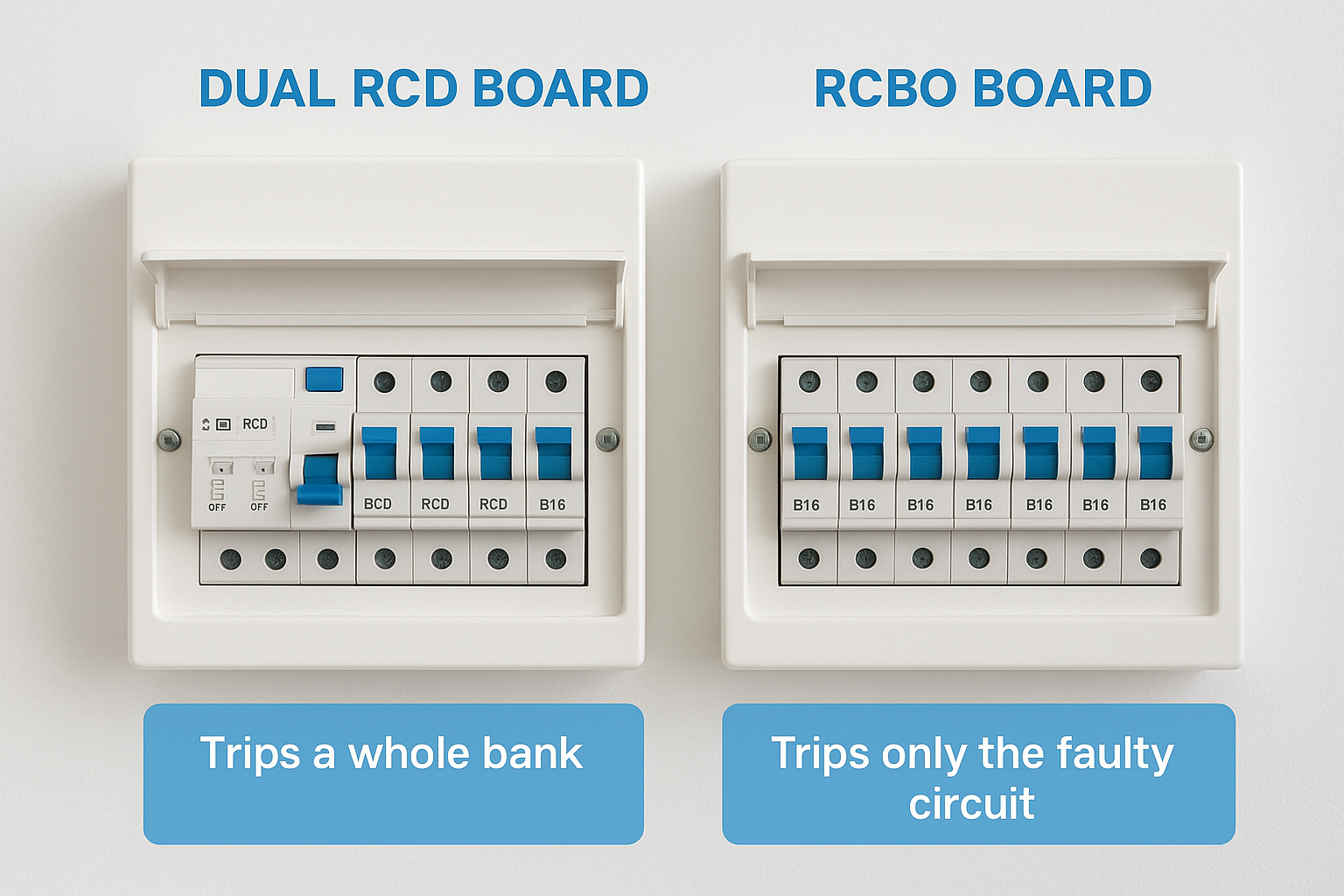
On a dual RCD board, the circuits are split into two banks and each bank shares one RCD. A fault on the garden lights can trip that RCD and cut every circuit in the bank, including sockets and lighting. On an RCBO board, only the faulty circuit goes off.
What the extra money buys
The price gap comes from the devices. A single RCBO costs about £15 to £25, against £5 to £8 for a plain MCB, so a board with eight circuits carries £120 to £200 of RCBOs on their own. Labour is also slightly higher, because there are more devices to connect and test.
In return, you see straight away which circuit failed, and a tripped kitchen circuit no longer switches off the fridge freezer and the router with it.
|
|
Dual RCD board |
RCBO board |
|---|---|---|
|
Protection |
Two RCDs shared by all circuits |
One RCBO per circuit |
|
What a fault does |
Trips a whole bank of circuits |
Trips only the faulty circuit |
|
Typical fitted cost |
£400 to £650 |
£500 to £1,000 |
|
Extra cost |
Baseline |
About £150 to £300 |
When a cheaper board still makes sense
Both board types meet BS 7671, the UK wiring regulations. A dual RCD board is a reasonable choice for a small flat with few circuits, or for a tight rental budget where the saving decides whether the work happens at all.
My view is that you should choose RCBOs unless the budget really cannot stretch. Whichever board you pick, a new domestic consumer unit has had to be metal enclosed since January 2016, so a quote for a plastic board is a warning sign.
Paying about £150 to £300 more for RCBOs means one faulty circuit trips alone instead of taking half the house with it.
How much an RCBO consumer unit costs fitted
A fitted RCBO consumer unit costs about £350 to £450 for a small flat, £485 to £600 for a typical 10-way board in a two or three-bed home, and £750 to £1,000 for a large house. These figures cover the board, labour, testing and certification, and they assume your existing wiring is in good condition.
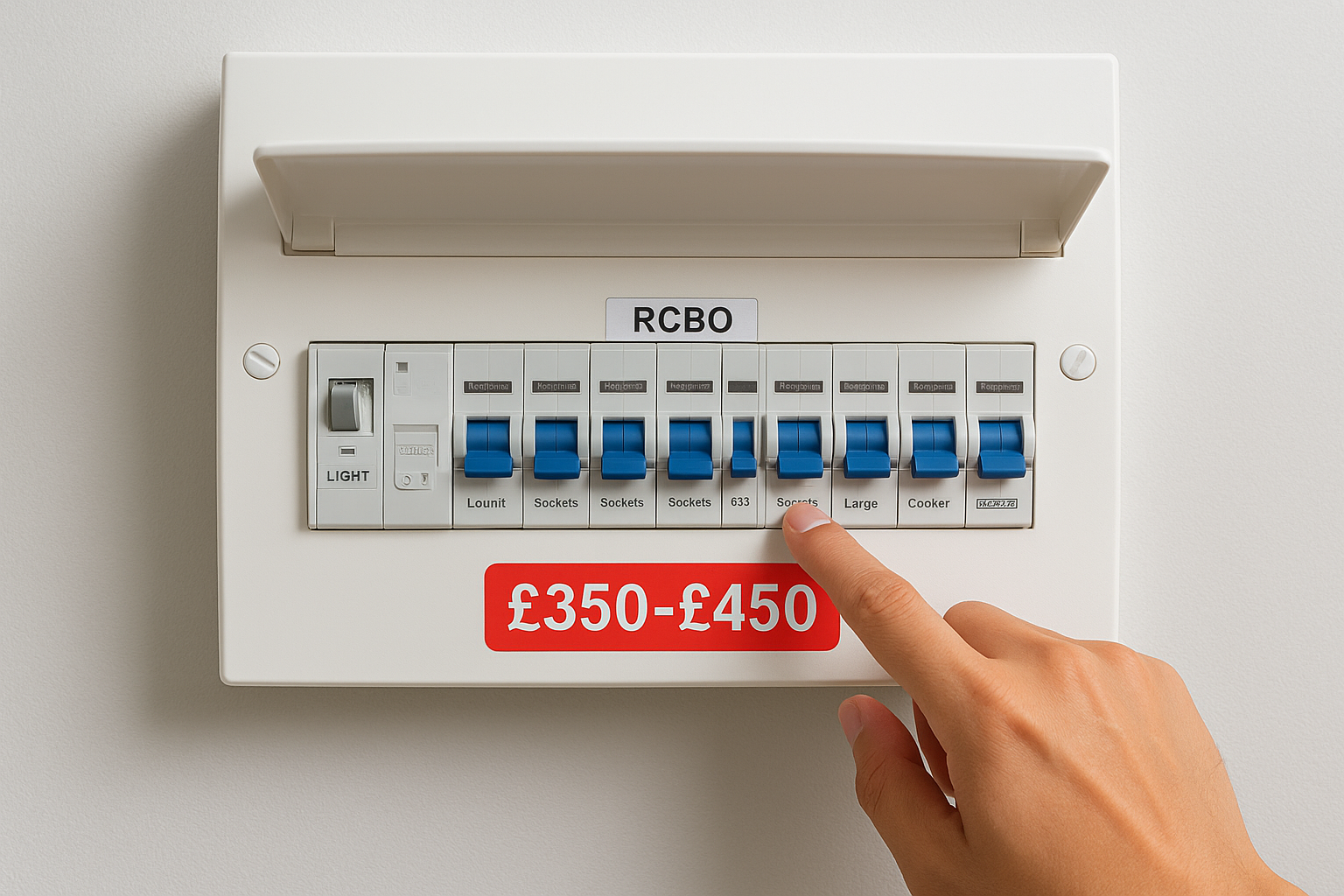
Fitted price by board size
Board size follows the number of circuits, and circuit count follows the size of your property. Each extra way adds an RCBO, a bigger enclosure and more testing time. The ranges below combine published UK cost guides and homeowner reports, so treat them as a budgeting guide, not a quote.
|
Board size |
Typical property |
Typical fitted price |
|---|---|---|
|
4 to 6 ways |
Flat or small terrace |
£350 to £450 |
|
10 ways |
Two to three-bed semi |
£485 to £600 |
|
12 to 14+ ways |
Large detached or extended home |
£750 to £1,000 |
Check whether a figure includes VAT. Many trade price lists quote ex VAT, and homeowners pay 20% VAT on top.
A worked example for a 10-way board
Take a three-bed semi with eight circuits and a 10-way populated RCBO board. A typical supply price is £250 ex VAT. Fitting takes about five hours at around £45 an hour. Here is how the bill adds up.
|
Item |
Cost |
|---|---|
|
10-way populated RCBO unit |
£250 |
|
Labour, 5 hours at £45 |
£225 |
|
Subtotal ex VAT |
£475 |
|
VAT at 20% |
£95 |
|
Total |
£570 |
That sits inside the £485 to £600 range. In London and the South East, labour often runs 20% to 30% above the national average. That moves labour to roughly £270 to £295 and the total to around £625 to £650 including VAT.
Where our price sits
Our Consumer Unit Replacement service is priced at £390 plus VAT, which is £468 including VAT. It is a full replacement of a domestic fuse box with a modern 18th Edition unit, using Wylex or Contactum boards. Ask for RCBOs and check the number of ways before you accept.
A typical 10-way RCBO board costs about £570 fitted including VAT, and London labour can add £50 to £80 to that.
What an RCBO consumer unit costs supply only
Buying an RCBO consumer unit on its own typically costs £120 to £250 ex VAT for a populated board, with compact boards listed from around £55 ex VAT. The price rises with the number of ways, the brand and how many RCBOs come fitted in the box.
Supply-only prices at a glance
Retail and trade listings differ because some boards arrive empty, some part populated and some fully loaded. Always check whether the listed price includes the RCBOs and the meter tails.
|
Item |
Typical price |
|---|---|
|
Compact RCBO board, retail listing |
From about £55 ex VAT |
|
Larger populated RCBO board, retail listing |
About £120 to £150 ex VAT |
|
Fully populated 10-way RCBO board |
About £250 ex VAT |
|
Single RCBO |
£15 to £25 |
|
Single MCB, for comparison |
£5 to £8 |
|
Surge protection device (SPD) |
£80 to £150 |
|
Meter tail cable |
About £4 per metre |
The same populated 10-way board is typically listed at about £120 as an MCB version and about £250 as an RCBO version. That £130 difference is the RCBO premium on materials alone.
Should you buy the unit yourself?
Buying the board yourself rarely saves much. The electrician already buys at trade prices, and any saving is small next to the labour, testing and paperwork that make up most of the bill. Some electricians will not fit customer-supplied boards, or will not warranty them, so ask before you order anything.
There is also the risk of buying the wrong thing. If the board has too few ways for your circuits, or lacks a surge protection provision, you pay twice. And you cannot fit it yourself. Consumer unit replacement is notifiable work under Part P of the Building Regulations in England, so a registered electrician must certify the job.
Buying the unit yourself saves little, and a board that does not suit your circuits costs more than the discount.
What pushes your quote up or down
Your RCBO consumer unit cost rises mainly with circuit count, wiring condition, extras such as surge protection, and any need to move the board. A straightforward like-for-like swap in good-condition wiring sits at the low end of the ranges above. Surprises found during testing sit at the top.
Extras that add to the bill
These are the add-ons that most often appear on a consumer unit invoice. Ask your electrician which ones they expect for your property, and get them written into the quote.
|
Extra |
Typical cost |
|---|---|
|
Earthing or bonding upgrade |
£80 to £300 |
|
Replacement meter tails, fitted |
£100 to £200 |
|
Surge protection device |
£80 to £150 |
|
Additional circuit |
£150 to £300 each |
|
Arc fault detection, per circuit |
Around £65 |
|
Moving the unit |
Around £400 |
|
Moving the unit and incoming mains cable |
£2,000 or more |
Surge protection is the extra I would add at the same visit. Fitting it later means a second call-out, and adding it during the swap is far cheaper. Moving the mains cable is a different matter. It can involve the distribution network operator, which is why that figure jumps.
How London and the South East change the price
Material costs barely change across the country. Labour does. London and South East rates are commonly 20% to 30% higher than the national average, and parking, congestion charges and cramped meter cupboards in flats add time. When you compare a quote with a national figure, compare it with the labour element, not the whole price.
Surveys and inspections before the work
Faulty wiring can stop a new board being fitted, so the electrician needs to know what is behind your old one. Our pre-work survey costs £70 plus VAT. It checks only the items that would prevent installation, and we do not check or test any final circuits.
A full domestic EICR costs from £115 for a studio up to £210 for a six-bedroom home, and includes up to eight circuits. Choose the survey if you simply want to know whether a board can go in. Choose the EICR if the property has never been inspected, if you are a landlord, or if you are buying. A landlord needs one every five years anyway.
Pay for a survey or EICR first if you are unsure about your wiring, because a hidden defect can cost far more than the inspection.
What a fair quote includes and how long it takes
A fair fitted quote includes the new metal board, removal of the old one, testing of every circuit, an Electrical Installation Certificate and Part P compliance. The work usually takes between three and seven hours, with the power off for part of that time.
What the quote should list
Ask for a written quote, and check each of these items is in it before you compare prices.
-
The make of the board, the number of ways and the number of RCBOs
-
Removal and disposal of the old fuse box
-
Full testing of all circuits
-
An Electrical Installation Certificate and building regulations compliance
-
Whether surge protection is included
-
What happens if testing finds defects, and how any remedial work is priced
-
VAT, shown separately
Quotes that leave out testing or certification look cheaper, and then cost you at the point of sale or insurance claim.
Certificates and the rules behind them
Under Part P, an electrician in a competent person scheme such as NICEIC or NAPIT can self-certify the work. If they are not registered, you must notify building control yourself, which typically costs £200 to £400 for an inspection. After the job you should receive an Electrical Installation Certificate, a compliance certificate and a circuit chart, and the electrician should show you how to use the RCD test button.
Keep these documents. A buyer's solicitor or your insurer may ask for them, and missing paperwork can delay a sale.
How long the work takes
Our consumer unit replacements take three to five hours, and other published guides give four to seven hours for a standard job. Your power is off for part of that, commonly two to four hours, so charge devices and plan meals in advance. Large boards, earthing upgrades or remedial work can stretch the job to a full day. Our Consumer Unit Replacement service also carries a one-year parts and labour warranty, which is worth asking any electrician about.
Compare quotes line by line, because the cheapest figure usually leaves out testing, certification or surge protection.
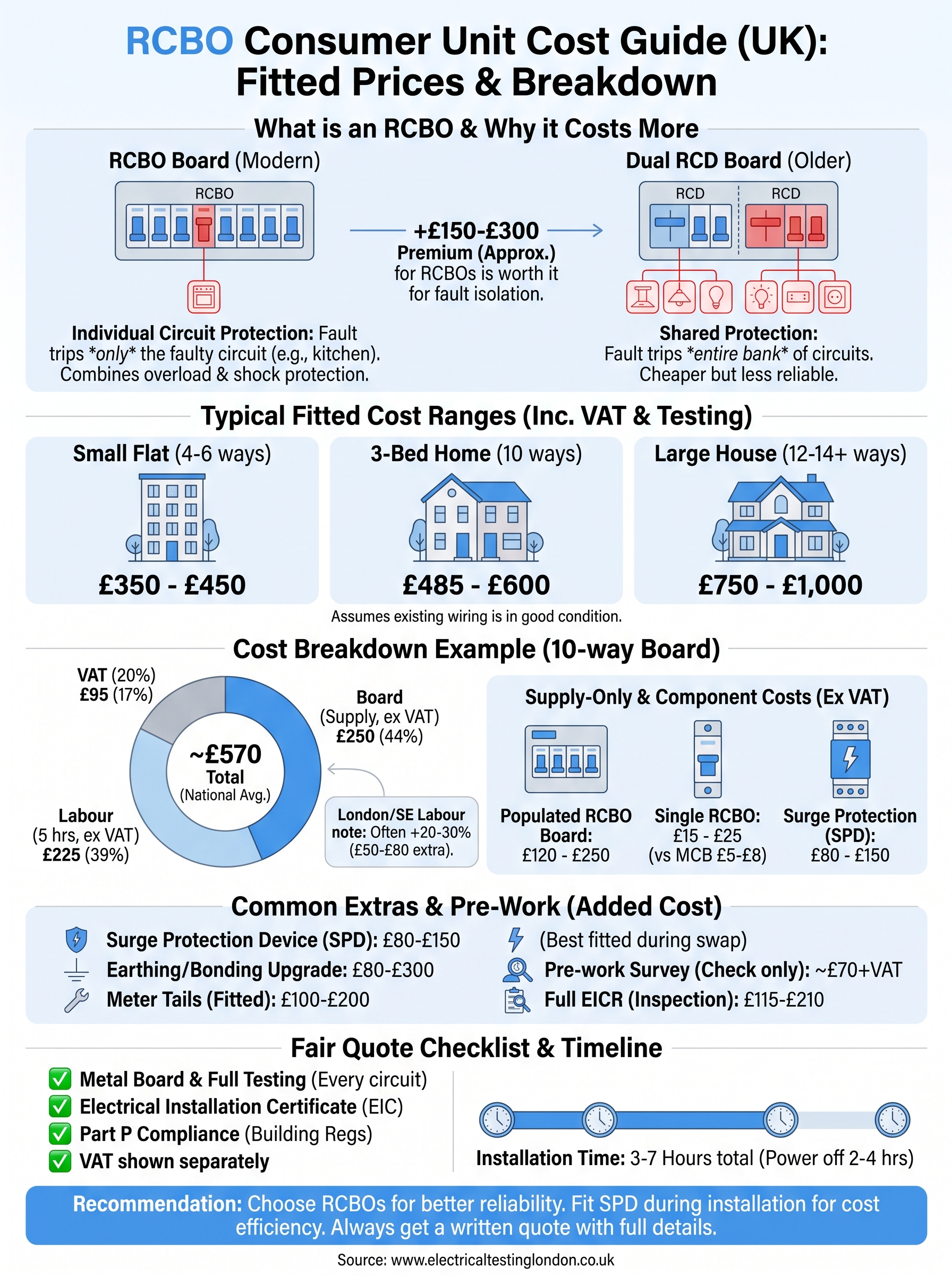
Getting a price for your own board
The fitted RCBO consumer unit cost for most homes is £485 to £600, with flats at the low end and large houses nearer £1,000. The unit alone is £120 to £250 ex VAT, and the rest is labour, testing and certification. Pick RCBOs over a dual RCD board unless budget forces the choice, and ask for surge protection in the same visit.
Before you accept a quote, check the number of ways, what is included, whether VAT is shown, and which certificates you will receive. If you are unsure about your wiring, start with a survey or EICR. When you are ready for a price on your own property, request a quote for your consumer unit.

