






RCBO vs RCD Consumer Unit: Differences and Which to Choose



An RCBO vs RCD consumer unit comparison comes down to one question: how many circuits lose power when a fault occurs? A dual RCD (split-load) board shares two RCDs across all your circuits, so one fault can switch off half the house. An RCBO board gives every circuit its own protection, so only the faulty circuit trips. Both are safe and compliant when properly designed, but for most homes the RCBO board is the better choice.
Some terms first. An RCD (residual current device) cuts the power within milliseconds when it detects current leaking to earth, for example through a person. An MCB (miniature circuit breaker) protects a circuit against overloads and short circuits. An RCBO combines both functions in one device for a single circuit.
This guide explains why the choice matters, how each board protects your circuits, the real pros and cons, and how to decide when you replace a fuse box. Electrical Testing London inspects and replaces consumer units for homeowners and landlords across London and the South East, so the advice reflects the boards we see and fit.
Why the choice matters when you replace a fuse box
The choice decides how much of your home goes dark when something fails, and how quickly anyone can find the fault. Protection against electric shock is similar in both designs. The difference is disruption, diagnosis and day-to-day reliability.
What one fault does to your home
On a dual RCD board, your circuits are split into two groups, each behind one RCD. A fault on a kitchen socket circuit trips that RCD, and every circuit in the same group goes off with it. That can mean the freezer, the router and the lights at once. If you are away, you may come back to spoiled food and a dead alarm panel.
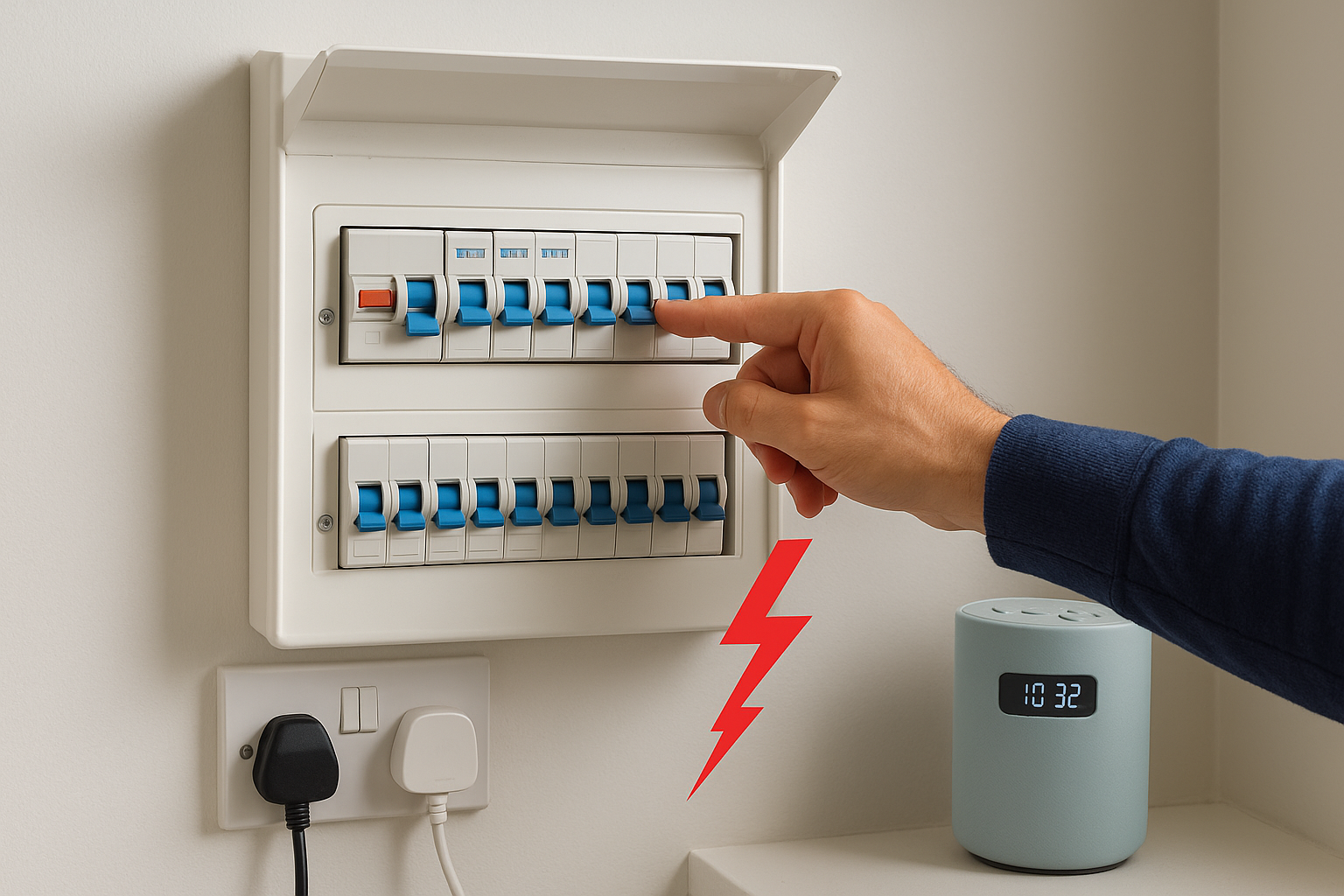
Shared RCDs also suffer from cumulative leakage. Every appliance leaks a tiny current to earth, and on a shared RCD those currents add up. The RCD can then trip with no real fault present. An RCBO sees only its own circuit, so this problem is far less likely.
The main difference between the two boards is not shock protection, it is how many circuits you lose when one fails.
What the regulations expect
BS 7671, the UK wiring regulations, expects 30 mA RCD protection on socket outlets and, in practice, on almost all domestic final circuits. It also expects an installation to be divided into circuits so that a single fault causes the least inconvenience. A dual RCD board meets this when the circuits are split sensibly. RCBOs go further, because each circuit is isolated from the rest.
Replacing a consumer unit in a home in England is also notifiable work under the Building Regulations. Use a registered installer who tests the installation and issues an Electrical Installation Certificate. Both board types can be fitted in a non-combustible enclosure with surge protection where required, so neither is a shortcut on safety.
How RCBO and dual RCD boards protect your circuits
A dual RCD board shares earth-fault protection between groups of circuits, while an RCBO board gives each circuit its own device. Overload and short-circuit protection exists in both. MCBs supply it in the first design, and it is built into each RCBO in the second.
Inside a dual RCD (split-load) board
A dual RCD consumer unit has a main switch, two RCDs and a row of MCBs. Each MCB protects one circuit against overload and short circuit. Each RCD protects the MCBs wired behind it against earth faults. You may also see an RCD called an RCCB. That is simply an RCD with no overcurrent protection of its own, and it is the type used in these boards.
Older split-load boards often left lighting circuits on a side with no RCD at all. That arrangement no longer reflects current practice, and it is one reason many homeowners replace an older fuse box.
Inside an RCBO board
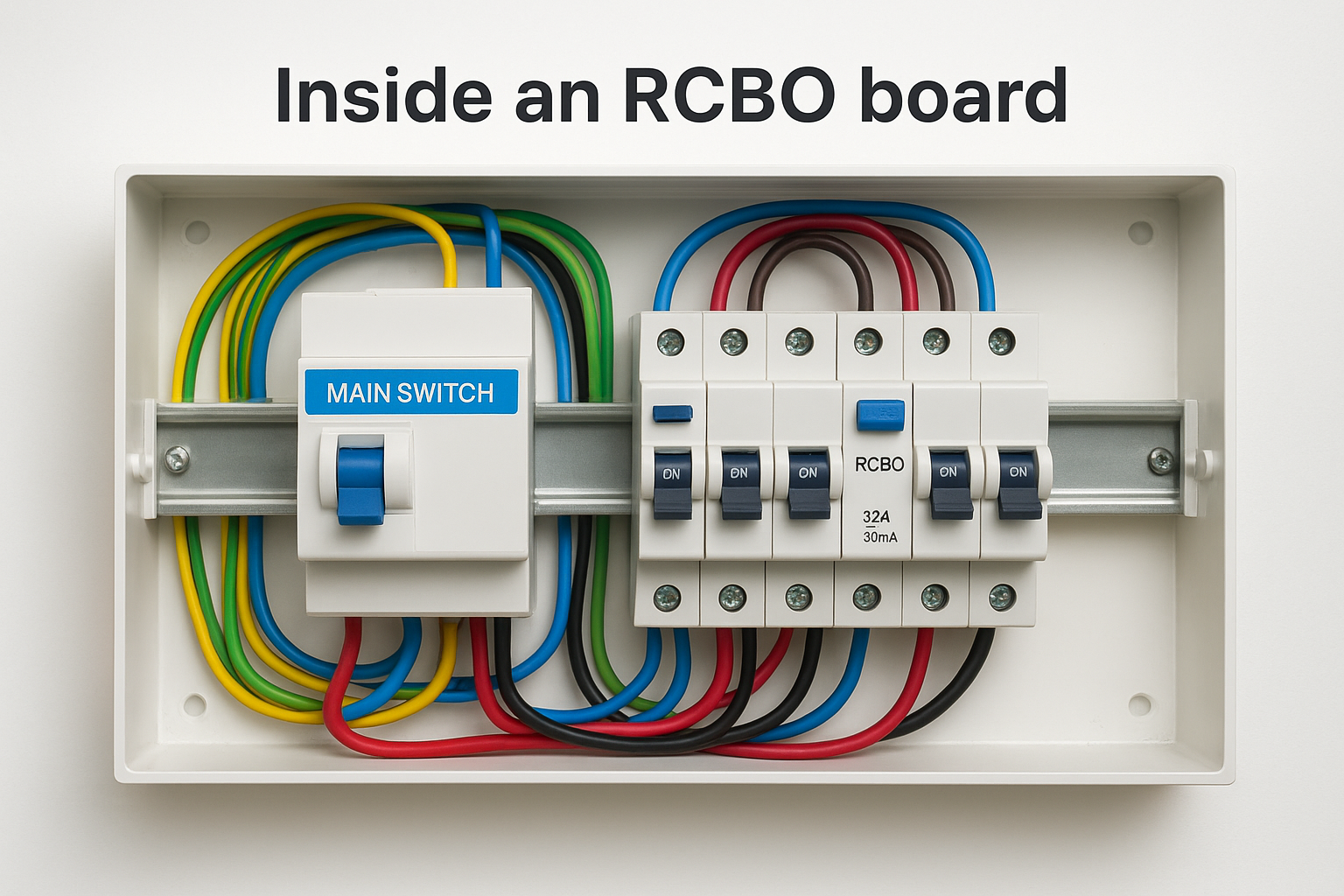
An RCBO board has a main switch and one RCBO for each circuit. Each RCBO compares the current leaving on the live conductor with the current returning on the neutral. If the two differ by more than 30 mA, it trips, exactly as an RCD does. It also trips on an overload or a short circuit. There is no shared RCD, so no circuit depends on another.
|
Feature |
Dual RCD (split-load) board |
RCBO board |
|---|---|---|
|
Earth-fault protection |
Two RCDs, each shared by a group of circuits |
One per circuit |
|
Overload and short-circuit protection |
One MCB per circuit |
Built into each RCBO |
|
Circuits lost when one faults |
Every circuit on that RCD |
Only the faulty circuit |
|
Finding the fault |
Switch circuits off one by one |
The tripped device names the circuit |
|
Nuisance tripping from leakage |
More likely, leakage adds up |
Less likely, leakage stays separate |
|
Cost of protective devices |
Lower |
Higher |
|
Typical home |
Small flat, tight budget |
Most family homes and rentals |
An RCBO board is a dual RCD board with the sharing taken out.
RCBO vs RCD consumer unit: pros and cons
RCBOs win on fault isolation, fault-finding and reliability, while a dual RCD board wins on upfront cost. Neither one is unsafe, so the decision is about convenience and budget.
Where RCBOs come out ahead
The benefits show up on the day something goes wrong.
-
Only the faulty circuit trips. The lights, freezer and broadband stay on.
-
The tripped device points to the problem. On a split-load board, an electrician often switches circuits off one at a time to find an earth fault. With RCBOs, the device that tripped is the answer.
-
Less nuisance tripping. One leaky appliance cannot combine with the rest of the house to trip a shared RCD.
-
Space. Modern single-module RCBOs are as wide as an MCB, and replacing two RCDs with RCBOs can free room on the rail.
Landlords gain most. A tripped shared RCD leaves tenants without lights, and the call-out comes to you. With RCBOs, a fault in one appliance circuit does not leave a tenant in the dark.
If a tripping fault would leave you in the dark or defrosting a freezer, pay for RCBOs.
Where a dual RCD board still makes sense
The main argument for a dual RCD board is price. A standard single-pole type A RCBO costs from about £10 excluding VAT at trade prices, with compact and double-pole versions costing more. In a home with seven circuits, that is roughly £70 to £140 of RCBOs, before VAT. A dual RCD board replaces that with two RCDs and seven cheaper MCBs, so the saving is real but modest. It is usually small compared with the labour, testing and certification in the whole job.
The drawbacks of RCBOs are few. Each device must be one that the board manufacturer approves, so you cannot freely mix brands, and a failed unit costs more to replace. A dual RCD board suits a small flat with few circuits, no sensitive loads and a landlord who accepts the occasional trip. An existing dual RCD board is not unsafe in itself, and it does not by itself make an installation unsatisfactory on an EICR.
How to choose and what to do when replacing
Choose an RCBO board unless the budget is very tight or the property is small and simple. Then work through a few checks before you sign the quote.
A simple way to decide
Go through these points with your electrician.
-
Count your circuits. The more circuits, the more a shared RCD hurts when it trips.
-
List loads that must stay on. Freezers, alarms, broadband, a home office and any medical equipment all justify RCBOs.
-
Think about who lives there. A rented property or a home left empty for long periods benefits most from isolated circuits.
-
Plan for special loads. An EV charger, heat pump or hot tub may need its own protective device, and sometimes a different RCD type. Follow the equipment manufacturer's instructions.
-
Get the arrangement in writing. Ask the quote to state whether it is a dual RCD or RCBO board, the manufacturer, and what is included.
What replacement involves and costs
Our Consumer Unit Replacement is priced at £390 plus VAT, which is £468 including VAT at 20%. It is a full replacement with a modern 18th Edition Amendment 2 unit, from Wylex or Contactum. It takes 3 to 5 hours, ends with an Electrical Installation Certificate, and carries a one-year parts and labour warranty. Confirm the circuit protection type on your quote and ask for any difference in cost to be shown.
If you are unsure whether your existing wiring can take a new board, our Pre-work survey costs £70 plus VAT. It checks only the items that would prevent installation, and it does not test final circuits. A Domestic EICR, from £115 for a studio to £210 for six bedrooms, gives the full picture of the installation.
After the new board is fitted
Press the test button on every RCD or RCBO about every three months. Each one should trip and then reset. If a device does not trip, call an electrician. Keep your Electrical Installation Certificate with your property papers, because a buyer, insurer or letting agent may ask for it. Landlords should also remember that a domestic EICR is valid for 5 years or until a change of tenancy.
Making the call on your new board
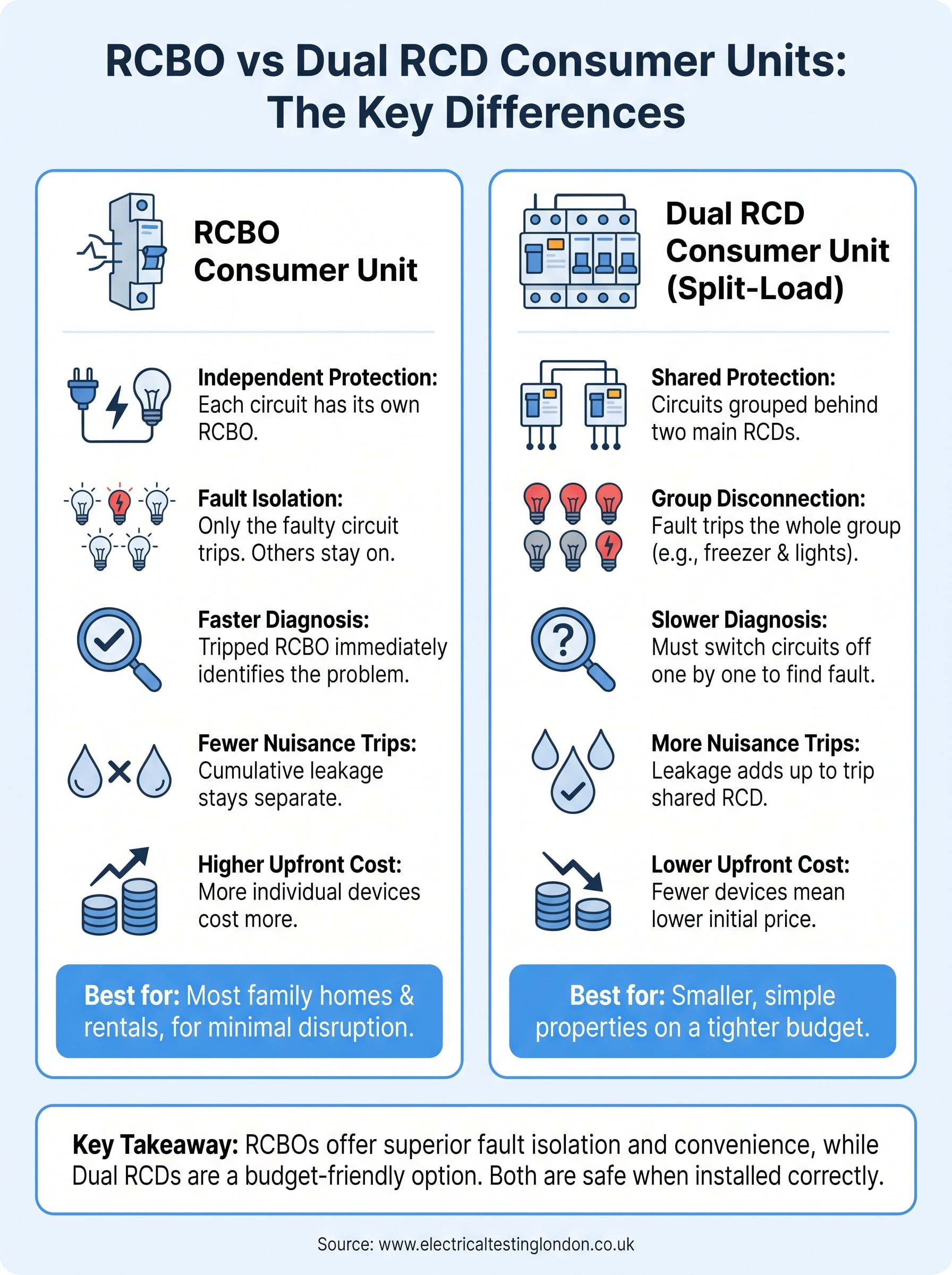
A dual RCD consumer unit protects your home safely and costs less, but one fault can disconnect half of it. An RCBO consumer unit costs a little more and isolates each circuit, which means fewer outages, faster fault-finding and less nuisance tripping. For most homes and almost every rental, we recommend RCBOs.
If you are replacing a fuse box in London or the South East, ask for the board type, the manufacturer and the certification to be written on the quote. When you are ready, you can request a quote for a consumer unit replacement.