






Rental Electrical Safety Check Cost: What to Expect



If you're a landlord searching for a rental electrical safety check cost, you've probably already found a dozen different numbers online and none of them quite agree. That's because pricing depends on property size, location, and how much rewiring or remedial work turns up once an engineer opens the consumer unit. Without a clear benchmark, it's hard to know whether a quote is fair or whether you're being overcharged before you've even signed off the job.
This article gives you straight answers. We break down average EICR prices across studio flats, one-bed properties, and larger HMOs, and show how costs shift depending on whether you're in central London or further out into the South East. You'll also see what pushes the price up, such as outdated consumer units or properties that haven't been tested in years.
By the end, you'll know what a reasonable quote looks like for your property type, what's included in a standard EICR, and how to budget for any remedial work a report might flag. We've priced hundreds of these checks for landlords across London, so the figures here reflect what you'll actually be quoted, not a national average that doesn't apply to your postcode.
Why rental electrical safety checks matter
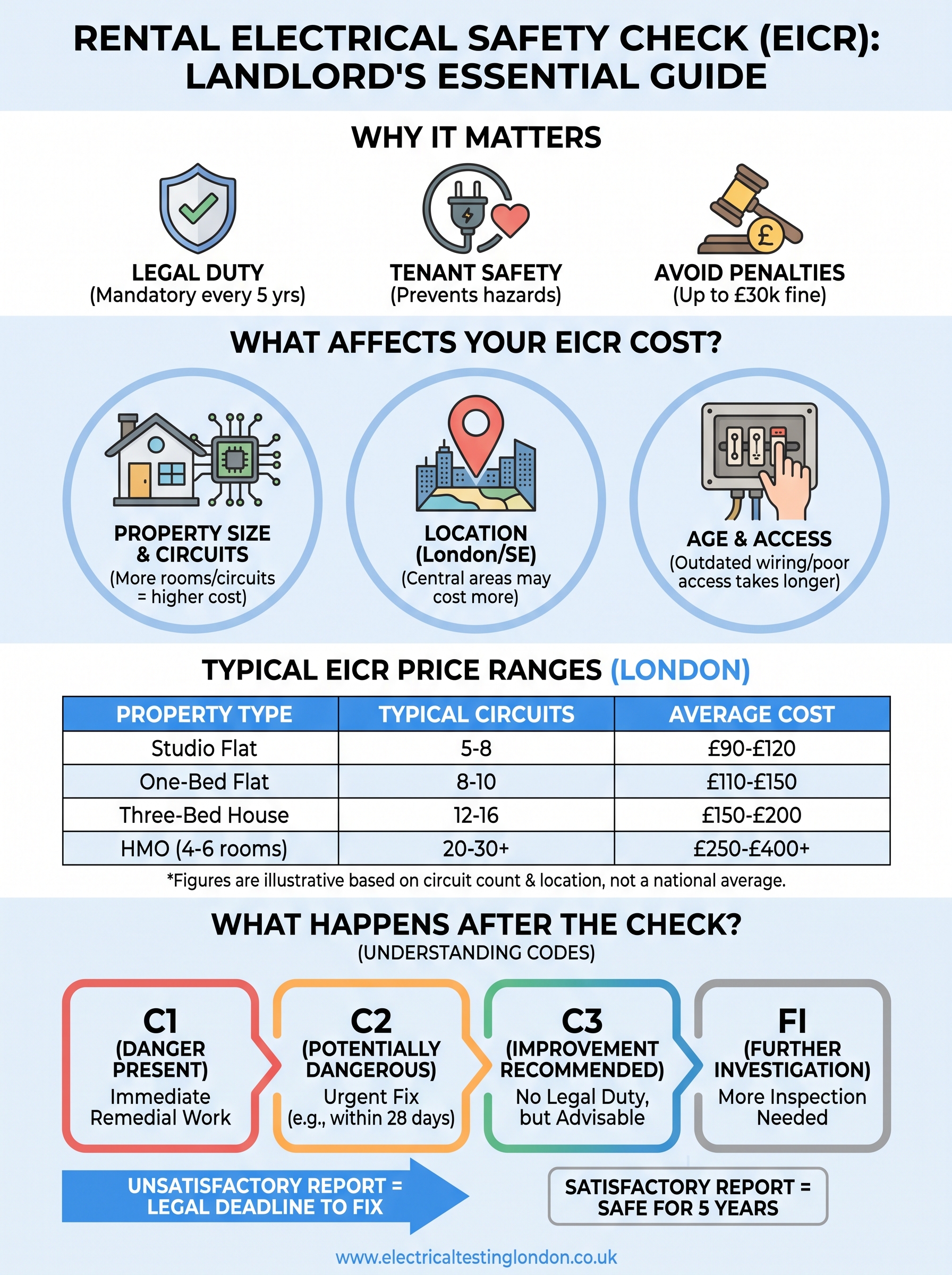
Landlords in England have a legal duty to get their properties checked, not just a good idea to consider when there's spare budget. Since 2020, the EICR regulations for landlords in England have required every private landlord to hold a valid Electrical Installation Condition Report before letting a property, and to renew it at least every five years. Skipping this isn't a grey area. Local authorities can and do enforce it, and tenants can report a landlord who hasn't complied.
The legal requirement behind the checks
Government guidance sets out exactly what's expected: a qualified electrician must inspect the fixed wiring, consumer unit, sockets, and earthing arrangements, then issue a report classifying any faults found. You can read the full regulations on gov.uk, but the practical takeaway is simple: no valid EICR means you're not legally allowed to let the property.
A landlord without a valid EICR isn't just risking a fine, they're letting a property they're not legally allowed to rent out.
Penalties for skipping the check
Local councils have real teeth here, and the consequences escalate quickly if you ignore a request to produce a report:
-
Civil penalty: up to £30,000 per breach, issued directly by the local authority
-
Remedial notice: councils can force you to carry out work within 28 days
-
Invalid insurance: many landlord insurance policies exclude claims if there's no current EICR on file
-
Tenant disputes: tenants can withhold rent or take action if safety documentation is missing
These aren't hypothetical risks. Councils across London have become noticeably more active in checking compliance since the regulations came in, partly because tenants now know they can request a copy of the report within 28 days of asking.
Protecting tenants and your investment
Safety, not just paperwork, is the actual point of a landlord electrical safety certificate in London. Faulty wiring causes house fires, and rental properties with older installations are disproportionately represented in electrical fire statistics. Getting a check done means a qualified engineer catches degraded insulation, overloaded circuits, or a consumer unit that's past its working life before it becomes a hazard rather than after.
Thinking about the rental electrical safety check cost as pure overhead misses half the picture. Consider it protection for your tenants and for the asset itself. A property with a clean, current EICR is also easier to sell or remortgage, since buyers and lenders increasingly expect to see one as standard due diligence. Landlords who treat these checks as a routine five-year cost, rather than something to put off, tend to spend less overall because small faults get fixed before they turn into expensive rewiring jobs.
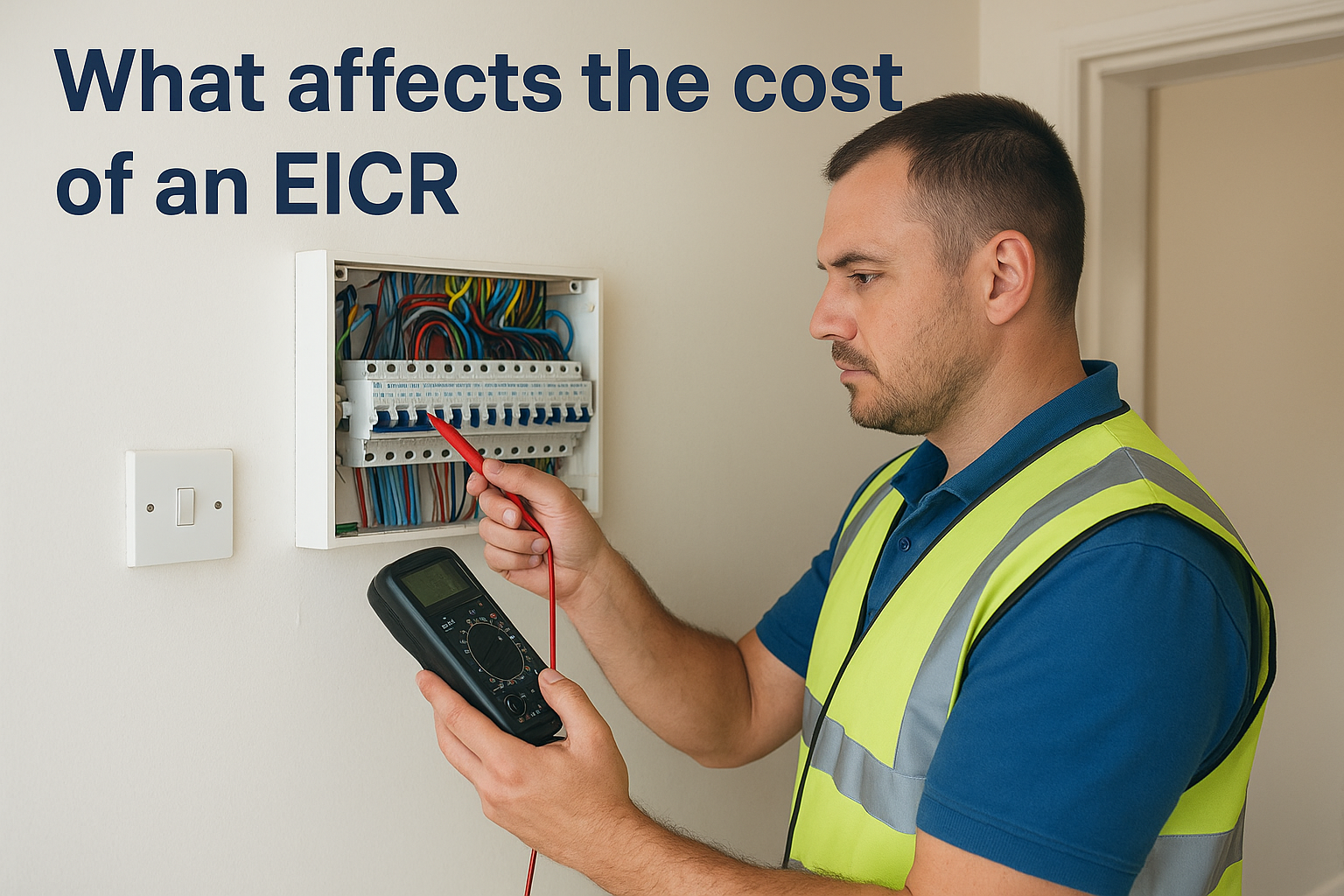
What affects the cost of an EICR
Several factors decide what you'll pay for an EICR price, and none of them are arbitrary. Engineers price based on how many circuits they need to test, how accessible the wiring is, and how far they have to travel to reach you. Understanding these variables means you can spot a fair quote versus one that's padded or, worse, one that's suspiciously cheap because corners are being cut.
Property size and circuit count
Bigger properties simply have more to test. A studio flat might have six or seven circuits; a converted HMO with five bedrooms could have thirty or more, each needing individual inspection and dead testing. That's why a rental electrical safety check cost scales so directly with bedroom count and floor area, as our breakdown of EICR costs in London by property size and circuits shows.
|
Property type |
Typical circuits |
Average EICR cost |
|---|---|---|
|
Studio flat |
5-8 |
£90-£120 |
|
One-bed flat |
8-10 |
£110-£150 |
|
Three-bed house |
12-16 |
£150-£200 |
|
HMO (4-6 rooms) |
20-30+ |
£250-£400+ |
The single biggest driver of your quote isn't your postcode, it's the number of circuits an engineer has to test.
Location within London and the South East
Geography still moves the needle, though less than most landlords expect. Central London jobs tend to sit at the top of each price band because of parking costs, congestion charges, and higher demand for engineer time. Properties further out into Kent, Surrey, or Essex often land at the lower end, simply because travel and overheads are cheaper for the firm carrying out the work.
Age, access, and prior condition
Older installations with outdated fuse boards or hard-to-access wiring under floors take longer to test properly, which pushes the price up, and it's one of the main factors behind landlord electrical inspection prices. If a property hasn't been inspected in years, expect the engineer to spend extra time tracing circuits that weren't documented clearly last time round, another reason a full EICR inspection from an experienced team pays off in accuracy.
How to arrange a rental electrical safety check
Knowing how to arrange a landlord electrical safety check in London doesn't need to be complicated, but timing and preparation matter more than most landlords realise. Book too close to a tenancy start date and you risk delaying move-in if the engineer flags something serious. Book with a reputable firm and you get a clear quote upfront, based on property type and circuit count, rather than a vague estimate that changes once someone's on site.
Booking with a qualified engineer
Always confirm the electrician holds current NICEIC or NAPIT accreditation before booking, since an EICR from an unregistered tester carries no legal weight if challenged. You can request a free quote based on your property's size and location, and a properly run company will ask about bedroom count, property age, and whether it's tenanted before giving you a figure.
An EICR is only as good as the engineer who signs it, so check accreditation before you check price.
What to expect on the day
Preparing the property properly saves time and keeps costs down, since engineers charge more when they're chasing access to circuits. Before the visit, make sure the following are ready:
-
Clear access to the consumer unit, ideally with nothing stored in front of it
-
Tenants informed of the appointment time, especially if they need to be present
-
Any previous EICR or electrical paperwork available for comparison
-
Sockets and switches unobstructed by furniture where possible
Timing your booking around tenancies
Scheduling around tenant occupancy avoids awkward disruption, particularly in HMOs where several rooms need testing on the same visit. Most engineers can complete a domestic EICR in London within two to four hours depending on property size, and you'll usually get the written report within a few working days, giving you time to act before the five-year renewal deadline creeps up again.
What happens if the report flags issues
Every EICR ends with a classification, and understanding these codes matters more than most landlords expect when a report lands in their inbox. Engineers grade each observation using a standard scale, and only some of them mean you need to act immediately, which is why what the EICR codes actually mean is worth reading before you panic.

|
Code |
Meaning |
Action required |
|---|---|---|
|
C1 |
Danger present |
Immediate remedial work |
|
C2 |
Potentially dangerous |
Remedial work required, usually within 28 days |
|
C3 |
Improvement recommended |
No legal obligation, but worth fixing |
|
FI |
Further investigation needed |
Additional inspection before certification |
Getting a satisfactory result means no C1 or C2 codes were found, and you can carry on renting as normal until the five-year renewal. An unsatisfactory report, by contrast, means at least one C1 or C2 issue exists, and under the Electrical Safety Standards regulations you're legally required to fix it, typically within 28 days or sooner if it's marked C1, so it's worth knowing what happens if an EICR fails.
An unsatisfactory EICR isn't the end of the process, it's the start of a legal deadline you can't ignore.
Hiring the same firm that carried out the inspection for the follow-up EICR remedial works often saves time, since they already know the property's layout and wiring history. Our team handles this directly through remedial electrical work, and because we did the original inspection, there's no second site visit charged just to diagnose what we've already documented.
Once the remedial work is complete, the engineer issues a minor works certificate or an updated EICR confirming the fault's been resolved. Sending this to your local authority if they've already flagged the property closes the loop, and keeps your paperwork ready for the next tenant, mortgage lender, or insurance renewal that asks for proof.
Keeping your rental property safe and compliant
Budgeting for a rental electrical safety check cost gets far easier once you know the numbers behind it. Circuit count, property size, and location set the baseline price, while age and access decide whether you land at the top or bottom of that range. Compliance isn't optional, but it doesn't have to be a scramble either if you book ahead of your five-year deadline and use an accredited engineer from the start.
Getting this right protects tenants, protects your investment, and keeps you clear of the penalties that come with an expired or missing EICR. Skip the guesswork and get a figure based on your actual property rather than a national average that doesn't reflect your postcode. If you're ready to see what your property would cost to test, get a quote for your EICR and we'll give you a straight answer before you commit to anything.