


Rental Property Electrical Requirements: The UK Rules Explained


If you rent out a property in England, the law is specific about what you must check, when, and how you prove it. Get it wrong and you're not just risking a fine, you're risking your tenants' safety and your ability to serve a valid Section 21 notice. Understanding rental property electrical requirements uk landlords face isn't optional reading, it's a core part of running a compliant tenancy.
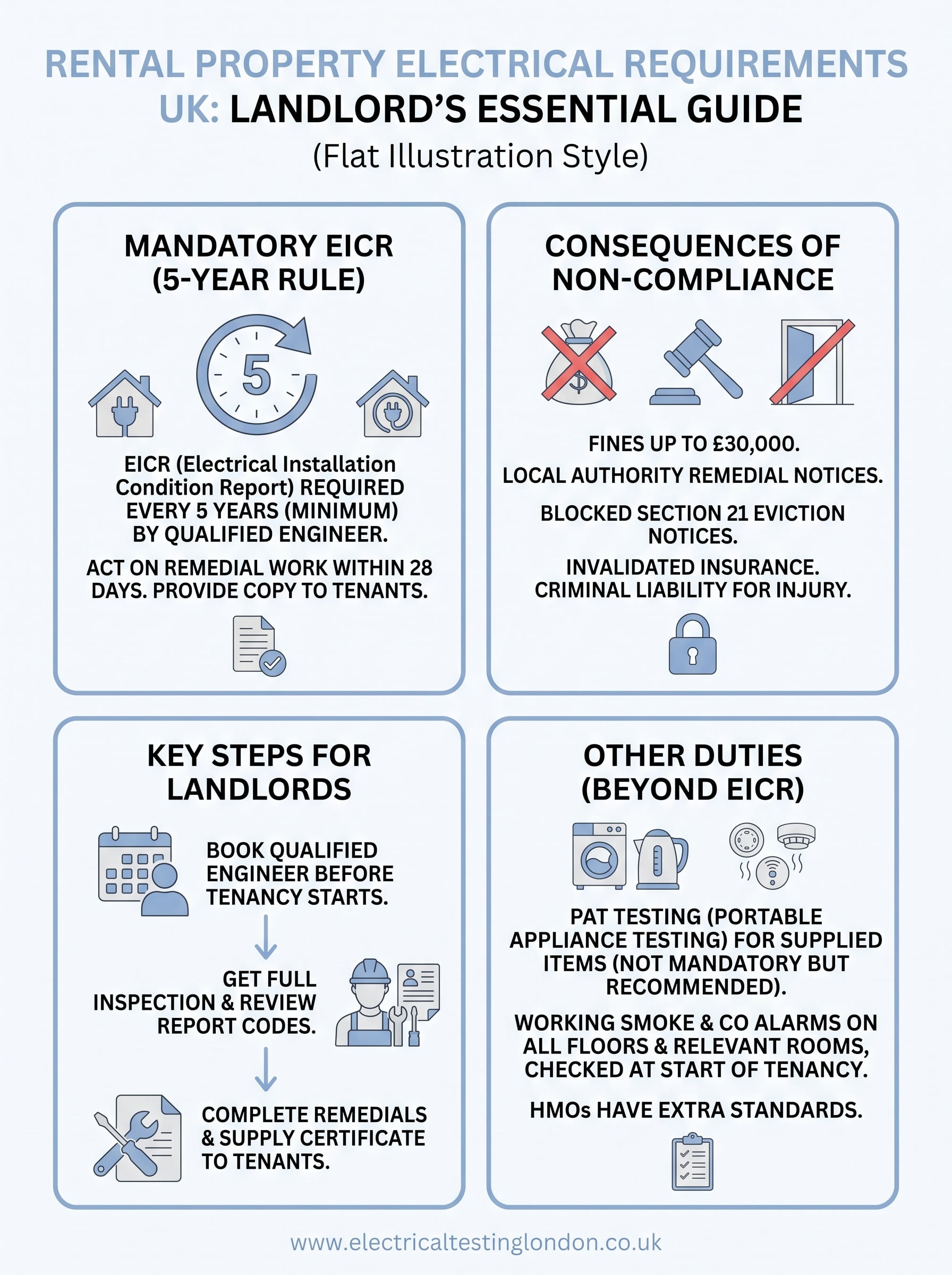
The short answer: every landlord must have a valid EICR (Electrical Installation Condition Report) carried out at least every five years, provide a copy to tenants and incoming tenants, and act on any remedial work flagged within 28 days or sooner if urgent. There are also separate expectations around PAT testing for rental properties where you supply appliances, smoke and carbon monoxide alarms, and record-keeping that local councils can demand at short notice.
This article breaks down exactly what the regulations require, who's responsible for what, the deadlines you need to hit, and what happens if you don't comply. We'll cover the current legislation in plain terms, so you know precisely where you stand as a landlord in London or anywhere else in England.
Why electrical safety compliance matters for landlords
Electrical safety isn't a box-ticking exercise landlords do to keep councils happy. It's the legal backbone of a safe tenancy, and it exists because faulty wiring, old consumer units, and unsafe appliances genuinely kill people. Fire and Rescue Services attend thousands of electrical fires in homes every year, and rented properties, particularly older housing stock, carry a disproportionate share of that risk. When you understand electrical safety standards for landlords, you're not just avoiding paperwork trouble, you're protecting people who trust you with their home.
The legal foundation you're working within
The Electrical Safety Standards in the Private Rented Sector (England) Regulations 2020 put a legal duty on every private landlord in England to have the electrical installations in their property inspected and tested by a qualified person at least every five years. This isn't guidance or best practice, it's statute. Local housing authorities can demand evidence of compliance within seven days of a request, and they have real enforcement powers if you can't produce it. Scotland and Wales run their own parallel frameworks, so if you let property outside England, check the specific rules that apply there.
A five-yearly EICR isn't red tape, it's the legal proof that your property won't electrocute or burn down around your tenants.
What's actually at stake
Beyond the legal duty, there's a practical reason this matters: rented properties age faster than owner-occupied ones. Tenants don't always report flickering lights or warm sockets, and landlords managing several properties can't inspect wiring on every visit. An EICR catches the things nobody else will notice until something fails.
Consider what non-compliance actually exposes you to:
-
Tenant injury or death from electric shock or fire, with potential criminal liability attached
-
Invalidated insurance if a claim follows an incident and you can't show a valid EICR
-
Blocked Section 21 notices, since courts have increasingly linked valid possession proceedings to compliance with safety documentation
-
Local authority penalties, including remedial notices and civil penalties up to £30,000
Compliance also protects your reputation. Letting agents and referencing services increasingly ask for proof of a current EICR before onboarding a landlord, and mortgage lenders on buy-to-let products are starting to ask the same question. If you'd rather have a qualified engineer handle the inspection and the paperwork properly, our domestic EICR service in London covers exactly this obligation across London and the South East.
How to meet your EICR obligations step by step
Meeting your EICR obligations doesn't need to be complicated if you follow the process in order rather than scrambling when a tenant moves in. Most landlords who fall foul of the rules simply lost track of dates or assumed a previous report still covered them.
The five-step compliance process
Here's the sequence you need to follow, from first inspection through to renewal:

-
Book a qualified engineer registered with a recognised scheme (NICEIC, NAPIT, or similar) before a tenancy starts.
-
Get the inspection carried out on the full fixed electrical installation, not just visible sockets and switches, so you know how an EICR is carried out before the engineer arrives.
-
Review the report classification, coded C1, C2, C3, or FI, so you know what each EICR code means and whether anything needs urgent action.
-
Complete remedial work within 28 days, or immediately if the report flags a C1 danger present.
-
Send copies to tenants, new tenants before they move in, and the local authority within 28 days if requested.
Miss step four and every other step you got right still leaves you non-compliant in the eyes of the law.
Keeping the paperwork straight
Once work is done, get written confirmation from the engineer that the report is now satisfactory, and keep this alongside the original EICR. Set a calendar reminder for four years and nine months after the inspection date, giving yourself a buffer before the five-year deadline lapses. Landlords managing multiple properties often find a simple spreadsheet with property address, inspection date, and renewal date prevents last-minute panic. If you'd rather not track this yourself, a managed service can handle scheduling and reminders on your behalf, which is often worth the modest cost against the risk of an expired report.
What happens if you don't comply
Failing to meet your electrical safety obligations doesn't just risk a strongly worded letter from the council. Local housing authorities have statutory powers to investigate, demand documentation, and issue penalties without going through a court first. Once a local authority is aware of a possible breach, usually through a tenant complaint or a routine inspection, they can serve a remedial notice giving you 28 days to fix the problem, and if you ignore it, they can arrange the work themselves and bill you, much the same as when an EICR fails and deadlines are missed.
Financial and legal penalties
Beyond remedial notices, civil penalties for non-compliance can reach £30,000 per breach, and local authorities are increasingly willing to use the full range available to them. The table below shows how enforcement typically escalates.
|
Breach |
Typical enforcement action |
|---|---|
|
No valid EICR on request |
Remedial notice, 28 days to comply |
|
Remedial notice ignored |
Local authority arranges works, recharges landlord |
|
Serious or repeated breach |
Civil penalty up to £30,000 |
|
Death or injury linked to fault |
Criminal prosecution possible |
A missed EICR renewal can turn a routine compliance task into a £30,000 penalty overnight.
Knock-on effects for your tenancy
Missing documentation also undermines your ability to manage the tenancy itself. Courts have shown growing willingness to link Section 21 possession claims to a landlord's compliance record, meaning you could be stuck with a tenant you can't legally remove until paperwork is sorted. Insurers, too, are within their rights to decline a claim following an electrical fire or shock incident if you can't produce a current, satisfactory EICR, leaving you personally exposed for damages that a policy should have covered.
Other electrical duties landlords should know about
Beyond the five-yearly EICR, landlords carry a handful of other electrical safety checks that get overlooked far too often. These duties sit alongside the main inspection cycle rather than replacing it, and missing them creates the same exposure to fines and liability as a lapsed EICR would.
Appliances, alarms, and shared spaces
If you supply appliances with the property, kettles, washing machines, microwaves, anything with a plug, you're responsible for their safety too. PAT testing isn't a legal requirement under the same regulations as the EICR, but the Health and Safety at Work Act and general product safety law mean you still need to show the appliances you provide won't cause harm. Annual testing on high-use items is sensible practice, and it gives you a defensible paper trail if something fails. Alongside this, the Smoke and Carbon Monoxide Alarm (England) Regulations require a working smoke alarm on every storey and a carbon monoxide alarm in any room with a fixed combustion appliance, checked at the start of each new tenancy.

Supplying an appliance means supplying the risk that comes with it, so test it before a tenant plugs it in.
HMOs and commercial lets carry extra obligations
Licensed Houses in Multiple Occupation face tighter standards again, including mandatory emergency lighting in communal escape routes and more frequent fire safety checks. Commercial landlords letting to businesses should expect tenants to ask for evidence of compliant wiring and lighting before signing a lease. Our emergency lighting testing service covers exactly this requirement for landlords managing HMOs or mixed-use buildings across London.
Staying compliant year after year
Getting through one EICR cycle isn't the finish line. Rental property electrical requirements uk landlords face are ongoing, and the five-year EICR timescale starts again the moment your engineer signs off the report. Build a simple system now, a calendar reminder, a spreadsheet, whatever suits how you manage your properties, and you'll never face a lapsed report or a scramble before a tenant moves in.
Juggling EICRs, PAT testing, alarm checks, and remedial works across several properties gets harder every year you leave it informal. Treat electrical compliance the way you treat rent collection: scheduled, documented, never left to memory.
If you'd rather hand the scheduling and the engineering over to someone who does this daily, get a quote from our team and we'll keep your properties compliant, your tenants safe, and your paperwork ready whenever a council or insurer asks for it.

