


Rental Property Electrical Safety Check: What It Involves


If you're a landlord in London or the South East, you've probably had a tenant or letting agent ask about your rental property electrical safety check. It's not a box-ticking exercise. Since 2020, the law has required landlords across England to have their electrical installations inspected on a fixed schedule, and getting it wrong can mean fines running into thousands of pounds.
So yes, do landlords need an electrical certificate? Absolutely, and it's not optional or a one-off job you can skip once you've done it. This article explains exactly what the electrical safety certificate for rental properties confirms, who's legally required to hold one, and how often does a landlord need an electrical safety certificate to stay compliant.
We'll walk through what an inspector actually checks during the visit, what counts as a pass or fail, and what happens if your report flags remedial work. By the end, you'll know precisely what to expect before you book an engineer, and how to avoid the common mistakes that catch London landlords out year after year.
Why electrical safety checks matter for landlords
Getting an electrical safety check done isn't just about avoiding a fine, though that's reason enough on its own. It's about knowing the wiring, sockets, and fuse board in a property you're renting out won't start a fire or shock a tenant while you're not there to notice. Faulty electrics are one of the leading causes of house fires in the UK, and as a landlord, you carry legal responsibility for the condition of the installation the moment someone else is living in that property.
The legal requirement behind it
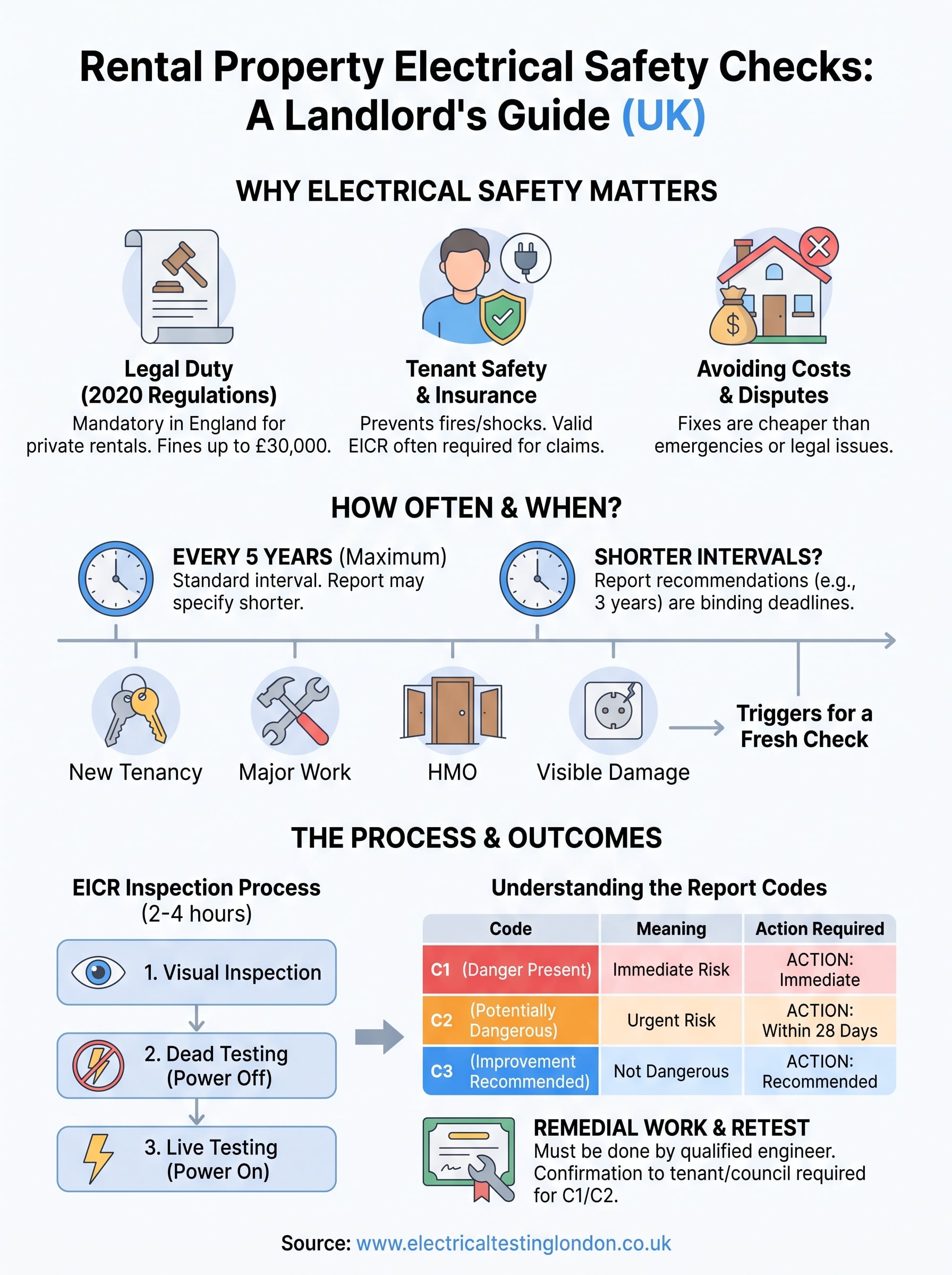
Homeowners can put off a wiring check indefinitely if they want to take the risk themselves. Landlords can't. The Electrical Safety Standards in the Private Rented Sector (England) Regulations 2020 make it a legal duty to have the electrical installation inspected and tested by a qualified person, and to give tenants a copy of the resulting report. Skip these landlord electrical safety regulations, and your local council can issue a remedial notice, then fine you up to £30,000 if you ignore that too.
A missed electrical safety check isn't a paperwork gap, it's a legal breach that can cost you tens of thousands of pounds.
What's actually at stake
Beyond the legal side, there's the practical reality of what happens when something goes wrong in a rented property. An overloaded circuit or a damaged cable behind a wall doesn't announce itself until it causes a problem, and by then you're dealing with a tenant dispute, a damaged property, or worse. A valid electrical safety certificate for rental properties also matters for reasons that go beyond compliance:
-
Insurance claims: many landlord insurance policies require proof of a current EICR before they'll pay out on an electrical fire or fault claim.
-
Tenant disputes: a documented, in-date report protects you if a tenant later claims the property was unsafe.
-
Property sales: buyers and their solicitors increasingly ask for the most recent EICR as part of due diligence.
-
Mortgage and letting agent requirements: many buy-to-let lenders and agents won't proceed without evidence of a valid certificate on file.
For commercial landlords, who need an electrical safety certificate for a commercial property, the stakes multiply. A single faulty circuit in a shop, office, or HMO can affect multiple tenants at once, and the regulatory scrutiny on multi-occupancy buildings is considerably tighter than for a single rented house. Whichever type of property you own, the certificate is your evidence that you've done your legal duty, and it's the first document any inspector, insurer, or court will ask to see if something goes wrong.
How often landlords need an electrical safety certificate
The standard answer for how often landlords need an EICR is every five years, but that's not the whole story. How often does a landlord need an electrical safety certificate depends partly on what the previous report recommends, not just a fixed calendar date. If your inspector flags a shorter interval, three years for an older installation or a property with heavy tenant turnover, that shorter date becomes your legal deadline, not the default five-year mark.
The five-year rule and its exceptions
Under the 2020 regulations, every private rented property in England needs a valid EICR dated within the last five years, or within whatever shorter period the report itself specifies, so it pays to know how long an EICR certificate is valid for. You can't average it out or round up. If the certificate says "next inspection due in three years," that's binding, and turning up on year five with an out-of-date certificate leaves you in breach even though you thought you had time left.
Five years is the maximum gap, never a guarantee, always check what your last report actually recommends.
When you need a fresh inspection sooner
A few situations force a new check regardless of when the last one expires:
-
New tenancy starting: many landlords commission a fresh EICR before each new tenant moves in, even if the current one is still valid, to avoid disputes later.
-
Major electrical work carried out: a rewire, consumer unit swap, or new circuit installation should trigger a fresh inspection to confirm the work is safe.
-
HMOs: houses in multiple occupation often face tighter local authority scrutiny and sometimes shorter recommended intervals given higher usage.
-
Visible damage or tenant complaints: flickering lights, tripping breakers, or burning smells warrant an inspection straight away, certificate or not.
What happens during a rental electrical safety check
Once you book an engineer, the visit itself follows a fairly predictable pattern. A qualified electrician carries out an Electrical Installation Condition Report (EICR), which means testing the fixed wiring, consumer unit, sockets, and switches throughout the property rather than just glancing at the fuse board. Expect the visit to take between two and four hours depending on property size, and expect the power to go off for parts of it while circuits are tested individually.
The inspection process step by step
Here's roughly what the engineer works through during the visit, and our step-by-step guide to how an EICR is carried out covers each stage in more detail:
-
Visual inspection: checking for damaged sockets, exposed wiring, or signs of overheating.
-
Consumer unit assessment: confirming the fuse board has proper RCD protection and correctly rated circuit breakers.
-
Dead testing: checking circuits with the power isolated to measure insulation resistance and earth continuity.
-
Live testing: checking earth fault loop impedance and RCD trip times with the power back on.
-
Sampling sockets and fittings: testing a representative selection of outlets, light fittings, and switches, not necessarily every single one.
Understanding the report codes
At the end, you get a written report with a pass or one of three fail codes, and what each EICR certificate code means decides your next step. A C1 means danger present, requiring immediate action. A C2 means potentially dangerous, needing urgent remedial work. A C3 is just a recommendation for improvement, not a legal requirement to act on straight away.
A C1 or C2 code turns your report from a formality into an immediate legal obligation.
Our team at Electrical Testing London explains every code in plain English before we leave, so you're never staring at a report wondering what it actually means for your tenancy.
What to do if the report flags a problem
What happens if an EICR fails isn't the end of the tenancy, but a report back with a C1 or C2 code does start a clock. Remedial electrical works need to happen within the timeframe your inspector sets out, usually 28 days for a C2 and immediately for a C1, and you're legally required to send written confirmation to your tenant and local council once the work's done. Ignoring the deadline is what turns a fixable fault into a council enforcement case.
Understanding your deadlines
The table below shows roughly what each outcome means in practice:
|
Code |
Meaning |
Typical deadline |
|---|---|---|
|
C1 |
Danger present |
Immediate action |
|
C2 |
Potentially dangerous |
Within 28 days |
|
C3 |
Improvement recommended |
No legal deadline |
|
FI |
Further investigation needed |
Before certificate issued |
A C2 code with a missed 28 day deadline is exactly the kind of gap councils look for when they issue penalties.
Getting the work done properly
Qualified engineers should carry out any remedial work, not a general handyman, because the follow-up certificate needs to confirm the fault's been fixed to the required standard. Retesting the affected circuits after the repair is standard practice, and you'll get an updated certificate showing the property's now compliant. Sending that paperwork to your tenant and, where required, your local authority closes the loop and protects you if the issue's ever raised again. Landlords who use the same engineer for both the inspection and the remedial work usually find the process faster, since there's no back-and-forth explaining what the original report meant. We handle both stages directly through our EICR remedial works service, so nothing gets lost between the report and the fix.
Keeping your rental property safe and compliant
A rental property electrical safety check isn't something to schedule around and hope for the best. You now know the five-year rule, the shorter deadlines your report might set, what an engineer actually tests during the visit, and what happens once a C1 or C2 code lands on your paperwork. None of that changes whether you're renting out one flat or managing a portfolio across London.
Getting ahead of your renewal date, rather than scrambling once a tenant or letting agent chases you, keeps you clear of council notices and keeps your tenants genuinely safe. If your current certificate is approaching its expiry, or you've never had one done on a property you're already letting, don't wait for a reminder that never comes. Get a quote from our team and we'll get an engineer out to sort it properly, first time.

