


What Electrical Checks Do Landlords Need? Full Guide


If you rent out a property in England, the law is specific about what you must check and when. Get it wrong and you're not just risking a fine of up to £30,000, you're risking a tenant's safety. So what electrical checks do landlords need to have in place before handing over the keys?
The short answer: every rental property needs a valid Electrical Installation Condition Report (EICR) carried out at least every five years, alongside PAT testing for any appliances you supply. An electrical safety check on rented property covers the fixed wiring, consumer unit, sockets, and switches, looking for faults that could cause fire or shock. Your local authority can also demand proof of compliance at any time, so having the paperwork ready matters as much as the inspection itself.
In this guide, we'll walk through exactly which checks are legally required, how often each one needs repeating, what a qualified engineer actually inspects during an EICR, and what happens if your property fails. We'll also cover the practical side, from booking an inspection to fixing any issues an inspector flags, so you stay compliant without unnecessary disruption to your tenants.
Why electrical safety checks matter for landlords
Landlords in England have carried a legal duty to check their rental properties' electrics since the EICR regulations for landlords in England came into force in 2020. This isn't a box-ticking exercise recommended by insurers or letting agents, it's a statutory requirement enforced by local councils, and it applies to every private tenancy regardless of the property's age or how recently it was rewired. Understanding why these checks exist helps you see them as protection rather than paperwork.
The legal requirement behind the checks
Under the regulations, every landlord must ensure the electrical installations in their rental property are inspected and tested by a qualified person at intervals of no more than five years. That inspection produces the Electrical Installation Condition Report (EICR) we mentioned earlier, and you must give a copy to your tenant within 28 days of the test, and to a new tenant before they move in. Councils can request this report at any point, often triggered by a tenant complaint, and failing to produce one within seven days is itself a breach.
A missing or expired EICR is one of the easiest ways for a landlord to end up in front of a tribunal.
What happens if you skip it
The consequences for non-compliance are steep and deliberately so. Local authorities can issue remedial notices giving you 28 days to sort out the wiring, and if you ignore that, they can arrange the work themselves and bill you for it. On top of that:
-
Financial penalties of up to £30,000 per breach, per property
-
Rent Repayment Orders in some council areas, forcing you to refund tenants
-
Difficulty enforcing Section 21 notices if you can't prove compliance when trying to regain possession
-
Invalidated landlord insurance if a fire or electrical incident occurs without a valid EICR in place
Quoting figures like these isn't scaremongering, it reflects how seriously the Housing Act framework treats electrical safety in tenanted properties.
Protecting people, not just avoiding fines
Beyond the legal exposure, think about what the check is actually catching. Overloaded circuits, deteriorating wiring behind plaster, and DIY additions from previous occupants are common findings in older housing stock, and any one of them can start a fire while a tenant sleeps. Rented housing in London tends to be older, converted, and multi-occupied, which raises the stakes further, since a fault in one flat can affect several households. Statistics from the London Fire Brigade consistently show electrical faults among the leading causes of accidental house fires, which is exactly the risk a domestic EICR in London is designed to catch before it becomes an emergency.
Safety aside, a current EICR also protects your relationship with tenants and your reputation as a landlord. Tenants increasingly ask to see safety certificates before signing a tenancy agreement, particularly in London's competitive rental market, and having everything in order signals that you take your obligations seriously. Ultimately, the check exists to catch problems while they're still cheap and simple to fix, rather than after they've caused damage, injury, or a legal dispute.
How to arrange an electrical safety check for your property
Getting an EICR sorted doesn't need to be complicated, but it does need to be done properly. Arranging a landlord electrical safety check in London starts with booking a qualified engineer, and the person carrying out the test must be registered with a competent person scheme such as NICEIC or NAPIT. Anyone can call themselves an electrician, but only a properly registered inspector can issue a certificate that satisfies your legal obligation, so always ask for proof of registration before confirming a booking.
Choosing the right engineer
Homeowners and letting agents sometimes assume any electrician will do, but the regulations specifically require a "qualified and competent person" for this inspection. Look for someone who works regularly in rental properties, since they'll know exactly what council inspectors and tenants tend to flag. At Electrical Testing London, our engineers have at least ten years of hands-on experience with landlord compliance work across London and the South East, which means fewer surprises and a faster turnaround.
The right engineer catches problems before your tenant or your council does.
What to expect on the day
How an EICR is carried out varies a little by property, but inspections usually take between one and three hours depending on the size and the number of circuits, and the engineer will need access to the consumer unit, all sockets, switches, and any fixed appliances wired directly into the system. Tenants should be given reasonable notice, ideally at least 48 hours, and it helps to explain that the power may need switching off briefly during testing.
Before the visit, it's worth preparing a few things:
-
Clear access to the consumer unit, usually in a hallway or cupboard
-
A list of any known electrical issues tenants have reported
-
Previous EICR or electrical certificates, if the property has changed hands
-
Confirmation of tenant availability or a key arrangement if they won't be home
Once the test is complete, you'll receive the EICR document within a few working days, showing whether the installation is satisfactory or requires further action, which is exactly what we'll unpack next.
Understanding your EICR results and remedial work
Once the engineer finishes testing, the EICR document will classify your property as either "satisfactory" or "unsatisfactory", and it's the codes attached to any faults that determine what happens next. Each observation gets a rating that tells you how urgent the problem is, and a single C1 or C2 code is enough to tip the whole report into unsatisfactory territory, even if everything else passes.
Reading the classification codes
Getting your head around what the EICR codes mean early saves a lot of back-and-forth with your engineer later on.
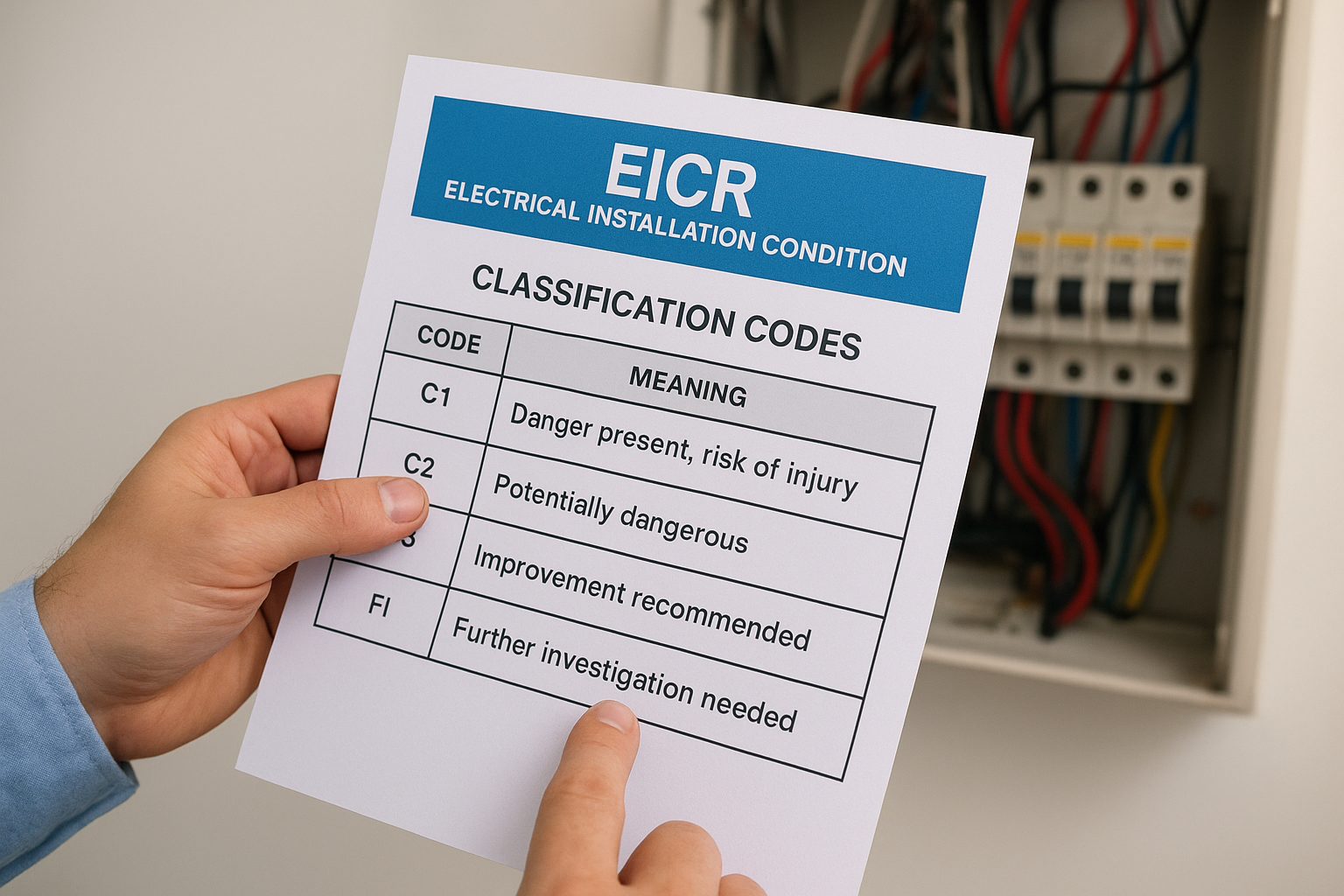
|
Code |
Meaning |
Action required |
|---|---|---|
|
C1 |
Danger present, risk of injury |
Immediate remedial work |
|
C2 |
Potentially dangerous |
Urgent remedial work |
|
C3 |
Improvement recommended |
Not mandatory, but advisable |
|
FI |
Further investigation needed |
Must be carried out before report is finalised |
A single C2 code turns a "pass" into a legal obligation to act.
What counts as unsatisfactory
An unsatisfactory EICR doesn't mean the property is unsafe to live in right now, but it does mean the local authority expects you to fix the flagged items within 28 days, or sooner if a C1 is involved. Reports commonly flag things like a missing RCD protection, an outdated fuse board, or unearthed bathroom circuits, none of which are unusual in older London housing but all of which need sorting before the certificate is reissued as satisfactory.
Getting the remedial work done
EICR remedial works have to be carried out by a qualified person too, and once finished you'll need a follow-up certificate confirming the issues have been resolved, not just a verbal assurance from whoever did the repair. Our remedial electrical works service handles exactly this gap, fixing the faults an EICR identifies and issuing the paperwork the council or your tenant will expect to see. Skipping this step, or patching things up without proper certification, leaves you just as exposed as if you'd never had the inspection done at all, since an unresolved C1 or C2 still counts as non-compliance in the eyes of the law.
Other electrical checks worth considering
The EICR covers your fixed wiring, but it's not the only check that keeps a rental property genuinely safe. Depending on what's inside the property and how it's used, a few additional inspections are worth building into your routine, even where they're not strictly mandatory for every tenancy type.
PAT testing for supplied appliances
If you furnish the property with a kettle, washing machine, or any other portable appliance, you have a duty of care to make sure those items are safe to use, even though PAT testing isn't set at a fixed legal interval like the EICR. Most letting agents recommend PAT testing for rental properties annually, and our service covers everything from white goods to lamps, with a certificate for each item tested.
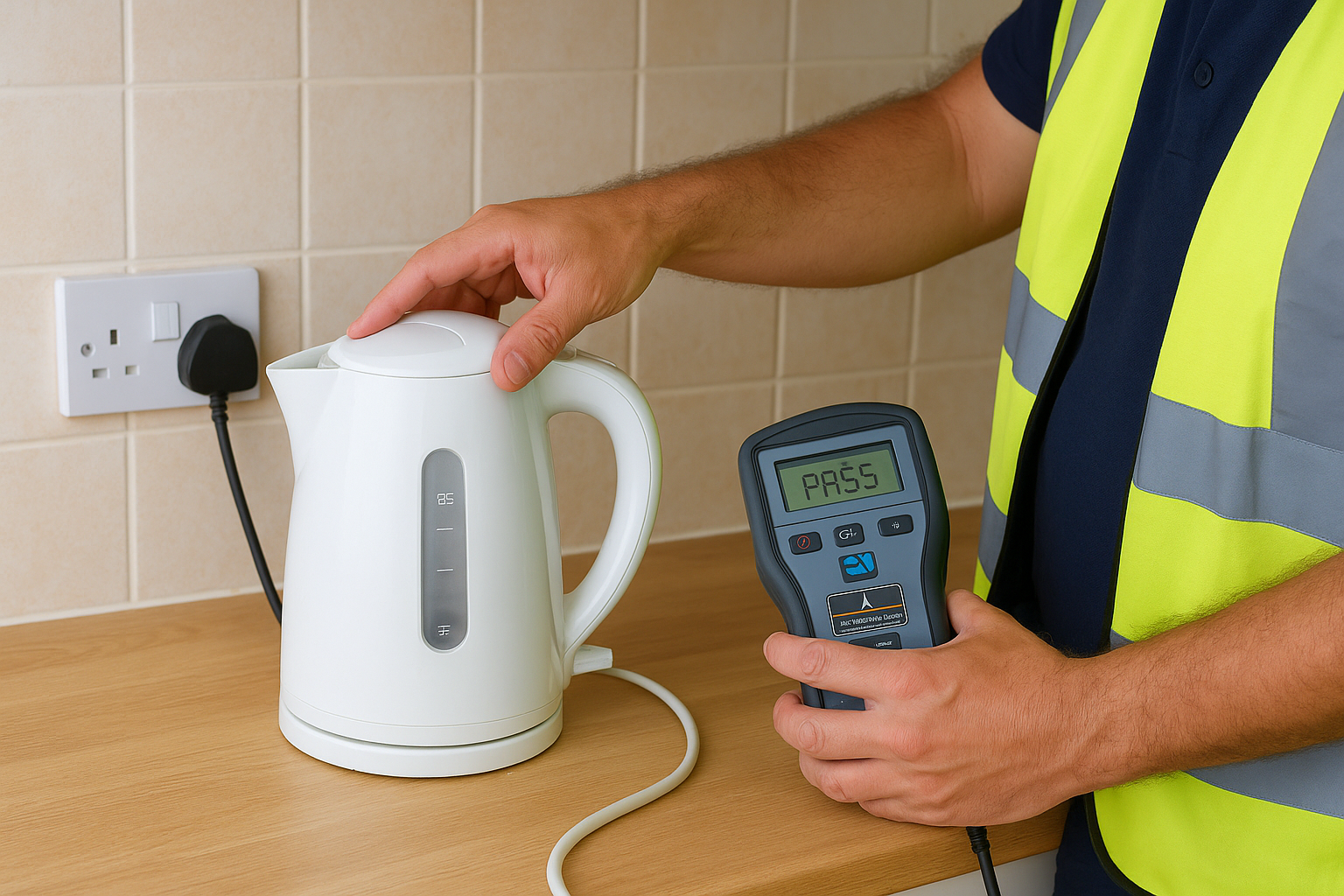
An untested appliance can undo all the good work of a passing EICR.
Emergency lighting in shared and commercial buildings
Block managers and commercial landlords need to think beyond the individual flat. If your property has shared corridors, stairwells, or a fire escape route, emergency lighting testing ensures those lights actually work when the power cuts out, which fire regulations treat as a separate obligation from domestic electrical safety.
Thermal imaging for early fault detection
Thermal imaging inspections spot overheating connections and overloaded circuits long before they'd show up as a visible fault or trip a breaker. It's not a legal requirement, but landlords managing older properties or multiple lets often use it alongside their five-yearly EICR to catch problems early.
Consumer unit upgrades and EV charging
Finally, if your consumer unit is an old fuse board without RCD protection, replacing it removes a recurring source of C2 findings on future reports. And with more tenants driving electric vehicles, adding EV charging installation to a property can also be a sensible upgrade, one that adds value while keeping the electrics modern and compliant.
Keeping your rental property compliant
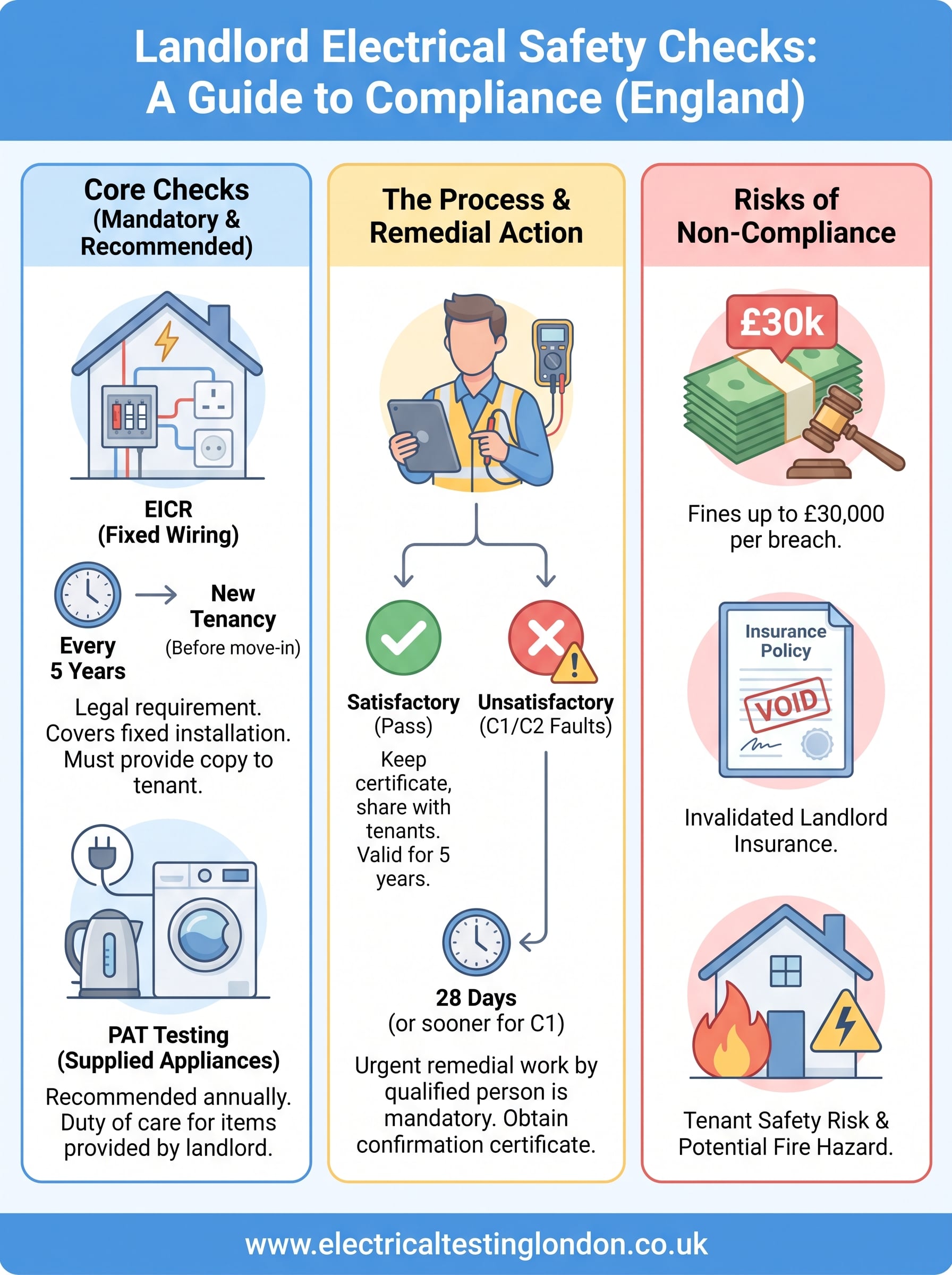
Staying on the right side of the law comes down to a short list: a valid EICR at least as often as landlords need one, PAT testing for anything you supply, and prompt remedial work whenever a C1 or C2 code turns up. None of this needs to be stressful once you've got a reliable engineer booked in and a diary reminder set for renewal dates. Landlords who treat these checks as routine maintenance, rather than a hurdle to clear when a tenant complains, avoid the fines, the tribunal hearings, and the awkward conversations about invalidated insurance.
If you're due a check, behind on paperwork, or just want a straightforward quote for your next electrical safety check on rented property, get in touch with our team. We work across London and the South East with engineers who know exactly what compliance looks like for landlords, and we'll get you sorted with minimal disruption to your tenants. Request a quote for your landlord EICR today and tick this off your list.

