






What Goes in an Emergency Lighting Certificate Template



If you are searching for an emergency lighting periodic inspection and testing certificate template, you probably want something you can fill in, sign and hand to a client the same day. A vague form will not do. A weak certificate leaves gaps that a fire risk assessor, insurer or enforcing authority will spot straight away.
Here is the short answer. A compliant certificate, following the format in BS 5266-1, records who the premises and responsible person are, what was tested, what failed, and when the next test is due. It must also carry the engineer's declaration and signature. Without those, it is just a checklist.
This article walks through each section a good template should contain, from site details and luminaire schedules to duration test results, defects and recommendations. We carry out emergency lighting testing across London and the South East, and issue these certificates every week. So the fields below come from what clients and inspectors actually ask to see, not from theory.
Why a proper certificate template matters
A certificate is the only lasting proof that testing took place. Without it, a flick test in March and a full-duration test in June are just things someone says they did. A good emergency lighting periodic inspection and testing certificate template turns that work into a record that stands up to scrutiny.
It is evidence, not paperwork
The Regulatory Reform (Fire Safety) Order 2005 puts the duty on the responsible person, usually the owner, landlord or employer. They must keep escape routes lit and be able to show the system works. Your certificate is the document they hand over when a fire officer, insurer or auditor asks.
Consider a claim after a fire, or a visit from the fire and rescue service. The first question is rarely "does the lighting work?" It is "show me the last test." A certificate that names the premises, the fittings and the results answers that in seconds.
If a certificate cannot show what was tested and what failed, it cannot prove compliance.
What a weak form leaves out
Many free downloads stop at a single tick box. They look tidy but say almost nothing that an inspector can check, and they leave you exposed if a fitting fails later. The table shows the difference.
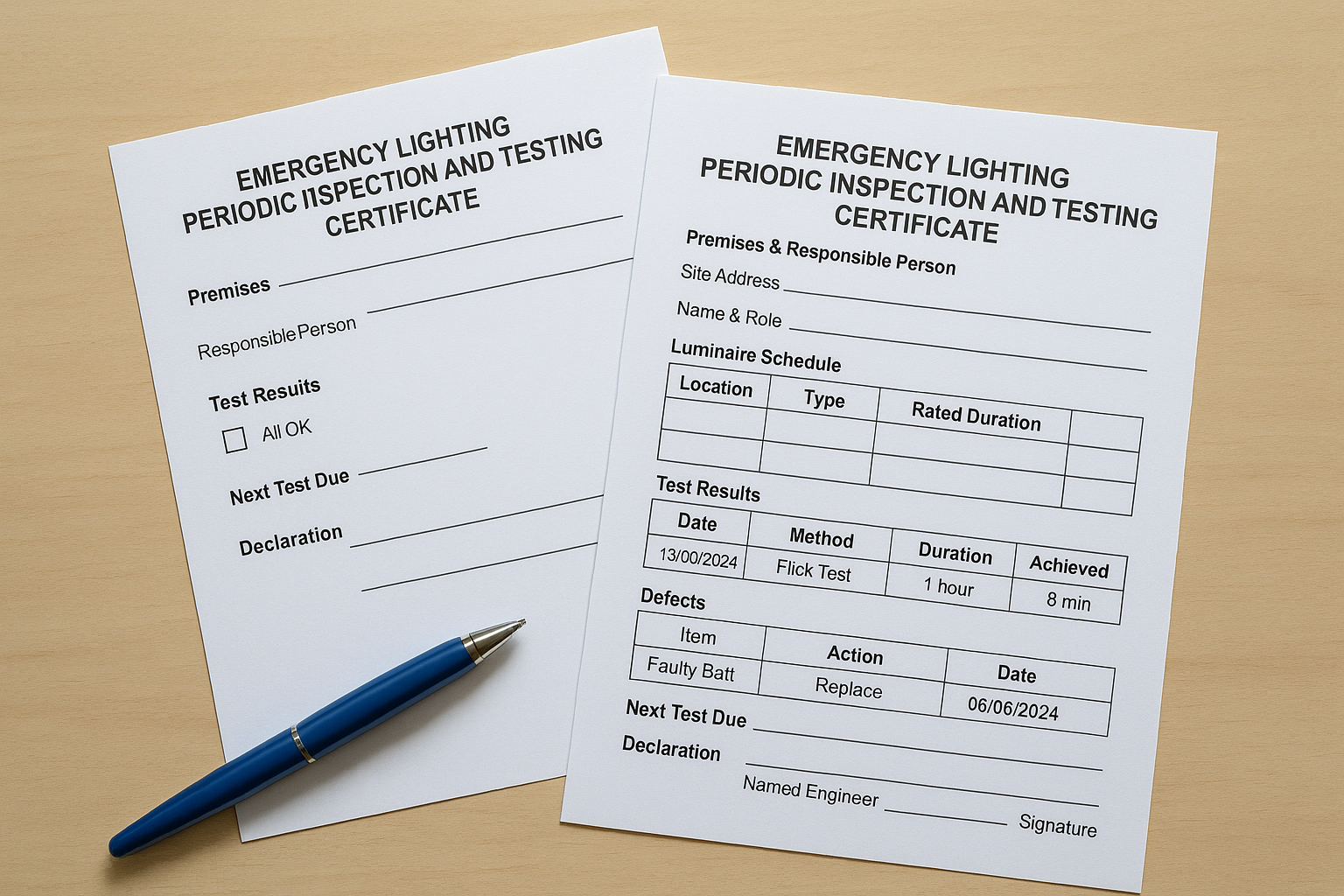
|
Detail |
Weak form |
Proper template |
|---|---|---|
|
Premises and responsible person |
Address only |
Site address, name and role |
|
Luminaire schedule |
"All OK" |
Each fitting by location, type and rated duration |
|
Test results |
One pass/fail tick |
Date, method and duration achieved |
|
Defects |
Blank |
Itemised, with action and timescale |
|
Next test due |
Missing |
Dated |
|
Declaration |
Initials |
Named engineer, competence, signature, date |
There is a commercial point too. A detailed certificate protects you as the contractor. If a battery fails four months after your visit, the record shows what you tested, what you found and what you advised. Clients also notice the difference, and they tend to come back to the contractor whose paperwork they can actually use.
How to complete an emergency lighting certificate
Work through your emergency lighting periodic inspection and testing certificate template in the order you do the job. Fill in the site details first, then record results as you test, not from memory afterwards. Memory is where wrong dates and missed fittings come from.
Start with the site and system details
Begin with the administrative section. It ties the certificate to one building and one responsible person, so it must be exact. If a previous certificate exists, check its open defects and carry them forward.
-
Site address and premises type
-
Responsible person's name and role
-
Engineer's name, date and test type (monthly, annual or commissioning)
-
System type: maintained or non-maintained
-
Reference to the previous certificate
Test, record and sign
Every fitting gets its own line in the schedule. Note its location, type and rated duration, usually one or three hours, then the result. For the annual test, run each luminaire for its full rated duration and record the time achieved. Monthly checks are a short functional test only.
Finish with the declaration once the schedule is complete. State your competence, sign, date, and give the next test due date.
Sign only what you have personally tested and recorded.
Recording defects, deviations and recommendations
Defects are the part of a certificate that clients read first and inspectors question hardest. Your emergency lighting periodic inspection and testing certificate template needs a separate place for each type of finding, because each one calls for a different response from the responsible person.
Keep the three entries apart
Mixing findings together muddles priorities. A failed battery needs repair now, while a suggested extra fitting can wait for the next budget round. Separate sections let the client see at a glance what is urgent.
|
Entry |
What it means |
Example |
|---|---|---|
|
Defect |
A fault found during testing |
Luminaire fails its 3-hour test |
|
Deviation |
A departure from BS 5266-1 or the original design |
Exit sign missing at a final exit |
|
Recommendation |
Advice that is not a failure |
Add a fitting near a new call point |
Make every entry actionable
Each defect line should name the fitting, the fault, the action and a timescale. Vague notes such as "some lights weak" cannot be acted on or checked later.
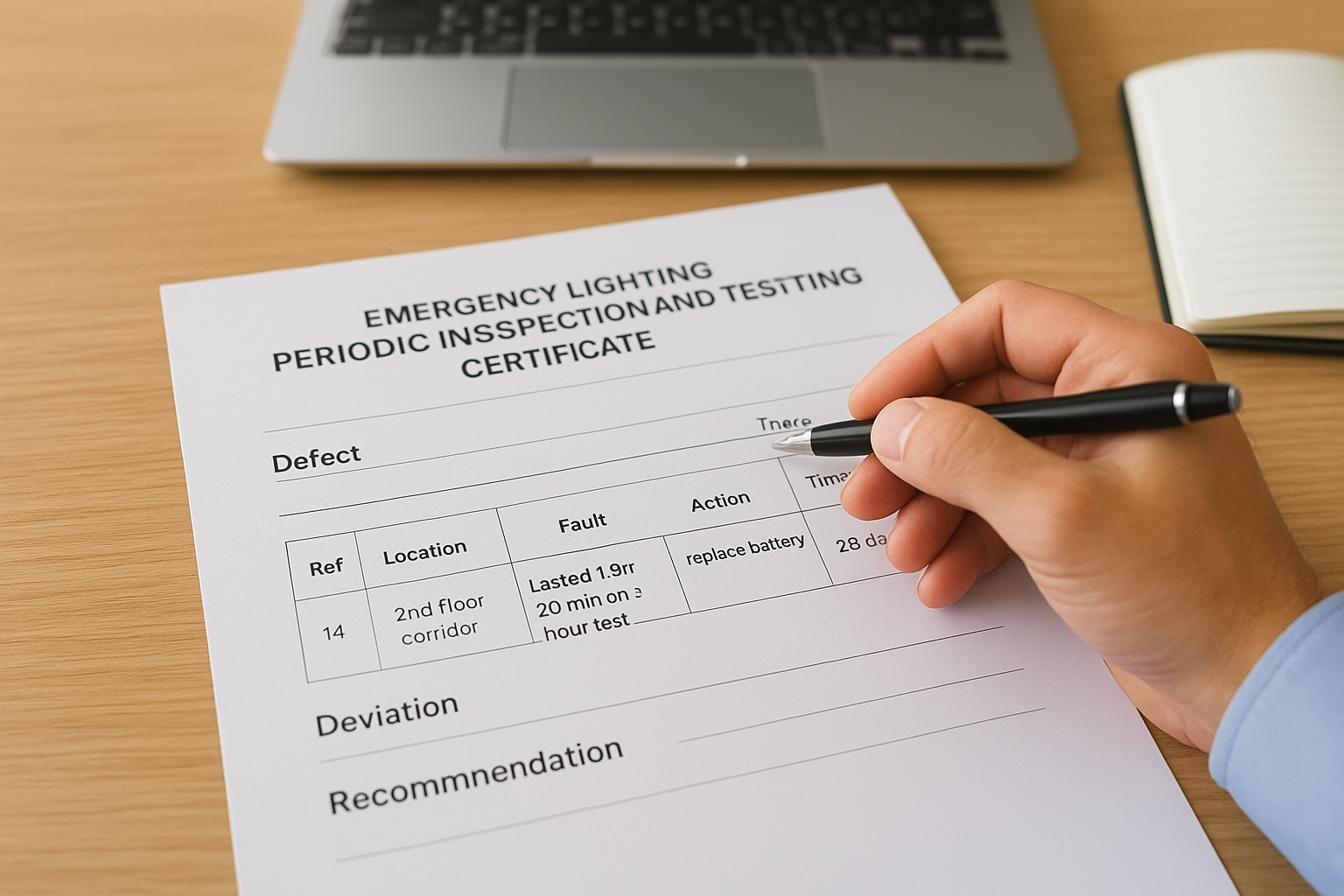
Ref 14 | 2nd floor corridor | Lasted 1 h 20 min on 3-hour test
Action: replace battery | Timescale: 28 days | Status: open
A defect without an owner and a date is just a complaint.
Finally, be honest about the overall outcome. If an open defect affects an escape route, mark the system unsatisfactory rather than softening it. Clients can rely on that, and it protects you if the fitting fails again.
What the BS 5266-1:2025 update changes for certificates
The 2025 edition of BS 5266-1 replaces the 2016 version as the code of practice for emergency escape lighting. Do not rebuild your emergency lighting periodic inspection and testing certificate template around rumour. Buy the current standard, read the revised clauses and model forms, then adjust your fields to match what it actually says.
Cite the right edition
Start by naming the edition on the certificate. A form issued today that quotes BS 5266-1:2016 tells an inspector your paperwork is out of date. Also reference the testing and maintenance standard, BS EN 50172 (BS 5266-8), and check which edition you are working to.
A certificate should always say which edition of the standard it was judged against.
Existing systems and design basis
Systems are not automatically non-compliant because a new edition appears. Record the edition the system was designed to, then list any gaps against the current standard as recommendations rather than defects. The exception is where the building's use or layout has changed, because then the original design may no longer fit.
Before you reissue your template, run through this short list:
-
Current edition of BS 5266-1 cited throughout
-
Design edition recorded in the site details
-
Declaration wording compared with the standard's model forms
-
Older template versions archived, not deleted
Keep the archive. If a client queries a certificate from 2023, you need to show which wording applied on the day.
Common mistakes and a quick checklist before you sign
Even a well-built emergency lighting periodic inspection and testing certificate template can produce a poor certificate if you fill it in carelessly. The errors below turn up again and again, and every one is avoidable with a few minutes of care before you issue the document.
Mistakes that get certificates challenged
The most damaging habit is copying last year's results forward. Inspectors compare certificates, and identical durations for every fitting look invented. Close behind is an incomplete schedule. If the building has 62 luminaires and your form lists 58, the whole certificate becomes unreliable.
-
Pass ticked with no duration time recorded
-
Fittings missed in stairwells, plant rooms or upper floors
-
Defects noted in the schedule but absent from the summary
-
No next test due date
-
Declaration unsigned, or no statement of competence
-
No note that batteries need up to 24 hours to recharge after a duration test
Every figure on the certificate must come from a test you carried out that day.
Final checks before you sign
Run through this list before the certificate leaves your hands. It takes about two minutes and catches most errors.
-
Site, responsible person and standard edition are correct
-
Fitting count matches the drawings or the previous certificate
-
Every duration is a measured figure
-
Open defects carry an action and a timescale
-
Overall outcome matches the defects listed
-
Next test date, name, signature and date are complete
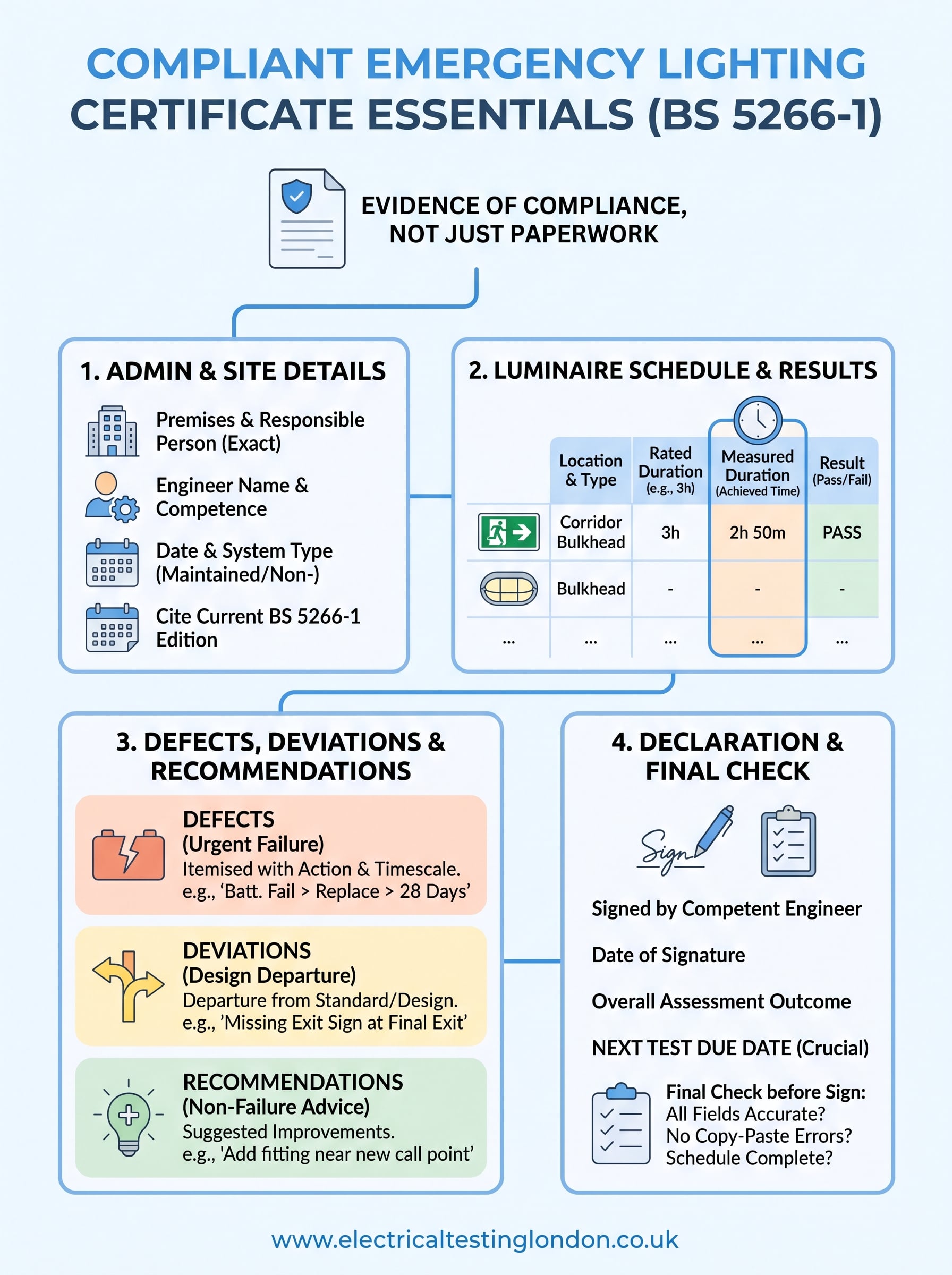
Getting your certificate right
A good emergency lighting periodic inspection and testing certificate template does one job. It records what you tested, what failed and what happens next, in a form a client, insurer or fire officer can rely on. Site details, a full luminaire schedule, measured durations, itemised defects, the correct BS 5266-1 edition and a signed declaration are the parts that matter.
Build your template around those fields and fill it in as you test. Then run the final checklist before you sign. That habit turns a routine visit into evidence that protects both you and the responsible person.
If you would rather hand the work to engineers who issue these certificates every week, request a quote from Electrical Testing London. We cover premises across London and the South East.