





What Is a Self-Testing Emergency Light? How It Works



Manual emergency light testing is easy to forget. Someone has to walk the building, flick a key switch and note the result every month, then run a full duration test once a year. Miss a test and you have no proof the lights will work when the power fails.
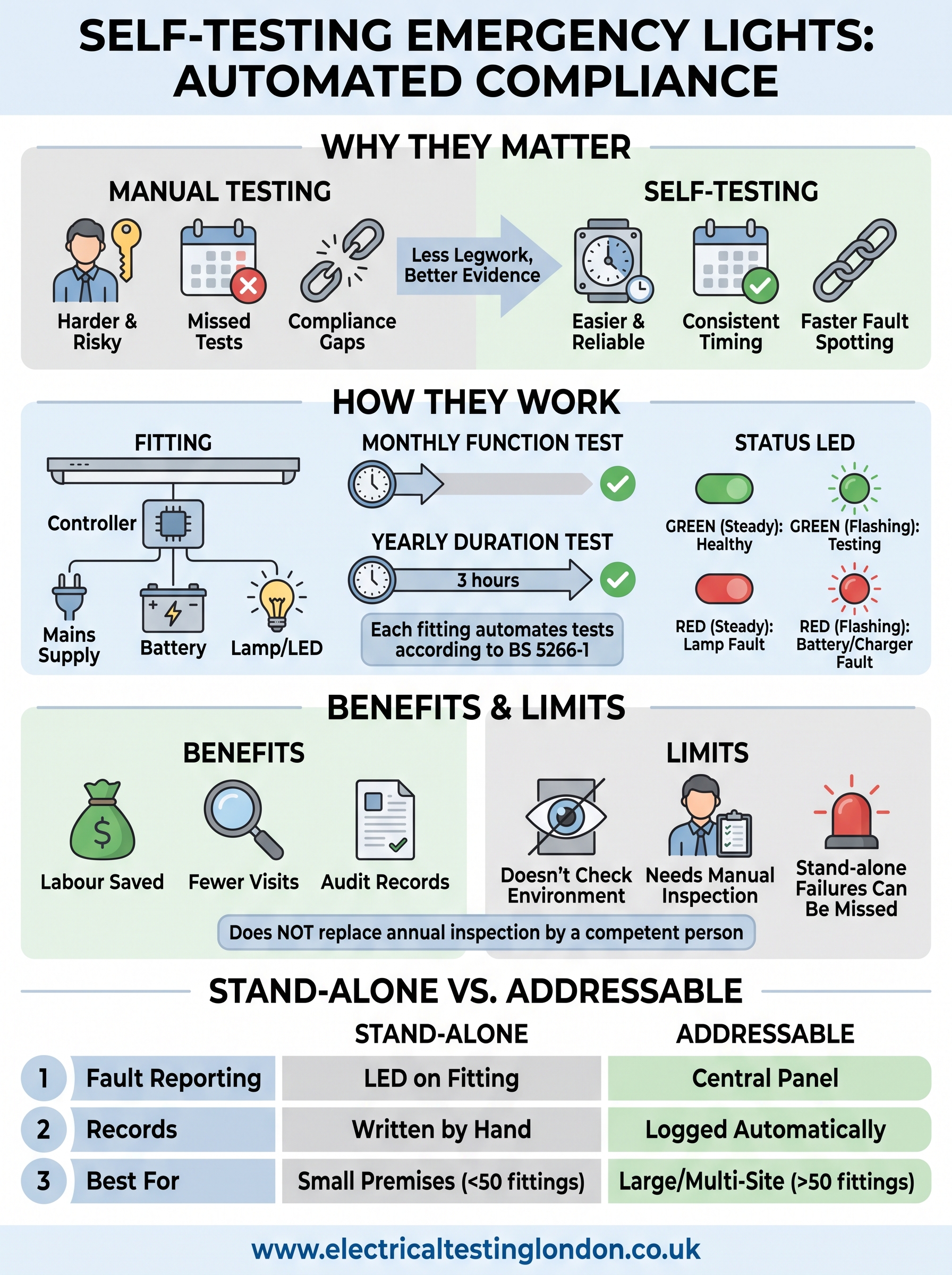
A self-testing emergency light is a fitting that does this for you. Built-in electronics run a short monthly function test and a yearly full-duration test automatically, in line with BS 5266-1. Each fitting shows its status through an LED indicator, and addressable systems report faults to a central panel. A self testing emergency light fitting still needs a competent person to check indicators, keep records and fix faults.
Below, we explain how the testing circuit works, what the fitting checks and what it cannot. We also cover the benefits and the costs, so you can decide whether to install them. Our engineers at Electrical Testing London test emergency lighting across London and the South East, so this comes from hands-on work in real buildings.
Why self-testing emergency lights matter
The compliance duty behind the testing
Under the Regulatory Reform (Fire Safety) Order 2005, the responsible person must keep escape lighting working. BS 5266-1 sets the routine: a brief monthly function test and a full rated duration test every year, usually three hours.
Insurers and fire risk assessors expect dated records of both. Manual testing often breaks down here. Keys go missing, a busy week pushes the test back, and after a full duration test the batteries need hours to recharge, so the building is exposed if power fails straight afterwards.
If a test is not recorded, you cannot prove it happened.
What automation changes
A self-testing emergency light removes most of the legwork. Compared with conventional fittings, you get tests that run on schedule and faults that show themselves. In practice, that means:
-
Consistent timing: nobody has to remember the date.
-
Fewer site visits: no one walks round with a test key every month.
-
Faster fault spotting: a failed lamp or battery shows on the LED indicator straight away.
-
Better evidence: addressable systems log results automatically.
Savings add up in larger premises. A 60-fitting office needs 60 manual checks every month, and each one is a chance to miss a failure. Self-test fittings cost more per unit, but the labour saved usually repays that, and you gain fewer compliance gaps between inspections.
How self-testing emergency lights work
The test circuit inside the fitting
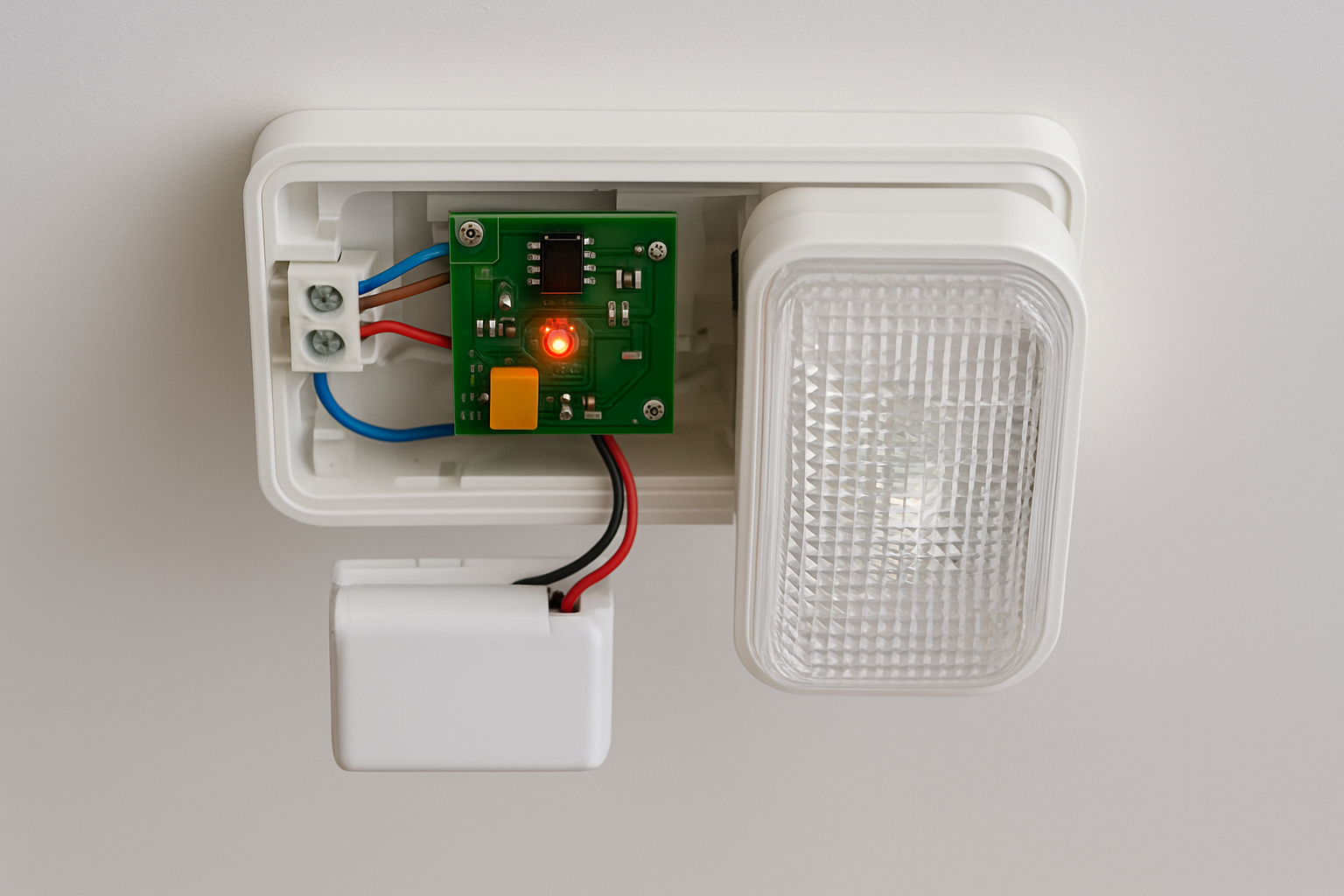
Inside each fitting, a small controller sits between the mains supply, the battery and the lamp. On a set timer, it switches the lamp to battery power and measures what happens. The monthly test lasts seconds. The annual test runs for the full rated duration, usually three hours. It checks:
-
Lamp or LED driver: is it drawing current and lighting?
-
Battery: can it carry the load?
-
Charger: is it topping the battery back up?
Reading the result
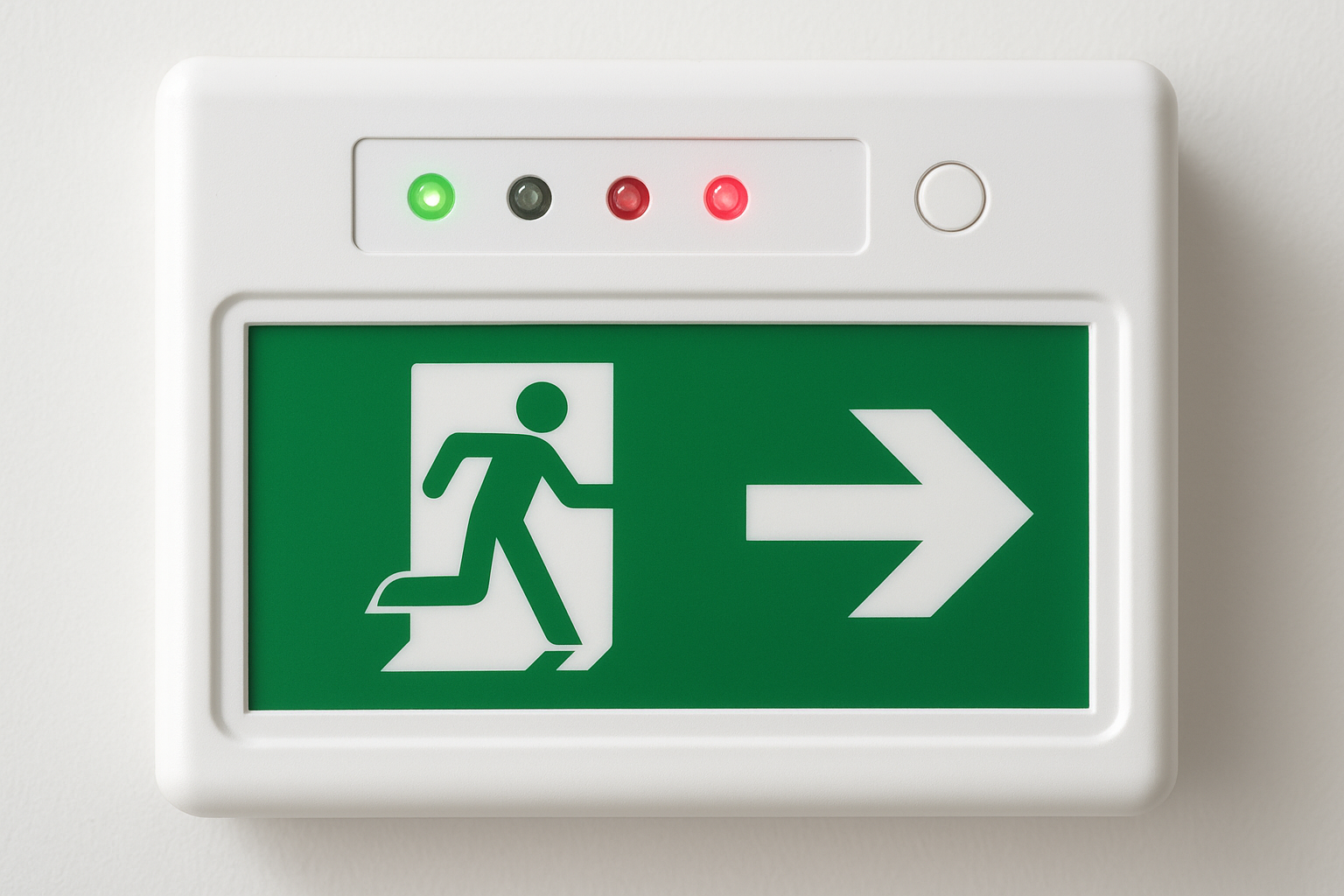
Each fitting reports through a tri-colour LED, typically green for healthy and red or flashing for a fault. Codes differ between manufacturers, so check the datasheet. Stand-alone units show this locally only, so someone must still look at every indicator.
Addressable fittings send the same results to a central panel, which logs every test automatically. That removes the walk-round entirely.
A self-testing emergency light finds the fault, but a person still has to act on it.
How to choose and install self-testing fittings
Choosing the right fitting
Start with your fire risk assessment, which sets how long the lights must run and where they go. Then compare specifications, and check that each self testing emergency light fitting meets BS EN 60598-2-22.
-
Mode: maintained lights stay on, non-maintained lights come on only when power fails.
-
Duration: one or three hours, as the assessment requires.
-
Control: stand-alone for small sites, addressable for larger ones.
-
Visibility: an LED you can see from floor level.
Installing them properly
Have a competent electrician fit them. Each unit needs an unswitched permanent live feed. If it sits on a switched circuit, turning the lights off looks like a power cut, and the battery drains.
A fitting on a switched live cannot be trusted to test itself.
Finally, commission every unit and run a first full-duration test. Log the install date and fitting locations, because the commissioning date starts your annual test cycle and gives inspectors a clear baseline.
Limits of self-test and when to use addressable systems
What self-test cannot do
A self-testing emergency light checks its own lamp, battery and charger. It cannot judge whether the light is in the right place, or whether a stacked pallet now blocks it. Nor does it replace the annual inspection by a competent person, who checks coverage, signage and records.
Stand-alone units can also fail quietly. The LED turns red, but nobody notices if the fitting sits in a locked plant room or a stairwell no one uses.
Self-test checks the fitting, not the escape route.
When addressable systems earn their cost
Choose addressable once you have more than about 50 fittings, several floors or awkward locations. The panel gathers every result in one place, so you see faults without walking the building.
|
|
Stand-alone |
Addressable |
|---|---|---|
|
Fault reporting |
LED on the fitting |
Central panel |
|
Records |
Written up by hand |
Logged automatically |
|
Best for |
Small premises |
Large or multi-site buildings |
Cost is higher upfront. Even so, a panel that logs every test removes the monthly walk-round and gives you audit-ready records for insurers.
Example test schedule and what indicator signals mean
A typical yearly schedule
Take a stand-alone self-testing emergency light installation commissioned in January. The monthly checks are quick, but the annual full-duration test needs planning. Run it outside opening hours so the batteries can recharge.
|
When |
Test |
Your action |
|---|---|---|
|
Every month |
Function test, lasting seconds |
Check each LED and log it |
|
Every January |
Full-duration test, usually 3 hours |
Check LEDs next day, record results |
|
Every year |
Inspection by a competent person |
Review coverage, signage and records |
What the LED signals mean
Codes vary by manufacturer, so check the datasheet before relying on any of these. The patterns below are common, and an unlit LED deserves attention too.
-
Steady green: mains present, fitting healthy.
-
Flashing green: test running, so leave it alone.
-
Red: lamp or LED fault.
-
Flashing red: battery or charger fault.
-
No light: no mains feed, or a dead unit.
A red LED is a repair job, not a reminder for next month.
Replace the faulty part promptly and record the date, because an unresolved fault counts against you at inspection.
Making the right choice for your building
Choosing a self-testing emergency light comes down to the size of your building and how you will act on the results. Small premises with a handful of fittings suit stand-alone units, as long as someone checks every LED. Larger buildings, with more than about 50 fittings or several floors, usually justify an addressable system that logs every test. Either way, self-test automates the monthly and annual checks, but it does not replace the annual inspection by a competent person or the records that prove your lights work.
If you are unsure which option fits, our engineers can survey your premises and advise on fittings, installation and testing. For a clear price on emergency lighting work anywhere in London and the South East, request a quote from Electrical Testing London and we will talk you through the options.