


What Is Commercial EICR Testing? Duty, Scope and Timing


Commercial EICR testing is the periodic inspection and testing of the fixed electrical installation in a business premises. A qualified electrician carries it out and records the result in an Electrical Installation Condition Report (EICR). The report tells you whether the wiring, distribution boards and protective devices are still safe to use. For most offices, shops and schools the recommended gap between reports is five years. Higher-risk sites need them sooner.
This article explains why the test matters, how to arrange one, what the inspector checks and who is responsible for it. It also sets out how the recommended intervals differ by type of premises, so you can plan your next report.
Electrical Testing London carries out commercial EICRs for businesses, landlords and local authorities in London and the South East. The advice below reflects how these inspections run in practice, so you know what to expect before you book.
Why commercial EICR testing matters
Commercial EICR testing matters because it is the standard way to prove that your electrics are maintained so that they do not cause danger. That is the duty the Electricity at Work Regulations 1989 place on you.
The legal duty behind the test
Regulation 4(2) of the Electricity at Work Regulations 1989 requires electrical systems to be maintained so as to prevent danger, so far as is reasonable. The Health and Safety at Work etc. Act 1974 adds a general duty on employers to keep people safe. No regulation names the EICR for commercial premises, which is why some sources say it is not a legal requirement.
That is technically true and practically unhelpful. If an enforcing officer, insurer or buyer asks how you have met your duty, a current EICR is the evidence most people expect to see. Without one, you have nothing solid to show.
No law says "get an EICR", but the law does say keep your electrics safe, and the report is how you prove it.
What the report does for your business
A commercial EICR gives you more than a certificate. It gives you a dated record of the condition of your installation. In practice it does four jobs:
-
It finds ageing cables, overloaded circuits and failing protective devices before they cause a fire or shock.
-
It gives your insurer evidence of maintenance, which many insurers ask for when you renew or make a claim.
-
It reduces unplanned downtime, because a fault found during a planned test does not stop trading at a busy moment.
-
It sets a baseline for lease events, such as a new tenant, a break clause or the end of a term.
How to arrange a commercial EICR test
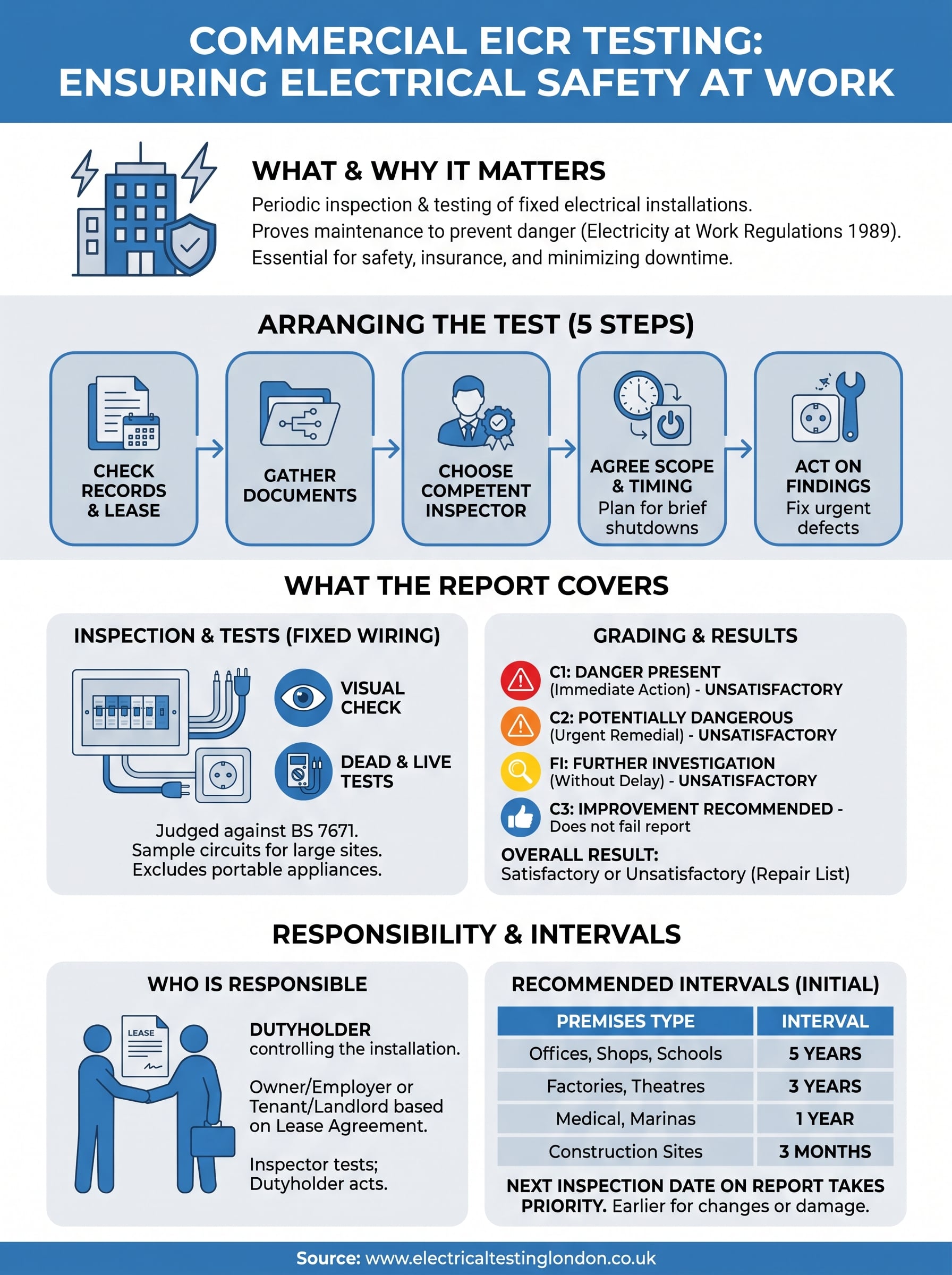
Arrange a commercial EICR in five steps: confirm who controls the installation, gather your records, choose a registered inspector, agree the scope and timing, then act on the findings.
Steps from booking to report
-
Check your last report and your lease. The next inspection date on your last EICR is the date that counts. The lease shows who looks after the electrics.
-
Gather your records. Collect the previous EICR, circuit schedules, distribution board diagrams and details of any alterations since.
-
Choose a competent inspector. Look for registration with a recognised scheme such as NICEIC, experience of commercial installations and public liability insurance.
-
Agree scope and timing. Settle the number of distribution boards, which circuits are sampled and whether the work happens out of hours.
-
Act on the report. Fix urgent defects quickly, get a quote for the rest and keep the certificate with your health and safety records.
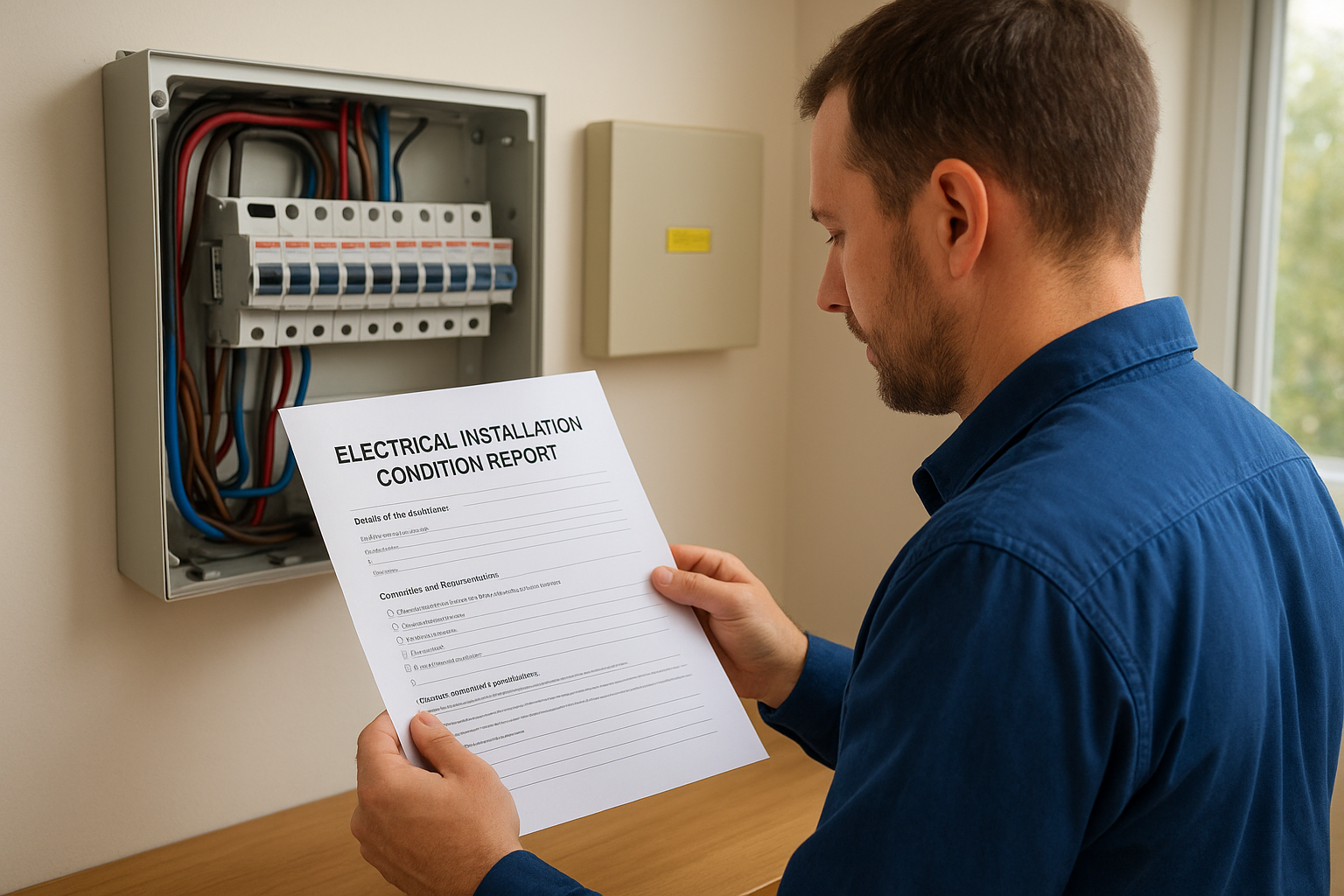
Step four decides how disruptive the day is. The inspector must switch circuits off briefly for the dead tests. Tell staff in advance and plan around servers, tills and refrigeration. For larger premises, work outside opening hours keeps trading running.
Agree the scope and the shutdown plan before the inspector arrives, and the test will cost you very little trading time.
Cost and disruption: a worked example
Electrical Testing London's commercial EICR starts at £169 and covers up to 10 circuits. Additional circuits are charged from £10 each plus VAT. A small shop with 14 circuits therefore costs £169 plus 4 extra circuits at £10, which is at least £209, with VAT added to the extra circuits.
If the report is unsatisfactory, the follow-up matters. Here, a free Satisfactory EICR is issued once the remedial work is complete. Compare that with any provider you consider, because a re-inspection fee can add a surprising amount to the total.
What a commercial EICR covers
A commercial EICR covers a visual inspection and a set of electrical tests on the fixed installation, judged against BS 7671, the IET Wiring Regulations. It looks at the permanent wiring and equipment, not the things you plug in.
The inspection and the tests
The inspector starts with a visual inspection of distribution boards, cables, sockets, switches, light fittings, earthing and bonding. They look for damage, overheating, missing covers and inadequate protection. Then come the tests. The dead tests measure the continuity of protective conductors and insulation resistance. The live tests measure earth fault loop impedance, polarity and the trip times of RCDs.
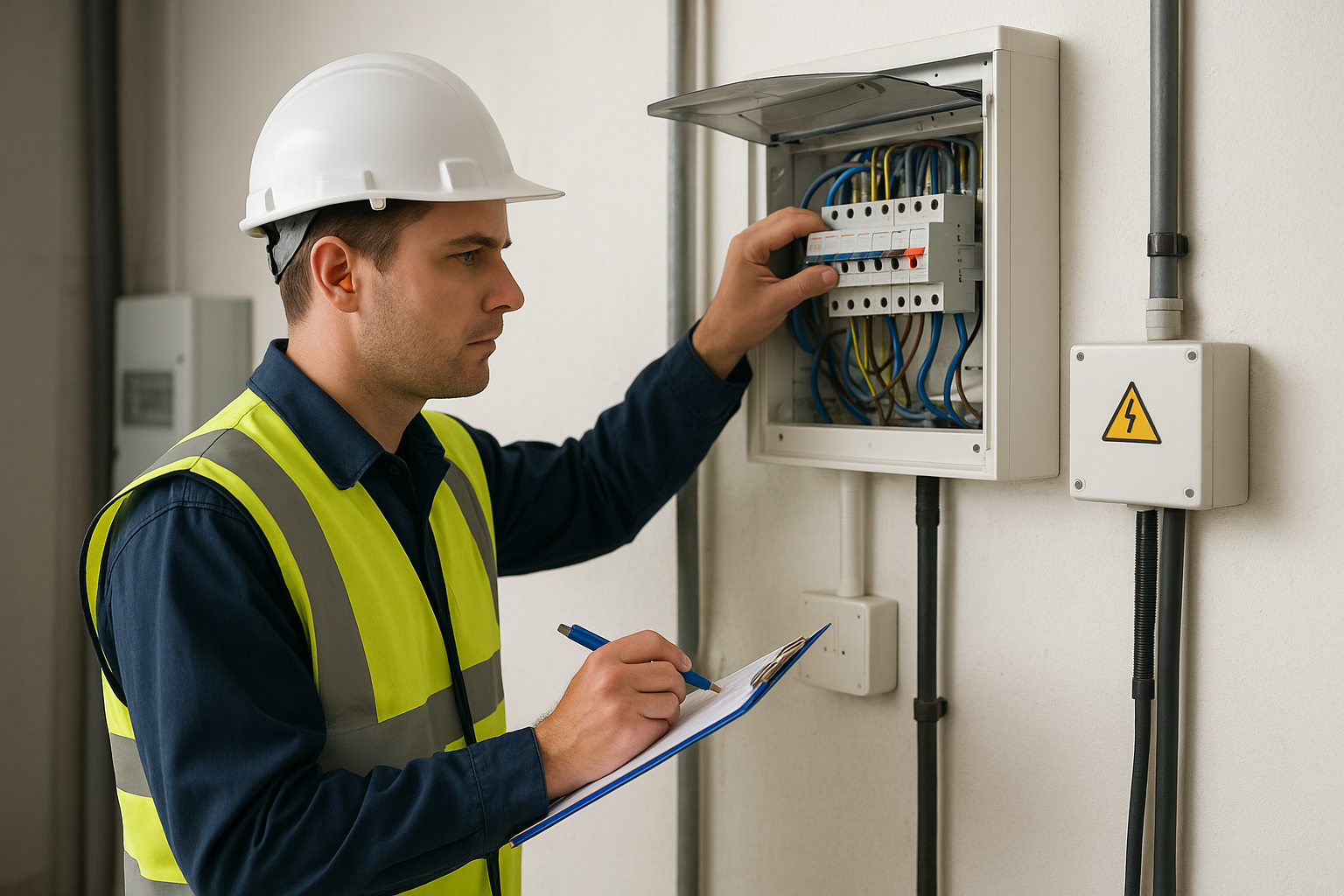
Commercial premises add complexity, with multiple distribution boards, three-phase supplies and many circuits. For large sites the inspector may test a sample of circuits rather than every one. That sample must be agreed in advance and recorded in the report. An EICR does not replace portable appliance testing, and emergency lighting and fire alarms are usually tested separately.
An EICR judges the fixed wiring. Plugged-in equipment, emergency lighting and fire alarms need their own tests.
How the report is graded
Each defect is recorded with an observation code. The overall result is either Satisfactory or Unsatisfactory.
|
Code |
Meaning |
Effect on result |
|---|---|---|
|
C1 |
Danger present, immediate action needed |
Unsatisfactory |
|
C2 |
Potentially dangerous, urgent remedial work needed |
Unsatisfactory |
|
FI |
Further investigation required without delay |
Unsatisfactory |
|
C3 |
Improvement recommended |
Does not fail the report |
An unsatisfactory result is not a penalty. It is a repair list. At Electrical Testing London the Qualifying Supervisor checks the results and defect analysis before certification, and you receive a quotation for rectifying defects alongside the certificate.
Who is responsible and how often to test
The dutyholder who controls the electrical installation is responsible, and the recommended interval is five years for most commercial premises. Shorter intervals apply as the risk rises.
Who is responsible for the test
If you own and occupy the building, the duty is yours as the employer or business owner. In rented premises it depends on who controls the installation. Many commercial leases pass day-to-day upkeep to the tenant, while the landlord usually keeps responsibility for shared areas in a multi-let building. Where the lease is silent or unclear, agree in writing who arranges and pays for the EICR.
The inspector is responsible for testing competently and reporting honestly. You are responsible for acting on what they find. A report with open C1 or C2 items that nobody fixes is worse than no report, because it proves you knew.
Responsibility follows control of the installation, so read your lease before you assume the landlord or the tenant will arrange the test.
How often a commercial EICR is needed
The intervals below are the recommended initial frequencies in IET guidance, not a single legal timetable.
|
Premises or installation |
Recommended interval |
|---|---|
|
Construction site installations |
3 months |
|
Petrol stations, launderettes, swimming pools, marinas, medical locations |
1 year |
|
Factories, industrial and agricultural premises, theatres, leisure complexes |
3 years |
|
Offices, shops, schools, laboratories, restaurants, hotels, churches |
5 years |
The next inspection date written on your latest report always takes priority, because the inspector sets it from the condition and use of the installation. A change of occupancy, a major alteration or damage can justify an earlier inspection. Between full reports, an annual thermal imaging survey can spot hot spots under normal load. Electrical Testing London offers one from £350 for ten distribution boards, with no downtime.
Getting your commercial EICR booked
Commercial EICR testing is a scheduled inspection of your fixed wiring that proves you are keeping your electrics safe. The person in control of the installation is responsible for it. Most offices and shops need a report every five years, and higher-risk premises need one sooner. The inspector tests the installation against BS 7671, grades each defect and gives you a clear repair list.
Check your last report date and your lease first. Then book an inspector who is registered, experienced with commercial sites and willing to agree the scope and timing with you. If your premises are in London or the South East, you can request a quote for your commercial EICR and get the cost confirmed before any work starts.

